
Housing Provision
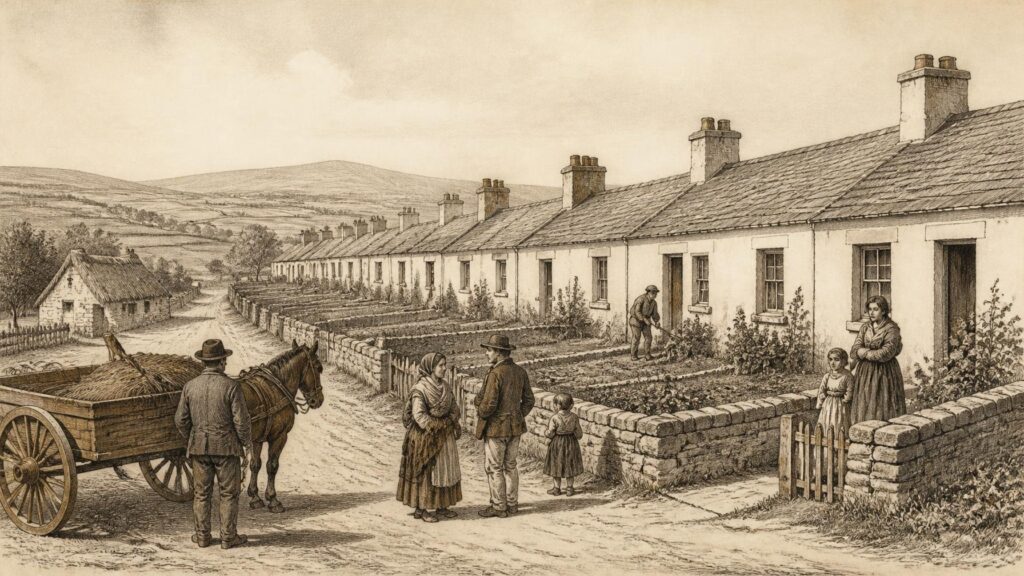
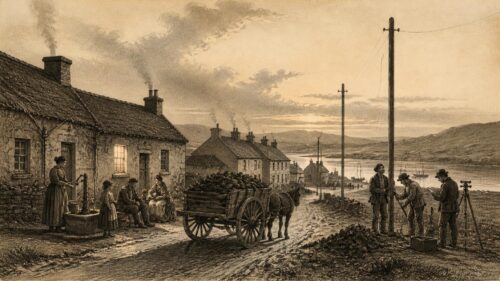
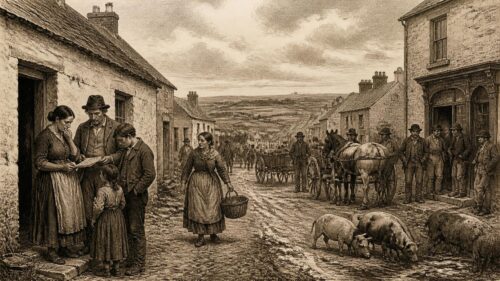
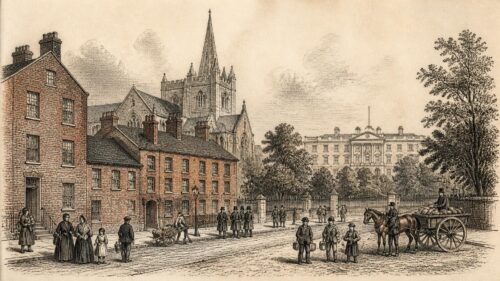
AI generated historical illustration, not a contemporary photograph.
At a Glance
Historical Scope
Irish housing policy has never been solely a matter of building houses. It has been a long argument over land, public health, class, family security, local power, ownership and the duties of the State. From the labourers’ cottages of the late nineteenth century to twentieth-century council estates, tenant-purchase schemes, private-rental regulation and the supply programmes of the present century, the history of housing reveals the changing assumptions by which Ireland has tried to make shelter secure.
This is principally a history of policy in the twenty-six counties that became the Irish Free State in 1922 and the Republic of Ireland thereafter. Before partition, however, much of the legislation discussed here applied across Ireland as part of the United Kingdom. Northern Ireland subsequently developed under a separate governmental and legal framework; it belongs to the wider history of housing on the island, but should not be folded uncritically into the record of the Irish State.
The documentary evidence is unusually rich. It includes statutes, official reports, census material, local-authority records and the work of historians and social-policy scholars. That evidence makes one point clear: social housing did not emerge suddenly after independence. Its foundations lay in nineteenth-century responses to unsanitary urban dwellings and to the poor accommodation of agricultural labourers. Michelle Norris traces the origins of social housing in the Republic to the mid nineteenth century, when concerns about disease, poverty, efficiency and unrest began to justify State-backed intervention in the homes of lower-income people.
Interpretation is still necessary. Figures can count dwellings, tenancies, grants and sales, but they do not by themselves establish whether a programme was humane, socially transformative or inadequate. Nor should the history be reduced to a comforting national story in which cottages, estates and home ownership steadily displaced hardship. Many schemes gave families better homes; many also relied upon restrictive eligibility, uneven local administration, displacement, indebtedness or a narrowing of the homes available for rent. Folklore often turns the labourer’s cottage or council house into a simple symbol of liberation. The surviving record supports a more substantial conclusion: these homes could be life-changing, but their provision was shaped by power and scarcity as much as benevolence.
Rural Foundations
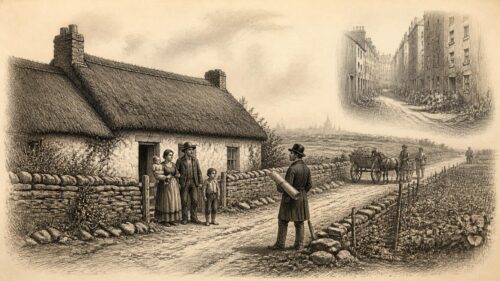
The earliest large public housing effort in Ireland was rural rather than metropolitan. This matters because the familiar story of British and European housing reform commonly begins with industrial cities and slum clearance. In Ireland, the condition of landless agricultural labourers prompted an intervention of exceptional scale. The Labourers (Ireland) Acts, beginning in 1883, empowered rural sanitary authorities—closely associated with the Poor Law system—to provide cottages and plots for labourers. Later legislation expanded the machinery, finance and reach of the programme.
Its immediate setting was a countryside marked by insecure work, seasonal employment and cramped cabins. Housing was inseparable from the land question. A cottage with a garden or allotment offered more than shelter: it could provide a degree of domestic independence, room for food production and a modest material basis for family life. Yet it did not abolish rural inequality. The labourer was not turned into a substantial farmer merely by receiving a cottage, and access to houses could be influenced by local interests and by the practical limitations of the authorities responsible for schemes.
The scale nevertheless deserves emphasis. Research by the historical geographer F. H. A. Aalen finds that, before building was halted by the First World War, almost 50,000 cottages with small allotments had been erected under the labourers’ legislation. He characterised it as the first major public-housing enterprise in the British Isles, operating nationally but concentrated in rural districts. The geographical distribution was uneven: provision was stronger in much of the south and east than in Connacht and Ulster. That unevenness is a warning against treating the programme as one uniform national experience.
The cottages also expressed late Victorian ideas about sanitation, morality and social order. Their standard forms, roadside siting, gardens and separation from the older cabin landscape were intended to create healthier households as well as better buildings. Such assumptions could be paternalistic, but they had concrete consequences. A well-built cottage with separate rooms, ventilation and a plot of ground differed materially from a one-room dwelling shared by a family. The historical evidence therefore supports both propositions at once: the programme was an important improvement in housing conditions, and it was an instrument through which the State and local institutions sought to remake rural life.
It is tempting to call every surviving labourer’s cottage a relic of a single idealised past. That is folklore rather than history. Individual cottages were altered, enlarged, sold, abandoned or rebuilt; their tenants had varied occupations and circumstances. What can be documented is the policy principle established by the Acts: public authorities could acquire land, borrow money, build dwellings and let them to people whose housing the ordinary market had failed to provide. Later Irish housing policy would return repeatedly to that principle, even when it placed greater faith in private ownership.
Urban Distress
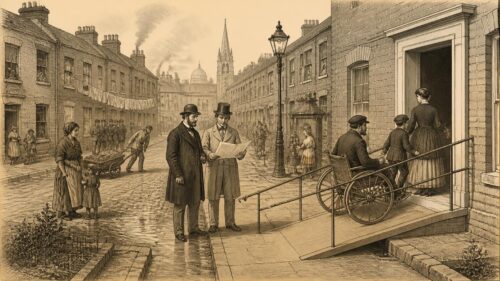
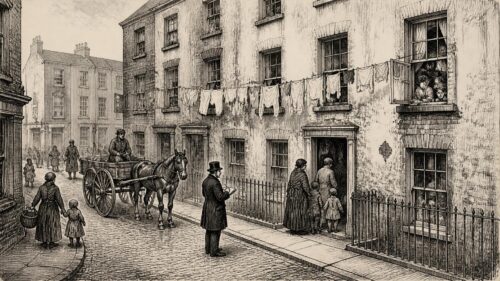
Urban housing followed a different path. Dublin, Cork, Limerick, Waterford and other towns contained overcrowded and insanitary accommodation, while Dublin’s tenement districts acquired a particular notoriety. The legislative origins lay in public-health measures, common-lodging-house regulation and powers to deal with unfit property. They were not initially a complete programme for supplying good homes to all who needed them; they were first concerned with inspection, nuisance, clearance and minimum standards.
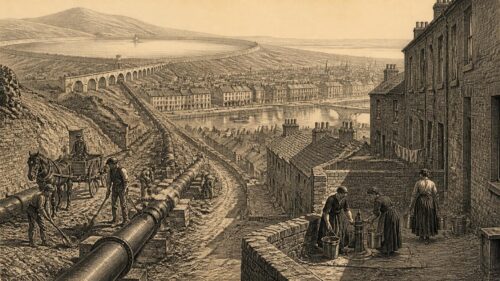
Under the Labouring Classes (Lodging Houses and Dwellings) Act of 1866, low-cost public loans could assist private companies and urban local authorities with a portion of housing-scheme costs. The Artisan’s and Labourers’ Dwellings Improvement Act of 1875 made further cheap public finance available for clearing insanitary sites. At this stage, however, local authorities were generally expected to build only when an alternative provider could not be found. Philanthropic bodies, limited-dividend companies and employers consequently remained significant providers. Norris identifies organisations such as the Guinness Trust, the Dublin Artisans’ Dwellings Company and the Cork Artisans’ Dwellings Company as part of this mixed early field.
The Housing of the Working Classes Act 1890 became the foundation statute of the urban housing code. It enlarged and consolidated powers relating to unhealthy areas and working-class dwellings. Yet statutory authority did not automatically mean rapid construction. Clearance could displace families, while replacement homes required land, capital, administrative will and rents that poorer households could meet. The difference between condemning a bad dwelling and securing a decent alternative is one of the persistent tensions of housing history.
By the early twentieth century, Irish urban reformers had pressed for more active support. The Housing of the Working Classes (Ireland) Act 1908, commonly associated with J. J. Clancy, provided the first dedicated subsidy for urban working-class housing in Ireland. The distinction is significant. Earlier measures made action possible; subsidisation recognised that desirable housing could not reliably be supplied to low-income households on commercial terms alone. As later policy repeatedly demonstrated, the question was not whether public money would influence housing, but whether it would support local-authority provision, private builders, owners, landlords or tenants.
Urban housing policy before independence thus did not proceed on one straight line from neglect to municipal welfare. It combined inspection, clearance, philanthropic enterprise, employer involvement, loans and subsidies. Its legacy was institutional as much as architectural. It accustomed authorities to treating housing conditions as a public responsibility and created the legal vocabulary—unfitness, overcrowding, clearance, improvement and provision—that endured into the twentieth century.
National Beginnings
The revolutionary decade, partition and the creation of the Free State occurred amid a profound shortage of adequate housing. The new State inherited old legislation, unequal local resources and a housing stock damaged by long-term underinvestment. It also inherited a political culture in which land ownership had immense symbolic as well as economic weight. The result was a policy tradition that often promoted owner occupation while also relying on municipal rental housing when private building could not answer need.
The 1920s were not an uncomplicated founding moment for social housing. Financial arrangements constrained local authorities. In her study of the financing of Irish social housing, Norris notes that the Housing Act 1924 replaced earlier Exchequer interest subsidies for social-house-building loans with development grants set at the same level as those available to home buyers. The grants were much less generous than the earlier support and were confined to urban social housing. The Act also enabled rate remission for homeowners; legislation in 1929 made this compulsory. Because rates were important to the servicing of local-authority housing loans, these changes weakened authorities’ capacity to borrow and build.
Finance was not a technical afterthought. It determined whether a local authority could provide houses with rents within reach of lower-income tenants. Municipal bonds helped Dublin and Cork, but many authorities faced expensive or unsuitable credit. The practical consequence was a slow start in a decade when poor housing remained pressing. This is one reason why histories that date Irish State housing merely from 1922 can mislead: independence created a new government, but it did not instantly supply the revenue, capacity or construction system required to resolve inherited conditions.
The record also complicates the idea that the Free State uniformly chose private housing over public provision. Its policies supported private ownership through grants and fiscal relief, but it retained and gradually strengthened the public housing machinery. The balance changed with economic circumstance. When finance, materials and political priorities aligned, local-authority house building became a significant arm of national policy. When they did not, aspirations for healthier homes could remain administrative promises.
There was a further continuity with the earlier land question. Rural owner occupation had been encouraged by land reform before independence, leaving the new State with a society in which ownership was already deeply embedded outside the towns. Later promotion of the owner-occupied home was therefore not invented in the twentieth century from nothing. It extended an existing preference and linked it to new grants, mortgages, tax reliefs and tenant-purchase arrangements.
Municipal Expansion
The decisive expansion of local-authority housing came from the early 1930s. New subsidy arrangements and a more sustained national commitment enabled councils to build on a scale that altered the housing landscape. Slum clearance, rehousing and estate construction became visible expressions of the State’s capacity. In Dublin and other towns and cities, families moved from congested inner-city rooms into houses with gardens, indoor facilities or, at least, markedly improved space and sanitation by the standards of the period.
The statistical weight of this expansion was substantial. Norris and Michael Byrne report that social housing accounted for between 52 and 65.2 per cent of Irish housing output in the 1930s, 1940s and 1950s, while 18.4 per cent of the population was accommodated in the sector in 1961. These figures do not mean that every need was met. They demonstrate instead that social housing was then a core part of total supply, not a marginal residual service.
Local authority housing also had macroeconomic purposes. It provided construction employment and stimulus in periods of weak labour demand. Rents were commonly related to income, making the tenure more affordable for households unable to buy or to pay commercial rents. In this sense the council house was a social service, an employment measure and an instrument of public health. Such multiple purposes help explain why housing was often debated in the language of national development rather than simply welfare.
War interrupted the momentum. Shortages of labour and materials during the Emergency limited building, while the post-war years confronted both accumulated need and changing expectations about domestic standards. Yet the broad post-war outcome was expansion. The national dwelling stock, which had declined between 1911 and 1946 through demolition, abandonment and migration as well as inadequate replacement, began to rise steadily thereafter. The official Housing Policy Review recorded an increase of roughly 100,000 dwellings in each decade after 1946.
Municipal expansion should not be romanticised. Estate location could separate residents from employment and services; allocation systems could be contested; maintenance varied; and large schemes did not erase poverty. Nevertheless, the central historical fact remains that councils built at a scale later generations often forgot. The inherited streets, cottages and estates of this era are physical evidence that Irish governments once treated direct construction as a normal rather than exceptional response to housing shortage.
Ownership Ascendant
Alongside the growth of council housing ran another powerful trend: the construction of an ownership-centred housing system. Home ownership was associated with independence, family stability, thrift and civic standing. These values were not merely cultural preferences. They were advanced through public policy: grants to purchasers and builders, favourable taxation, mortgage supports, rate relief and the sale of public housing to sitting tenants.
The effect was dramatic. An ESRI analysis recorded owner occupation increasing from just over half of dwellings in 1946 to almost 80 per cent by 1991. It also cautioned that the 1946 position was itself shaped by earlier land reform: rural owner occupation was already far higher than urban owner occupation. The history of the owned home is therefore entwined with the conversion of agricultural tenants into proprietors, not simply with suburban development after independence.
Tenant purchase was particularly consequential. It could give working-class households a route into ownership at a discounted price, often providing security and an asset that would otherwise have been out of reach. For many families, this was a tangible social gain. But it reduced the number of dwellings held for future tenants unless construction replaced what had been sold. The ESRI estimated in the 1990s that, of approximately 300,000 local-authority homes built since the foundation of the State, more than 200,000 had been sold to tenants. That estimate conveys the scale of the policy, though it should be read as a period assessment rather than a current stock count.
The Housing Act 1966 consolidated and modernised a large body of legislation. Its significance was administrative as well as legal: it brought together powers concerning loans, grants, unfit houses, needs assessment, allocation and sales. In broad terms, it required housing authorities to assess need and prepare building programmes for people unable adequately to house themselves, while preserving extensive powers to manage and sell dwellings. The statute remains the principal legislative reference point for many later housing measures.
There is no need to choose between seeing tenant purchase as emancipation or as depletion of public stock; historically it was both. Its benefits accrued to purchasing households, while its long-term cost fell upon the supply of secure, low-rent homes for those unable to purchase. That tension became sharper as the social rented sector came increasingly to house people with lower incomes and more complex needs.
Rental Retreat
By the later twentieth century, Irish housing policy increasingly treated ownership as the preferred tenure and renting as provisional, marginal or a stepping stone. Local authorities continued to build in the 1960s and 1970s, and their output exceeded 20 per cent of total new construction for much of that period. Yet sales of existing homes and the growth of the overall housing stock meant that the relative public-rental share declined. Fiscal retrenchment in 1987 further reduced direct social-house-building expenditure; the share of new construction accounted for by social housing fell below 10 per cent and did not recover to the earlier levels in the years that followed.
Private renting was not absent, but it was long underdeveloped and weakly regulated compared with owner occupation. Tax reliefs, grants and the political prestige of purchase gave owners a privileged position. From the 1980s, incentives such as Section 23 relief sought to stimulate investment in designated areas, but this was not the same as creating a stable rental system with durable security for tenants. The policy mix often treated the landlord’s investment decision as the route to rental supply while leaving tenants exposed to a fragmented market.
The rise of voluntary and co-operative providers, later generally described as approved housing bodies, added another dimension. They could develop or manage housing for particular groups and widened provision beyond the council alone. This was an important institutional change, but it did not simply restore the old municipal model. The system increasingly combined local authorities, non-profit providers and private landlords supported by public payments.
The notion of residualisation helps describe the social consequence. As better-off households purchased homes or entered owner occupation directly, council housing became more concentrated among those with the least income and the greatest housing difficulty. Residualisation is not a moral judgment on tenants or estates. It is an analytical description of a tenure becoming narrower in social composition and more heavily associated with disadvantage. It could place heavier demands on neighbourhood services while making it easier for public debate to misrepresent structural inequality as the failure of particular communities.
The Housing Policy Review of 1990–2002 registered the change in institutional terms. It found that local-authority building had averaged 20 to 30 per cent of total output between 1930 and 1980, but had not exceeded 10 per cent since 1985. That was a historical reversal: the State had not ceased to influence housing, but it increasingly did so through subsidies, tax measures, private provision and income supports rather than through building and retaining large public stocks.
Boom Collapse
The economic boom of the 1990s and 2000s transformed the housing question again. Population growth, smaller households, employment expansion, credit conditions and investment demand intensified pressure on prices and supply. Construction rose to extraordinary levels, but high output did not guarantee affordability, suitable location or secure tenure. The surge also encouraged a belief that market activity could solve a shortage without a comparably large revival of public housing.
Housing became more financialised. For purchasers, access to mortgage credit mattered as much as wages or construction costs. For investors, tax treatment and expected capital gain influenced building and acquisition. For tenants, rents and security were increasingly central. The establishment of the Private Residential Tenancies Board, now the Residential Tenancies Board, under the Residential Tenancies Act 2004 marked recognition that the private rented sector required a dedicated registration and dispute-resolution framework. The RTB later described the pre-2004 sector as effectively unregulated in the sense that disputes generally had to proceed through the courts.
The property crash exposed the fragility of a system dependent upon buoyant private development and credit. Norris and Byrne record that private-sector house building fell from 88,211 dwellings in 2006 to 10,501 in 2014, while house prices fell by around half from the 2006 peak to the 2012 trough. At the same time, funding for new social housing fell by 88.4 per cent between 2008 and 2014 and social-housing output declined by 91.5 per cent.
The crisis therefore was not merely a collapse in house prices. It was a failure of capacity across tenures. Households in mortgage difficulty required protection; unemployed and low-income renters faced escalating insecurity; councils and non-profit providers had insufficient new supply; and homelessness became far more visible in public life. The legacy was a deepened reliance on rent supports in the private market, including Rent Supplement, the Rental Accommodation Scheme and, later, the Housing Assistance Payment.
This shift had practical merits for some households: it could secure accommodation more quickly than waiting for new construction. Yet it also made public assistance dependent on the availability and price of privately owned dwellings. ESRI research found that 293,673 households received housing-cost support in 2020, compared with 134,973 in 1994, and identified a long-term movement away from direct provision towards subsidising private rents. The historical lesson is not that income support is inherently mistaken. It is that a support system cannot, by itself, create homes in places where the market cannot or will not provide them at accessible prices.
Contemporary Reckoning
Recent policy has attempted to address supply, affordability, vacancy, homelessness, home purchase and rental security at once. That breadth reflects the accumulated complexity of the system. Ireland no longer has one housing question: it has interlinked questions about land, infrastructure, planning, construction capacity, apartment viability, public finance, tenant protection, social need, disability, Traveller accommodation, ageing, migration and regional development.
Housing for All, launched on 2 September 2021, framed policy around home ownership, social housing and homelessness, new supply, and vacancy. It was later superseded on 13 November 2025 by Delivering Homes, Building Communities 2025–2030: An Action Plan on Housing Supply and Targeting Homelessness. The successor plan is the relevant official national framework among the material consulted for this article. The change of plan should not be mistaken for a complete break with the past. Its recurring concerns—direct social provision, private supply, affordable purchase, rental cost and vacant homes—are recognisably the modern forms of older policy dilemmas.
Official guidance issued in 2026 stated that the 2025–2030 plan envisaged scaling average annual social-housing delivery from about 8,000 to 12,000 homes, or 72,000 new social homes over the life of the plan. These are targets and administrative commitments, not evidence that the homes have already been completed. The distinction is important in any historical account. Announcements reveal policy intention; completion data reveal delivery; lived experience reveals whether provision is secure, affordable and suitable.
The contemporary system also continues to revise the status of renting. The RTB notes that tenancies of unlimited duration came into effect on 11 June 2022, replacing the former cycle of fixed Part 4 security for new tenancies, subject to lawful grounds for termination. This is a significant departure from the older assumption that renting was necessarily short-term. Yet legal security, affordable rent and actual availability remain distinct matters. A tenancy can be legally more secure while still being unaffordable or difficult to find.
Historical comparison should encourage modesty. The council estates of the mid twentieth century cannot simply be replicated, because construction standards, household structures, environmental requirements, land values and settlement patterns have changed. Equally, the enormous rural cottage schemes of the nineteenth century cannot be treated as a ready-made answer to city housing. Their common lesson is more basic: large housing problems have previously required public land powers, long-term finance, administrative competence and the willingness to build for people whose needs were not met by the prevailing market.
Historical Balance
The long history of Irish housing policy is not a neat march from primitive cabins and tenements to universal security. It is a history of recurring advances followed by constraints, of direct building followed by privatisation, and of private incentives repeatedly supplemented when their limits became plain. Rural labourers’ cottages established that public bodies could improve housing on a national scale. Urban reform proved that public health could not be separated from the home. The municipal decades showed that councils could become major builders. Tenant purchase broadened ownership while shrinking rental stock. The boom illustrated that volume of construction alone does not settle affordability or stability. The post-crash years reasserted the need for public capacity while also embedding rent subsidies and more formal rental regulation.
The strongest documented conclusion is therefore neither that the State has always failed nor that it has once possessed a lost perfect model. Rather, Irish policy has repeatedly depended on a mixed system in which public authority shapes land, finance, building, standards and tenure. The question has been where that authority is directed. When it has concentrated on the ownership aspirations of households already close to purchase, rental and social needs have often been left behind. When it has supported direct provision at scale, it has improved conditions but has also faced the enduring problems of funding, location, management and social segregation.
For historians, houses are not passive scenery. A labourer’s cottage, a Dublin flat, a suburban semi-detached house, a council estate and a rented apartment are records of decisions about who should bear risk and who should receive security. The built landscape preserves those decisions long after the grants, Acts and ministerial statements that produced it have passed from public memory. That is why Irish housing policy belongs not at the edge of national history, but near its centre.

The article highlights a lasting paradox: tenant purchase expanded security and assets for many former council tenants, yet, without equivalent replacement building, it also diminished homes available to later households needing affordable rental accommodation. This tension suggests that housing policy outcomes should be judged across generations, rather than only by immediate gains in ownership. The earlier prominence of direct local-authority construction also challenges assumptions that public provision is inherently exceptional in Ireland. How should policymakers weigh the benefits of tenant purchase against its effects on public rental capacity, when comparing municipal building eras with reliance on private markets and supports?