Irish Harp
At a Glance
Hidden Origins
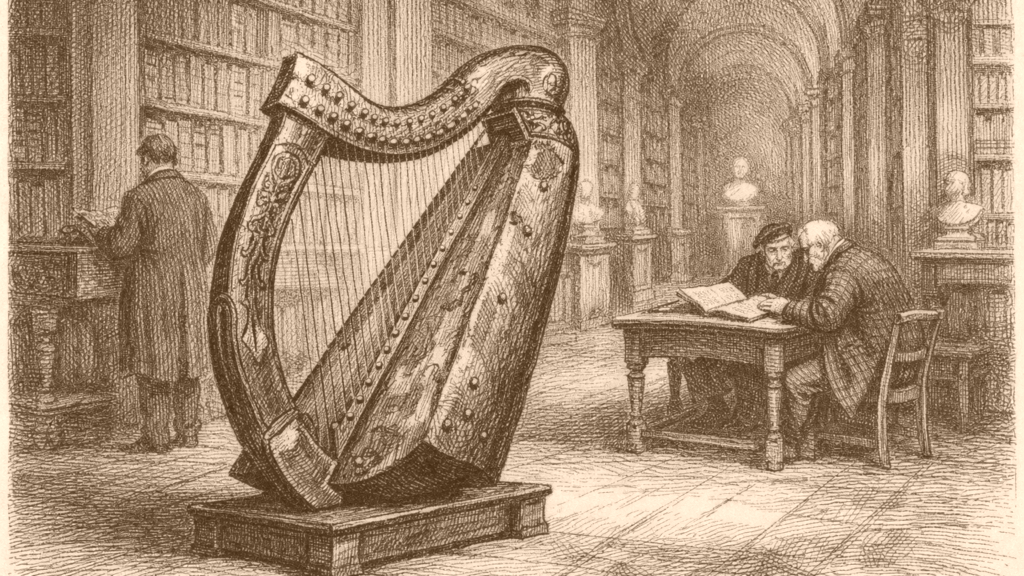
The surviving harp associated with Brian Boru should be understood first as a later medieval object whose beginnings are not securely documented. Trinity College Dublin calls it the oldest surviving Irish harp, but also says its early history is uncertain and that it probably dates from the later Middle Ages. That evidence places the instrument after Brian Boru’s lifetime and makes its royal association an issue of memory, not direct proof.
The same institution identifies the harp’s materials as oak and willow and notes twenty-nine brass strings. Those details matter because they anchor the object in its physical survival rather than in legend alone. The harp’s significance therefore lies in a combination of craftsmanship, preservation, and later interpretation. Its present importance does not depend on a fully documented medieval biography, which the record does not provide.
Royal Memory
The association with Brian Boru is explicitly described as mistaken by Trinity College Dublin, yet the name endured. That persistence shows how a prominent ruler can become attached to a surviving object through later commemoration rather than through contemporary testimony. In historical terms, the harp’s identity is layered: it is a medieval instrument, a celebrated relic, and a symbol shaped by retrospective naming.
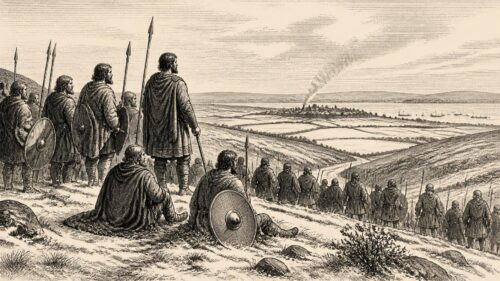
Brian Boru himself remained central to Irish historical memory because of Clontarf and the treatment of his death. Trinity’s exhibition material says the battle of 1014 dominated the Annals of Ulster entry for that year and that Brian’s burial received special reverence at Armagh after his body was taken north. Those details do not prove a connection with the harp, but they help explain why his name became available for later symbolic attachment.
Annal Sources
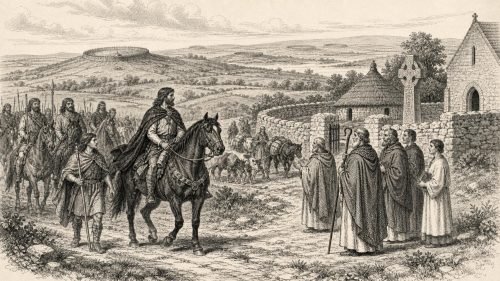
The broader written record preserves the sort of historical world in which such associations were created. The Annals of Ulster is presented as a chronicle of Irish affairs, with manuscript traditions extending across many centuries, and the CELT edition notes its scholarly transmission through multiple manuscripts and modern editorial work. This does not mention the harp directly in the available material, but it shows the infrastructure through which Irish memory was recorded and renewed.
Davis’s list of sources for Irish history is even more revealing of method. It brings together annals, lives of saints, tracts, state papers, speeches, and antiquarian material, including references to antiquities, dress, and arms. That catalogue suggests that Irish historical writing was built from many genres, not from annals alone. The harp belongs within that wider intellectual culture, even though the excerpted material does not supply a direct early narrative for the object.
Library Display
The harp’s modern authority was strengthened by preservation at Trinity College Dublin rather than by continuous use in performance. The college states that the harp is on permanent display in the Long Room, and the library’s historical-objects page places it among significant holdings linked to manuscripts and Irish heritage. In that setting, the object became part of an institutional story about custody, scholarship, and public viewing.
The Long Room itself is an important context for that display. Trinity describes it as the main chamber of the Old Library, built in the early eighteenth century, with marble busts and treasured objects arranged among its books. The harp’s presence there situates it within a scholarly interior that already carried strong associations with learning and prestige. The evidence supports display and significance, but not a claim about uninterrupted ceremonial function.
National Sign
The harp also acquired a national role. Trinity says it is the model for the emblem of Ireland, and the library material repeats that it is the finest known example of the traditional Irish instrument. This shows how an artefact can move from preservation into representation. The evidence supports symbolization, but not a simple story in which the object was always understood in the same way.
That symbolic power rests partly on rarity and survival. The college repeatedly identifies the harp as the oldest surviving Irish harp, while the historical-objects page notes that it has been mistakenly linked to Brian Boru but probably dates from the later Middle Ages. The result is a public emblem built from a real medieval artefact and a later historical misattribution. The object’s fame is therefore historical, but also interpretive.
Historical Sense
The history of the Irish harp is best read as a sequence of changing meanings rather than as a single continuous narrative. The surviving object is later medieval; the Brian Boru association is mistaken but persistent; and the instrument now occupies a permanent place in one of Ireland’s best-known libraries. Those facts can be stated with confidence. What remains uncertain is the route by which the name and the object became inseparable in popular memory.
Seen historically, the harp is less a solved origin story than a demonstration of how Irish antiquarianism, institutional preservation, and national iconography interact. Annals, catalogues, and exhibitions all helped shape public understanding, but none of them close the gap between later medieval manufacture and early modern legend. That gap is important evidence in itself, because it shows how a revered object can accumulate authority without a fully documented beginnings.