
Circuit Of Power1006 CE
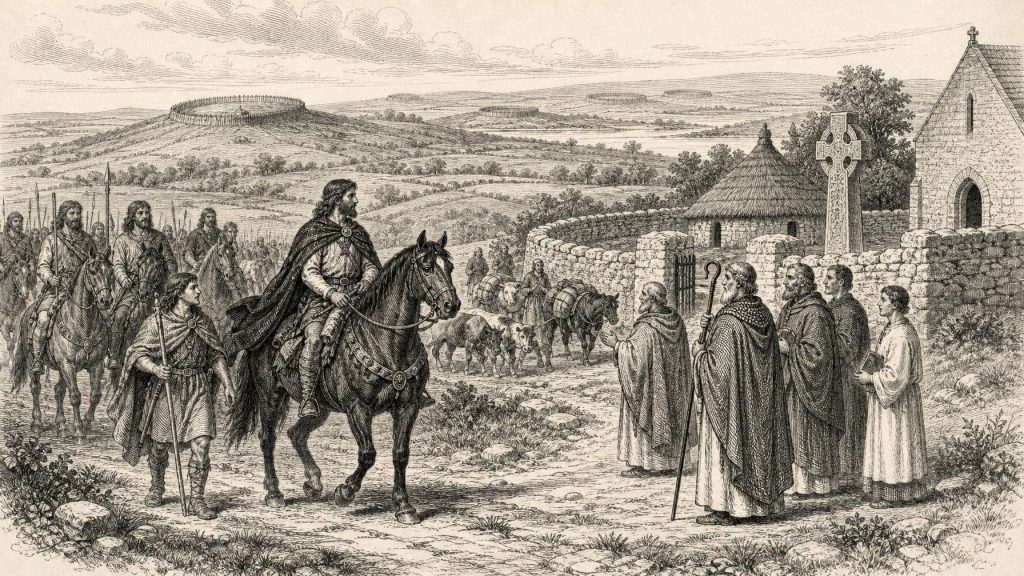
In 1006, Brian Bórama demonstrated the reach yet limits of his Irish overlordship by leading a broad coalition from Munster, Leinster, Mide, Connacht and Dublin through the north. His circuit secured Ulaid hostages and satisfied Armagh’s claims, strengthening royal and ecclesiastical legitimacy, but Cenél Conaill and Cenél nEógain withheld submission. Provincial violence continued, including killings of regional kings, revealing unstable local rule. The deaths of Armagh churchmen underline clerical institutions’ importance. A mild, food-rich winter offered relief after scarcity, while the army’s passage burdened rural communities. Dublin’s participation reflected its growing military, commercial and maritime value within Brian’s negotiated supremacy.
Dateline
The year 1006 stands near the high point of Brian Bórama’s effort to turn a Munster kingship into island-wide overlordship. The evidence is annalistic and terse, so it does not allow a day-by-day narrative. What it does show is a year in which Brian’s authority was publicly tested in the north, the church of Armagh pressed its claims, regional kingships remained violent and unstable, and ordinary life still depended on weather, food supply, cattle and the movement of armed retinues across the countryside.
The Irish annals do not always align perfectly in their year-numbering. The Annals of Ulster introduce their 1006 entry with a computistical note giving the Kalends of January and adding “AD 1005 alias 1006”. Chronicon Scotorum and the Annals of Inisfallen also preserve notices placed under 1006. Later compilations, especially the Annals of the Four Masters, sometimes place nearby events under a different annalistic year. For this account, the safest course is to treat Brian’s northern circuit, the deaths and killings recorded under 1006, and the environmental notice for the winter as the year’s firm core, while using wider context only where it explains those entries.
Brian’s Northern Circuit
The dominant event of the year was Brian’s expedition through the north of Ireland. The Annals of Inisfallen describe an unusually broad coalition: Brian came with the men of Munster, Leinster, Mide, Máel Sechnaill, the Connachta, the foreigners of Dublin, and “the whole of Ireland south of Sliab Fuait”. That list is politically important. It shows Brian not simply as a provincial ruler raiding Ulster, but as a king able to gather allies, former rivals and subject forces from across the southern and midland world. Máel Sechnaill mac Domnaill, the former dominant Uí Néill king of Tara, still mattered; his presence in the record suggests that Brian’s kingship depended on managed partnership as well as command.
The route itself was a statement. The annals take Brian’s army to Áth Luain, through Connacht, over Eas Ruaidh at Ballyshannon, through Tír Conaill, into Cenél nEógain, across Fertas Camsa, into Ulaid and the assembly of the Conaille. These names trace an arc around the northern half of the island. They also reveal the difficulty of ruling Ireland in practice. Brian had to move through territories whose dynasties had their own claims, enemies and ecclesiastical loyalties. The expedition was not a neat conquest; it was a travelling demonstration of power, designed to collect pledges, force acknowledgement and display the reach of the king of Munster.
The Annals of Ulster say that at Lammas the host reached Belach Dúin, where the full demand of the community of Patrick and of his successor, Máel Muire son of Eochaid, was granted. Lammas, 1 August in the ecclesiastical and agrarian calendar, is the one seasonal marker attached to the event. The detail implies that Armagh’s clergy were not passive observers of Brian’s politics. They accompanied, negotiated with, or at least met the army at a moment when a royal expedition could enforce church claims. In an Ireland where major churches possessed lands, dues, clients and relics, ecclesiastical authority and royal power were deeply entangled.
Chronicon Scotorum gives a sharper assessment of the outcome. It says the Ulaid gave hostages, but that Brian obtained neither the hostages of Cenél Conaill nor those of Cenél nEógain. This is crucial. Brian’s march was impressive, but it did not produce complete submission from the two great north-western dynastic groups. The year therefore reveals both the reach and the limits of his kingship. He could mobilise an island-wide army and compel Ulaid; he could not yet turn the northern Uí Néill and Cenél Conaill into dependable subjects.
Armagh And Royal Legitimacy
The meeting with the “community of Patrick” continued a relationship already visible in the preceding years. Brian’s visit to Armagh and his association with the Book of Armagh gave his regime a sacred and documentary weight unusual for an Irish king. The famous memorandum in that manuscript, commonly connected with the early years of his supremacy, presents Brian in exalted terms and confirms Armagh’s claims. Whether every detail belongs exactly to 1005 or should be understood more broadly, the 1006 annalistic notice shows that the alliance was active in this campaigning season.
Armagh’s support suited Brian’s needs. As a Dál Cais ruler from Munster, he had broken the long Uí Néill hold over the highest kingship. He therefore needed more than battlefield success. Recognition by Patrick’s principal church helped frame his overlordship as lawful, Christian and island-wide. Armagh also benefited. A king able to march from Munster through Connacht to Ulaid was a powerful partner in the collection of dues and in the assertion of primatial authority against rival churches and regional lords.
The death of Airmedach son of Coscrach, bishop and scribe of Armagh, is recorded under the same year by the Annals of Ulster, and Chronicon Scotorum also notes the death of Airmedach, bishop of Ard Macha. Such notices are easy to pass over, but they point to the learned world behind political events. A bishop and scribe belonged to the class of churchmen who preserved books, copied texts, maintained institutional memory and gave written form to authority. In a year when Armagh’s claims were being honoured by a campaigning king, the death of such a figure reminds us that ecclesiastical power rested on schools, manuscripts and trained clerical personnel as well as on relics and buildings.
Violence In The Provinces
Brian’s circuit did not suspend local conflict. The Annals of Ulster record that Eichmílid ua hAitid, king of Uí Echach, was killed by the Ulaid; Máel Ruanaid son of Flannacán was killed by the Conaille; and Cathalán, king of Gailenga, was killed. These entries are brief, but together they show a political landscape in which lesser kings and local ruling families continued to settle rivalries by violence even while greater kings claimed overlordship above them.
The north-east was especially unsettled. The aftermath of the major battle of Cráeb Tulcha in 1004 had weakened both Ulaid and Cenél nEógain leadership, and the notices around 1006 and adjacent years show succession struggles and revenge killings. The killing of Ulaid rulers in the annals should not be treated as mere background noise. For Brian, instability in Ulaid could be an opportunity: divided rulers were more likely to yield hostages. For local communities, however, such instability meant exposed farms, shifting obligations and the danger of armies moving through lands already strained by internal feud.
In Leinster, the death of Máel na mBó, king of Uí Cheinnselaig, “by his own people” points to another regional fracture. Uí Cheinnselaig power in south-east Leinster would become highly significant later in the eleventh century, but in 1006 the annalistic notice is one of internal killing rather than expansion. The phrase “by his own people” is stark. It suggests that royal authority was never secure simply because a man held a title. Kin-groups and client lineages could make and unmake kings.
Weather, Food And Everyday Life
Chronicon Scotorum preserves one of the year’s most vivid non-political details: a return of calm, good weather and food in the winter, with foliage and wild garlic growing. This notice matters because annalists usually recorded weather when it affected subsistence or seemed remarkable. A mild winter with visible growth was worth remembering, especially in a society where the balance between scarcity and sufficiency could be narrow.
The previous year’s notices include hardship among the Ulaid, who are said in the Annals of Inisfallen to have abandoned their land because of scarcity and scattered through Ireland. The 1006 report of food and mild weather may therefore mark relief after pressure. We should not imagine a modern economy with deep reserves. Rural Ireland depended on cattle, dairying, cereals, pigs, woodland resources, fisheries and seasonal labour. A good winter could preserve livestock and reduce hunger; a bad one could weaken households before spring growth returned.
The movement of Brian’s army also had everyday consequences. Armies required food, fodder, guides, boats or river crossings, and places to camp. Their presence could enrich allies through wages, gifts and plunder, but it could also burden communities along the route. The annals describe kings and hostages; behind them were cooks, horse-boys, clerics, messengers, craftsmen, herdsmen and women managing households while armed men were away.
Dublin, Trade And The Wider Sea
The Annals of Inisfallen’s inclusion of the foreigners of Áth Cliath among Brian’s forces is one of the year’s clearest signs of the changed place of Hiberno-Norse Dublin. After the defeat of Dublin and Leinster at Glenn Máma and Brian’s subsequent dominance over the town, Dublin was not simply an enemy stronghold. Its king, Sitriuc Silkbeard, and its inhabitants occupied a complicated position within Irish politics: sometimes rebellious, sometimes subordinate, always valuable.
By 1006 Dublin was a trading and craft centre of exceptional importance. Archaeology from Viking-age Dublin shows woodworking, metalworking, textile activity, imported goods, weights, scales and dense urban occupation. Coinage struck in Sitriuc’s name from the late tenth century marks a major development in Irish monetary history, though coin use remained far more urban and coastal than rural. Brian’s ability to draw Dubliners into a northern expedition therefore had economic as well as military significance. It connected his kingship with ships, silver, craftsmen and Irish Sea networks.
Most people in Ireland did not live in towns. The wider settlement pattern remained dominated by rural enclosed farmsteads, ecclesiastical settlements and regional royal sites. Large churches such as Armagh, Clonmacnoise, Kells, Ros Cré and Clonfert were centres of worship, learning and exchange. The deaths recorded in 1006 of churchmen connected with Armagh and Ros Cré, and in related annalistic material with Clonfert and Clonmacnoise, belong to that world of monastic and clerical networks.
A Year Of Partial Supremacy
The significance of 1006 is not that Brian “united Ireland” in any simple sense. The best evidence points to something more interesting: he could assemble an extraordinary coalition, move it through the northern half of the island, satisfy Armagh’s claims and take hostages from Ulaid, yet still fail to secure the full submission of Cenél Conaill and Cenél nEógain. His power was real, but negotiated; impressive, but resisted.
The year also warns against treating political history apart from society. A mild winter, the death of a scribe-bishop, the claims of Patrick’s church, the presence of Dubliners in Brian’s host, and the killing of regional kings all belong to the same landscape. Ireland in 1006 was a Christian, learned, militarised and overwhelmingly rural society tied increasingly to urban and maritime exchange. Its most powerful king was trying to make overlordship visible by travelling through the land. The annalists’ brief entries allow us to see him on the road, but they also let us glimpse the weather, churches, rival dynasties and local communities through which that road passed.
Primary Sources
- The Annals of Ulster: Year U1006
- Chronicon Scotorum
- Annals of Inisfallen
- Annals of the Four Masters, Volume 2
- Irish Texts at CELT
- Translated Texts at CELT
- Brian Bórama (Bóruma, Boru) | Dictionary of Irish Biography
- Ua Néill, Flaithbertach | Dictionary of Irish Biography
- Sitriuc Silkbeard (Sitric, Sigtryggr Ólafsson Silkiskeggi) | Dictionary of Irish Biography
- ‘Emperor of the Irish’: Brian Boru and the Battle of Clontarf 1014
- The Book of Armagh – MS Trinity College Dublin 52
- Brian Boru and the Book of Armagh
- Trinity College Dublin in conjunction with the National Museum of Ireland Celebrate Brian Boru and the Battle of Clontarf
- Brian Boru – Brian Boru Millennium
- Brian Boru – St Patrick's Cathedral, Armagh
- Saint Patrick – St Patrick's Cathedral, Armagh
- Viking | National Museum of Ireland
- 950-1450: Vikings, Normans and Medieval Mints | National Museum of Ireland
- Early Medieval Archaeology Project Report 2.1
- Early Medieval Ireland: Archaeological Excavations, 1930-2009
- The Economy of Early Medieval Ireland
- Irish Historic Towns Atlas – Digital Repository of Ireland
- Dublin, part I, to 1610: Irish Historic Towns Atlas, no. 11