Glenn Máma’s Winter Battle999 CE
In 999, Ireland’s political order was strained as Sitriuc of Dublin and Máel Mórda seized Leinster’s kingship, imprisoning Donnchad mac Domnaill. Raids on Kildare, Leinster and Uí Echach demonstrated warfare’s dependence on cattle, captives and plunder. On Thursday 30 December, Brian mac Cennétig’s coalition, including Máel Sechnaill’s forces, defeated the Dublin–Leinster army at Glenn Máma, killing Dublin nobles and opening the route to the port. Dublin’s sack occurred at the year’s turn, not within 999. Máel Sechnaill’s conversion of the fallen Lia Ailbi into millstones linked authority, memory and subsistence. The year altered power without creating unity or millennium expectations.
Dateline
A Year of Shifting Allegiance
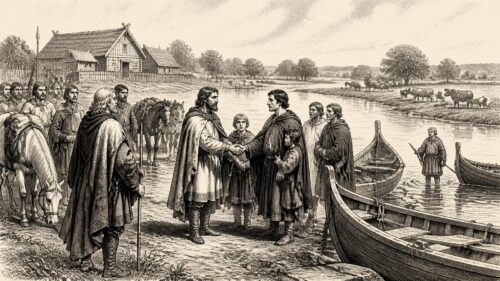
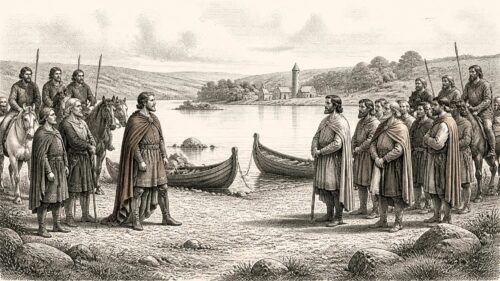
Ireland in 999 was not a single kingdom with a settled government. It was a landscape of provincial rulers, ambitious overkings, church communities and port towns, tied together by hostage-taking, tribute, marriage alliances, raids and negotiated submission. Two men stood above the crowded political field. Máel Sechnaill mac Domnaill of the southern Uí Néill was king of Tara and exercised a recognised, if contested, pre-eminence in the north and midlands. Brian mac Cennétig of the Dál Cais, king of Munster and associated in the annals with Cashel, had become the dominant force in the south. Their agreement of 997 had divided influence between them: Brian received the southern half of Ireland and the hostages of Leinster and Dublin, while Máel Sechnaill retained the northern half and his senior royal standing.
That arrangement is essential background rather than an event of 999 itself. In the year under review, its weaknesses became visible. Leinster was not a passive southern dependency, and Dublin was not merely a foreign enclave. The kingdom at Áth Cliath was ruled by Sitriuc, or Sigtrygg, son of Amlaíb, and formed part of the Irish Sea world of shipping, commerce, dynastic connections and warfare. Its ruler and inhabitants could ally with Gaelic kings as readily as fight them. The annals’ frequent term “foreigners” records a political and cultural distinction important to their authors, but it should not obscure the dense connections between Dublin and neighbouring Irish dynasties.
Leinster’s Disputed Kingship
Early in the annalistic record for 999, Donnchad son of Domnall, king of Leinster, was seized by Sitriuc of Dublin and by Máel Mórda son of Murchad. The Annals of Ulster say plainly that the kingship of Leinster was then given to Máel Mórda. This was a coup within Leinster’s ruling world, backed by Dublin’s king; it was also a direct challenge to the arrangement under which Brian held Leinster’s hostages. The sources do not give a precise day, a surviving speech, or a complete explanation of motives. They do establish the essentials: a reigning Leinster king was imprisoned, Máel Mórda took his place, and Dublin’s ruler was involved.
Other entries show the consequences of insecurity well beyond a royal court. Kildare, one of Ireland’s great ecclesiastical centres, was plundered by the Dubliners according to the Annals of Tigernach. The same tradition records Máel Sechnaill taking a great prey from Leinster. Such notices are terse, yet their implications were severe. An armed raid could strip food stores, livestock, valuables and people from religious settlements and farming districts. It disrupted households as well as political prestige. The annals rarely describe ordinary victims individually, but their language of plunder, captives and cattle makes clear that warfare was sustained by the appropriation of movable wealth.
A separate northern notice brings this rural economy into still sharper focus. Áed son of Domnall raided Uí Echach and carried off a great cattle tribute in what was remembered as the “great raid of Mag Coba”. Cattle were food, breeding stock, a measure of status and a means of payment. To drive them away was to transfer wealth and damage a rival’s ability to support dependants. This was not a side issue to high politics: cattle, hostages and tribute were among the practical currencies by which kingship operated.
Thursday, 30 December
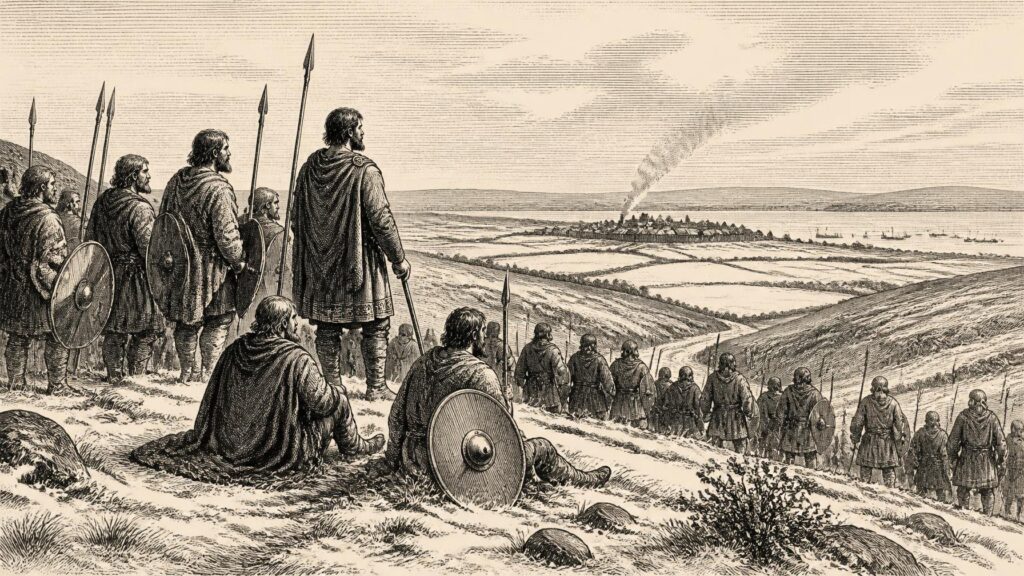
The decisive event securely attached to the calendar year was the battle of Glenn Máma on Thursday, 30 December 999. The Annals of Ulster provide both the day of the week and the Roman calendar date. Brian, described there as king of Cashel, led an army to Glenn Máma. The Dubliners, accompanied by the men of Leinster, came against him and were defeated. The Annals of Inisfallen, a source with strong Munster connections, calls it the slaughter of the Dubliners by Brian and says that the leading men of Munster were with him. Other annalistic accounts name Máel Sechnaill alongside Brian, with forces from Meath and Munster. Taken together, the evidence indicates a major coalition confronting the Leinster–Dublin alliance.
The precise site of Glenn Máma remains debated, though it lay on the approaches between Leinster and Dublin rather than in the city itself. That uncertainty need not diminish the battle’s significance. An army travelling from Brian’s southern sphere towards Dublin had to pass through contested Leinster. The battlefield was therefore a strategic gateway. The victory broke the opposing field force before it could defend the Dublin hinterland or preserve Máel Mórda and Sitriuc’s political initiative.
The Annals of Ulster name Aralt son of Amlaíb and Cuilén son of Eitigén among the dead, along with other nobles of Dublin. The Annals of Inisfallen goes further in its compressed manner, saying that the greater part of the “foreigners of Ireland” fell there. This should not be converted into an uncheckable total of casualties, nor into a simple ethnic war. The forces defeated included Dubliners and Leinster men; Brian’s army included Munster men and, in other accounts, Máel Sechnaill’s midland forces. Glenn Máma was a struggle for authority, access to resources and control of a strategically vital port, fought across political communities that were already intertwined.
Dublin at the Year’s Edge
The battle immediately exposed Dublin. The Annals of Ulster state that Brian afterwards entered Áth Cliath and that it was plundered. The fuller account in the Annals of Tigernach says that he remained for a week, took gold, silver and captives, burned the fortress and drove Sitriuc out. Yet chronology requires care. Some Irish annal series place the battle under an entry numbered 998 or 999 because their systems of year-reckoning differ; the Annals of Inisfallen place the occupation, burning and later submission of Dublin under the following year, beginning on the Kalends of January. Thus the battle belongs firmly to 30 December 999, while the sack and settlement belong to the immediate turn of 999–1000 and must not be presented as securely dated events within the earlier calendar year.
Even so, the impending fate of Dublin explains why Glenn Máma mattered. By the end of 999 the port was vulnerable to Brian’s army. Dublin was more than a fortified royal base. It was an established trading settlement whose river and sea connections brought silver, imported goods, ships and people into Irish politics. Archaeological work in the city has demonstrated the scale and density of Viking-age settlement, while the annals’ references to gold, silver, captives and hostages reveal what military victors hoped to obtain. To command Dublin was to gain leverage over a centre of exchange and maritime mobility, not simply a trophy of war.
Monuments, Mills and Memory
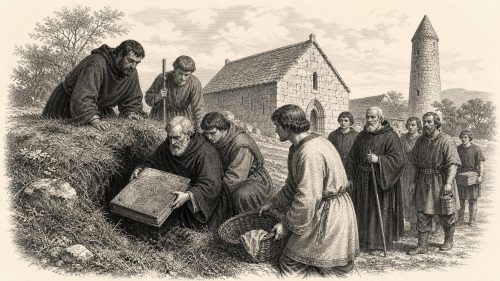
One of the year’s most striking notices concerns neither a king nor a battle. The Annals of Ulster report that the Lia Ailbi, described as the chief monument of Mag Breg, fell. Máel Sechnaill then had four millstones made from it. The entry does not permit a modern identification of the monument with certainty, and it should not casually be equated with the Lia Fáil at Tara. But its recorded status as a principal monument of Brega suggests a landmark invested with regional meaning. Its remaking as millstones is equally revealing: a conspicuous ancient stone entered the working material world of grinding grain.
That transformation offers a rare glimpse of the relationship between memory and daily subsistence. Milling was indispensable to households dependent on cereals; a millstone was a practical object, not a royal emblem. Yet Máel Sechnaill’s involvement made the act politically resonant. In a region central to his power, a monument associated with the past was converted into useful property under his authority. The annalist thought the episode memorable enough to preserve, perhaps because the stone’s fall seemed portentous, perhaps because the king’s response was striking, or both.
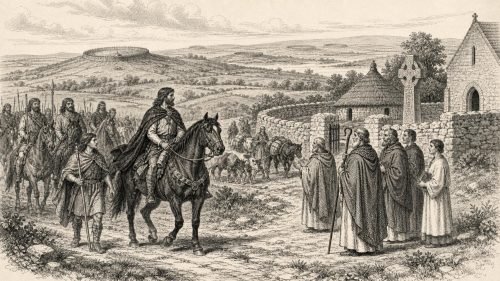
Religion also remained embedded in this political environment. Kildare’s plundering showed that even a major church settlement could be exposed when rival armies moved through Leinster. Monasteries and churches were communities of worship, learning, landholding and production; they held livestock, food, metalwork and books, and their personnel possessed connections that rulers sought to influence. Their vulnerability did not mean that they stood outside politics. Rather, their wealth, sanctity and networks made them important prizes and partners in the contests of kings.
No Millennium Calm
The year 999 ended not with an island united under Brian, but with the balance of power dramatically altered. Máel Sechnaill still held his own kingship and Brian had not yet obtained his submission. Sitriuc was not permanently removed from Dublin, and Máel Mórda remained a powerful figure in Leinster. Those later outcomes should not be pulled backwards into this year. What 999 demonstrably brought was the seizure of Leinster’s kingship, raids that exposed the costs of rivalry, and the crushing defeat of the Leinster–Dublin alliance at Glenn Máma on 30 December.
For contemporaries, the approach of the year 1000 was marked in some annals by calendrical calculation and Christian chronology. But the record of 999 offers no evidence of a general Irish expectation that the millennium itself would end the old order. The urgency came from more immediate realities: cattle to be defended or seized, hostages to be held, churches and settlements to protect, and Dublin’s wealth and sea routes to command. In that hard political landscape, the winter victory at Glenn Máma gave Brian the initiative that would shape the opening years of the eleventh century.
Primary Sources
- The Annals of Ulster
- Annals of Inisfallen
- Annals of Inisfallen
- The Annals of Tigernach
- Annals of Tigernach
- Annals of the Four Masters
- Annals of the Four Masters
- Chronicon Scotorum
- Irish Texts at CELT
- List of Published Texts at CELT
- Vikings in Ireland
- Brian Bórama (Bóruma, Boru)
- Queen Gormlaith, Brian Boru and The Northmen of Dublin Transcript
- Useful Sources of Information for Archaeologists Working in Dublin City
- Early Medieval Ireland, AD 400–1100: The Evidence from Archaeological Excavations
- Edel Bhreathnach
- Máire Ní Mhaonaigh
- Dublin Festival of History: Vikings of Islandbridge: Dublin’s Hidden Viking Past
- Be a Medieval Detective
- Ireland, Scotland and Wales to the Early Eleventh Century