Athlone’s Week of Hostages998 CE
In 998, Brian of Munster and Máel Sechnaill of Tara jointly asserted authority across Ireland. At Athlone, Brian secured Connacht’s hostages within a week and transferred them to Máel Sechnaill, recognising Tara’s overlordship while displaying his own military reach. The kings also obtained guarantees from Dublin’s Hiberno-Scandinavian rulers. Athlone’s Shannon ford enabled movement between Mide and Connacht, making it a strategic political meeting point. Hostage-taking signified submission rather than territorial conquest. The year also saw the deaths of leading churchmen at Armagh and Clonmacnoise. Though later conflict approached, 998 demonstrated Brian’s growing power within an uneasy partnership with Máel Sechnaill.
Dateline
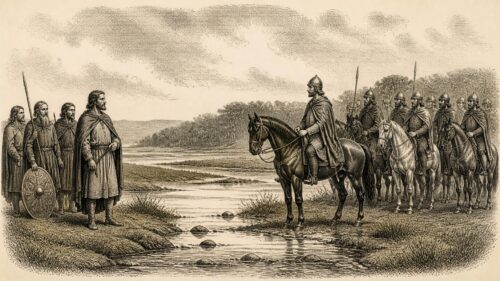
In 998, Ireland’s political map was being redrawn not by a single coronation or a decisive battle, but by the movement of rulers, armies and hostages across its great internal waterways. The most securely dated development is recorded by the Annals of Inisfallen: Brian son of Cennétig, king of Munster, came to Áth Luain—Athlone—and within a week took the hostages of Connacht before handing them to Máel Sechnaill son of Domnall, king of Tara. It is a compressed notice, but it reveals a great deal. Athlone was not merely a crossing on the Shannon: it was a place where power between the eastern midlands and the western province could be tested, negotiated and displayed.
Brian, later remembered as Brian Boru, was not yet sole ruler of Ireland. Máel Sechnaill remained the established overking of Tara, while Brian’s rise from the Dál Cais of north Munster had made him the most formidable rival to Uí Néill predominance in generations. Their accommodation, reached in the previous year, allotted Brian authority in the southern half of the island and left Máel Sechnaill with Leth Cuinn, the northern half. Such language should not be mistaken for a tidy partition administered from two capitals. Irish kingship rested upon personal alliances, military capacity, tribute, ecclesiastical relationships and, above all, the ability to obtain and retain hostages.
Athlone and the Connacht Hostages
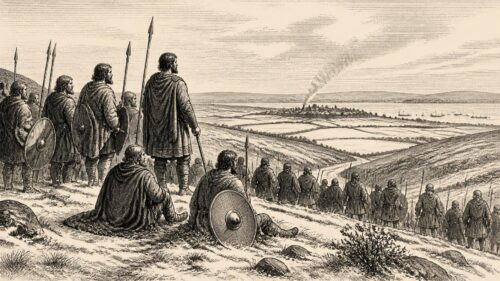
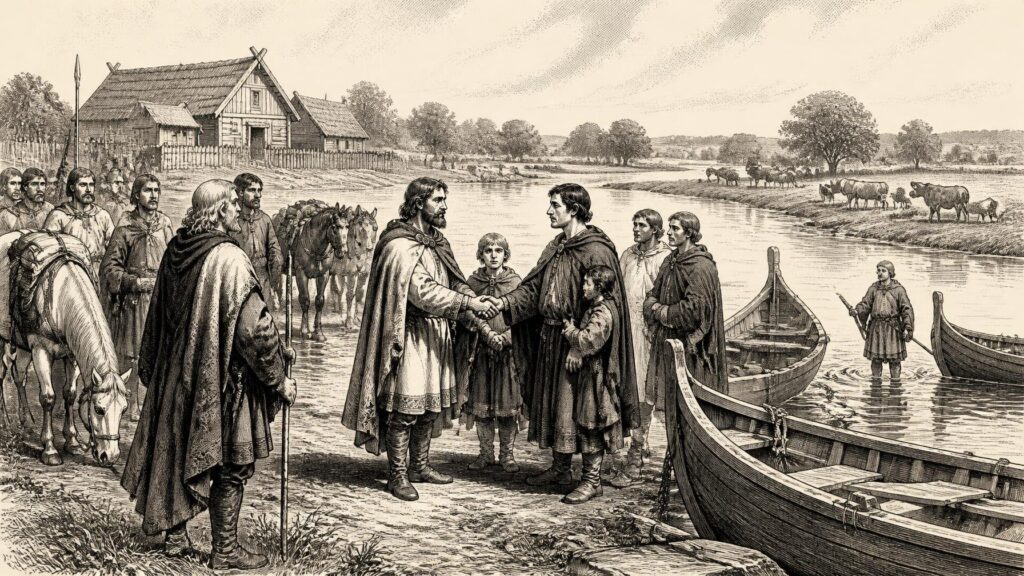
The record for 998 shows Brian acting with, rather than openly against, Máel Sechnaill. The Annals of Ulster say that the two kings made an expedition and took hostages from the foreigners of Dublin as guarantees of good conduct towards the Irish. Chronicon Scotorum likewise places an expedition by the two rulers in this year, adding that Brian and the men of Munster, alongside Máel Sechnaill’s force from Mide, went into Connacht and took its hostages. The Inisfallen annalist gives the sharpest local detail: Brian reached Athlone, secured the Connacht hostages in a week, and delivered them to Máel Sechnaill.
These accounts need not describe every stage of one perfectly documented campaign. Medieval annals are terse, and their surviving chronological systems do not always align without difficulty. Taken together, however, they firmly associate 998 with a co-operative assertion of authority by Brian and Máel Sechnaill over Dublin’s Scandinavian rulers and over Connacht. The handover at Athlone is particularly significant. Brian’s success could be presented as service to Máel Sechnaill’s wider kingship; yet it also demonstrated that the Munster king possessed the men, logistics and political reach to compel submission well beyond his own province.
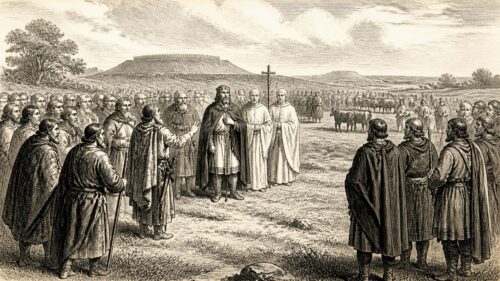
Hostages were central to this world. They were commonly relatives or high-status dependants of a ruler who had made terms, and their custody was intended to bind an agreement. Their presence did not mean that a province had been conquered in a modern territorial sense. Nor did it guarantee lasting peace. It did mean that the receiving king could claim a relationship of superiority, and that the party giving hostages had made a costly, public acknowledgement of pressure or dependence. To transfer Connacht’s hostages to Máel Sechnaill was therefore an act of diplomacy as well as a practical security measure. It upheld the existing king of Tara while advertising Brian’s importance within the arrangement.
The Shannon Frontier
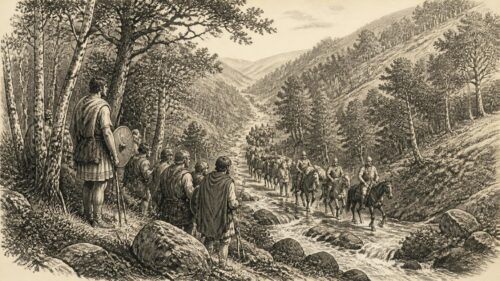
Áth Luain was an apt setting for such politics. Its name means the ford of Luan, and the place lay where the Shannon could be crossed between Mide on the east and Connacht on the west. The river was a route as well as an obstacle. It connected lakes, settlements and ecclesiastical centres, while its fords controlled the movement of cattle, people, messengers and armies. Archaeological and landscape evidence indicates settlement at Athlone by the early medieval period; its strategic value was later made unmistakable by causeways, bridges and castles. In 998, however, the power of the place lay in the ford itself and in the ability to bring armed followings to it.
The campaign also points to the practical burdens of early Irish warfare. A hosting required food, animals, weapons, boats where necessary, guides and the co-operation of local magnates. Campaigns were often short because supplies were difficult to maintain and because raiding, cattle seizure and hostage-taking could achieve political aims more quickly than a prolonged siege. The annalist’s phrase “in one week” should not turn the operation into a bloodless administrative visit. Rather, it suggests speed and effectiveness: Brian’s presence at the crossing was sufficient to procure the guarantees required.
For ordinary communities, such a royal expedition was rarely distant spectacle. Armies needed provisions and transport; livestock could be driven away; roads and river crossings became crowded with fighting men and followers. The political vocabulary of kings and hostages thus rested on the labour of farmers, herders, craftspeople, boatmen and religious communities. The sources do not tell us what any individual household experienced at Athlone in 998, and it would be wrong to invent such scenes. They do show, nonetheless, that central Ireland’s routes and resources were being drawn into the rivalry and partnership of the island’s leading rulers.
Dublin, Kildare and Uneasy Peace
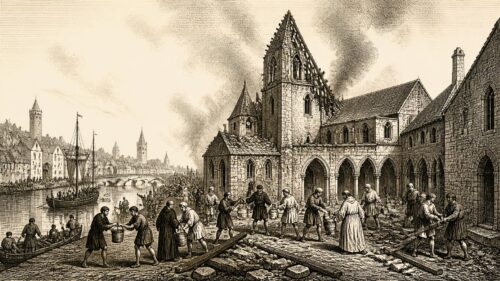
The hostage-taking from the foreigners concerned the Hiberno-Scandinavian kingdom of Dublin, ruled by Sitriuc Silkbeard. Dublin was far more than a military target or an ethnic enclave. It was Ireland’s most important port town, a defended settlement of merchants and craftspeople with commercial links to Britain, Scandinavia, northern France and beyond. Archaeology has recovered evidence for metalworking, woodworking, comb-making, textile production, weights, scales, bullion and coinage. Its rulers could field ships and mounted men, while its markets connected overseas goods with products obtained from the Irish hinterland.
That did not make the relationship between Dublin and neighbouring Irish kingdoms simple. Dublin’s rulers made alliances with Irish dynasties, intermarried with them and fought beside them as well as against them. The term “foreigners”, used by the annalists, marks political and cultural distinction, but it must not be turned into a story of two permanently separate peoples. The 998 agreements were an attempt to regulate a dangerous but indispensable power-centre. Dublin gave hostages; it was not removed from Irish politics.
A raid on Kildare is often attached to 998 in later annalistic compilations. Yet the surviving chronicles distribute the notice differently, and the connected major conflict at Glenn Máma is placed in 999 by the best chronological reconstruction of the principal evidence. It is therefore safer not to claim either the plundering of Kildare or the battle of Glenn Máma as a firmly dated event of the calendar year 998. This caution matters. The events were related to the mounting struggle between Brian, Leinster and Dublin, but they belong to the crisis that followed rather than to a securely established episode of this year.
Churches and Learned Communities
Religion remained inseparable from public life. The Annals of Ulster date the death of Dub dá Leithe, successor of Patrick and of Colum Cille, to 2 June 998, in his eighty-third year. The title “successor” denoted not simply devotion but institutional inheritance, authority and access to the resources of major churches. Armagh’s association with Patrick gave it exceptional prestige, while the Columban tradition linked religious houses across Ireland and western Scotland. The death of so prominent a churchman was therefore a political as well as ecclesiastical moment, even though the annals offer no narrative of the succession that followed.
Chronicon Scotorum also records in this annal the death of Conaing Ua Coscraig, described as a learned bishop of Clonmacnoise. Situated beside the Shannon and near the great east–west route later called the Slí Mór, Clonmacnoise was a religious settlement, a centre of learning and a place of exchange. Its scribes and scholars belonged to a literate culture that preserved genealogies, law, hagiography, poetry and historical memory. Major monasteries were not secluded islands outside secular politics: they held land, received patronage, sheltered dependants and could be exposed to plunder or compelled to support travelling kings.
The year’s notices therefore bring royal and ecclesiastical power into the same frame. At Athlone, kings used a strategic crossing to take guarantees from Connacht. At Armagh and Clonmacnoise, the deaths of senior churchmen registered changes within institutions that shaped prestige and learning across the island. Neither sphere can be understood in isolation from the other.
Before the Break
In retrospect, 998 can look like a pause before the more dramatic events of the following years: Brian’s victory at Glenn Máma in 999, the attack on Dublin around the turn of the millennium, and his eventual displacement of Máel Sechnaill as leading king of Ireland in 1002. But it was not an empty interval. The Athlone operation showed both the usefulness and fragility of the Brian–Máel Sechnaill partnership. Brian could win submissions in the west and surrender their tokens to Tara; Máel Sechnaill could still receive them as overlord. The arrangement preserved a balance, yet every successful expedition enhanced Brian’s reputation and enlarged the network on which a future claim to island-wide authority could rest.
Primary Sources
- Annals of Inisfallen
- The Annals of Ulster: Year U998
- The Annals of Ulster: Year U998 (Irish text)
- Chronicon Scotorum: Annal CS998
- Chronicon Scotorum: Annal CS998 (Irish text)
- The Annals of Tigernach
- The Annals of Tigernach: Annals T997–T999
- Annals of the Four Masters: Annals M993–M1000
- The Leabhar Oiris
- Brian Bórama (Bóruma, Boru)
- Sitriuc Silkbeard (Sitric, Sigtryggr Ólafsson Silkiskeggi)
- Viking-Irish Alliances
- Battle of Clontarf: The Combat
- Dublin City Urban Archaeology Survey, 1988
- Introduction to Dublin City
- Waterways Study: Lanesborough to Shannonbridge
- Athlone Town Walls and Defences Conservation Plan
- High Crosses
- Irish School of Illumination, c. 650–1100
- The Economy of Early Medieval Ireland
- The Vikings in County Kildare
- A Game of Thrones: Leinster vs Munster at the Battle of Clontarf