Belach Lechta’s Turning Point978 CE
In 978, Ireland’s annals record conflict, illustrating fragmented authority among regional kings, churches and maritime powers. At Belach Lechta, Brian son of Cennétig defeated and killed Máel Muad of Cashel, securing leadership in Munster after his brother Mathgamain’s death and establishing the basis for his later ascendancy. Cork and Lismore were plundered and burned, though attackers and circumstances remain unknown. Dublin defeated Leinster at Bithlann, killing King Úgaire, while Airgialla routed Cenél Conaill in the north. Fiachra, superior of Iona, died. These events disrupted communities dependent on farming, cattle, church wealth and lordship, redistributing power without creating a unified Ireland.
Dateline
The Irish annals place a striking cluster of violence in 978: a decisive contest in Munster, a Dublin victory over Leinster, a northern rout, and assaults on two important southern ecclesiastical centres. These notices are terse, but together they show that Ireland was not moving under a single authority. Power lay in overlapping regional kingships, church networks and maritime towns. The year is especially important because it marked the emergence of Brian son of Cennétig—later Brian Bórama or Brian Boru—as the dominant figure in Munster.
Care is needed with the dating. The Annals of Ulster label their material “977 alias 978”, while the Munster-based Annals of Inisfallen explicitly place the battle of Belach Lechta in 978. The agreement of these independently transmitted annalistic traditions makes the battle and the other principal events securely connected with this year, even though no source gives a day or month. The records describe outcomes, not the full causes, numbers or experiences of those involved.
A Victory in Munster
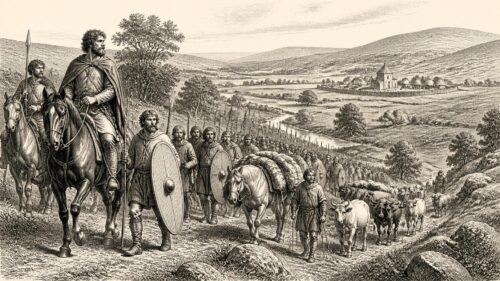
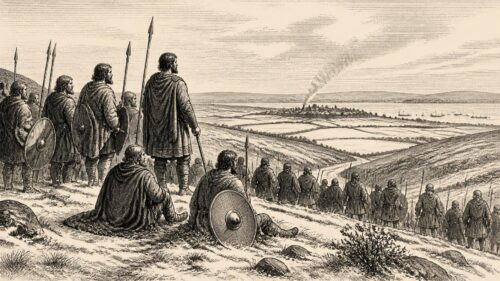
The central event was the battle of Belach Lechta. The Annals of Inisfallen state that Máel Muad son of Bran, king of Caisel, and many others were killed, and that Brian son of Cennétig was victorious. The Annals of Ulster likewise record a battle between Brian and Máel Muad, king of Desmumu, in which Máel Muad fell. The convergence is unusually valuable: it establishes both Brian’s victory and the death of his rival, while warning against later narratives that furnish the encounter with elaborate speeches or untestable detail.
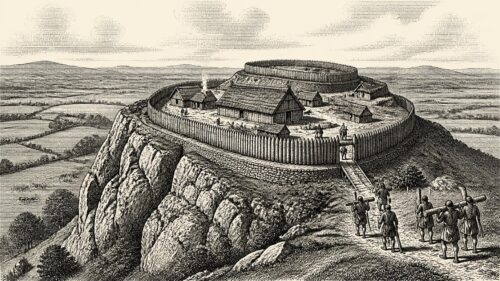
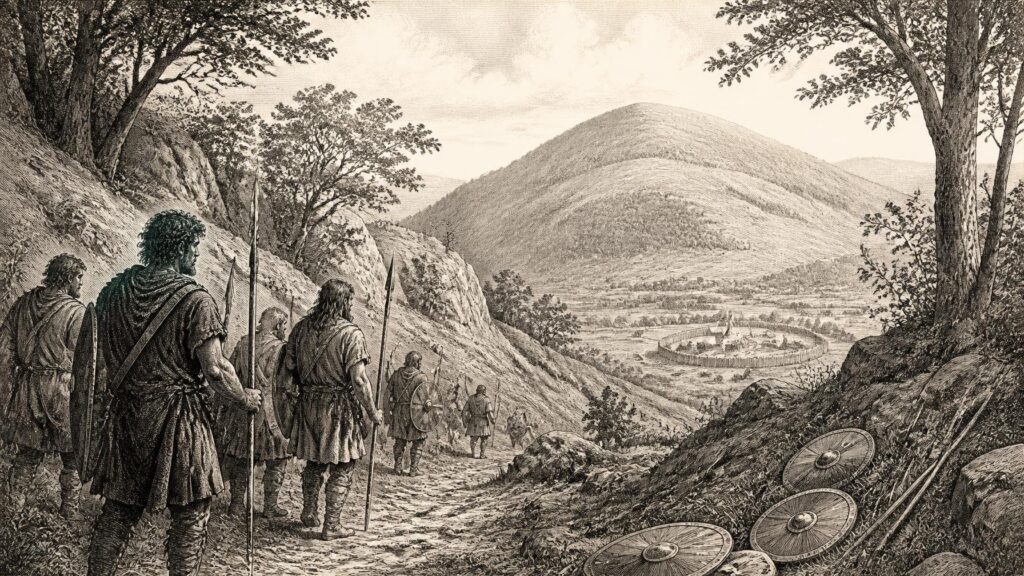
Belach Lechta was a pass in the contested country between north and south Munster, traditionally identified near the route between Kilmallock and Kildorrery. Its setting mattered. A pass was a meeting place of roads, grazing country and political jurisdictions: control of it carried strategic value, but the battle was about kingship rather than geography alone. Máel Muad represented an Eóganacht line associated with the established royal world of Cashel; Brian belonged to the rising Dál Cais of the Shannon region. Their struggle was therefore a contest over the leadership of Munster.
Brian had taken up his brother Mathgamain’s cause after Mathgamain was killed in 976. Máel Muad had been involved in the coalition that brought about that killing, alongside Donnubán of Uí Fhidgeinte and the Norse rulers of Limerick. Brian’s campaigning in 977 against Uí Fhidgeinte and the Limerick foreigners was already part of his response. The death of Máel Muad in 978 removed the most formidable remaining rival named in the annals. It did not instantaneously make Brian ruler of all Ireland, nor did it end resistance within Munster. What it did do was secure his position as Mathgamain’s effective successor and create the platform from which he would later extend his influence.
The cost should not be reduced to the death of one king. The annalist’s phrase “many others” implies the loss of retainers, allied landholders and fighting men whose households depended upon them. Armies were not permanent national forces. A king’s host was assembled from client communities and subordinate rulers, and its defeat could expose livestock, crops and settlements to subsequent raiding. The immediate aftermath is not described, but political change in such a society was felt in obligations of food-rent, military service, fosterage and hostage-giving as much as in the possession of a royal title.
Fire at Corcach and Lismore
Munster’s victory was accompanied by destruction nearer the coast and river valleys. The Annals of Ulster report that Corcach Mór—Cork—was “sacked by fire”; the Annals of Inisfallen say simply that Corcach was plundered and add the death of Bishop Fínnechta. Neither source identifies the attackers or proves that the bishop died in the assault. Those limits matter. It is responsible to say that Cork suffered plunder and burning in the year, and that its bishop died; it is not responsible to turn this brief notice into a fully known siege.
Cork was then above all an ecclesiastical place on the River Lee, although Scandinavian activity had long affected the surrounding waterways and a small Viking-age settlement may have existed there. Archaeology has not produced a clear urban picture for 978, and the more substantial surviving evidence for Hiberno-Norse Cork belongs largely to later centuries. The annal nevertheless reveals why the place was vulnerable and valuable: it lay amid channels, islands and routes that joined inland Munster to the sea. Fire in a settlement of timber, wattle, thatch, stores and workshops could devastate buildings quickly, while plunder removed portable wealth—metalwork, food, animals, textiles and ecclesiastical valuables.
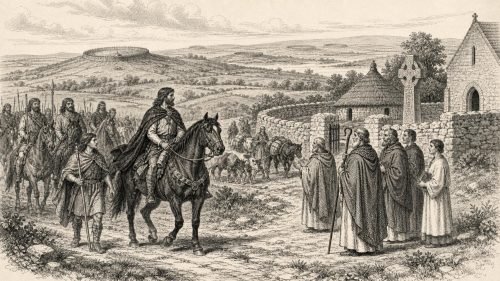
The same Ulster annal says that Les Mór Mo-Chutu, Lismore, was plundered and burned. This was no incidental rural chapel. Lismore, on the Blackwater, was an old and prestigious church settlement associated with Mochutu, also known as Carthach. Irish monasteries were centres of worship and burial, but also landholders, schools, workshops and places where clerics and lay dependants lived. Their enclosures held churches and dwellings as well as cultivation and cattle. An attack could therefore interrupt prayer and learning while also dispossessing workers, tenants and neighbouring farming communities.
The annals do not state whether the burnings of Cork and Lismore formed one coordinated campaign or were separate episodes in a wider season of warfare. They should not be automatically attributed either to Brian or to Viking forces. What can be said is that the year’s conflict reached institutions whose wealth, river access and political connections made them conspicuous targets. The apparently religious landscape was inseparable from the secular one: kings cultivated churches as allies, churches depended on lay protection, and both possessed resources worth seizing.
Dublin’s Blow Against Leinster
While Munster was being remade, the foreigners of Áth Cliath—Dublin—won the battle of Bithlann against the Laigin, the people of Leinster. King Úgaire son of Tuathal fell there, with many others. Bithlann is generally identified with Belan in modern County Kildare, an identification that places the encounter west of Dublin and within the wider Leinster heartland. It was not a minor border skirmish: the death of a provincial king marked a serious reversal for Leinster.
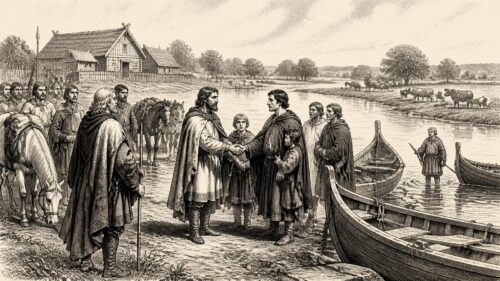
The word “foreigners” in the annals is not a simple ethnic label. Dublin’s rulers and inhabitants belonged to a Scandinavian-Gaelic, Irish Sea world linked by ships, trade, marriage, warfare and tribute. They could be adversaries of Irish kings on one occasion and allies on another. Dublin’s success at Bithlann demonstrates that its military reach extended beyond its fortified settlement and harbour. The battle also shows that the relationship between a Gaelic province and the port was not a fixed story of Irish resistance to outsiders. It was a shifting contest among rulers, dynasties and communities with intersecting interests.
Úgaire’s death created a problem of succession for Leinster’s Uí Dúnlainge ruling elite. Such a loss could encourage rivals to assert their own claims, renegotiate alliances or exploit weakened client districts. Yet the surviving 978 notices do not tell us who succeeded him, why the battle occurred, or whether Dublin imposed a lasting settlement. The proper historical conclusion is narrower: Dublin inflicted a major defeat, and Leinster lost its king in the field.
A Northern Rout and an Island Church
The year’s violence also reached the north. The Airgialla inflicted a battle-rout on Cenél Conaill, and Niall ua Canannáin was among those killed. Chronicon Scotorum adds further casualties, underlining that this was more than an isolated death. Airgialla was a politically varied grouping in the central and eastern north, while Cenél Conaill was a major kindred in the north-west. Their clash belongs to the enduring, localised rivalry that shaped Ulster and the north-west; the annals provide no secure location or detailed explanation, so none should be invented.
Not every entry concerned war. The Annals of Ulster record the death of Fiachra, superior of Í, or Iona. Although Iona lies off the west coast of Scotland, it was deeply embedded in Irish ecclesiastical and learned networks through the Columban tradition. Its inclusion in an Irish chronicle is a reminder that the sea connected rather than divided the Gaelic world. Clerical offices, books, relics and intellectual authority travelled along the same maritime routes that carried merchants and war bands.
A Fragmented Island
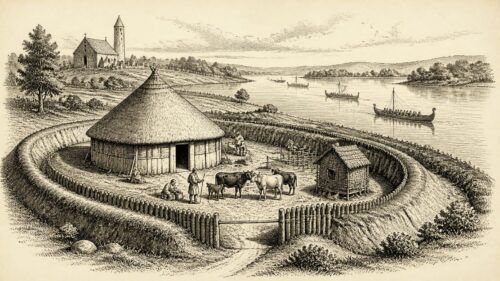
For ordinary people, 978 was experienced locally: through the mustering of a lord’s followers, rumours carried along roads and rivers, the loss of kin, the seizure of cattle, or the danger of fire. Most people lived in dispersed farming communities, often in or near enclosed homesteads, relying on mixed agriculture and livestock. Cattle remained a principal measure of wealth and a practical source of milk, hides, traction and tribute. A great battle or a raid could disturb the agricultural year long after the armed men had dispersed.
The annals preserve kings, bishops and named dynasties because their deaths and victories were judged worth recording. They leave unnamed the labourers who repaired burned buildings at Cork and Lismore, the households that supplied hosts, and the dependants of those killed at Belach Lechta, Bithlann and in the north. Even so, their silence does not make those people peripheral. The political transformations of 978 rested upon their food, animals, craftwork and service.
In retrospect, Belach Lechta stands out because Brian’s later rise gave the victory exceptional significance. In 978 itself, however, Ireland remained resolutely plural. Brian had strengthened his command in Munster; Dublin had proved dangerous in Leinster; Airgialla had struck Cenél Conaill; churches could still be burned and plundered. The year was not the birth of a unified kingdom. It was a hard-fought redistribution of power across an island of competing regional worlds.
Primary Sources
- The Annals of Ulster, Year U978
- Annals of Inisfallen, Annal AI978
- Chronicon Scotorum
- Annals of Tigernach
- Annals of the Kingdom of Ireland by the Four Masters, Volume 2
- Brian Bórama (Bóruma, Boru), Dictionary of Irish Biography
- Tuathal, Dictionary of Irish Biography
- Augaire, Dictionary of Irish Biography
- Biothlann/Belan, logainm.ie
- Brian Boru’s Origins and the Kingdom of North Munster
- Cogadh Gáedhel re Gallaibh and Cork
- Church-Raiding and Subjugated Vikings, 980–1014
- Vikings in Ireland and Scotland
- The Vikings in Ninth-Century Ireland: Sources and Settlements
- The Archaeological Heritage of County Cork
- Cork’s Viking Settlement
- Early Christian Monasteries
- The Earthen Rath or Lios
- Iona and the Shrine of Columba, c. 800–1200
- Í > IOUA > IONA – Iona’s Namescape
- Cenél nEógain and the Donegal Kingdoms, AD 800–1200
- The History and Topography of Viking Cork