
Brian’s Northern Ascendancy1011 CE
In 1011, Brian Bórama’s supremacy reached the north-west through a major campaign against Cenél Conaill. Forces led by Brian and his sons, allied with Flaithbertach Ua Néill and other rulers, raided, seized cattle and captives, and compelled Máel Ruanaid Ua Máel Doraid to submit at Cenn Corad. The events demonstrated both Brian’s wide influence and the negotiated, competitive character of Irish over-kingship. Máel Sechnaill remained within Brian’s political order, while Ulster’s dynastic conflicts continued. Deaths among royal heirs and prominent churchmen, illness near Armagh, and a plentiful nut harvest reveal a society shaped by warfare, ecclesiastical learning, disease, and resources.
Dateline
The year 1011 falls in the last, formidable phase of Brian Bórama’s supremacy. The annals do not give a modern narrative history, and their dating can be awkward: some entries are marked “AD 1010 alias 1011” or are shifted by a year in later compilations. Even so, the central development that can be responsibly connected with 1011 is clear. Brian’s power, based at Cenn Corad near Killaloe on the Shannon, reached deep into the north-west, while older royal houses continued to act, raid and bargain within the hard rules of Irish over-kingship.
This was not a year of one famous set-piece battle. It was a year of hosting, submission, cattle-taking, hostage politics, church deaths, and the continued testing of authority. In that sense it shows more of how power usually worked in eleventh-century Ireland than the better-known drama of Clontarf three years later.
Brian And Cenél Conaill
The most substantial dated evidence for the year is Brian’s campaign into Cenél Conaill, the north-western branch of the Northern Uí Néill associated above all with Donegal and neighbouring districts. The Annals of Inisfallen record “a great muster of the men of Ireland” by Brian, son of Cennétig, into Cenél Conaill. The army was divided: one part, under Brian’s sons Murchad and Domnall, harried the territory and carried much booty back towards Munster; Brian himself then went on to the lake, a detail that evokes the practical geography of campaigning in a land of rivers, loughs and routeways rather than neat frontiers.
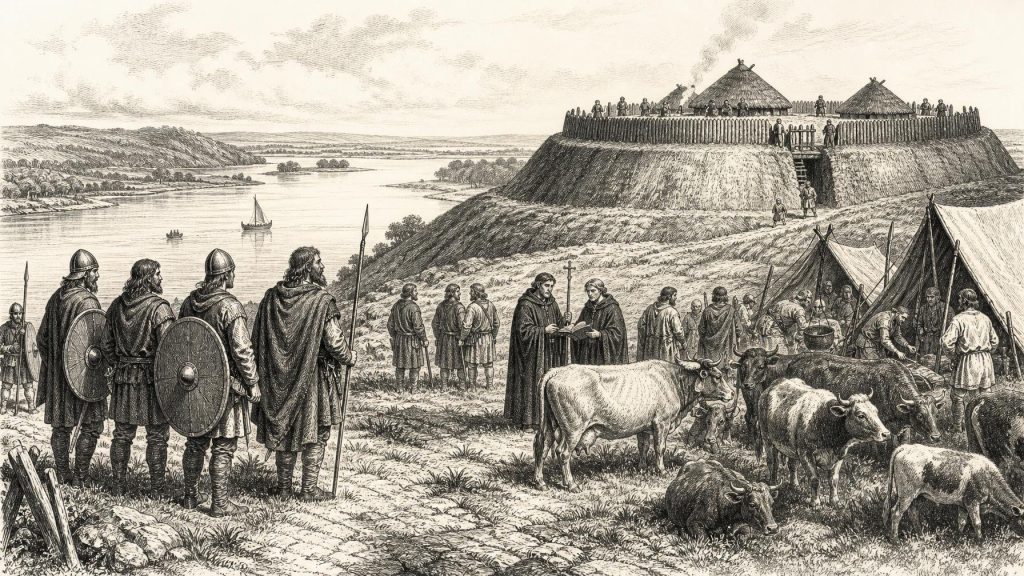
A second Inisfallen notice for the same year states that Brian made a great hosting to Cenél Conaill “both by land and sea”. Mael Ruanaid Ua Maíl Doraid, king of Cenél Conaill, came with him to Cenn Corad, accepted a large stipend and made full submission. That combination of force and payment is important. Submission was not merely emotional allegiance to a “high king”; it was performed through hostages, tribute, stipends, attendance, and the movement of kings between royal centres. By bringing a northern king to Cenn Corad, Brian turned his own Munster base into an island-wide theatre of power.
The Annals of Ulster preserve a related picture. They report that Flaithbertach Ua Néill, king of Ailech, accompanied by northern warriors, and Murchad son of Brian with Munstermen, Leinstermen and the southern Uí Néill, invaded Cenél Conaill and took three hundred captives and many cows. Here Brian’s hegemony appears as a coalition. It drew in former enemies and dependent allies, including Leinster and the southern Uí Néill, but it also depended on the ambitions of powerful northern rulers such as Flaithbertach himself.
Alliance, Rivalry And Raiding
Flaithbertach Ua Néill is one of the key figures in the year. As king of Ailech, he represented Cenél nEógain, the other great Northern Uí Néill dynasty and a long-standing rival of Cenél Conaill. His participation in the campaign suited Brian, because it brought northern military strength into Brian’s orbit. It also suited Flaithbertach, because pressure on Cenél Conaill strengthened his own regional hand. The annals therefore reveal not a simple chain of command but a political bargain: Brian could claim island-wide obedience, while local kings used that wider order to advance older rivalries.
The same Ulster annalistic cluster records that Brian and Máel Sechnaill were again in their naval camp at Enach Duib. Máel Sechnaill mac Domnaill, former king of Tara and king of Mide, had been the dominant Irish over-king before Brian displaced him in 1002. By 1011 he appears not as an independent rival at the centre of events but as a major actor within the political settlement shaped by Brian. The mention of a naval camp is also telling. Eleventh-century Irish warfare was not confined to inland cattle-raiding. Fleets, river movement and coastal access mattered, especially when kings sought to project power beyond their own provinces.
The year also saw violence within and around Ulster. Mael Ruanaid Ua Domnaill, king of Cenél Lugdach, was killed by the Fir Maige Itha, and Aengus Ua Lapáin, king of Cenél Énna, was killed by Cenél nEógain of Inis Eógain. Flaithbertach Ua Néill led an army to Dún Echdach, burned the fort, demolished the settlement and took a pledge from Niall son of Dub Tuinne. These notices are terse, but they show a landscape of fortified places, local kingships and sudden coercion. A “town” in this annalistic language need not mean a later walled borough; it may indicate a defended settlement or royal site within a Gaelic political landscape.
Deaths In Royal Houses
The Annals of Inisfallen say that Aed son of Mathgamain and Domnall son of Brian died “in a single season at their houses”. Aed was an heir of Cashel, and Domnall was one of Brian’s sons. The wording is striking because these were not battle deaths. In a society where royal succession was competitive and often violent, the natural or domestic death of a dynastic figure could still alter the political balance.
Domnall’s death removed one of Brian’s sons before the crisis years that followed. Murchad, another son, appears actively leading troops in 1011 and would become central to later events. The annals do not allow us to reconstruct family feeling, succession planning or court discussion at Cenn Corad, but they do show that Brian’s wider political system rested on a vulnerable dynastic household. His sons were not decorative princes; they were commanders and agents in the field.
Churchmen And Learned Communities
Several firmly dated notices for 1011 concern churchmen. The Annals of Ulster record the deaths of Dúnadach of the oratory of Colum Cille in Armagh; Flaithbertach Ua Ceithineáin, successor of Tigernach, described as an elder and learned bishop who had been wounded by the men of Bréifne and later died in his own monastery; and Muiredach son of Críchán, successor of Colum Cille and lector of Armagh, who died on 28 December in the eighty-fourth year of his age. Dálach of Dísert Tóla, successor of Feichín and Tóla, also died at an advanced age.
These entries remind us that the Ireland of 1011 was held together not only by kings and armies but by churches, schools, relics and learned offices. Armagh was especially important. Brian had already cultivated its support earlier in his reign, and the Book of Armagh preserves the celebrated context in which he was associated with the title imperator Scotorum, “emperor of the Irish” or “emperor of the Gaels”. That inscription belongs to the years before 1011, not to 1011 itself, but it forms the essential background to his northern policy. Recognition by Armagh helped give religious weight to a kingship that had broken the older Uí Néill monopoly on the highest claims of rule.
The death of a lector at Armagh is more than a local obituary. A lector was a senior teacher, part of the intellectual life of a church settlement where Latin learning, biblical study, law, record-keeping and the preservation of memory intersected. The annals themselves are products of that world. When they list bishops, coarbs, abbots and learned men beside raids and royal deaths, they reflect a society in which ecclesiastical authority and secular power were deeply intertwined.
Illness, Food And Everyday Life
A sickness at Armagh is placed by major annalistic witnesses in the following annal-year, running from Samhain to Bealtaine. Because Samhain falls at the beginning of November, the outbreak is plausibly connected with the winter of 1011–1012 rather than a neatly isolated modern calendar year. It is described as an affliction involving lumps and internal pains, killing seniors and students as well as prominent churchmen. The notice should not be converted into a modern diagnosis, but it does show the vulnerability of dense religious and educational communities to epidemic disease.
Everyday life is glimpsed most clearly through what the annals assume. Armies sought cows because cattle were mobile wealth: food, tribute, status, compensation and political leverage. Captives mattered too, both as hostages and as human booty in a world connected to Irish Sea trade. The taking of three hundred captives in Cenél Conaill was therefore a social catastrophe as well as a military success. Behind the brief entry lay broken households, displaced labour and bargaining over ransom or allegiance.
The Annals of Inisfallen add one small but vivid environmental note: there was an abundance of nuts in the year. Such comments are rare and valuable. Hazelnuts were a seasonal food gathered from woods and scrub, and a good mast year could ease local diets, feed pigs and serve as a sign of natural plenty. Set beside the notices of raiding, death and submission, the nut harvest reminds us that most people in 1011 were not royal commanders. They were farming, herding, fishing, gathering, paying dues, serving churches and trying to survive the demands of their lords.
A Year Of Command
By the close of the year, Brian’s authority looked exceptionally wide. Cenél Conaill had been harried; its king had submitted at Cenn Corad; Brian’s sons had operated as commanders; Flaithbertach Ua Néill and Máel Sechnaill were drawn into the same political field; and the churches continued to record, legitimise and suffer through the age’s upheavals. Yet the evidence also warns against imagining a unified state. Ireland remained a mosaic of kingdoms, dynasties, ecclesiastical federations and maritime towns, with obedience constantly renewed through force, tribute and personal negotiation.
Seen from 1011, Brian’s supremacy was real, but it was also strenuous. It had to be carried by armies across mountains, plains, rivers and seas; expressed in cattle, captives and stipends; and witnessed by churchmen whose own communities were vulnerable to violence and disease. The year’s importance lies in that tension. It shows Brian near the height of his power, but it also reveals the unstable machinery by which that power had to be made visible again and again.
Primary Sources
- Annals of Inisfallen, Part 56: AI1003–AI1011
- Annals of Inisfallen: English Translation
- Annals of Inisfallen: Original Text
- The Annals of Ulster: English Translation
- The Annals of Ulster, Year U1011
- Annals of Ulster: TEI Header and Bibliographic Information
- Annals of the Four Masters, Volume 2: M903–M1171
- Chronicon Scotorum: English Translation
- Chronicon Scotorum: Original Text
- Annals of Tigernach
- Annals of Loch Cé A.D. 1014–1590: English Translation
- The Book of Armagh: Dublin, Trinity College, MS 52
- ‘Emperor of the Irish’: Brian Boru and the Battle of Clontarf 1014
- Brian Boru and the Book of Armagh
- Brian Bórama (Bóruma, Boru)
- Ua Néill, Flaithbertach
- Brian Boru’s Fort
- Early Medieval Ireland: Archaeological Excavations, 1930–2009
- The Irish Sea and the Atlantic Trade in the Viking Age
- Reassessing the Irish ‘Monastic Town’
- Changing Human-Cattle Relationships in Ireland: A 6000-Year Isotopic Perspective
- The Archaeology of Livestock and Cereal Production in Early Medieval Ireland, AD 400–1100
- Irish Clientship
- Ireland in the Middle Ages