Nicholas Street
At a Glance
Archive Context
The surviving digital descriptions point first to archives rather than to a single named Nicholas Street series. Limerick Local Studies presents trade and street directories as a long-running resource for addresses and occupations, and it notes that the fully searchable table extends to 1969. That makes the directories a useful companion to photographs, because they can anchor where businesses were listed even when images are not immediately identified in the catalogue.
The same description also warns that the directories are not exhaustive and that small traders and disadvantaged classes tend not to appear. That limitation matters when searching for shopfronts on a particular street, because the record may preserve some businesses while leaving others unlisted. For Nicholas Street, the excerpted material therefore supports a method of comparison between directories, photographs, and other local collections, rather than a complete street-by-street inventory.
Retail Setting
Limerick retail history is described as shifting across the city over time, with the heart of shopping moving through several streets before reaching William Street in the 1950s and 1960s, and then giving way to suburban shopping centres from the 1970s onwards. That wider pattern places shop photographs in a changing commercial landscape. The excerpts do not mention Nicholas Street in that summary, so any link to it must remain local and specific rather than generalized to the whole city.
The same publication describes the use of maps, newspapers, advertisements, business records, photographs, and oral testimony to trace retail change. It also notes that readers supplied memories of shopping in the city. For an inquiry into Nicholas Street shops, that combination shows how a street image may be read alongside business records and remembered use, but the excerpts here do not identify a specific Nicholas Street shop photo from the 1960s or 1970s.
Street Record
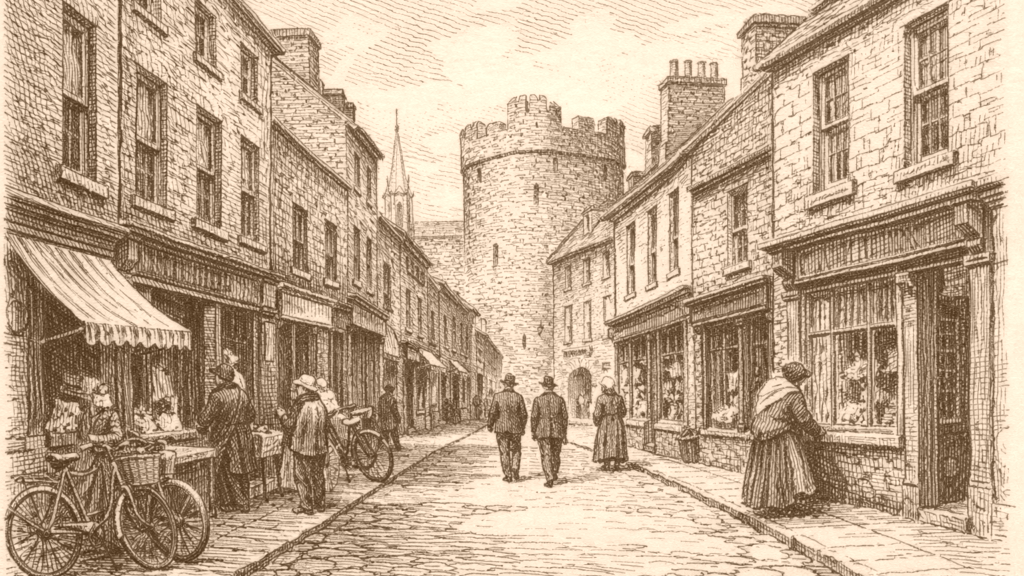
One explicit Nicholas Street image appears in the Tipperary Archive: a black-and-white photograph titled Thomond Provision Company, Grocery Store, 41 Nicholas Street, Limerick City. Its description identifies a boy at the entrance and gives the date as the 1930s. The tags include grocery store, Limerick City, Nicholas Street, shop front, and sign writing, making it a clearly shop-focused street image even though it falls outside the 1960s and 1970s.
Because the dated Nicholas Street photograph in the excerpt belongs to the 1930s, it cannot itself answer a search for the 1960s or 1970s. It does, however, establish that Nicholas Street shopfront material exists in digital form and that the visual record preserves street-level commercial detail. The evidence here is therefore one of continuity in place and subject, but not of continuity in date within the cited item.
Photographic Holdings
For the 1970s, the strongest evidence is archival scale rather than a Nicholas Street caption. Limerick Museum and Archives, working with the Limerick Leader, present a major archive of more than 25,000 images of daily life in Limerick during the 1970s. Another account says the archive offers pictures, publications, and videos, and that the 1970s collection is an affectionate snapshot of the city in that decade.
The Limerick Leader material also says many photographs from the archive never made it into print and remained unseen for decades, while the online series can be searched and the pictures ordered. A related report notes that the paper’s nostalgic magazine series ran from 1965 to 1994 and included photographs and advertisements. These details show the kind of pool from which shop images from Nicholas Street might be sought, though no excerpt names such an image.
Access Routes
Limerick.ie states that digital archives are freely available to the public to promote research into the history of Limerick and that the originals are preserved by allowing them to rest. This matters for shop research because it explains why a photographer’s print, a newspaper archive, and a municipal collection may all be encountered online in different forms. The excerpt supports access, not a claim that any one Nicholas Street image is already digitised there.
The university photographic archive adds another route. Its guide says the collection is being catalogued and digitised, with a representative sample made available on the digital library, spanning from the 1960s to the mid-2000s. That chronological span overlaps the decade range of interest here. The excerpt also shows that the archive is divided into series, which suggests a structured but not necessarily complete path to locating city photographs.
Research Summary
The combined record supports a modest conclusion. A Nicholas Street shop image is clearly documented in one digital archive, but it dates to the 1930s rather than the 1960s or 1970s. Separate Limerick archives preserve large bodies of 1970s photographs and longer runs of trade records and newspaper imagery. The evidence therefore supports a search strategy, not a definitive claim that the desired decade-specific Nicholas Street photographs are present in the excerpts themselves.
What can be stated with confidence is narrower still: the archives described here preserve shop-related photographs, street records, and searchable online access. What remains uncertain is whether a specific Nicholas Street shop picture from the 1960s or 1970s survives in the cited catalogues, because none of the excerpts names such an item directly. In that sense, the historical value of the material lies in proximity, context, and method as much as in any single photograph.