Election Record
At a Glance
Election Phrase
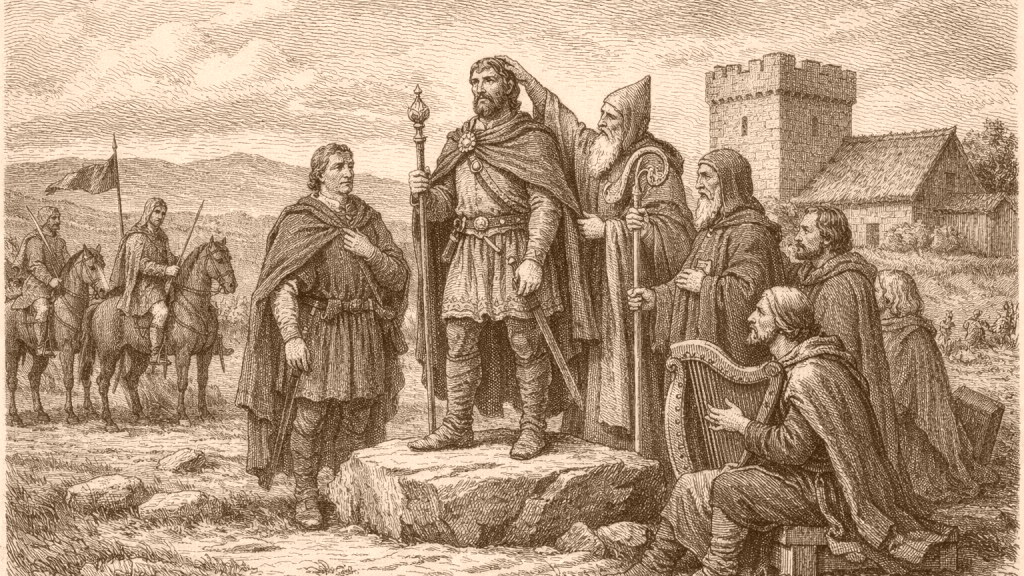
The clearest election language in these excerpts appears in the Connacht material for 1293. After Manus O'Conor's death, Hugh, son of Owen, is described as receiving the kingdom of Connaught and being inaugurated as successor through the influence of the Lord Justice. The same notice says that, on the tenth day after his election, he was captured by Fitzgerald and his followers suffered losses. The entry ties election, inauguration, and rapid reversal together.
The surrounding 1293 notices help fix that election within a wider sequence of deaths and transfers. In the same year the annals record the death of Manus O'Conor, the death of Murrough O'Melaghlin, and the death of Florence O'Carolan, Bishop of Derry. The year also includes the deposition of relics at Sabhall, showing that the entry set mixes political change with ecclesiastical and devotional material, without spelling out a broader explanation for the election itself.
Connacht Context
The year before and after the election notice presents Connacht as a place of repeated seizure, deposition, and retaliatory action. In 1292 an army led by the Red Earl came to Roscommon but withdrew without hostages or power, while in 1294 Hugh, son of Owen, committed depredations, the castle of Sligo was razed, and Richard Burke was captured. These entries are brief, but they show a sequence of reversals rather than a settled rule.
The same 1294 material also states that Fitzgerald and Mac Feorais Birmingham treacherously attacked the Connacians and attempted to depose Hugh, son of Owen, yet acquired no power over the province. Another 1294 notice says the Red Earl was taken prisoner, and that his capture threw Ireland into disturbance. These claims are close in wording and keep the focus on capture, desolation, and failed domination rather than on any sustained electoral process.
Royal Succession
The Ulster and Connacht annals also record succession without using the same explicit election formula. In 1172 Tiernan O'Rourke is said to have been slain and his head and body displayed in Dublin, while in 1172 and 1173 several bishops and abbots died and were replaced in the ordinary course of the entries. A synod at Tuam is mentioned, but the text does not describe an election there. The notice style is about loss, appointment, and death.
The same records show that ecclesiastical office could be accompanied by formal succession language, yet still without a cited election. Gilla Mac Liag Gelasius is identified as successor of St. Patrick and Primate of Ireland, and the entry notes the number of years he had held the abbacy of St. Columbkille before that succession. The annals therefore preserve titles and transitions, but in these excerpts they rarely narrate the act of choosing the new holder.
Ecclesiastical Notice
The 1443 and 1444 entries offer another register of office, kinship, and movement. They report deaths of abbots, bishops, and lords, alongside attacks, plundering, and the taking of hostages. Hugh Boy O'Neill is called Roydamna of Ireland, and after his death an army is led by Owen, son of Niall Oge, against the Clann-Hugh-Boy. The entries remain terse, but they preserve a clear succession sequence after the death notice.
In the same cluster, other names are linked to lordship and replacement: Owen, son of Donnell, son of Murtough O'Conor, Lord of Sligo and Carbury, is slain, and the record then moves to plunder in the English settlements of Oriel. This is not an election notice, but it shows how a lordly death, military action, and territorial change can stand side by side in the annalistic sequence without further explanation.
Textual Range
Taken together, these excerpts show how unevenly the language of election appears across the annals. The Connacht notice for 1293 is the only passage here that explicitly pairs election with inauguration. Elsewhere the wording turns instead to deaths, slayings, plundering, hostages, and succession titles. The comparison is therefore one of wording and structure within the excerpts, not of a fully traceable institutional history.
The record also shows that neighboring notices can differ sharply in emphasis even within the same year block. Some entries name a bishop, abbot, or lord and then add death, while others record military action or the transfer of hostages. Because the excerpts are brief and selective, they do not let us reconstruct the full circumstances of the election. They do, however, preserve the exact combination of election, inauguration, and capture in 1293.
Final Reading
A restrained reading of the excerpts points to a narrow but important distinction. In 1293, the annals explicitly say that Hugh, son of Owen, had been elected and inaugurated, then immediately captured. In other years and regions, the same compilations more often narrate succession indirectly through death notices, appointments, or the arrival of a successor. The record thus preserves one explicit election phrase set against a much broader field of notices about rule and loss.
That contrast matters only within the bounds of these passages. It does not prove a general practice, and it does not explain why the 1293 notice is phrased so fully while others are not. What can be stated securely is simpler: these annals preserve one explicit election, place it in Connacht, and place it beside capture, hostages, deaths, and ecclesiastical change in a sequence of brief dated entries.