Housing Justice
At a Glance
Health Housing
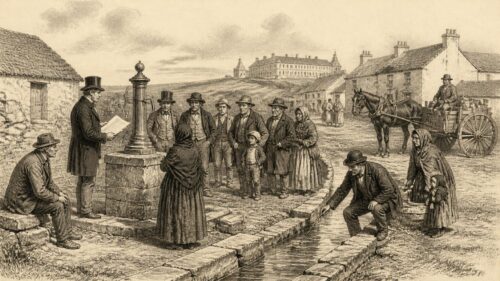
The housing accounts place health at the centre of early reform. One text says that responses to industrialization were driven by slum housing, poor sanitation, and the spread of disease, and that these conditions prompted public health and later social housing actions. Another places a chapter on housing beside a chapter on health and welfare in its contents, a simple but visible sign that the two themes are treated as linked rather than separate fields of study.
The same summary also links housing policy to disease control rather than to building alone. It states that industrialization produced poor sanitation and the spread of disease, and that these pressures led first to public health action and then to social housing action. The evidence here is limited to that sequence as presented in the text; it does not itself describe the agencies, localities, or contested meanings behind those measures.
State Provision
After Independence, the housing summary describes major State-funded house-building programmes. Policy alternated between subsidies for private provision and for public provision, showing that the state did not work through a single model. The same passage says that housing programmes were used to stimulate economic growth and to secure political support through home ownership. Those claims are made in the text itself; the excerpt does not quantify their success or failure.
A broader housing overview reinforces that view of the State as an active provider. It says that the periods before and after the Second World War involved significant State housing provision, and that by the 1980s two-thirds of this housing had been sold to tenants, creating a basis for a housing market. That passage also points to major structural change after the 1960s, without describing those changes in more detail.
Rural Tenure
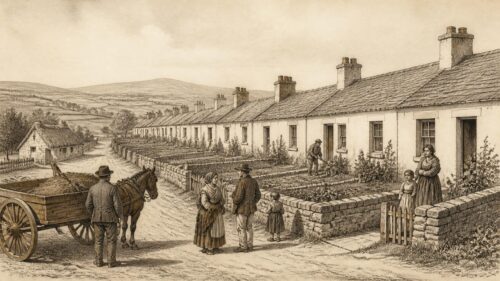
The housing summary also makes rural property central to the story. It says that agrarian campaigning and legislation created a property-owning class among rural tenants, associating housing with land and property. A related housing overview goes further in describing the new peasant proprietors as a foundation for Irish State policy-making. The evidence here is descriptive rather than argumentative: it identifies property ownership as a background condition for housing policy.
That same overview says that freehold titles for small holdings could be registered in a State-guaranteed Land Registry, and that this made property and land ownership central to Irish debate until recent times. It then connects this system to the widening and protecting of home ownership as urbanisation grew. The paragraph stays within that description and does not extend it into claims about broader social consensus or conflict.
Urban Pressure
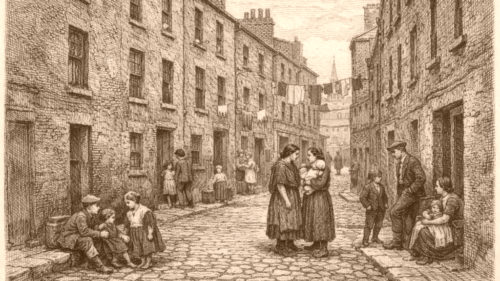
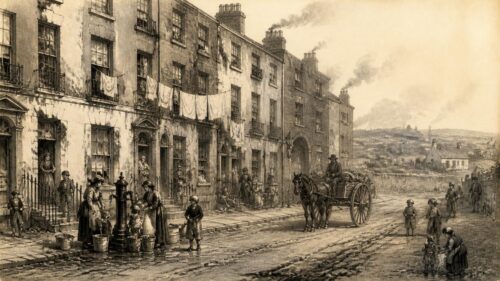
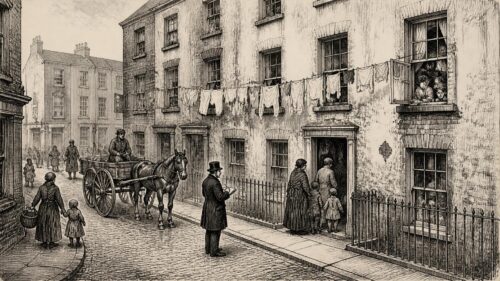
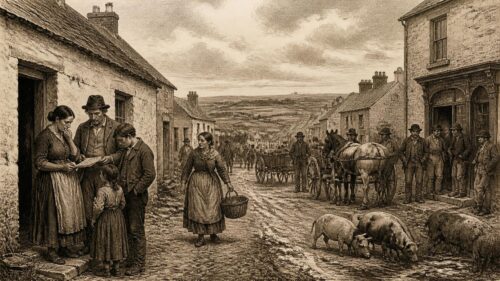
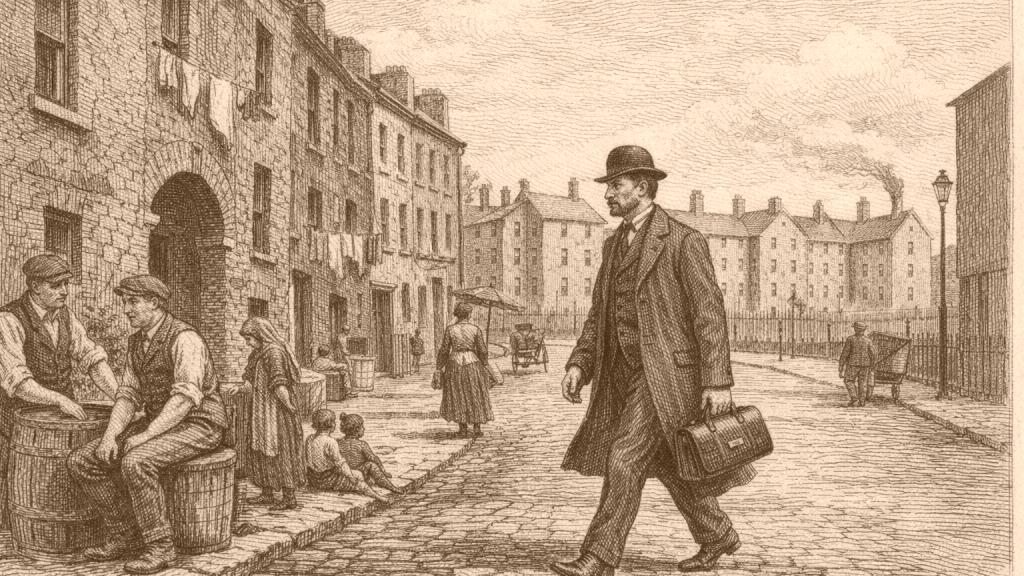
The urban picture in these texts is one of shortage and poor quality. One overview says the new State inherited very poor housing stock, with ten per cent of urban dwellers and thirty-eight per cent of rural dwellers living in third- and fourth-class homes. It also states that half the Dublin population lived in tenements or second- and third-class small houses. Those figures are presented as part of the summary, without further explanation in the excerpt.
The same passage notes a legal framework for sanitation and slum clearance, including British public health and housing legislation. It then says that the Housing of the Working Classes Act 1908 provided a State subsidy for urban housing, but housed only 2.5 per cent of Dublin's population by 1914. The evidence gives a stark contrast between the existence of a legal mechanism and the small scale of its immediate reach.
Market Shift
The later housing summary describes a move toward a housing market. It says that by the 1960s a critical mass of State-built housing had provided a foundation for State promotion of a housing market, with new policy supports for mortgage lending. It then adds that planning, land prices, and community facilities were minimally regulated. The sequence is clear in the excerpt: construction first, market support second, and weak regulation alongside it.
The same text says that this laissez-faire approach led to major price increases in development land and rising house prices for workers migrating to the cities. It also says that these legacies still affect public perceptions of housing policy, with many citizens viewing housing as an asset. The excerpt presents those outcomes as consequences and legacies, but it does not supply comparative data beyond the stated trend.
Welfare Justice
The clearest language of justice appears in the overview of the first Dáil. It says the Democratic Programme did not specifically address housing policy, but affirmed that private property must be subordinated to the public right and welfare, and that no child should suffer hunger or cold for lack of food, clothing, or shelter. That is the strongest direct statement in the texts linking shelter to welfare and justice.
Read together, the passages show three levels of concern: health, provision, and welfare. They describe housing reforms arising from disease and sanitation pressures; they record State building, subsidies, and mortgage support; and they preserve an explicit welfare claim that shelter belongs within public right. The texts do not resolve these themes into a single doctrine, but they do show housing repeatedly framed as more than a market commodity.