
Living Costs
At a Glance
Official Inquiry
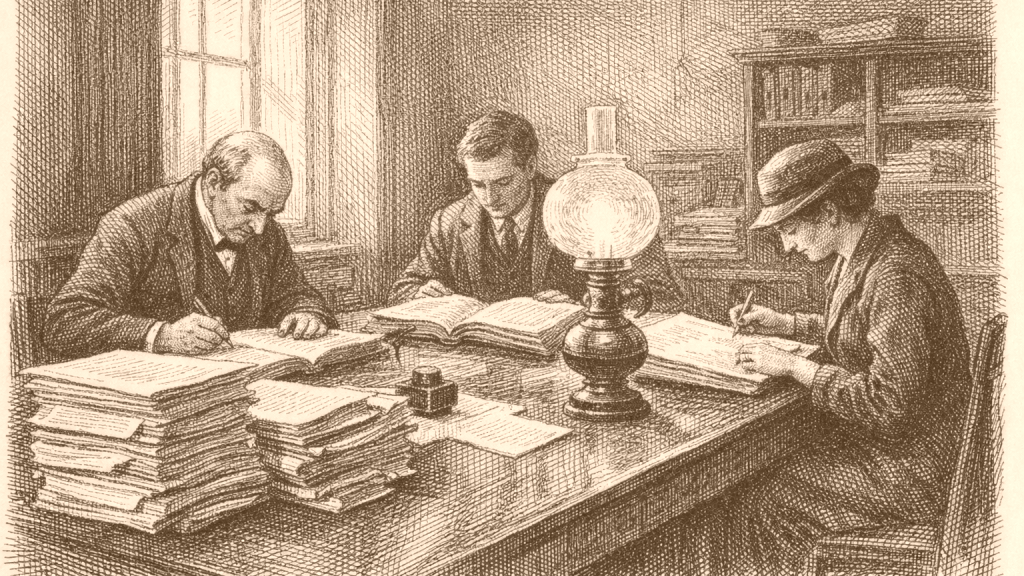
The report was issued by the Ministry of Economic Affairs in Dublin in 1922 and printed by authority of the Stationery Office. Its preface says the Provisional Government had been told it was desirable to calculate an official figure for Ireland showing the change in the cost of living from 1914 to the present. It also says a committee was appointed on 10 June 1922, with representatives from Agriculture, Finance, Economic Affairs, and Labour. The report therefore records a formal state inquiry rather than a private estimate. [1]
The document gives a clear timeline for the work. It says the committee reported on 4 August 1922, while the ministry dated the preface 23 August 1922. The same preface explains that the report was intended to provide a practical official figure, and that the Committee’s detailed explanation of procedure was appended. These statements show the report as a completed administrative exercise with a defined date, authorship, and purpose inside the emerging state’s machinery. [1]
Price Baseline
The committee compared the cost of living in March and June 1922 with July 1914. Its report explains that the measure was meant to show the average increase in the cost of maintaining the same standard of living for a family dependent on wage earnings. The preface repeats that this was the closest practicable approximation. The benchmark was therefore not a general price level for everyone, but a specific comparison centred on wage-earning households and selected months. [1]
The figures given in the report are precise. In the letter reproduced in the text, the committee says that the increase in the cost of living of wage-earning classes in Ireland between July 1914 and June 1922 was 85.2 per cent, and between July 1914 and March 1922 was 91.4 per cent. The report then confirms that these are the main results of the inquiry. It also notes that the work was not exhaustive, even though it presents the final figure as usable. [1]
Family Standard
The wording of the report narrows the inquiry to one kind of household experience. It repeatedly refers to the standard of living for a family dependent on wage earnings, and to the wage-earning classes in Ireland. This language distinguishes the report from a broad survey of all households, since the committee’s target was the maintenance of the same living standard rather than the cost of particular items in isolation. The scope is social in the limited sense defined by the text itself. [1]
The report also states that the inquiry applied to the whole of Ireland. At the same time, it limits the practical comparison to places with 500 or more inhabitants. That combination matters because it shows both breadth and selectivity: the inquiry was national in coverage, yet its stated basis was urban or semi-urban enough to be treated as reasonably dependable for practical purposes. The report does not, in these excerpts, list a fuller rural breakdown. [1]
Collection Method
The report says that the collected information could support several kinds of analysis, but that the committee lacked time to pursue them all. It remarks that many figures were assembled and that a longer period of digestion might have brought out other facts, though not a different final result for the Irish cost of living figure. This is an explicit statement of methodological restraint. The report preserves the chosen result while marking other possible uses of the data as unfinished. [1]
The document also indicates a future routine for the same basis of calculation. It proposes that a cost of living figure be calculated at three-month intervals, with September named as the next month for determination. Another passage says the collected information had incidentally revealed relations between wholesale and retail prices of several important commodities, and between prices in similar localities, which required explanation. The report therefore links routine measurement with unresolved questions about price relations. [1]
Working Conditions
The committee’s account says that work was delayed because a considerable proportion of staff could not reach the offices during the recent troubles in Dublin. That passage is important because it gives the report’s own explanation for the timing of completion. The committee had been asked to finish by mid-July if possible, but was given until 25 July. The delay is thus recorded as an administrative difficulty within the report itself, not as later interpretation. [1]
The same account shows that the committee communicated provisional results before the final report was drafted. On 26 July it wrote to the head of government that the main lines had been agreed and that the investigation showed the percentage increase in the cost of living. This suggests a staged process of reporting, with preliminary notice followed by the final document in August. The evidence here is limited to the report’s own narration of its work and timing. [1]
Archival Context
The report belongs to a wider documentary landscape preserved in Irish public repositories. The National Archives of Ireland describes itself as the official repository of State records and explains that it holds government records, including those more than thirty years old. It also says that its collections include records from the early years of the Irish State. These statements support the report’s character as part of the surviving documentary record of government administration. [4]
University College Cork’s collections pages also show how such material is situated within research resources. One page lists the Annals of the Four Masters among Irish texts, while another lists source material for Irish economic history and includes government and statistical documents. Although these pages do not identify the 1922 report by name in the excerpted lines, they indicate the institutional settings in which Irish historical sources and economic records are catalogued for research use. [2] [3]
Source References
Hover over a number to see the source. Select it to open the source.

How did the Irish government’s June 1922 cost of living report define its benchmark, scope, and stated limits in relation to wage-earning households?