
Annal Reunion
At a Glance
Entry Context
The passage belongs to the Annals of Ulster and is dated to 1510. Its opening places the notice in a numbered year entry and immediately introduces Gerald, Earl of Kildare, as leading a host into Munster, where he builds a castle in Carraic-Cital. The entry is not isolated: it sits within a larger annal text that the CELT edition describes as extending from 1379 to 1588, with manuscript witnesses in Trinity College Dublin and the Bodleian Library. [2] [3]
The year heading and the prose that follows are plainly sequential. After the opening dating formula, the account moves from Munster to Meath and then back toward Munster. The same paragraph later shifts to another scene at Limerick, so the reunion notice appears as part of a continuous movement sequence rather than as a separate isolated remark. The editorial notes also show that the online text preserves an extended annalistic framework, not a short excerpt. [2] [3]
Named Forces
The entry repeatedly names groups rather than leaving them generic. Besides Gerald, Earl of Kildare, it names Ua Domnaill, James son of the Earl of Desmond, the Foreigners of Munster, and Mag Carthaigh the Swarthy, identified as Domnall son of Diarmait son of Finghin and Cormac junior son of Cormac son of Tadhg. It also distinguishes the Foreigners and Gaidhil of Meath and Leinster, and later refers to Toirdelbach son of Tadhg O Briain. [3]
The naming pattern is dense and cumulative. Some people are given office or kinship, some are identified by territory, and some appear through a mix of both. The passage also distinguishes a small force from the larger host, and this contrast is explicit when Ua Domnaill follows with a small force. No explanation is offered for why these names are grouped together beyond their place in the sequence of actions. [3]
Military Movement
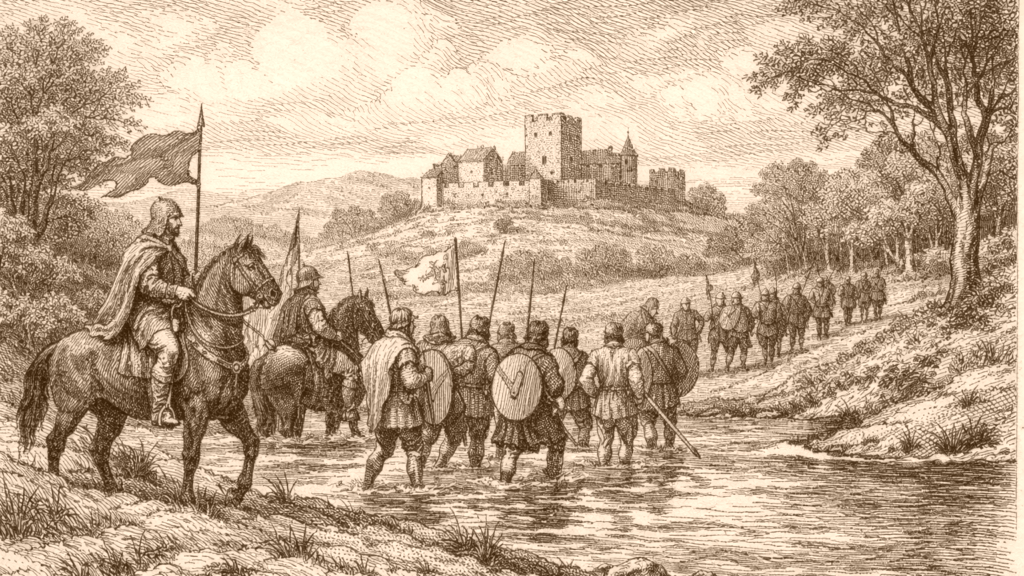
The narrative advances by verbs of motion and occupation. Gerald leads a host into Munster and builds a castle; Ua Domnaill follows through Meath, then into Munster, and the two forces proceed together into Ella. They take the castle of Cenn-tuirc, harry the country, and continue into great Desmond, where they take the castle of the Pailis and the castles along the Maing in their entirety before going safe back into county Limerick. [3]
The passage then turns from capture to regrouping. After the return to Limerick, the text says the host is made into a reunion. That wording stands between the account of the march and the description of who assembles on each side. The sequence suggests a formal joining or reassembling of forces, but the text itself does not explain the reason or outcome beyond the act of reunion. [3]
Return Passage
The reunion notice is followed by a list of those who assemble. The Geraldines of Munster gather under James, son of the Earl of Desmond, while the Foreigners of Munster gather beside them. Mag Carthaigh the Swarthy is included in the same movement, and the Foreigners and Gaidhil of Meath and Leinster are also named as moving together. All of this ends with the statement that they go to Limerick. [3]
A second movement then appears in the opposite direction. Toirdelbach son of Tadhg O Briain, king of Thomond, with Mac Conmara, the Sil-Aodha, and Clann-Ricaird muster against them. The Earl and his host move by named routes, reach a wooden bridge across the Shannon, and break it. Afterward the Earl and O Briain camp on opposite sides, close enough that each half can hear the other’s conversation and story-telling. [3]
Clash Detail
The text then describes how the Earl arranges his host, placing the Foreigners and Gaidhil of Munster in front and the Foreigners of Meath and Ath-cliath to the rear. Ua Domnaill dismounts and remains on the rear among the Foreigners. The host then takes the shortest way to Limerick, and the Sil-Briain attack the Foreigners. This portion is a sequence of placement, movement, and attack rather than a separate battle report. [3]
The final lines of the passage give a limited outcome. The host of the Foreigners departs in defeat, while the Sil-Briain return with many chattels. The text singles out Ua Domnaill’s rear-guard service as the action of greatest fame that day for either side. This judgment is confined to the entry itself and does not explain wider consequences beyond that local praise. [3]
Textual Frame
The same year entry continues with brief notices that are separate from the host narrative. Mac-an-baird of Tir-Conaill, O Fialain, and Eogan son of Brian O Uiginn all die in 1510. Ua Domnall, Aodh son of Aodh the Red, then goes on pilgrimage to Rome. These notices are adjacent in the same year, but the text itself gives no explicit link between them and the reunion passage. [3]
The edition notes help situate the annal as a written text with manuscript witnesses and lacunae, yet they do not alter the wording of the passage itself. The Ulster edition states that later parts of the annals rely on Mac Carthy’s edition, while the Tigernach edition lists its own manuscript fragments, separate from the Ulster material. That comparison shows two annal texts presented through distinct editorial frames, both preserved as historical records. [1] [2]
Source References
Hover over a number to see the source. Select it to open the source.

How is the 1510 Annals of Ulster entry that uses the term reunion structured around named groups, movements, and adjacent notices?