
Housing Services
At a Glance
Land Tenure
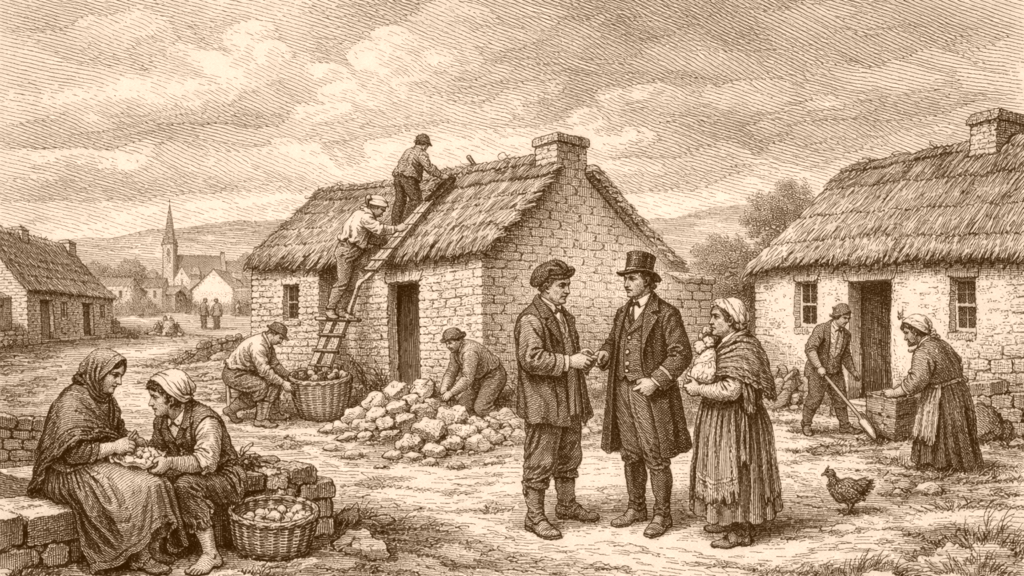
The earliest passage in this set places housing within the land question rather than within a modern welfare system. It describes long conflict between landlord and tenant in Ireland and says that farmers could not settle to steady work. It then sketches an early attempt at reform through a Tenant Right Bill, followed by the Devon Commission, whose recommendations were not enacted. In this account, the tenant remained exposed to the landlord’s power, and later legislation sought to change that arrangement. [4]
The same passage presents the 1860 Act as an attempt to end customary tenures and to place landlord and tenant relations on contract alone, though it says this proved unjust and unworkable. It then moves to the later Land Act, which adopted the Ulster custom, gave tenants a financial interest in improvements, and offered compensation for disturbance to smaller tenants. The evidence is narrow, but it clearly shows a shift from customary protection toward statutory regulation. [4]
State Credit
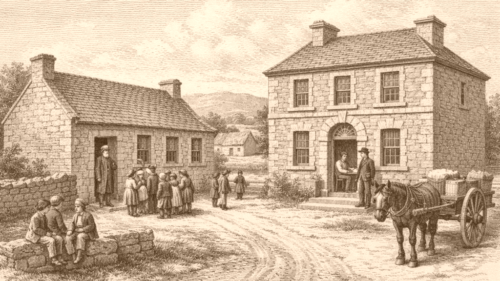
A later Unionist account describes land reform in more concrete financial terms. It says the system of dual ownership was thought to require the use of state credit on a large scale. The plan it outlines involved the state purchasing the landlord’s interest and vesting ownership in the occupying tenant for a fixed term of annual payments. Those payments were presented as interest plus a sinking fund, not as rent, and the occupier became owner subject to a continuing state obligation. [1]
This account also says that the practical working of the scheme depended on the credit of the state and its ability to borrow cheaply. It contrasts the Imperial Government’s borrowing power with that of any possible Home Rule government, and argues that the reform might otherwise have required confiscation. Whatever one thinks of that political framing, the passage itself shows housing and land purchase being tied to public finance, rather than left to private agreement alone. [1]
Rural Development
A related Unionist text broadens the discussion from tenure to rural development. It presents the maintenance of the legislative Union as being defended in Ireland’s interests, and it says the country’s ills were economic and social rather than political. It then states that Unionists believed those conditions could be handled more effectively under the existing constitution than under Home Rule. The passage is explicit about its own viewpoint, and the evidence here is that housing policy sat beside wider claims about rural improvement and state resources. [1]
That text also gives a compact summary of what it calls a bird’s-eye view of policy in relation to rural development during 1885 to 1905. It identifies land purchase and the abolition of dual ownership as one of two pillars of the constructive policy it describes. The second pillar is not developed in the excerpt provided, so the safest reading is that housing and land were treated as part of a broader package of rural reform, not as a single isolated measure. [1]
Famine Conditions
Another voice in the record links housing and livelihood through the pressures of famine. It says the outbreak beginning in 1845 and intensifying until 1849 brought class antagonism in Ireland to a head. In the same discussion, the staple food of the peasantry is the potato, while other produce and cattle were sold to pay rent. The extract does not speak directly of housing construction, but it does show how rent, property, and survival were bound together in rural life. [3]
The same chapter presents the famine as sharpening older disputes over property, while rejecting the idea that later political split can be reduced to a simple theoretical quarrel about force. For a housing history, the more modest point is that private property and public conduct were already being discussed together. The passage does not offer a policy blueprint, but it does expose the social setting in which later land purchase and tenancy reform took shape. [3]
Modern Partnerships
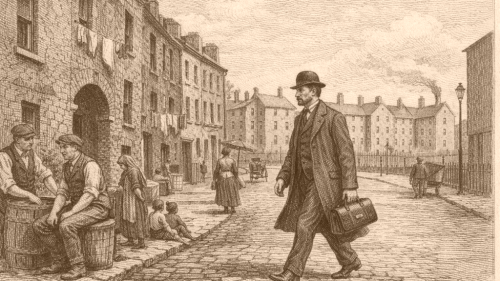
By the early twenty-first century, the language of the record has changed from tenancy and land courts to governance and partnership. A 2011 scoping paper on Northern Ireland says partnerships between government and third-sector organisations, and among third-sector bodies, are well established in many states. It adds that tighter public finances required such structures to find new ways of operating so they could protect frontline services while budgets were reduced. The subject is housing support, but the frame is public-service delivery. [2]
The paper then narrows to two elements of social housing provision in Northern Ireland: housing support services funded through the Supporting People programme, and the procurement of new social housing developments. It says both include collaborative and contractual arrangements involving the public, private, and voluntary or third sectors. It also places these arrangements after the return of functioning devolution in May 2007 and connects them with housing and social care powers held by the Assembly and Executive. [2]
Comparative Change
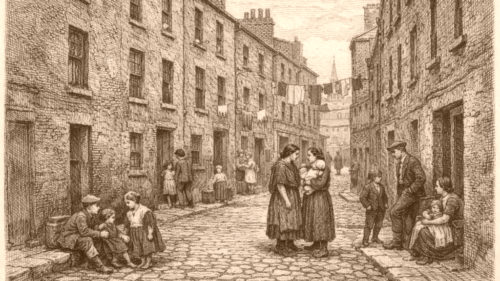
Read together, these passages show a long movement in the treatment of housing-related problems. Nineteenth-century texts focus on tenants, landlords, rents, improvement, and state-backed purchase. The modern Northern Ireland paper focuses on services, procurement, budgets, and partnerships. The comparison should not be stretched beyond the evidence: one set speaks chiefly about land and ownership, the other about social housing administration. Even so, both place housing within structures of public authority rather than treating it as a purely private matter. [1] [2] [4]
The documentary record here is also uneven. The older passages say little about service delivery in the modern sense, while the newer paper says nothing about nineteenth-century tenant struggles. That omission matters, because the evidence permits comparison but not a continuous institutional history. What it does permit is a careful narrative of changing administrative language: from rent, tenure, and purchase to funding streams, procurement, and collaborative governance in social housing and related public services. [1] [2] [4]
Source References
Hover over a number to see the source. Select it to open the source.


How did housing provision and related public services in Ireland and Northern Ireland move between land reform, tenant ownership, and partnership-based social housing governance?