
Boer Private
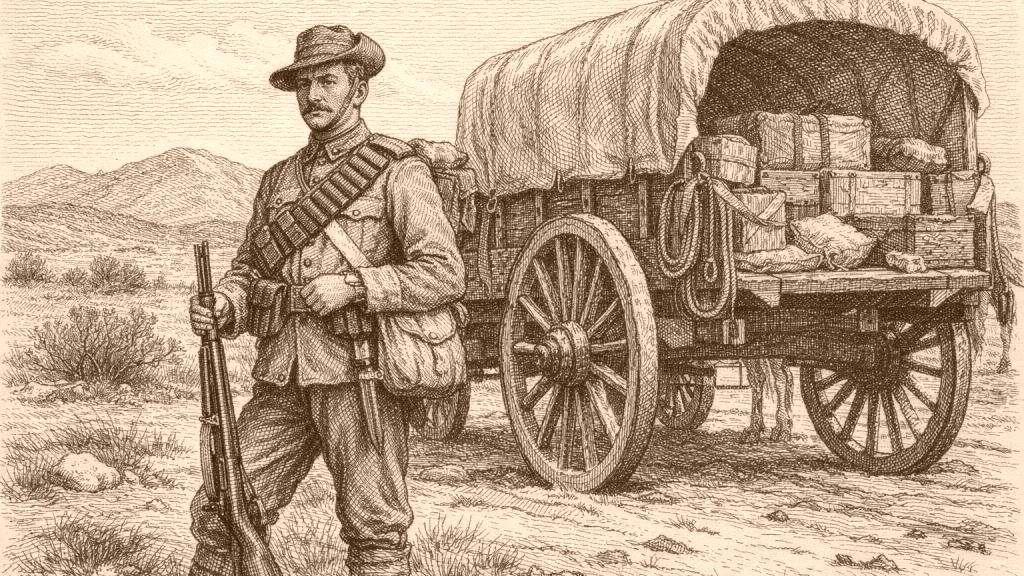
At a Glance
War Records
The National Archives describes the South African War of 1899 to 1902, also called the Second Boer War, as the main focus of its overview, while noting that some guidance can also be applied to the First Boer War of 1880 to 1881. It identifies the Boer War records as central-government holdings and states that they include material from all branches of the military. The guide presents the war as an archival search field rather than a single record set. [3]
The same guide explains that the records are arranged by the government department that created them, with the War Office, Colonial Office, and Dominions Office singled out as especially important for Boer War research. It also says that many other departments may have transferred related records. This arrangement means that a search for one soldier may have to move across several departmental series rather than remain within a single office or archive box. [3]
Search Terms
The Boer War guide says that a researcher should begin by using keywords and dates in the online catalogue, where short descriptions and document references are provided. It adds that the terms South African War, Boer War, and Anglo-Boer War all appear in the catalogue, and that different search terms return different results. That detail shows a practical limitation of searching: the wording chosen can affect what is found, even before consulting the records themselves. [3]
The guide also notes that some records are available online through the National Archives website or through licensed partners such as Ancestry and Findmypast, while other records must be consulted in Kew or ordered as copies. This means the research path is mixed: some material can be searched digitally, but other items remain tied to the archive building or to ordered reproductions. [3]
Army Service
The guide to British Army soldiers up to 1913 says that it covers soldiers discharged before the First World War and includes the rank of private among the non-commissioned ranks. It states that self-contained service records, such as those created and retained for the First World War, do not exist for this earlier period. Instead, service must usually be pieced together from the records that survive. The guide therefore frames army research as reconstructive work. [1]
Among the record types named are regimental muster books and pay lists, discharge papers, and pension records. The guide also says attestation records survive only in relatively small numbers and often among the papers of men discharged to pensions. For a private soldier, then, the surviving trail may be narrow or uneven, and in some cases muster rolls and pay lists may be all that remain. [1]
Boer Connections
The Boer War guide points researchers toward British Army personnel who fought in South Africa and separately toward the Imperial Yeomanry and African forces. It also notes that Royal Navy and Merchant Navy personnel fought on land, even though no naval engagements were fought at sea. The guide’s scope is therefore broader than infantry alone, but the presence of a private soldier remains one identifiable strand within that wider military record field. [3]
The same guide mentions medal rolls for the Queen’s and King’s South Africa medals and says these can be downloaded from Discovery or searched by name on Ancestry. It adds that the merchant navy did not keep records of individual seamen at this time. That contrast makes the military records more visible for some categories of serviceman than for others, while still leaving the basic problem of identifying one man among many with the same name. [3]
Irish Context
The Irish ancestors guide says that records for people from Ireland held at The National Archives are historical records of the UK central government, not internal Irish administrative records. It also notes that Irish research may require consulting the National Archives of Ireland or the Public Record Office of Northern Ireland. For a private soldier with Irish connections, that separation of repositories matters because no single archive holds every relevant class of record. [2]
The same guide warns that record titles, descriptions, and the documents themselves may use outdated or offensive language, and that Irish names may appear in anglicised forms. It also explains that records are arranged by creator, record type, and date, with no case file containing all information about one person. These observations support a cautious reading of names and identities in military research without filling in details that the records do not provide. [2]
Reading Limits
Taken together, the archival guides show a research environment defined by scattered record series, multiple search terms, and uneven survival. They do not provide a single, complete biography of any one private soldier. Instead, they indicate where evidence may lie: in catalogue entries, departmental groupings, medals, muster rolls, pay lists, discharge papers, or pension files. The record trail is real, but it is partial and distributed across several systems. [1] [2] [3]
The guides also make clear what cannot be assumed from the excerpts alone. They name record types and search procedures, but they do not identify a particular soldier, a specific battle, or a personal career. Any historical account of a Boer War private therefore has to stay within what the surviving records can directly show, while leaving open the possibility that further detail may emerge only from additional archival searching. [1] [2] [3]
Source References
Hover over a number to see the source. Select it to open the source.

How do archival guides describe the records available for researching an individual British soldier associated with the Second Boer War?