
Irish Technology
At a Glance
Early Collections
The earliest institutional frame in these records begins with the Royal Dublin Society, founded in 1731 to encourage husbandry, manufactures, and other useful arts. Its collecting first included modern agricultural and industrial machinery. Later accounts add classical archaeology, plaster casts, geological minerals, and other material used for teaching. The picture is of a mixed collection, practical and learned at once, rather than a single, narrow category of technology. [3] [6]
A later museum history says that, before the National Museum of Ireland was established in 1877, the core of its collections came from the Royal Dublin Society, the Royal Irish Academy, and the Museum of Irish Industry. The same account says the Science and Art Museum brought those collections together and expanded them through loans, purchases, and donations. Technology here appears as part of a wider institutional gathering of objects, not as an isolated field. [6] [1]
Industrial Education
The Museum of Irish Industry was established in 1845 as the Museum of Economic Geology, then quickly redirected by Sir Robert Kane toward the Museum of Irish Industry and Government School of Science. Its stated purpose included industrial education, the use of Ireland’s natural resources, and an improved standard of living. The museum also had lectures and exhibitions. These descriptions present the institution as a place where science, education, and practical improvement were deliberately linked. [4]
The same account says opposition followed this approach and that the museum was abolished about 1865, with its collections transferred to the Royal Dublin Society. Another museum page says the Dublin Science and Art Museum Act of 1877 created a new public museum that absorbed earlier institutional collections. The evidence here is limited to institutional sequence and transfer, not to broader political motives or social consequences. [4] [1]
Museum Industry
The museum pages describe acquisition as central to the new institution after 1877. Officials, advised by South Kensington Museum, began to collect from private collections, international makers, and local firms. The examples named include Tiffany, William de Morgan, Vodrey, Pugh, and Belleek. The same page also says the museum collected objects illustrating industrial and economic development in Ireland, especially from the seventeenth century. Its policy combined foreign and Irish material within one display agenda. [1] [6]
The source also states that the collections expanded so greatly that, when the Kildare Street premises opened in 1890, some material remained on exhibition in Leinster House because of space constraints. This is a direct comparison between growth and available display space. It does not explain why particular objects were chosen, but it does show that the museum’s technological and industrial holdings were large enough to exceed the new premises. [1]
Instruments Watches
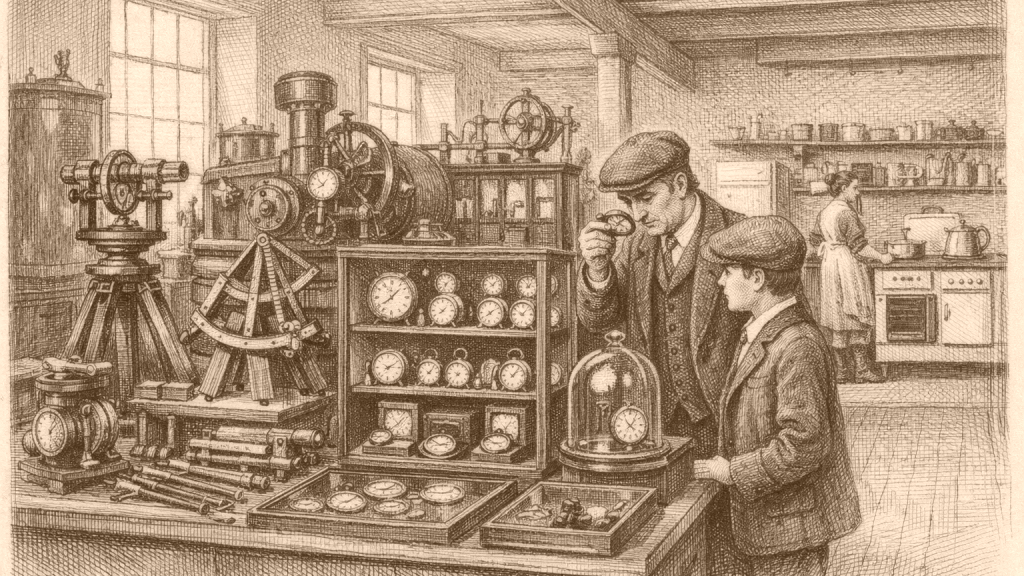
The scientific instruments page says the earliest surviving scientific instruments in Ireland date to the seventeenth century and that brass, replacing wood, improved survival. It also notes that instrument making developed particularly in Dublin. Named early makers include Gabriel Stokes, Thomas Cave, and Alexander Stephens. This is a specific record of material change and local craftsmanship, with emphasis on what survives and where production was concentrated. [2]
The same source says most surviving instruments date to the late eighteenth and early nineteenth centuries, with makers such as Seward, Spear, Mason, and Yeates. It lists surveyors’ compasses, octants, sextants, microscopes, telescopes, and mathematical instruments as examples produced in increasing numbers as navigation, astronomy, and the sciences developed. Later, Irish makers found it harder to compete with British mass production, though the Dublin firm of Grubb remained internationally renowned. [2]
The watch-making record is briefer but parallel. The page says watches were produced in Irish cities and towns, especially in Ulster, during the eighteenth century. By the mid-nineteenth century, however, watch makers could not compete with foreign mass production, and the craft did not survive the end of the century. The comparison here is between an earlier spread of production and a later contraction, as recorded by the museum summary. [2]
Rural Electrification
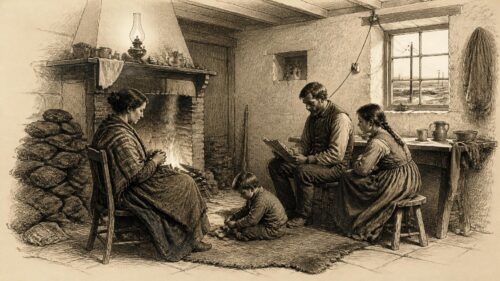
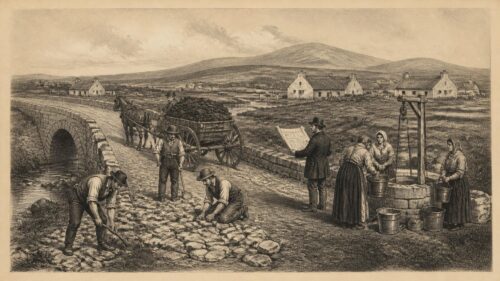
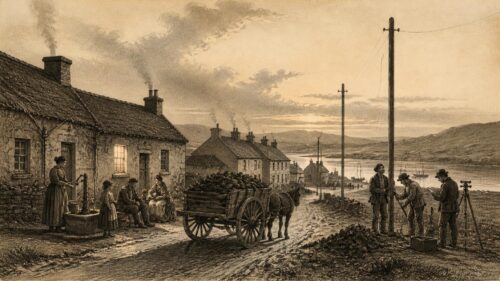
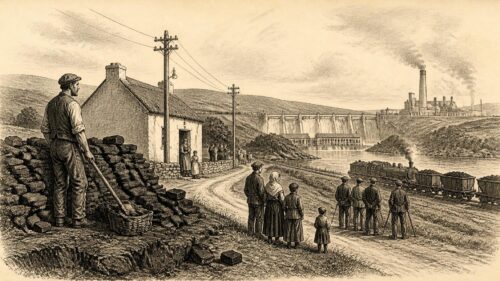
The Kitchen Power page shifts the story from manufacture to use. It says that in the 1940s and early 1950s Ireland was still largely powered by manual labour, draft animals, turf, wood, and coal, because electricity was rarely available outside towns and cities. Rural electrification changed daily life and work, and the Electricity Supply Board began the process in 1946. The project continued until 1965, with some rural areas not receiving electricity until the 1970s. [5]
The same source links electrification to domestic change in the kitchen. It says appliances were installed across the State, that the rural kitchen moved slowly from the traditional hearth to the fitted kitchen of the 1970s, and that the ESB and the Irish Countrywomen’s Association worked locally to improve women’s daily lives. Advertisements and demonstrations promised modernity while leaving existing gender roles intact. This is presented as a contemporaneous framing within the museum account. [5]
Institutional Memory
Taken together, the museum records present technology through institutions, collections, makers, and domestic use. The Royal Dublin Society gathered machinery and other useful objects; the Museum of Irish Industry linked science with industrial education; the later museum absorbed earlier collections; and the scientific instruments page identifies makers, tools, and periods of survival. The evidence is uneven in detail, but it consistently places technology inside collections that were also educational and classificatory. [3] [4] [6] [2] [5]
The same record also shows a shift in emphasis over time. Early passages highlight collecting for husbandry and manufactures, later ones stress industrial education, and the twentieth-century page on electrification focuses on domestic life and the kitchen. None of these pages provides a single continuous narrative of Irish technology, but together they preserve direct descriptions of changing objects and changing settings. What is absent from the excerpts is any detailed account of individual inventors beyond the named makers. [3] [4] [5] [2]
Source References
Hover over a number to see the source. Select it to open the source.

- [1] 1877-1899: The Science and Art Museum, Dublin | National Museum of Ireland
- [2] What's In Store: Scientific Instruments and Watches | National Museum of Ireland
- [3] From 1731: The Royal Dublin Society | National Museum of Ireland
- [4] 1845-1865: The Museum of Irish Industry | National Museum of Ireland
- [5] Kitchen Power Online | National Museum of Ireland
- [6] About Collections & Research at the NMI | National Museum of Ireland
How did Irish museum and documentary collections present technology as a changing field from early industrial collecting to rural electrification?