
Customs Records
At a Glance
Travel Customs
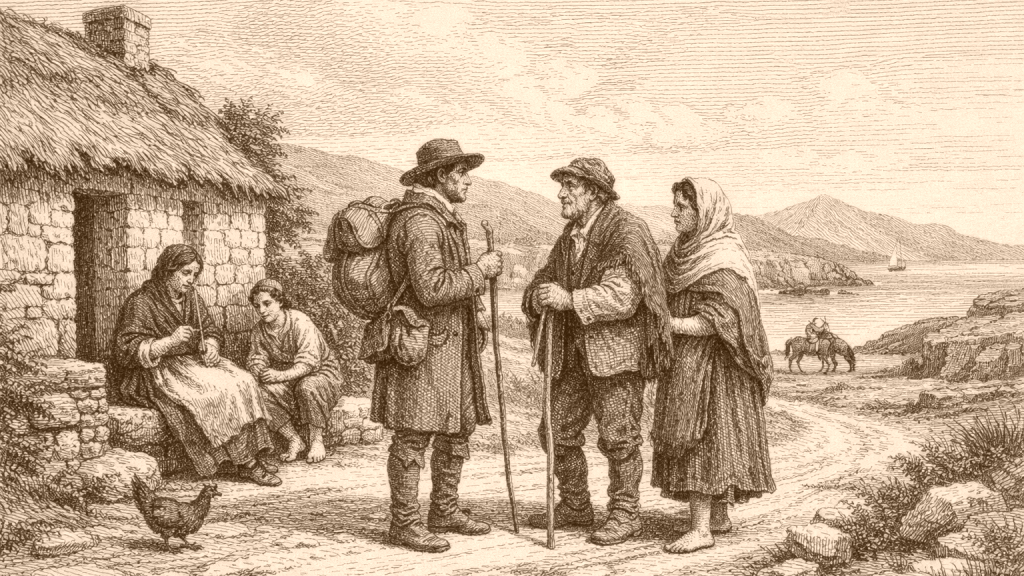
The travel collection presents customs as one recurring subject within a broader set of travel concerns. Its introductory note says that international visitors wrote about geography, life, local customs, and contemporary politics, and that this tradition reaches back to the medieval period. The same page points to individual accounts, including a 1517 French record of an accidental royal visit to Kinsale that is said to shed light on Irish costume and dress. On this evidence, customs appear as something observed in travel writing rather than as a separate standalone genre. [1]
The page also groups later travel accounts that explicitly touch on customs or social life. It mentions a French civilian traveller in 1644, Gerard Boate's Natural History of Ireland, and descriptions from 1668 and 1669. Another entry concerns the 1625 account by an Icelandic sailor about his stay in Youghal. The excerpt does not narrate the customs themselves in detail, but it does show a continuing interest in people, place, and lived practice across several centuries. [1]
Genealogical Customs
The Hy-Fiachrach text places customs within a genealogical and territorial framework. Its title names genealogies, tribes, and customs, while the opening note explains that a large genealogical table traces the principal families of the Hy-Fiachrach race in order of seniority. The editor says this was done from genealogical manuscripts, Irish annals, English-Irish records, and family documents. In this excerpt, customs are not separately defined; they appear as part of a learned compilation tied to descent, family order, and editorial method. [2]
The same text links kinship to narrative episodes involving succession, marriage, and conflict. It identifies Fiachra as ancestor of the Hy-Fiachrach tribes and says the O'Dowds, O'Heynes, and O'Shaughnessys were later the most distinguished families. It then recounts the rivalry among Mongfinn's sons and the battle in which Fiachra was defeated and captured. These passages do not describe customs directly, but they show how such a compilation joins genealogy, territory, and remembered action in one textual frame. [2]
Editorial Lists
CELT's list of Irish texts places several works with customs in prominent editorial series. It names The Tribes and Customs of Hy-Many, The Genealogies, Tribes, and Customs of Hy-Fiachrach, and The Tribes and Territory of Ancient Ossory, while also listing annalistic and historical collections. The evidence here is bibliographic, but the repeated pairing of tribes, territory, and customs shows how the catalogue organizes texts that connect social identity with place. [4] [3]
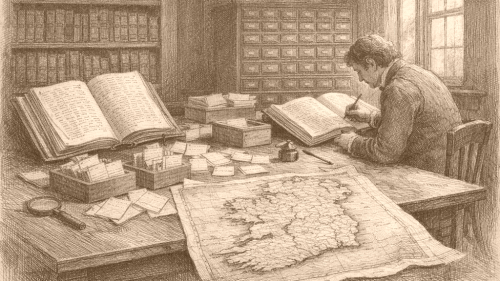
The separate John O'Donovan page presents those works as edited and translated publications rather than isolated manuscripts. It lists the Four Masters, The Circuit of Ireland, The Tribes and Customs of Hy-Many, The Genealogies, Tribes, and Customs of Hy-Fiachrach, and related titles. The chronology then gives publication dates and notes that the Hy-Fiachrach volume came from a manuscript of Duald MacFirbis and was accompanied by a map. This remains a catalogue of editions, not a direct narrative of customs. [5] [3]
Odonovan Work
The O'Donovan bibliography confirms that his work on customs formed part of a wider editorial career. It lists The Banquet of Dun na nGedh and the Battle of Magh Rath, The Tribes and Customs of Hy-Many, and The Genealogies, Tribes and Customs of Hy-Fiachrach among his editions and translations. It also shows his involvement with family names, charters, and annals. The evidence therefore supports a picture of customs as one recurring component within a larger body of historical editing. [3] [5]
The chronology on his page adds dated milestones that help place those editions in sequence. It says he was appointed to the Irish Record Office in 1826, worked on the Ordnance Survey in 1829, and published the Hy-Many text in 1843 and the Hy-Fiachrach text in 1844. It also notes that from 1848 to 1851 he transcribed, translated, and edited the six volumes of the Annals of the Four Masters. These are editorial facts, not direct descriptions of customs. [5]
Comparative Reading
Across these excerpts, customs appear in two distinct ways. Travel writing presents customs as observed features of Irish life, dress, and local practice, while the genealogical and territorial texts place customs inside learned compilations about families and districts. The catalogues then turn both kinds of works into items within editorial series. This comparison is limited to what the pages explicitly show: titles, descriptive notes, and bibliographic framing. One travel page describes international visitors commenting on “life, local customs and contemporary politics,” and notes that one account “sheds much light on Irish costume and dress” [1]. Another page lists “The Tribes and Customs of Hy-Many” and “The Genealogies, Tribes, and Customs of Hy-Fiachrach” among O’Donovan’s editions [5]. [1] [5] [3] [4]
The passages also differ in their level of detail. The travel page mentions customs, costume, and dress, but usually only in summary notes about specific accounts. The Hy-Fiachrach text gives a long genealogical narrative, yet customs remain embedded in its title and editorial description rather than isolated in a separate section. The surviving excerpts therefore allow careful comparison of emphasis, but not a full reconstruction of the contents of every text named. [1] [2] [5]
Source References
Hover over a number to see the source. Select it to open the source.

How do the CELT texts and O’Donovan editions represent Irish customs, and what kinds of evidence about customs are directly visible in these excerpts?