
Ireland at Davos
At a Glance
Irish Delegation
In January 2026, Peter Burke travelled to Davos to attend the annual meeting of the World Economic Forum. The government announcement says he was to represent Ireland there, and that his visit would include engagement with chief executives of multinational companies already operating in Ireland, as well as meetings with potential future foreign direct investment companies and international leaders. The text presents Davos as a site for Irish government representation rather than a ceremonial stop. [5]
The same announcement adds that Burke would lead Ireland’s IDA engagement while in Davos. It also states that he intended to emphasise Ireland’s economic performance, describing the country as still growing and attractive for foreign direct investment. This is direct evidence of the way the visit was framed: not as a private journey, but as part of an official programme built around investment promotion and meetings with political and business figures. [5]
Forum Origins
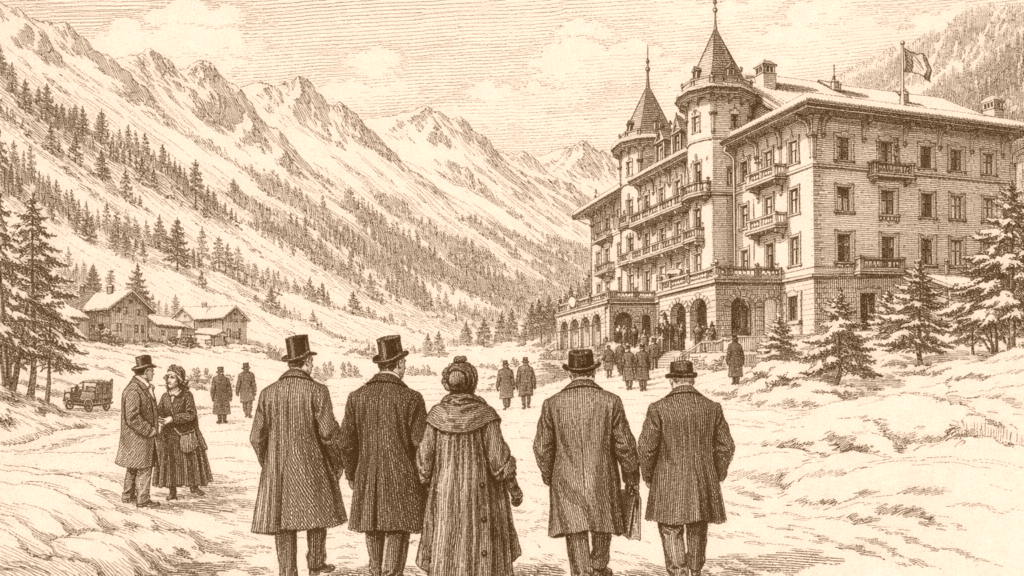
The forum’s Davos setting has a longer history than the 2026 Irish visit. A historical account notes that when world leaders converge there for the World Economic Forum, it marks the anniversary of a meeting first organised by German economist Klaus Schwab. He was then a professor at the University of Geneva and invited business leaders from across Europe to discuss competition in a global marketplace, especially against American firms. The forum’s early name was the European Management Symposium. [3]
The same account explains that Schwab chose Davos itself, despite the organising group being based in Chur. Davos was already known as a skiing resort, and the article stresses that the choice was not only about scenery. The passage provides a clear comparison between the administrative base in Chur and the meeting place in Davos, showing that the Swiss town was selected deliberately for the gathering. [3]
Cultural Frame
A further reason given for Davos’s appeal is cultural, not economic. The same article points to Thomas Mann’s The Magic Mountain as part of the setting’s significance. In that novel, a young man goes to Davos for a short stay and remains there for years, turning the resort into a literary place associated with isolation, convalescence and unusual concentration. The account uses that novel to explain why the location seemed fitting for an international gathering. [3]
The article also reproduces a contemporary review describing the sanatorium as a high and chilly retreat where the perspective of life changes. That review treats the mountain setting as a place where human ambitions seem small and where distractions from catastrophe become visible. These remarks are not about Ireland specifically, but they help explain why Davos acquired a reputation beyond a normal conference venue. [3]
Forum Growth
The Davos meeting later changed its scale and name. The same source states that the conference was retitled the World Economic Forum in 1987 when its scope expanded beyond the original title. This is a straightforward chronological marker in the history of the organisation, showing that the forum with which Ireland engaged in 2026 grew out of an earlier and narrower European meeting. [3]
That growth is illustrated with examples of later meetings. The account notes that the forum quickly produced high-profile outcomes, including diplomatic discussions between Greece and Turkey in 1988 and a 1992 meeting between F. W. de Klerk and Nelson Mandela. These examples show the forum’s later role as a venue for international political contact, though they do not themselves mention Ireland. [3]
Irish Records
For Irish historical research, the National Library of Ireland identifies a range of digital resources that include newspaper titles, reference works, government publications, digitised books, manuscripts and maps. Its eResources page also notes that some subscription sites are made available in reading rooms to registered readers. These holdings would be relevant to anyone tracing later Irish reporting on Davos, although the page itself does not name Davos or the World Economic Forum. [1] [2]
The same library pages list Irish newspaper archives and official publications among their research tools, including access to hundreds of Irish newspaper titles and serials and to official publications from Irish, British and international sources. Those catalogues do not establish any specific Irish-Davos episode, but they do show where documentary trails about Irish government travel or public reporting could be pursued in a research setting. [1] [2]
Current Context
The contemporary Davos environment is also visible in reporting from 2024, which describes the resort as a place where tensions over antisemitism were being confronted. That article refers to students attending Talmudic school in Davos and to a sign seen in a winter sports shop, showing that the town remains a lived place rather than only a conference venue. The evidence here is limited to that reporting, not to a broader social history. [4]
Read beside the 2026 Irish government notice, this shows two kinds of Davos presence: official conference diplomacy and everyday local life. The Irish announcement emphasises meetings, investment and multilateral discussion; the 2024 report emphasises residents, students and public concerns in the town itself. Taken together, the passages show Davos as both an international forum and a place with its own continuing social realities. [4] [5]
Source References
Hover over a number to see the source. Select it to open the source.

How has Ireland’s official presence at Davos been described in recent government reporting, and how does that presence relate to the forum’s longer history in the Swiss resort?