Red Hugh
Red Hugh O’Donnell, also known in Irish as Aodh Ruadh Ó Domhnaill, was an Irish clan chief and a leader of the confederacy of Irish lords during the Nine Years’ War. The surviving account identifies him as Hugh Roe O’Donnell II and gives his life dates as c. 20 October 1572 to 30 August 1602. He was born into the powerful O’Donnell clan of Tyrconnell, the Gaelic Irish noble dynasty based in the area now associated with County Donegal. O’Donnell was the eldest son of Hugh McManus O’Donnell and his second wife, Fiona “Iníon Dubh” MacDonald.
Dateline
Red Hugh O’Donnell, also known in Irish as Aodh Ruadh Ó Domhnaill, was an Irish clan chief and a leader of the confederacy of Irish lords during the Nine Years’ War. The surviving account identifies him as Hugh Roe O’Donnell II and gives his life dates as c. 20 October 1572 to 30 August 1602. He was born into the powerful O’Donnell clan of Tyrconnell, the Gaelic Irish noble dynasty based in the area now associated with County Donegal.
Clan Birth
O’Donnell was the eldest son of Hugh McManus O’Donnell and his second wife, Fiona “Iníon Dubh” MacDonald. His family belonged to the ruling branch of the O’Donnell line, and the account places his upbringing within a household tied closely to Gaelic lordship. The same source notes that by the age of fourteen he was recognised as his clan’s tanist, or heir. It also states that he was engaged to the daughter of Hugh O’Neill, Earl of Tyrone, forming an alliance between two prominent Ulster lordships.
The account further says that his father had ruled as clan chief and Lord of Tyrconnell since 1566. In 1569, Hugh McManus O’Donnell married Iníon Dubh of Clan MacDonald of Dunnyveg, and this alliance brought access to Scottish mercenary forces known as Redshanks. The source also records that in 1574 the O’Donnell clan formed an alliance with Hugh O’Neill, later Earl of Tyrone, through his marriage to Siobhán. These family connections placed Red Hugh within a network of dynastic alliances and rivalries that shaped his later career.
Early Fosterage
The account says that the Franciscan friars at Donegal Abbey served as the spiritual counsellors of the ruling O’Donnells and educated the dynasty’s children. It also notes that sons of Irish clan chiefs were typically trained from the age of seven in horse-riding and weaponry. In keeping with Gaelic aristocratic custom, O’Donnell was fostered by four families of differing political alignments: Clans Sweeney na dTuath and O’Cahan, together with two rival O’Donnell branches led by Hugh McHugh Dubh O’Donnell and Conn O’Donnell.
Captive Years
The account states that the English-led Irish government feared the alliance between O’Donnell and Hugh O’Neill would threaten its control over Ulster. It therefore says that Lord Deputy John Perrot had O’Donnell kidnapped by wine merchants at Rathmullan in 1587. After this abduction, O’Donnell spent four years imprisoned in Dublin Castle. He escaped in December 1591, with the source attributing the escape to the help of Tyrone’s bribery.
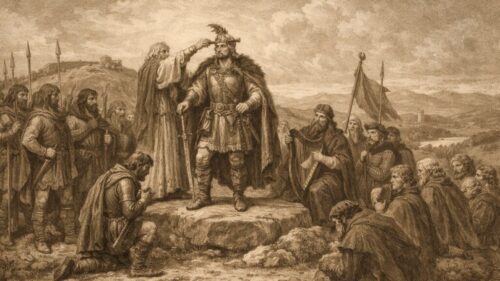
Following his escape, O’Donnell was inaugurated as clan chief at Kilmacrennan on 23 April 1592. This made him the recognised head of his clan.
War Leadership
During the Nine Years’ War, O’Donnell and Hugh O’Neill led a confederacy of Irish lords. The account says their resistance aimed to prevent English incursions into their territory and to end Catholic persecution under Queen Elizabeth I. Within that conflict, O’Donnell expanded his territory into Connacht by launching raids against successive Lord Presidents Richard Bingham and Conyers Clifford.
The source specifically notes that he led the confederacy to victory at the Battle of Curlew Pass. It also places military pressure on him in 1600, when he suffered various military and personal losses. In the same period, his cousin Niall Garbh defected to the English, which strengthened Henry Docwra’s troops and forced O’Donnell out of Tyrconnell.
Spanish Journey
After the crushing defeat at the Siege of Kinsale, O’Donnell travelled to Habsburg Spain to seek reinforcements from King Philip III. The source says the promised reinforcements were repeatedly postponed. While preparing for a follow-up meeting with the king, O’Donnell died of a sudden illness at the Castle of Simancas on 30 August 1602, aged 29. His body was buried on 1 September 1602 inside the Chapel of Wonders at the Convent of St. Francis in Valladolid.
The same account says that O’Donnell’s death disheartened an already weakening Irish resistance, and that Tyrone ended the Nine Years’ War in 1603 with the Treaty of Mellifont.
Source References
Hover over a number to see the source. Select it to open the source.