Aghakilmore’s Field of Defeat1429 CE

Dateline
The best-documented Irish event of 1429 was a major defeat at Achadh Cille Móire, now generally identified with Aghakilmore in County Cavan. It was not a battle between two neatly bounded nations. Rather, it grew from the shifting alliances, rival branches and armed followings that shaped lordship in the Breifne borderlands. The annals place it firmly in this year, while their differing emphases also reveal why a single encounter could matter far beyond the field on which it was fought.
War in Breifne
The Annals of Ulster report a “great war” between Tadhg Ua Ruairc (O’Rourke) and Eóghan Ua Raighillaigh (O’Reilly). Breifne, extending across much of the region later divided between Cavan and Leitrim, had long been contested by these powerful kindreds. Their authority rested on land, cattle, clients, churches, marriage links and the capacity to gather fighting men. It was therefore neither unusual nor trivial that a dispute between leading figures could draw in neighbouring rulers, minor lords and men attached to the English lordship in Meath.
The conflict was complicated from the outset. Sons of Mathghamhain Ua Raighillaigh joined “the Foreigners of Meath” against Eóghan Ua Raighillaigh, and the annalist records that the town or settlement of Ua Raighillaigh was burned. “Foreigners” in this context meant the English-descended population and political establishment of the lordship, not recent arrivals from overseas. Their participation demonstrates that the boundary between Gaelic and English political worlds was a zone of bargaining and warfare, rather than a hard national frontier. Nor was the O’Reilly side internally united: members of the ruling kin were fighting one another.
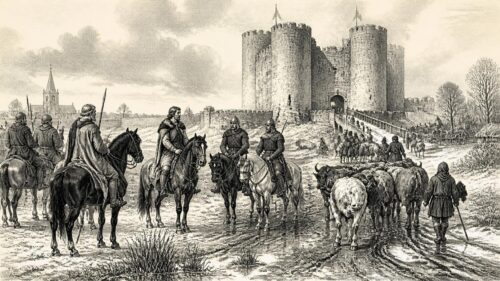
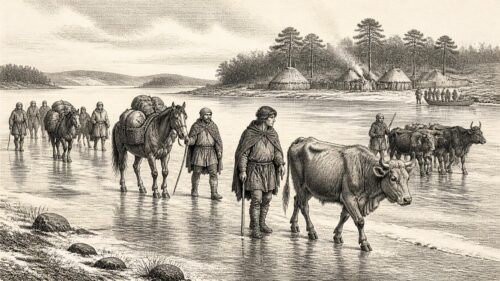
Eóghan responded by securing a formidable coalition. He brought in Ua Néill, the rulers of Oirgialla and the men of Fermanagh. The annal calls their force a predatory band before it reached Achadh Cille Móire, a reminder that campaigning involved raids and the taking of livestock as well as set-piece battle. Such movements threatened the resources on which rural households depended. Cattle were movable wealth, but a raid also endangered food supplies, labour, housing and the security of dependants.
The Battle at Achadh Cille Móire
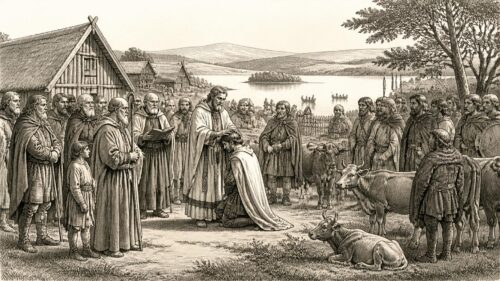
At Achadh Cille Móire, Tadhg Ua Ruairc and the sons of Mathghamhain Ua Raighillaigh assembled a counter-force. They were joined by the Baron of Delvin and by Mac Cába. The latter name belonged to a military family associated with the gallóglaigh, professional heavily armed warriors whose service connected Irish politics with the Gaelic-speaking west of Scotland. The opposing forces met “on that field”. The phrasing is unusually direct, and the result was decisive enough for the annalist to name it the defeat of Achadh Cille Móire.
Ua Néill, his sons, his gallóglaigh, the men of Fermanagh, Eóghan Ua Raighillaigh and his kinsmen advanced successfully. The Baron of Delvin was captured. Mac Cába, Henry Mac Cába, Diarmaid Ua Ruairc and other unnamed people were, in the annalist’s careful formulation, either taken or killed. The victors then returned home “triumphantly”. This was more than colourful language. Capturing a magnate could create leverage for ransoms, hostages, negotiations and future alliances; it also publicly damaged the standing of the defeated coalition.
The Annals of Loch Cé, compiled in a Connacht milieu, confirms the central outcome in a compressed entry: the defeat at Achadh Cille Móire was won by Ua Néill and Ua Raighillaigh against the Foreigners. That shorthand gives particular prominence to the English-interest contingent, whereas the fuller Ulster account preserves the layered Gaelic rivalries behind the encounter. Read together, the records show a regional war in which an alliance of Irish lords overcame a coalition that included Meath lords of the English settlement and opponents from within the O’Reilly kindred itself.
Another notice in the Annals of the Four Masters suggests that violence continued elsewhere in or around Breifne. Men of Breifne on an incursion into Sliabh Dá Chon were badly hit by Muintir Fheodacháin at the hill of Odhra. The chronicle gives a figure of at least forty dead, alongside men described as disabled, and names Conchobhar Mac Suibhne among those lost. It also notes casualties from Dartry and Clann Aodha Mag Uidhir. The entry should not be treated as a securely identifiable second phase of the battle at Aghakilmore: the annal does not explicitly connect the two. It does, however, establish that 1429 was a year of costly armed activity across this northern and north-western political landscape.
Raids, Houses and Succession
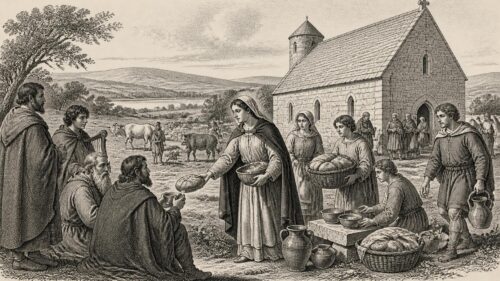
Violence also entered domestic space. Gilla-Ísu Ua Flannagáin of Tuath Ratha was killed in his own house by sons of Aodh Mag Uidhir in a night attack. The annals often preserve such killings because the victim’s rank made them politically consequential, but the detail of the house matters. A lord’s residence was a centre of hospitality, storage, administration and protection; a night assault on it was an attack on both a person and his local authority.
Other notices make clear that political insecurity extended well beyond Breifne. On 8 February, Hugh Díreach, son of Toirdhealbhach an Fhína Ó Domhnaill, and his son were killed by Toirdhealbhach, son of Niall Garbh Ó Domhnaill. The Four Masters adds that Ruaidhrí Ó Dochartaigh died within a quarter of a year. In Connacht, Maeleachlainn, grandson of the lord of Uí Mháine, was killed with a single javelin cast by John Cam Ó Taidhg, a man of the Ó Conchobhair following. Maeleachlainn Ó Máille, heir apparent to the lordship of Umhaill on the Atlantic coast, was killed by sons of Ó Máille. These were not all elements of one island-wide conflict; they were separate local struggles. Together, they show how succession, honour and control of lordship could be resolved through targeted violence.
Learning and Healing
Yet the year’s record is not solely martial. Donnchadh Mac Gilla-Fhinnein died on 30 November, one of the few dates preserved precisely. The Four Masters also records the death of Matthew Ó Cuirnín, described as ollamh, or chief learned man, of Breifne and as widely learned in history and music. The wording points to a learned culture in which genealogy, historical memory, verse, music and legal or political expertise were not marginal accomplishments. They helped families to articulate rank, inheritance and obligations.
The Annals of Ulster additionally commemorates Paul, son of Gilla-na-naem, son of Gilla-Cába Ó Caiside, a respected physician who served Conchobhar Mag Uidhir the Red and Ruaidhrí Mac Mathghamhna. His obituary is valuable evidence for the professional world behind elite politics. Gaelic medical families preserved specialist learning over generations, using Irish versions of medical writing ultimately rooted in classical, Arabic and European Latin traditions. Paul’s service to leading patrons in Fermanagh and Oriel shows that expertise moved across lordships and that physicians could enjoy status and protection at princely courts.
The annalist also cautiously notes that Aodh Ruadh Ó Domhnaill, later a ruler of Tír Chonaill, was born “as is said” in 1429. That qualification should be retained. It is a retrospective notice, not a precisely witnessed birth record, but it places a future northern political figure within the year’s chronicle. Its presence beside the physician’s obituary and the death of an ollamh underlines the annals’ broader purpose: they remembered not only victories and killings, but the people whose knowledge and lineage sustained lordship.
A Pale Measure
In the English lordship around Dublin, a measure conventionally dated to 1429 offered a subsidy of £10 to a royal liegeman who built a sufficiently fortified castle or tower within a stated period. The prescribed minimum dimensions were modest but exacting: twenty feet in length, sixteen in width and forty in height. Some modern discussions date the legislation to 1430 because of regnal and parliamentary dating conventions; its association with 1429 is nevertheless longstanding. What can safely be said is that the measure belongs to this immediate moment and addressed frontier insecurity in the Pale.
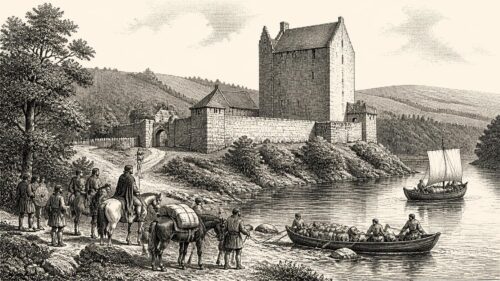
It did not create every Irish tower house, nor did it command construction across the island. Its direct reach was limited to the English political zone. Still, it is an unusually concrete sign of official concern about defence at a time when local power, raiding and unstable marchlands shaped everyday calculations. Small fortified residences would become a conspicuous feature of later medieval Ireland, built by both Gaelic and English-descended elites for residence, display and security.
Thus 1429 is best understood through connected but distinct scales of experience. At Aghakilmore, a coalition won a notable battlefield success and seized a baron. Across Breifne and neighbouring regions, raids and killings exposed the vulnerability of people, settlements and dynastic claims. Meanwhile, learned men and a physician received the kind of commemoration that reveals the intellectual infrastructure of Gaelic society. The surviving record is selective, but it captures an Ireland in which power was made through armed retinues, negotiated alliances, fortified places and inherited knowledge.
Primary Sources
- The Annals of Ulster: Year U1429
- The Annals of Ulster
- Annals of the Four Masters: Part 6
- Annals of the Four Masters
- Annals of Loch Cé A.D. 1014–1590
- CELT Project: Annals of Loch Cé
- Exploring the Irish Annals
- Galloglass Project
- Galloglass Project: How to Use the Database
- Medicine in Gaelic Ireland and Scotland, c.1350–c.1750
- Irish Medical Texts
- Medical Practice and Gaelic Ireland
- The Tower Houses of County Tipperary
- The Fortifications and Identity of a Military Frontier
- The Tower Houses of West Cork
- Cappaghfinn Archaeological Testing Report
- Frowning Ruins: The Tower Houses of Medieval Ireland
- The Statutes at Large Passed in the Parliaments Held in Ireland, Volume 1
- The History of Drogheda, with its Environs, Volume 2
- Annals of Ulster, Otherwise Annala Senait, Annals of Senat
- Annals of the Kingdom of Ireland
- Annals of the Kingdom of Ireland: General Index