Cathal at Céis Chorainn973 CE
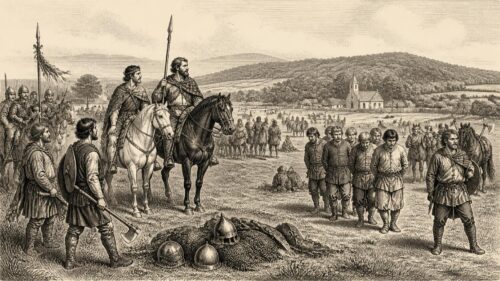
In 973, Conchobar son of Tadc, king of Connacht, died, and his kinsman Cathal was killed almost immediately after succeeding him at Céis Chorainn. Murchad ua Flaithbertaig of Ailech defeated Connacht forces, killing Géibennach of Uí Maine and others, then plundering the province. The chronology varies among annals, but Inisfallen assigns events to 973. In Munster, Dub dá Leithe of Armagh secured Patrick’s church’s levy after Mathgamain mediated with Emly’s coarb. Ecclesiastical deaths included leaders of Durrow, Clonard and Glendalough, and the anchorite Cinaed of Clonfert, demonstrating Ireland’s interconnected political and religious communities, while records leave ordinary people’s experiences unreported.
Dateline
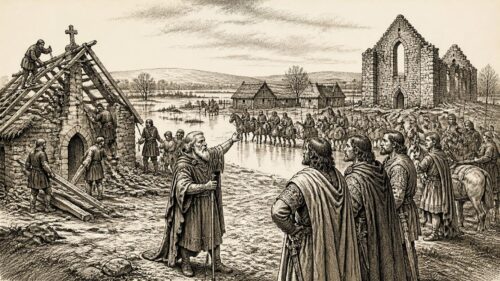
For Ireland, 973 was a year in which a provincial succession collapsed almost as soon as it began. The death of Conchobar son of Tadc, overking of Connacht, was followed by the brief elevation and near-immediate killing of Cathal son of Tadc. In the same conflict, Géibennach son of Áed, king of Uí Maine, and many others fell. The annals present these events starkly, but their consequences were substantial: Connacht lost both an established ruler and his short-lived replacement while an outside force harried the province.
The year must, however, be handled with care. The Annals of Inisfallen explicitly place these events in 973. The Annals of Ulster label their corresponding section “AD 972 alias 973”, a reminder that medieval Irish annalistic chronologies do not always align neatly with modern calendar years. This article treats the events as belonging responsibly to 973, while avoiding material which later compilations misplaced under neighbouring annals. In particular, reports of destructive wet weather and the death of the chief poet Cinaed ua hArtacáin belong to a chronologically displaced Four Masters entry and should not be asserted as events of this year.
A Connacht Kingship Broken
Conchobar son of Tadc died as king of Connacht. He belonged to Síl Muiredaig, a major branch of the Uí Briúin Aí, whose power-base lay in the central Connacht plain. His reign had begun only in the later 960s, after a period in which Connacht’s overkingship had been disputed by rival kindreds, notably the Uí Briúin Bréifne. Conchobar had benefited from important family connections beyond the province, including links by marriage to powerful Uí Néill dynasties. Yet such alliances did not make his position secure; Connacht was a large, politically diverse region in which local kings could retain considerable independence.
Cathal son of Tadc succeeded Conchobar, probably as a close kinsman rather than in a simple father-to-son transfer. That distinction matters. Irish kingship was not automatic primogeniture: eligibility was generally confined to a wider royal kindred, and succession could be settled by competition, negotiation or violence. The Annals of Inisfallen say that Cathal was killed immediately after taking the kingship. A later tradition preserved in the Book of Leinster reduces his reign to three days, but that striking detail should be treated as later evidence rather than a securely contemporary measurement of time. What is firm is that Cathal’s rule was extraordinarily brief.
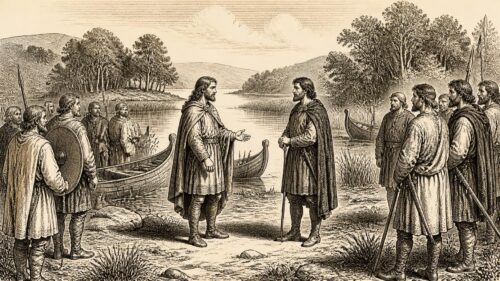
The opposing commander was Murchad ua Flaithbertaig, called Glún re Lár, “Knee to the Ground”, in the Munster annals. The Annals of Ulster identify the struggle simply as a battle between Murchad and the Connachta; the Four Masters name the battlefield as Céis Chorainn and add that Murchad afterwards plundered Connacht. The fuller account also makes Murchad king of Ailech, the northern Cenél nÉogain kingship. Taken together, the evidence indicates not merely a local succession dispute but a damaging intervention from the north-western political world in Connacht.
Cathal died in the battle, as did Géibennach son of Áed, king of Uí Maine. Uí Maine occupied a broad territory east and south-east of the Connacht heartland, spanning areas later associated with east Galway and south Roscommon. The death of its king reveals the scale of the Connacht coalition facing Murchad. The annalist’s phrase “and many others” is conventional but significant: elite casualties could mean the loss of household warriors, client leaders and kin whose survival underpinned a ruler’s authority. The immediate military result was therefore compounded by a political one. Murchad had disrupted the very network through which a new king might have established himself.
Pressure From the North
The conflict at Céis Chorainn belongs to the wider contest between Irish provincial powers, not to a unified national war. Domnall ua Néill of Cenél nÉogain was then the dominant Uí Néill ruler, and Murchad’s intervention in Connacht shows how readily the ambitions of Ailech could reach across provincial boundaries. But the sources do not say that Murchad annexed Connacht, nor that he acted on Domnall’s direct orders. It would be unsafe to turn a recorded raid and battle into a claim of permanent northern control.
Equally, the events should not be read as an inevitable step towards a later political map. Conchobar’s descendants would eventually supply the dynasty known as Ua Conchobair, or O’Connor, and his son Cathal emerged as king after the disaster of 973. That later outcome gives Conchobar retrospective importance, but it should not obscure the uncertainty felt in the year itself. A royal house which had regained Connacht in the 960s suddenly faced bereavement, invasion and a failed succession. The annals allow no view of the negotiations that followed, only the fact that the provincial kingship survived in altered hands.
Patrick’s Claim in Munster
Far to the south, a visitation by Dub dá Leithe, coarb or successor of Patrick at Armagh, produced a different kind of contest. The Annals of Inisfallen report that he came to Mumu, or Munster, to make a visitation. Such journeys were not simply devotional tours. They asserted the standing of an ecclesiastical community, renewed relationships with churches and lay rulers, and could involve the collection of dues or tribute.
Dub dá Leithe quarrelled with the coarb of Ailbe over the levy. The successor of Ailbe represented the prestigious church of Emly, an important Munster centre associated with St Ailbe. At issue was not an abstract question of theology but a practical and potentially lucrative claim: who possessed the right to receive a customary exaction. Mathgamain son of Cennétig, then the foremost ruler in Munster, acted as mediator. The parties reached peace and agreed to the perpetual right of Patrick’s successor.
This compact reveals much about the relationship of church and kingship. Armagh’s claim to island-wide primacy was advanced through saints’ successor-rights, personal visitations and the ability to secure recognition from rulers. Emly’s resistance demonstrates that this was contested on the ground. Mathgamain’s intervention, meanwhile, placed him publicly in the role of arbiter among powerful institutions. He had recently strengthened his position in Munster and Limerick; in 973, the settlement over church dues offered another way to display authority without fighting.
The word “perpetual” should not be understood as proof that the arrangement could never be challenged. Medieval agreements depended on living political support and on communities continuing to recognise them. Nevertheless, recording the settlement in the annals gave it a powerful memory. The agreement bound the claim of Patrick’s church to a named king of Munster and to the resolution of a public dispute.
Churches, Rivers and Mortality
The annals also record several ecclesiastical deaths, showing how widely religious institutions were distributed across Ireland. Mael Muire, superior of Dairmag, drowned at Es Ruaid. Dairmag is Durrow, the important Columban foundation in the midlands; Es Ruaid is generally associated with the dangerous waters at Assaroe on the Erne. The terse notice gives no explanation for the drowning. It does, however, preserve a reminder that travel between major churches, whether by river or sea-route, entailed real risk.
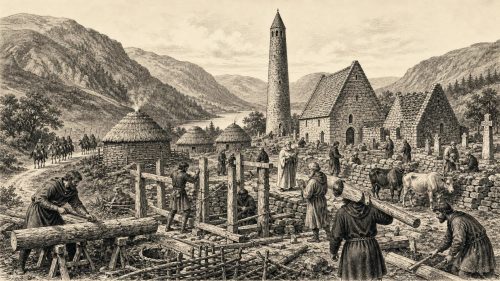
Bécán, successor of Finnén, died, as did Ailill, superior of Glenn dá Locha, in what the Annals of Ulster calls untroubled deaths. Bécán’s title links him with Clonard, the church of St Finnén in Meath, while Ailill headed Glendalough in the Wicklow mountains. These were not isolated retreats detached from society. Early Irish ecclesiastical centres were communities with churches, residences, cultivated land, craftsmen, dependants and links to political patrons. Their leaders were custodians of saints’ rights and property as well as religious figures.
The Annals of Inisfallen additionally note the death of Cinaed of In Durthach, described as an anchorite of Ireland, at Clonfert. The title signals a life of ascetic religious distinction, but the fact that his death was entered in a regional chronicle suggests a reputation extending beyond one small community. Taken with the deaths at Durrow, Clonard and Glendalough, it underlines the scale of the ecclesiastical network within which Irish learning, commemoration and authority circulated.
A Year Seen Through Records
Much remains beyond recovery. The annals do not tell us what ordinary households in Connacht suffered after Murchad’s harrying, how many farms were stripped of cattle or stores, or how the settlement over the Munster levy affected tenants and church dependants. They rarely describe women, labourers, traders or the unfree except when they enter an elite event. Nor can the sparse notices prove a general famine, population movement or commercial change in 973.
Yet the year’s surviving record is unusually coherent in one respect. In Connacht, political authority could be overturned with startling speed through succession and armed attack. In Munster, power was also exercised through mediation: deciding which saint’s successor could levy dues was a matter fit for the province’s leading king. Across the island, monasteries and churches remained centres of travel, wealth, memory and local government. Ireland in 973 was thus not a single kingdom moving in one direction, but a connected landscape of provincial dynasties and ecclesiastical communities, in which a battle at Céis Chorainn and an agreement over Patrick’s levy both mattered greatly.
Primary Sources
- The Annals of Ulster: Year U973
- Annals of Inisfallen
- Part 8 of Annals of the Four Masters
- Annals of Tigernach
- Irish Texts at CELT
- Irish Texts: Captured Editions
- Conchobar
- Cathal
- Mathgamain
- Brian Bórama (Bóruma, Boru)
- Cennétig
- The Annals of Inisfallen to Go on Public Display in University College Cork
- Irish Annals
- Clonmacnoise, County Offaly
- Monasterboice, County Louth
- Archaeological Survey
- Irish Field: A Guide to Ireland’s Archaeological Monuments
- The Earthen Rath or Lios
- Early Christian Monasteries
- Churches and Ecclesiastical Enclosures