Ballyeaston: historical settlement in County Antrim
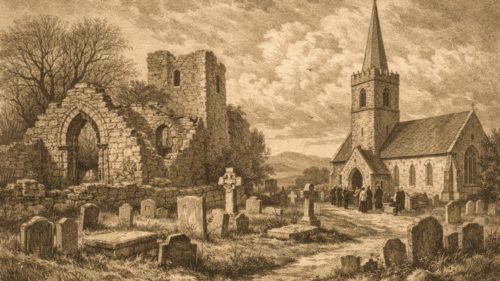
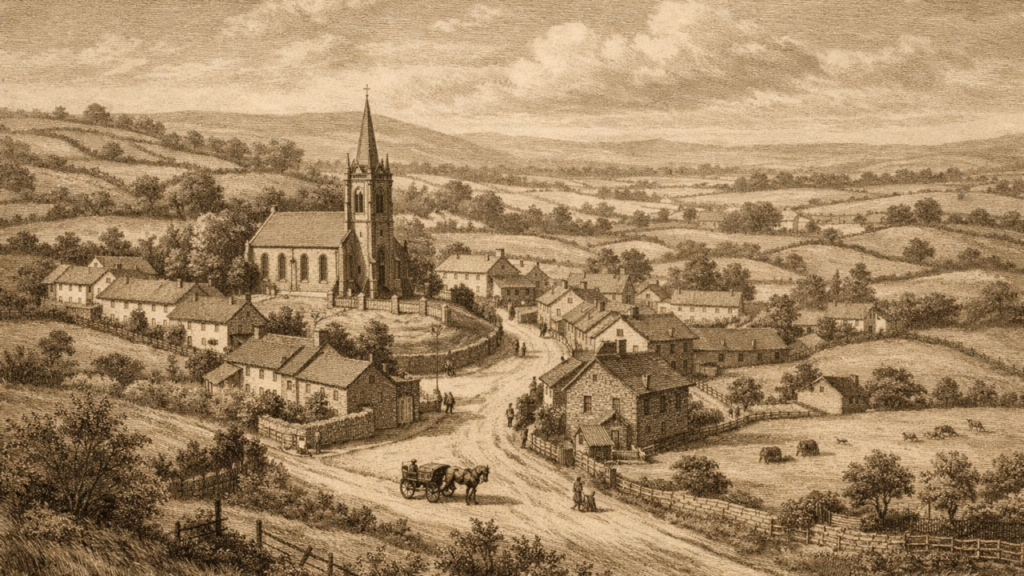
Ballyeaston is securely established as a small village and associated townland in County Antrim, Northern Ireland. Modern gazetteer treatment places the village within the townland of Ballyeaston and the civil parish of Ballycor, describing it as a settlement centred on a junction of three main routes beside the ruins of a medieval parish church 1. That matches the older nineteenth-century description in Bassett’s Book of Antrim, which places Ballyeaston on the side of a hill, in a parish of the same name, just north of Ballyclare 2.
Dateline
Settlement and setting
Ballyeaston is securely established as a small village and associated townland in County Antrim, Northern Ireland. Modern gazetteer treatment places the village within the townland of Ballyeaston and the civil parish of Ballycor, describing it as a settlement centred on a junction of three main routes beside the ruins of a medieval parish church 1. That matches the older nineteenth-century description in Bassett’s Book of Antrim, which places Ballyeaston on the side of a hill, in a parish of the same name, just north of Ballyclare 2. In other words, Ballyeaston was not an isolated hamlet invented by later mapping: it was already a recognisable settlement landscape, tied to its parish, road junction, and the farming district around it 12.
The county assignment is equally clear in the historical sources consulted. Bassett explicitly headed the entry “BALLYEASTON County Antrim,” and the Gazetteer of British Place Names likewise identifies it as a small village in County Antrim 12. The 1901 Census of Ireland volume for County Antrim also treats Ballyeaston as part of the county’s settlement system, noting that the town of Ballyeaston stood on the townland of the same name 3. Taken together, these sources confirm that Ballyeaston belonged historically to County Antrim, not to any neighbouring county or detached jurisdiction 123.
Name, spelling, and Irish form
The Irish-language form given in the Gazetteer of British Place Names is Baile Uistín, while the Logainm gazetteer of Ireland also lists Ballyeaston with the same Irish form, and gives it as entry 739 in the Irish-English gazetteer tables 14. This is important because it anchors the place in authoritative place-name scholarship rather than in later guesswork. The form Baile Uistín is straightforwardly a “Bally-” type settlement name, preserving a personal name element rather than an abstract topographical one 4.
The surviving published references consulted here do not show a wide historical spread of alternative spellings in the way that some older Irish place-names do. Instead, they consistently use Ballyeaston as the settled English spelling in the nineteenth century and in modern gazetteers 124. That stability matters: it suggests that by the time the name appears in printed county guides and later reference works, the spelling had already become standardised. If earlier manuscript or archival spellings existed, they were not needed to establish the modern canonical form for this settlement in the sources examined.
Nineteenth-century village life
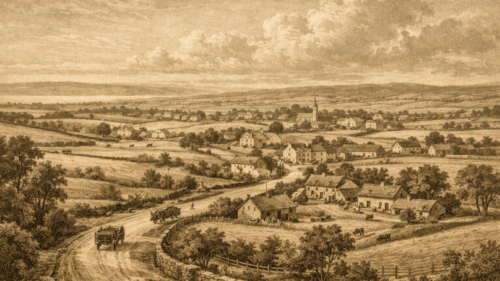
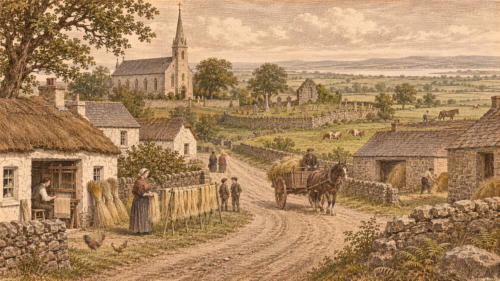
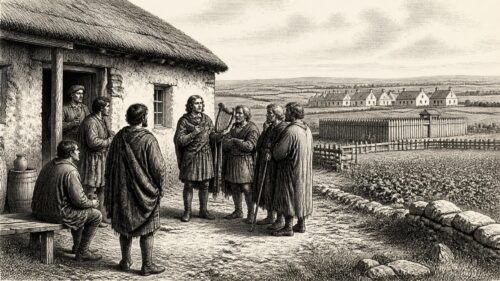
Bassett’s 1888 account is the most vivid historical snapshot among the sources consulted. He gives Ballyeaston a population of 191 in 1881 and notes that it received a daily mail from Ballyclare 2. He also comments on the district’s light land and its cropping pattern: oats, potatoes, and some flax 2. This is the classic rural Antrim mixed-farming economy of the later nineteenth century, with flax still present but no suggestion that Ballyeaston had become a manufacturing centre. The village’s history in this period was therefore one of modest agrarian settlement rather than urban expansion 2.
The physical location mattered to that economy. A hill-side setting would have shaped drainage, field pattern, and road access, while the parish church and later church buildings helped to define the village core 12. The Gazetteer’s note that the village clusters around the churches indicates that ecclesiastical buildings were one of the main organising features of the place by the time of modern description 1. Even if the built form changed over time, Ballyeaston remained legible as a small Antrim village rooted in parish geography and local roads 12.
Parish identity and administrative context
Historical sources repeatedly associate Ballyeaston with the parish of Ballycor. The Gazetteer of British Place Names states that the village lies within the townland of Ballyeaston in the civil parish of Ballycor 1. Vision-related county and parish summaries, visible in search results, likewise link Ballyeaston to the historic civil and ecclesiastical framework of Antrim Upper and the Ballycor parish area [5]. This is a useful reminder that Ballyeaston’s history is inseparable from older administrative layers: townland, civil parish, barony, poor-law district, and county all overlapped in shaping how the settlement was described and governed 13[5].
The 1901 census note that the town stood on the townland of the same name is also useful because it preserves the official statistical habit of distinguishing between the “town” and the surrounding townland while still recognising them as one geographic unit for many practical purposes 3. That kind of census notation is precisely the sort of evidence historians need for small settlements, because it shows that Ballyeaston was more than a road name: it was a named population place with enough identity to be separately remarked upon in state records 3.
What the historical record supports
On the evidence of the sources consulted, Ballyeaston’s history is that of a modest parish village and townland in County Antrim, north of Ballyclare, with a stable English name, an authoritative Irish form (Baile Uistín), and a nineteenth-century rural economy based on light land and mixed crops 124. Its documentary visibility is strongest in county directories, gazetteers, and census materials rather than in large political or military events 234. That itself is historically significant: Ballyeaston belonged to the network of small Antrim settlements that were important locally as parish centres, road junctions, and farming communities, even if they rarely appeared in broader narratives 123.
For historical purposes, then, Ballyeaston is best understood not as a dramatic or exceptional town but as a clearly attested Antrim settlement with an established parish setting, a documented nineteenth-century population, and an Irish-language form preserved by official placename scholarship 124. The sources are mutually reinforcing and place the settlement firmly in County Antrim throughout the historical references examined 1234.