National Network(c.1890s)
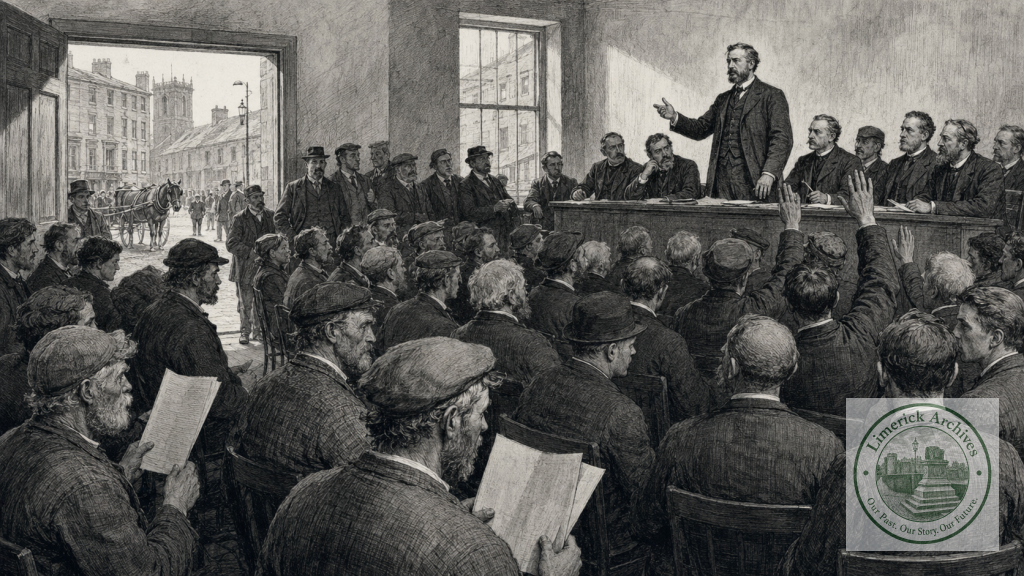
Parliamentary nationalism has acquired a powerful new local organisation following the acceptance of the United Irish League as the principal popular body supporting the reunited Irish Parliamentary Party. For nationalists throughout Limerick city and county, the arrangement promises to connect political representation at Westminster with campaigns concerning tenant rights, land purchase and the division of grazing estates. League branches may now provide farmers, labourers, shopkeepers and local political organisers with a direct influence upon nationalist policy and parliamentary candidate selection. The development places organised public opinion behind John Redmond’s leadership while preserving the land question as a central concern of Irish political life.
The United Irish League was established by William O’Brien at Westport, County Mayo, in January 1898, when parliamentary nationalism remained divided following the fall of Charles Stewart Parnell. O’Brien sought to revive popular agitation by concentrating upon the condition of small farmers, evicted tenants and landless families, particularly in western counties where extensive grazing farms stood beside crowded holdings. Public meetings, branch organisation and pressure upon occupiers of disputed land allowed the League to spread rapidly. Its success demonstrated that constitutional nationalism could not depend solely upon speeches delivered in the House of Commons but required an active organisation rooted in parishes, towns and rural communities.
The League’s growing strength helped compel the divided nationalist factions to settle their disputes and reunite under John Redmond during the opening months of 1900. William O’Brien supplied much of the movement’s popular energy, while organisers including John O’Donnell assisted the creation of branches across Ireland. The National Convention assembled in Dublin on 19 and 20 June adopted a constitution and rules establishing a representative structure for the organisation. The arrangement linked local branches with county and national leadership, giving the League an important role in raising funds, organising meetings, promoting parliamentary candidates and maintaining discipline throughout the broader Home Rule movement.
The alliance nevertheless contains possible causes of disagreement. O’Brien regarded the League as an expression of popular authority capable of directing parliamentary representatives, while Redmond and other members of the Irish Party believed that elected MPs must retain control of national policy. Agrarian agitation also brought controversy wherever League branches employed boycotting, public denunciation or pressure against graziers and disputed landholders. Government officials and unionist representatives accused the organisation of encouraging intimidation, charges which League supporters rejected as attempts to discredit lawful combination. The question of whether parliamentary leaders would govern the League, or the League would govern parliamentary leaders, remained unresolved beneath the public declaration of unity.
In Limerick, the League’s structure offered constitutional nationalists a means of joining local land grievances to the demand for Irish self-government. County communities containing tenant farmers, agricultural labourers and families affected by eviction or inadequate holdings could use local branches to carry their concerns beyond the parish. City nationalists could organise meetings, subscriptions and electoral work in support of Redmond’s parliamentary programme. The League therefore created a political road running from Limerick farms, market towns and urban meeting rooms to Westminster itself. Its influence would depend upon whether it could balance agrarian demands, party unity and disciplined constitutional action without reopening the factional divisions it had helped overcome.
Primary Sources
- United Irish League, Constitution and Rules Adopted by the Irish National Convention, 19th and 20th June 1900, printed in Dublin by Swan & Co., 1900; National Library of Ireland, pamphlet volume A17405, Thomas Bradley Papers, MS 33,561/2(12). This verifies the dates of the convention and the formal constitution adopted for the League’s national organisation. (catalogue.nli.ie)
- Correspondence between William O’Brien and John Redmond, 1900, John Redmond Papers, National Library of Ireland, MS 15,212/5. The correspondence concerns Redmond’s election, the United Irish League, the National Convention, party organisation and League finances, and can verify relations between the parliamentary leadership and the popular movement. (catalogue.nli.ie)
- Letter from William O’Brien, Mallow Cottage, Westport, to John Redmond, 26 June 1900, John Redmond Papers, National Library of Ireland, one item, three pages. The letter discusses O’Brien’s efforts to organise political meetings immediately after the National Convention and can illuminate the League’s expansion and leadership difficulties. Exact manuscript call number should be confirmed before formal citation. (catalogue.nli.ie)
- House of Commons Debates, “United Irish League Courts,” 2 August 1900, Hansard, volume 87. This parliamentary exchange verifies contemporary government and unionist concern about League activity, resolutions and agrarian organisation. The relevant columns should be confirmed before formal citation. (Hansard)
- Copy letter from John Redmond to William O’Brien concerning provincial directories of the United Irish League, 3 November 1900, John Redmond Papers, National Library of Ireland. This document can verify Redmond’s involvement in extending and organising the League beyond its original western base. Exact manuscript call number should be confirmed before formal citation. (catalogue.nli.ie)