Nationalist Victory
Limerick Archives — Wednesday, 24 October 1900
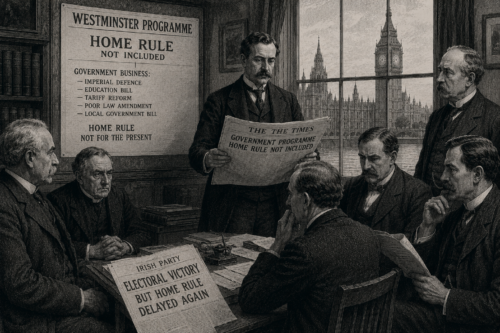
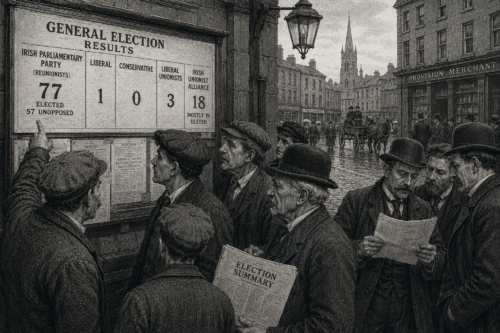
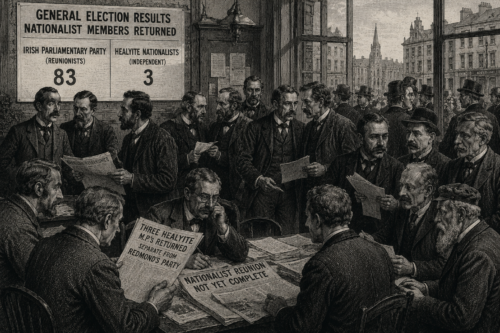
LIMERICK, Wednesday — The reunited Irish Parliamentary Party has emerged from the general election holding seventy-seven of Ireland’s 103 seats at Westminster, confirming constitutional nationalism as the country’s dominant electoral force. The result will be welcomed in Limerick, where Michael Joyce has captured the city constituency by a decisive majority and joined John Redmond’s restored parliamentary organisation. Although the Conservative and Liberal Unionist alliance retains power throughout the United Kingdom, Irish voters have again returned an overwhelming majority of representatives committed to Home Rule. The figures demonstrate that nearly a decade of nationalist division has not destroyed support for parliamentary self-government.
The election was the first held after the principal Parnellite and anti-Parnellite organisations formally reunited earlier this year. Their separation followed the political fall of Charles Stewart Parnell in 1890 and had produced rival candidates, personal hostility and weakened discipline. William O’Brien, the United Irish League and growing pressure from nationalist voters helped bring the factions together. Redmond was chosen chairman of the reunited party in February and entered the election promising renewed cooperation at Westminster. The campaign consequently became an important test of whether the agreement between former rivals possessed genuine electoral authority or represented only a temporary settlement among parliamentary leaders.
The party’s seventy-seven seats give it an overwhelming presence among Ireland’s Westminster representatives, though nationalist unity remains incomplete. Supporters of Timothy Healy have retained a smaller independent following, while unionists remain powerful in north-eastern Ulster and among sections of Dublin’s professional and commercial communities. The Irish Unionist Alliance secured eighteen seats, with Liberal Unionists and other candidates accounting for much of the remaining representation. Many constituencies were uncontested, reflecting the strength of established political organisations and the limited willingness of opponents to undertake expensive campaigns where the likely result appeared beyond serious doubt.
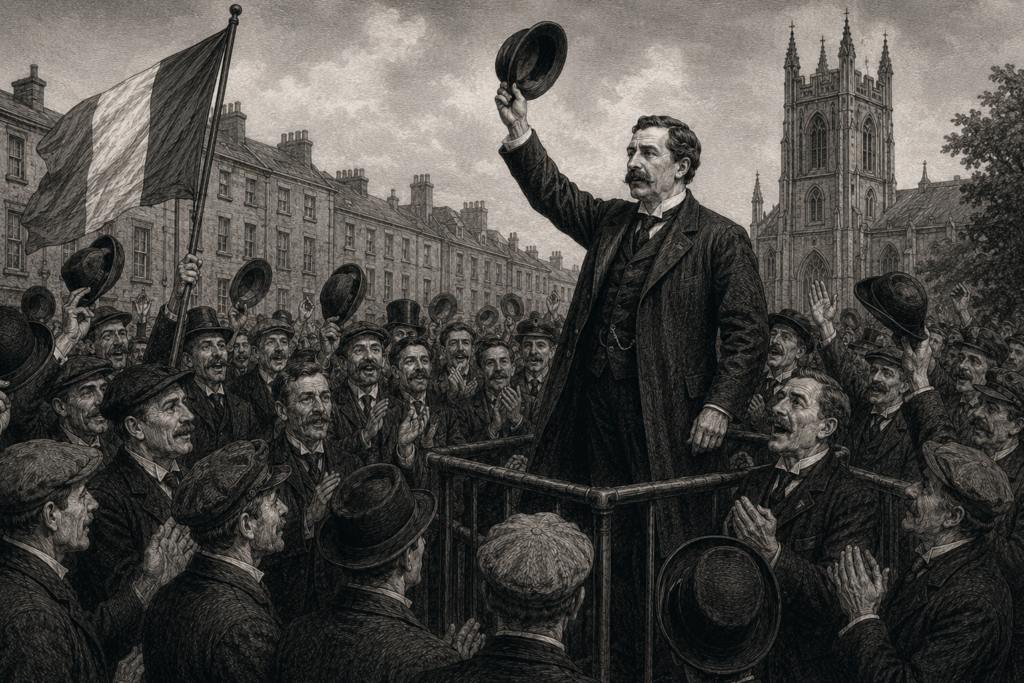
In Limerick City, Michael Joyce defeated Unionist candidate Francis Kearney by 2,521 votes to 474. Joyce’s victory carries particular local significance because he came from Merchant’s Quay, worked at sea and became a Shannon pilot before entering public life. His background allows nationalists to present the result as a triumph for a candidate rooted in the working and maritime life of the city. The wider county also remains firmly nationalist in parliamentary allegiance. Local supporters now expect their representatives to press for Home Rule, tenant purchase, labourers’ cottages and relief from poverty rather than allow renewed personal disputes to weaken Ireland’s parliamentary influence.
The election confirms that constitutional methods still command the allegiance of most Irish voters entitled to participate. Advanced nationalists may criticise dependence upon Westminster, but they possess neither the parliamentary representation nor the electoral organisation enjoyed by Redmond’s party. The reunited members must now demonstrate that numerical strength can be converted into political leverage against a government returned with a commanding British majority. Limerick’s electorate has endorsed that parliamentary strategy, but expectations will be high. The party has recovered unity, leadership and an imposing body of seats; its next challenge is to prove that these advantages can secure practical reforms and revive the campaign for Irish self-government.
- Parliamentary Election Returns, General Election of 1900, House of Commons Parliamentary Papers — the official returns recording every Irish constituency, candidate, vote total and elected member. The exact command-paper number and pages covering the complete Irish return should be confirmed before formal citation.
- Freeman’s Journal, 25 October 1900 — contemporary nationalist reporting and analysis of the completed election results, the strength of the reunited Irish Parliamentary Party and John Redmond’s leadership. Exact page and column should be confirmed before formal citation.
- The Irish Times, 25 October 1900 — contemporary reporting on the final Irish representation, Unionist results and the overall United Kingdom election outcome. Exact page and column should be confirmed before formal citation.
- Limerick Chronicle, 5 October 1900 — contemporary local reporting on Michael Joyce’s victory over Francis Kearney in Limerick City, including the declared vote totals and local reaction. Exact page and column should be confirmed before formal citation.
- John Redmond Papers, National Library of Ireland, 1878–1918 — contemporary correspondence and political records concerning party reunion, candidate organisation, the 1900 election and Redmond’s leadership of the Irish Parliamentary Party. The precise manuscript item should be identified before formal citation.