Ireland Votes
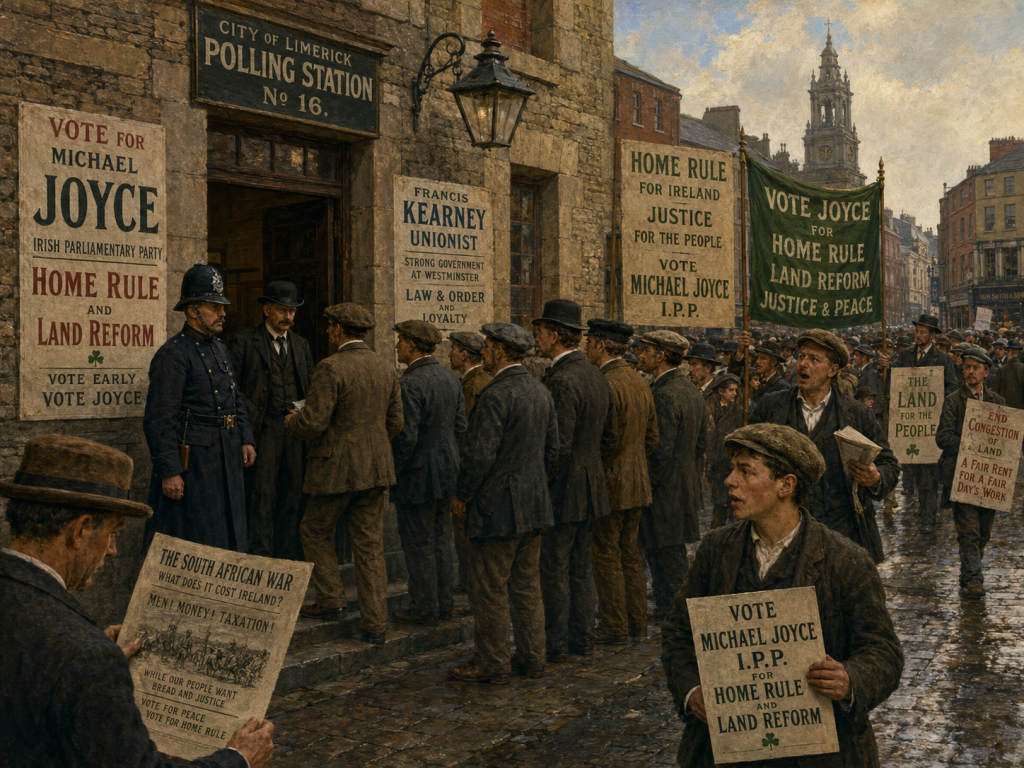
Electors in Limerick City are voting today as the United Kingdom general election continues across Ireland and Britain. The local contest places Michael Joyce of the reunited Irish Parliamentary Party against Francis Kearney, the Unionist candidate, and offers voters a direct choice between Home Rule nationalism and continued government from Westminster. Campaigning throughout the city has centred upon Irish self-government, land reform, the South African War and the ability of the newly reunited nationalist party to act with discipline. Across Ireland, polling is occurring on different days between late September and October rather than through one national election day.
The election follows the dissolution of Parliament on 25 September and has been called while the British Government expects public support for its conduct of the war in South Africa. Conservatives and Liberal Unionists are appealing to imperial confidence and military success, leading opponents to describe the contest as a “Khaki Election.” Irish nationalists approach it from a different direction. Their principal concern is whether the reunited parliamentary movement can recover the authority lost during the long division between Parnellites and anti-Parnellites. The vote therefore tests not only competing British governments but also the strength and credibility of constitutional nationalism throughout Ireland.
John Redmond leads the restored Irish Parliamentary Party into its first general election since reunion. Its candidates promise renewed pressure for Home Rule, tenant purchase and reforms benefiting impoverished rural communities. Unionists, strongest in north-eastern Ulster and among sections of the commercial and professional classes elsewhere, defend the Union and warn that Home Rule would threaten economic security and Protestant interests. A smaller number of nationalist candidates remain outside Redmond’s discipline, including followers of Timothy Healy. Although many Irish constituencies are uncontested, hard-fought campaigns in Limerick, Dublin and several provincial districts reveal that political reconciliation has not removed every rivalry or ideological division.
The Limerick City contest has particular local significance because Joyce is closely associated with the port, labour and civic life. Born at Merchant’s Quay and employed as a Shannon pilot, he presents himself as a representative familiar with the working lives of the electorate. Kearney’s candidacy ensures that the city’s unionist minority retains a parliamentary voice during the campaign, although nationalists expect a decisive victory. Public meetings, canvassing, newspaper appeals and personal influence have shaped the contest. Most women and many working-class men remain excluded from the parliamentary franchise, leaving political decisions in the hands of a limited male electorate meeting existing property qualifications.
Results from across Ireland will emerge gradually as constituencies complete their nominations and polls. The reunited Irish Parliamentary Party is expected to remain the country’s dominant political organisation, while Irish unionism should retain its strongest representation in Ulster. In Limerick, today’s result will show whether nationalist reunion has translated into electoral confidence and whether a candidate rooted in the city’s maritime and labouring life can secure its Westminster seat. Whatever the local outcome, Ireland will return 103 members to a Parliament sitting in London. The election therefore renews representation without resolving the central nationalist argument that Irish affairs should ultimately be decided in Ireland.
Primary Sources
- Limerick Chronicle, 4–5 October 1900 — contemporary local reporting on polling in Limerick City, the candidacies of Michael Joyce and Francis Kearney, campaign meetings and the declared result. Exact page and column should be confirmed before formal citation.
- Freeman’s Journal, 4–5 October 1900 — contemporary nationalist coverage of the Limerick contest and general-election results from constituencies across Ireland. Exact page and column should be confirmed before formal citation.
- The Irish Times, 4–5 October 1900 — contemporary reporting on Irish polling, Unionist and nationalist campaigns, constituency results and the wider United Kingdom election. Exact page and column should be confirmed before formal citation.
- Parliamentary Election Returns, General Election of 1900, House of Commons Parliamentary Papers — official returns recording candidates, votes, constituencies and elected members throughout Ireland. The exact command-paper number and page for Limerick City should be confirmed before formal citation.
- Royal Proclamation dissolving Parliament, 25 September 1900, The London Gazette — official notice initiating the general election and the issue of writs for new parliamentary elections. The exact Gazette issue and page should be confirmed before formal citation.