Health Inquiry

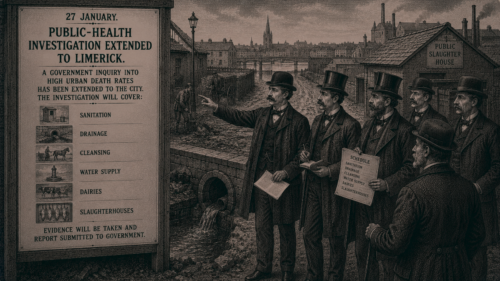
A government investigation into the causes of exceptionally high death rates in Irish cities was extended to Limerick, according to an announcement published on 27 January 1900. The Local Government Board was expected to apply machinery similar to that already established for examining public health in Dublin. The proposed scrutiny would reach beyond mortality statistics and examine how Limerick Corporation discharged its sanitary responsibilities. Drainage, cleansing, water supply, dairies and slaughterhouses were all identified for investigation. The announcement placed the city’s everyday environment under official examination and signalled that preventable illness and premature death would be treated as failures of administration as well as private misfortune.
Limerick Corporation served as the urban sanitary authority under the Public Health legislation then governing Ireland. Its responsibilities included removing refuse, maintaining sewers and drains, regulating nuisances, protecting water sources and enforcing rules affecting businesses capable of endangering health. The inquiry was expected to test whether those powers were being used effectively and whether deficiencies in staffing, finance or enforcement contributed to mortality. The announcement did not provide a precise local death rate or identify particular officials as responsible. It promised instead a broad examination of the systems through which the city attempted to prevent disease within densely occupied streets, courts, lanes and institutions.
Drainage and cleansing were central concerns because human and animal waste could accumulate rapidly where sewers, yards and refuse removal were inadequate. Blocked drains, overflowing privies, damp dwellings and dirty thoroughfares created conditions in which infectious illness spread easily, particularly among families living in overcrowded accommodation. Water supply required equally close inspection, since contamination could carry disease through entire neighbourhoods. Investigators would need to consider not merely whether water reached the city, but whether its sources, storage, distribution and household use protected public health. The condition of streets and houses could not be separated from the municipal engineering and cleansing services supporting them.
Dairies and slaughterhouses brought food production within the inquiry’s scope. Milk could become contaminated through diseased cattle, unclean vessels, poor drainage or dirty cowsheds, placing infants and families at particular risk. Slaughterhouses created their own hazards when blood, offal and animal waste were handled close to homes or allowed to enter drains and waterways. Inspection therefore involved the health of animals, the cleanliness of premises and the Corporation’s willingness to enforce sanitary regulations against commercial operators. The inquiry promised to examine whether food reaching Limerick households was produced and prepared under conditions compatible with the city’s obligation to protect life.
The extension of the investigation marked a significant intervention in Limerick’s civic affairs, although the announcement itself contained no final findings. It recognised that urban mortality could arise from connected failures involving poverty, housing, water, refuse, food and local administration rather than from one isolated source. Any official recommendations could require new expenditure by the Corporation and its ratepayers, but neglect carried a heavier cost in illness, lost wages and family bereavement. By placing sanitation and food supervision under government scrutiny, the inquiry challenged Limerick’s authorities to demonstrate that public-health responsibilities were being exercised thoroughly throughout the city rather than existing only in legislation and committee reports.
- Weekly Irish Times, “London Notes,” 27 January 1900, p. 18.
- Local Government Board for Ireland, Report of the Committee Appointed by the Local Government Board for Ireland to Inquire into the Public Health of the City of Dublin, Dublin: Her Majesty’s Stationery Office, 1900.
- Public Health (Ireland) Act 1878, 41 & 42 Vict., c. 52.
- Registrar-General for Ireland, Thirty-Sixth Annual Report of the Registrar-General of Marriages, Births and Deaths in Ireland, covering 1899, Dublin: Her Majesty’s Stationery Office, 1900.
- Limerick Corporation Public Health Services Pre-1960 Collection, L/AH/PH/1, Limerick Archives.
- Ruth Quiry, Public Health and Housing in Limerick City, 1850–1935: A Geographical Analysis, MA thesis, Mary Immaculate College, University of Limerick, 2013.