Excursion Riot
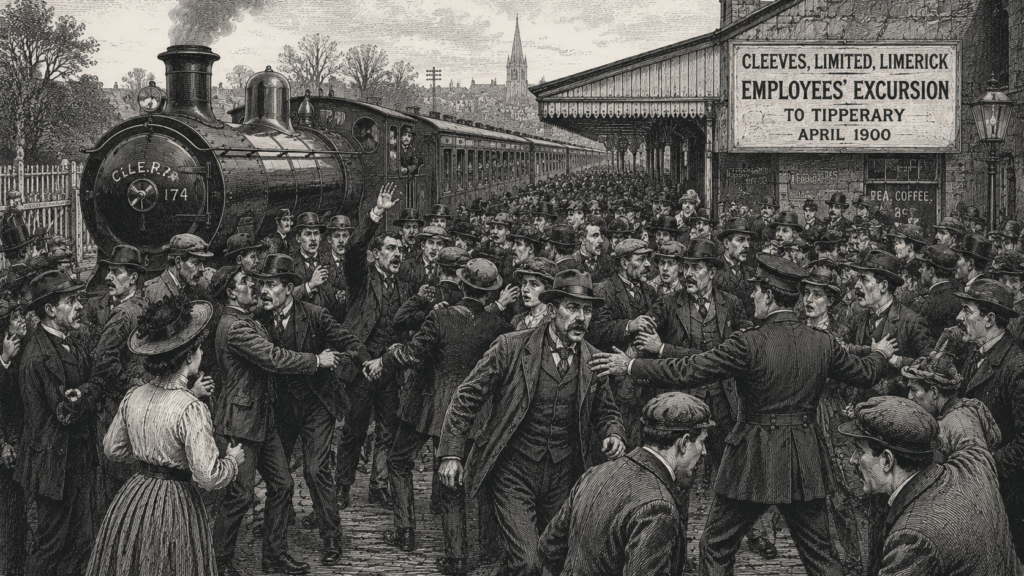
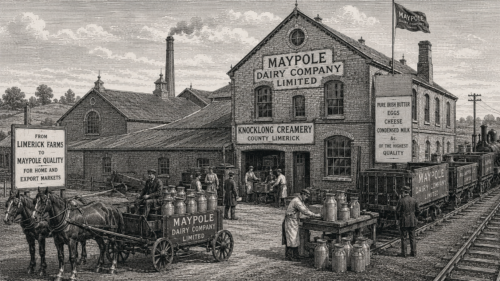
A railway excursion organised by Cleeve’s Creamery in Tipperary town drew the Limerick-based company into public controversy on Saturday, 7 April 1900. The creamery, then the town’s largest employer, arranged a special train to Dublin for its mainly female workforce during Queen Victoria’s final visit to Ireland. Each employee received a rosette in red, white and blue, and the journey was intended as a visible demonstration of loyalty as the royal procession passed through the capital. Because Cleeve’s had its headquarters and industrial identity in Limerick, the episode immediately touched the reputation of one of the city’s most prominent commercial enterprises.
The outing belonged to a wider programme of royal celebration, but it also exposed divisions sharpened by the South African War. Victoria’s visit was presented partly as an acknowledgement of Irish soldiers serving in British forces, while many nationalists regarded the campaign against the Boer republics with hostility. Cleeve’s decision to transport its workers to Dublin therefore carried political meaning beyond an ordinary day away from the creamery. The rosettes, special train and organised attendance identified the employees publicly with the royal occasion, whether every woman shared that enthusiasm or simply accepted an excursion provided by her employer.
When the train returned to Tipperary at about 11.20 that night, a hostile crowd gathered and disorder broke out around the station. Contemporary reports described angry opposition to the excursion and clashes between demonstrators and people whose relatives were serving in South Africa. The disturbance extended beyond shouting and jostling. Approximately forty tons of hay belonging to the creamery were set on fire, creating a large protest bonfire. One reported remark suggested that if Cleeve could pay for an excursion, he could also pay for the blaze, linking the destruction directly with resentment of the company’s sponsorship.
The surviving evidence points principally to political and communal antagonism, rather than establishing that overcrowding, drink or inadequate supervision caused the trouble. Bonfires already formed part of the town’s radical protest culture, and the attack upon company property gave the evening a deliberate symbolic character. The crowd’s hostility was directed not merely towards railway passengers returning from an outing, but towards what the excursion appeared to represent: loyalty to the Crown, support for an imperial war and the authority of a powerful employer. Workers caught in the confrontation occupied an uncomfortable position between company discipline, personal belief and local pressure.
For Cleeve’s, the episode demonstrated how closely commercial reputation could become entangled with politics. The company linked Limerick’s industrial economy to creameries, farmers and employees across Munster, so events at its Tipperary works could reverberate at headquarters on the Shannon. The damaged hay imposed a material loss, while reports of the riot associated the organised excursion with coercion and division. More broadly, the incident revealed that organised leisure was not politically neutral in 1900. A special train intended to reward workers became a public test of loyalty during a royal visit conducted beneath the shadow of war.
- Tipperary People, Friday, 13 April 1900, report concerning the Cleeve’s Creamery excursion and the disturbance following the train’s return.
- Tipperary People, Friday, 20 April 1900, further reporting concerning the excursion and subsequent disorder.
- Clonmel Chronicle, Wednesday, 11 April 1900, contemporary Unionist account of the disturbance at Tipperary.
- Clonmel Chronicle, Saturday, 21 April 1900, subsequent coverage of the Cleeve’s excursion controversy.
- Denis G. Marnane, “Tipperary Town One Hundred Years Ago: Issues of Identity,” Tipperary Historical Journal, 2022, pp. 169–170, 191.
- Shaun Boylan, “Cleeve, Sir Thomas Henry,” Dictionary of Irish Biography, Royal Irish Academy, Dublin.
- David Lee, “The Munster Soviets and the Fall of the House of Cleeve,” in Made in Limerick, Limerick Civic Trust.