
Fatal Confusion(c.1900s)
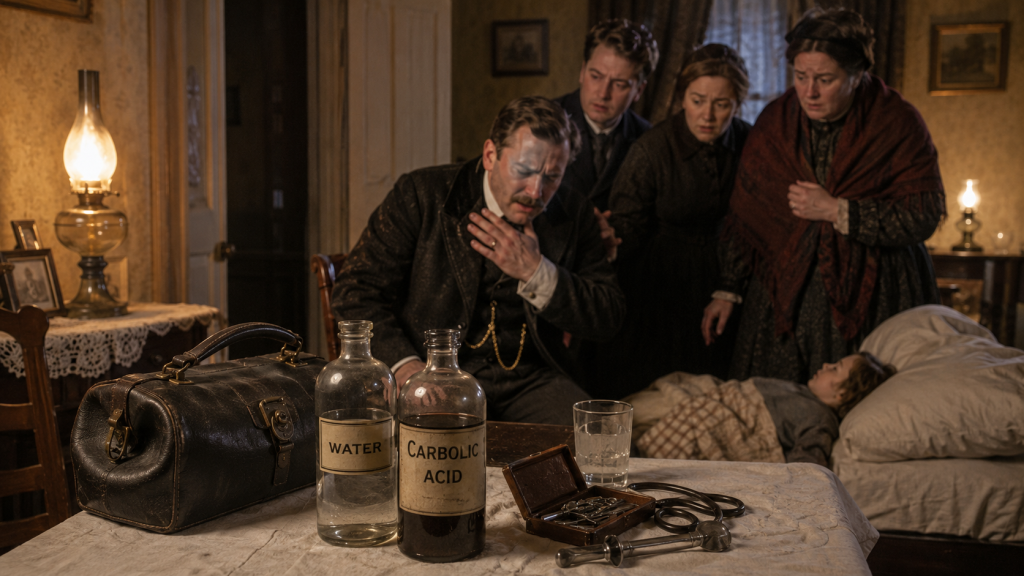
Cappamore and the surrounding district lost a medical practitioner in early February 1900 when Dr Charles Philip Tennant died after accidentally swallowing carbolic acid during an evening visit to a family at Rath. Tennant served patients across the Cappamore and Murroe area, where a country doctor might travel considerable distances to reach sick people in their homes. The surviving reports describe no deliberate act and no dispute over the cause. An ordinary medical call ended in tragedy because two liquids carried to the house were confused, turning a customary gesture of hospitality into a fatal emergency.
According to the reported sequence, a man named Mulcahy had travelled to obtain Tennant’s assistance for four sick children. On returning to the family home, Mulcahy carried two bottles: one containing whiskey and another holding carbolic acid intended for disinfecting purposes. Both were handed to Mrs Mulcahy while Tennant attended the children in a small bedroom. Carbolic acid was then widely employed as an antiseptic and disinfectant, but it was also a powerful poison. Its presence beside an ordinary drink created a danger that became greater within a poorly illuminated rural interior.
When Tennant had finished treating the children and prepared to leave, Mrs Mulcahy offered him whiskey to warm him before his journey home. Through a mistaken selection of the bottles, carbolic acid was poured instead. The doctor swallowed some of the liquid and immediately understood what had happened. He called for mustard and hot water, then commonly used to induce vomiting, while assistance was sought from Dr O’Callaghan. Despite the efforts made to save him, Tennant died shortly after the second doctor arrived. The contemporary report consistently characterised the poisoning as accidental.
The tragedy demonstrated the dangerous closeness between medicine and poison at the beginning of the twentieth century. Carbolic acid, also known as phenol, had become important in antiseptic practice and domestic disinfection, yet concentrated quantities could severely burn tissue and rapidly poison the body. The Cappamore incident arose not from an unfamiliar substance but from one carried for a useful purpose during an ordinary medical visit. When drinkable and poisonous liquids travelled together in similar containers, poor lighting, hurried handling and a momentary mistake could have irreversible consequences.
Tennant’s death removed a doctor from a rural district in which individual practitioners provided essential care across scattered communities. The story was reported in the Limerick press and later travelled far beyond Ireland, appearing in the New Zealand Tablet in April 1900 for readers among the Irish diaspora. Surviving records do not establish every detail of Tennant’s practice or the precise quantity swallowed, and later accounts differ over the exact date. They agree, however, that Charles Philip Tennant died through an unintended confusion between whiskey and carbolic acid while carrying out his professional duties.
- Limerick Chronicle, 8 February 1900, news report concerning the accidental poisoning of Charles Philip Tennant at Cappamore; death notice published 13 February 1900, as identified in the Limerick Local Studies obituary index.
- New Zealand Tablet, vol. XXVIII, no. 17, 26 April 1900, report from Cappamore concerning Dr Charles Tennant, the Mulcahy family at Rath and the accidental swallowing of carbolic acid.
- “The Death of Doctor Tennant by Poisoning in Murroe, Limerick, Ireland,” Limerick Life, 30 January 2013, later reconstruction of the incident from historical reporting.