Archived: 14 October 2026
Abstract
In 1659, the collapse of Richard Cromwell’s Protectorate transformed Irish government. Henry Cromwell resigned, and parliamentary commissioners assumed control in Dublin. Edmund Ludlow, a regicide and committed republican, reorganised the Irish army, tested officers’ loyalties and sent troops to England amid constitutional crisis. Meanwhile, completion of William Petty’s Down Survey provided maps and records enabling confiscated land to be redistributed among soldiers, adventurers and officials. The approximate 1659 census documented settlements and leading occupiers, though imperfectly. Political instability culminated in opponents seizing Dublin Castle in December. Despite changing regimes, the administrative framework for Protestant landholding and long-term social transformation endured.
Read Article
Archived: 14 October 2026
Abstract
In 1658, completion of Sir William Petty’s Down Survey gave the Commonwealth its first national-scale detailed mapping of Ireland, enabling confiscated land to be valued and allocated to Adventurers and soldiers. Though not covering Connacht or resolving competing claims, it strengthened Protestant ownership and made Catholic dispossession more enforceable. Henry Cromwell governed from Dublin, balancing courts, revenue, army discipline and an unstable land settlement. Oliver Cromwell’s death on 3 September brought Richard’s succession and Henry’s promotion to lord lieutenant. Religious policy privileged Protestants but constrained dissent and excluded Catholics. Beneath order, military power, land claims and constitutional legitimacy remained precarious.
Read Article
Archived: 14 October 2026
Abstract
In 1656, Cromwellian Ireland was being reorganised through Sir William Petty’s Down Survey, which recorded land, boundaries and value to distribute forfeited estates among soldiers and adventurers. Field books enabled officials to assess claims while reserving specified public and ecclesiastical lands. This administrative project underpinned confiscation and the uneven, coercive transplantation of Catholic landholders to Connacht and Clare, affecting rural society beyond formal removals. Henry Cromwell sought firmer Protestant civil government amid army and religious divisions, while war with Spain heightened security concerns. Catholic communities endured repression; Quakers faced persecution. Ussher’s death, Ware’s Patrick edition, and Molyneux’s birth reflected continuity.
Read Article
Archived: 14 October 2026
Abstract
In 1655, Cromwellian rule in Ireland advanced from conquest to practical settlement through transplantation, social control, land measurement and changing leadership. Government orders extended deadlines for Catholic proprietors removed to Connacht and Clare, punished noncompliance, restricted Shannon crossings, and expelled Catholics from Dublin. Debate between Vincent Gookin and Richard Lawrence exposed disagreement over transplantation’s economic costs and security aims. Henry Cromwell’s arrival in July made him effective governor after Fleetwood’s departure, altering political balance. William Petty began the Down Survey, using former soldiers and local knowledge to map forfeited land for army arrears and adventurer claims, embedding dispossession in administration.
Read Article
Archived: 14 October 2026
Abstract
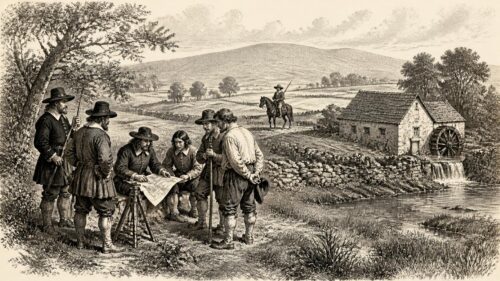
In 1654, the Commonwealth sought to consolidate Cromwellian conquest through transplantation, surveys and institutions. Catholics deemed liable to removal faced a 1 May deadline to move to Connacht or Clare, though enforcement proved uneven amid exemptions, shortages and local dependence on tenants. Courts of survey launched the Civil Survey, recording pre-war ownership, resources and boundaries to facilitate confiscation and redistribution. Charles Fleetwood, appointed Lord Deputy, pursued a hard settlement despite divisions among Protestants and intervention over exemptions. Ireland gained Westminster representation without an Irish parliament. In December, William Petty’s contract initiated preparations for the Down Survey, making dispossession administratively durable.
Read Article

Archived: 14 October 2026
Abstract
In 1653, the Commonwealth completed Ireland’s military conquest as Sir Phelim O’Neill was executed and Philip O’Reilly surrendered Cloughoughter Castle, the last formal Irish Catholic field-force stronghold. Catholic clergy faced expulsion, while Hugh O’Reilly’s death symbolised ecclesiastical disruption. Commonwealth plans shifted towards settlement: Connacht and Clare were designated for transplantation, and forfeited estates were prepared for soldiers and Merchant Adventurers through surveys and land allocation. These measures threatened Catholic proprietors and reshaped local society amid famine, disease, depopulation and insecurity. Cromwell’s Protectorate consolidated London-directed rule, inaugurating a Protestant military state whose post-war settlement rested on confiscation, displacement and administrative control.
Read Article




