

Petty’s Field Books1656 CE
In 1656, Cromwellian Ireland was being reorganised through Sir William Petty’s Down Survey, which recorded land, boundaries and value to distribute forfeited estates among soldiers and adventurers. Field books enabled officials to assess claims while reserving specified public and ecclesiastical lands. This administrative project underpinned confiscation and the uneven, coercive transplantation of Catholic landholders to Connacht and Clare, affecting rural society beyond formal removals. Henry Cromwell sought firmer Protestant civil government amid army and religious divisions, while war with Spain heightened security concerns. Catholic communities endured repression; Quakers faced persecution. Ussher’s death, Ware’s Patrick edition, and Molyneux’s birth reflected continuity.
Dateline
In 1656, Ireland’s conquest was being converted into paperwork. The major battles of the Cromwellian campaign had ended, but the country was far from settled in any ordinary sense. Its political order rested on a large occupying army, its Catholic landholding class faced confiscation and displacement, and its towns and countryside were being refashioned to reward soldiers, creditors and Protestant settlers. The most consequential work of the year was therefore not a single clash or proclamation, but the measured, written and mapped remaking of possession.
Surveying a Conquered Country
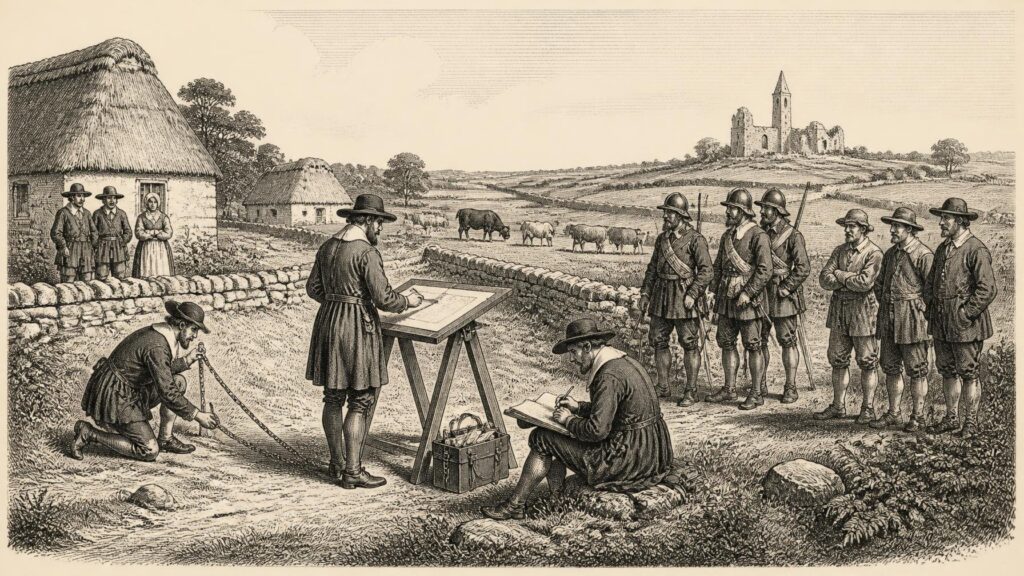
Sir William Petty’s Down Survey lay at the centre of that process. Commissioned to provide a detailed measurement of lands available to satisfy the arrears owed to the Commonwealth army, it was an extraordinary administrative enterprise. Petty’s teams measured land at local level, recording baronies, parishes, townlands, boundaries and the distinction between profitable and unprofitable ground. Maps and accompanying books turned complicated local landscapes into information which Dublin and Westminster could use for allocation.
It is important to be precise about the chronology. The Down Survey was undertaken across 1656–58, rather than completed in one clean moment during 1656. Yet Petty’s own account places the delivery of the principal survey of army lands at about the beginning of March 1656. In the same month, the Irish Council set a committee alongside Petty to examine the field books. These were not simply maps in the modern sense. They were working instruments through which claims could be tested, acreage calculated and estates set out for creditors and soldiers.
Further instructions from the Protector, dated 27 March, required particular categories of land to be marked off from forfeited property: crown lands, the estates of bishops, deans and chapters, corporate towns, and commons of pasture. An order of 3 September then addressed lands not yet included. Such measures show both the scale of the operation and the limits of central knowledge. Ireland could not be redistributed until officials knew, however imperfectly, what land existed, who had held it, what revenues it might yield and which areas the state meant to retain.
The survey’s technical achievement should not obscure its political character. It was among the earliest detailed national land surveys in Europe, but it was designed within a coercive settlement. Its practical purpose was to facilitate the transfer of much formerly Catholic-owned land to soldiers and ‘adventurers’ – financiers who had advanced money for the parliamentary war effort on the expectation of Irish land as security. A line on a map could therefore be the beginning of a new estate, a new tenancy and a new local balance of power.
Land, Arrears and Transplantation
The legal and military background to this work pre-dated 1656. The Act for the Settlement of Ireland of 1652 and subsequent measures had established a framework for punishment, forfeiture and the satisfaction of army and adventurer claims. By 1656 the harder task was execution. The government had promised land to men who had served in the conquest, while also trying to remove or contain many Catholic proprietors whose former estates were required for that purpose.
‘Transplantation’ to Connacht and County Clare was the most notorious element of the scheme. It did not mean that every Catholic inhabitant of Ireland was successfully driven west of the Shannon, nor should the later popular phrase ‘To hell or to Connacht’ be treated as the wording of a single contemporary order. Implementation was uneven, contested and administratively difficult. Many people who were supposed to move did not do so; exemptions, licences, local arrangements and shortages of available land complicated the policy. Nonetheless, the possibility of displacement was profoundly real for Catholic landholders and their families, and the machinery of government continued to enforce it.
A Dublin broadside published in 1656 demonstrates that Irish Catholics remaining in part of County Dublin were still being regulated under earlier declarations. That narrow surviving notice is a reminder that settlement policy did not concern only distant Connacht. It touched the capital’s hinterland, where security anxieties and the desire to create a dependable Protestant zone around the seat of government shaped official action.
For ordinary rural people, the changes were not confined to those formally ordered to transplant. New owners needed tenants, rents, livestock, labour and grain. Some newcomers depended on established inhabitants to keep farms productive, while former proprietors and their dependants faced loss of standing, insecure residence and fractured networks of patronage. The distinction between a proprietor, a tenant, a servant, a soldier and a dispossessed follower could determine whether a family retained access to a house, a field or a community. The survey’s categories made land legible to the state; they could not capture the human cost of remaking it.
Henry Cromwell’s Unfinished Government
Oliver Cromwell was Lord Protector of the three kingdoms, but day-to-day Irish government depended on the Dublin administration and its army. Henry Cromwell, Oliver’s son, had become the central political figure in Ireland after Charles Fleetwood’s departure in 1655. In 1656 he exercised substantial authority as commander and senior administrator, although he would not formally be appointed lord deputy until November 1657.
His position reflected a larger effort to replace the dominance of radical army officers with a more durable civil and Protestant governing interest. This was not a turn towards equality for the conquered Catholic majority: confiscation and coercive settlement remained integral to the regime. It was, rather, a contest over how a Protestant military conquest might be stabilised, financed and made governable. Henry Cromwell favoured a stronger administrative order, closer co-operation with established Protestant interests and less scope for officers whose religious radicalism made them politically unpredictable.
By late 1656, leading Baptist officers had been pressed to resign their commissions or leave Ireland. The episode reveals the unsettled nature of Commonwealth rule. The government that imposed restrictions on Catholics also contained sharp divisions among Protestants over church discipline, liberty of conscience and the army’s political role. Moreover, the outbreak of war between the Protectorate and Spain in 1656 revived fears of attack on Ireland and reinforced the costs of maintaining garrisons and naval security. Peace within Ireland was thus military peace: dependent on troops, revenue and vigilance rather than on broad consent.
Faith Beyond the Settlement
Religious life in 1656 cannot be reduced to a simple contest between an official Protestant state and a Catholic population. Catholic worship and clergy operated under severe pressure, while the established church and the various Protestant congregations competed for influence in the new order. The period also witnessed the growth of Quakerism, whose insistence on direct spiritual experience, refusal of oaths and resistance to tithes unsettled both civil officials and established clergy.
William Edmundson, a former soldier who had helped establish the first regular Quaker meeting in Ireland at Lurgan in 1654, farmed in County Cavan from 1656 to 1659. Belturbet, a plantation town on the Cavan–Fermanagh border, became one of the places associated with the movement’s early spread. Quaker preaching and meetings created a religious network outside parish conventions, but they also prompted persecution. In Limerick, Governor Henry Ingoldsby forbade interaction with Quakers during 1656 on pain of expulsion from the city. Such an order conveys the authorities’ fear that a small, mobile and dissenting religious body might challenge civic and ecclesiastical discipline.
At the other end of Protestant intellectual life, the death of James Ussher on 21 March closed the career of the Church of Ireland archbishop of Armagh and one of Europe’s most learned Protestant scholars. Ussher died in England, where he had lived during the upheavals of the preceding years, and Oliver Cromwell ordered him a state funeral at Westminster Abbey on 17 April. His burial with Anglican rites under a regime often hostile to episcopacy was a striking acknowledgement of his stature, but it also illustrated the odd compromises of the Protectorate.
Irish scholarship retained other forms of continuity. In 1656 Sir James Ware published the first printed edition of St Patrick’s Confessio and Letter to Coroticus, drawing on ancient manuscripts including the Book of Armagh. Produced in London, Ware’s edition was an Irish antiquarian landmark: a recovery of early Christian texts at a moment when the physical ownership of Ireland itself was being reordered. The contrast is telling. While surveyors measured fields for confiscation, scholars edited manuscripts that preserved a much older Irish past.
A Dublin Child and a Longer Future
On 17 April 1656, William Molyneux was born in Dublin into a well-connected Protestant family. His birth did not alter the politics of that troubled year. Yet his later career as a natural philosopher, political writer and founder of the Dublin Philosophical Society offers a useful glimpse of the social world being reconstructed around the capital: urban, Protestant, educated and increasingly connected to the intellectual currents of Britain and Europe.
For most people living through 1656, however, the future was less abstract. The decisive facts were the pressure of soldiers, the changing ownership of farms, the reach of official orders, the persistence of Irish Catholic communities, and the uneasy growth of new Protestant congregations. Petty’s field books did not settle those questions. They supplied the state with the means to act upon them, leaving a cartographic record of a country whose land, authority and everyday life were being forcibly rearranged.
Primary Sources
- The Down Survey of Ireland
- About the Down Survey
- Book of Survey and Distribution: County Roscommon, Volume I
- Add MS 72868-72873: Petty Papers, Down Survey
- Add MS 72877: Orders, Warrants, Petitions etc. Relating to the Down Survey
- The History of the Survey of Ireland, Commonly Called the Down Survey
- Sir William Petty: History of the Down Survey of Ireland
- Cromwell, Henry
- Cromwell, Oliver
- The Correspondence of Henry Cromwell, 1655–1659
- Prelude to Restoration in Ireland: The End of the Commonwealth, 1659–1660
- Enforcing Transplantation, 1655–1659
- The Transplantation to Connacht, 1654–58
- Ireland under the Commonwealth: Documents Relating to the Government of Ireland from 1651 to 1659
- By His Highness the Lord Protectors Council for the Affairs of Ireland
- Ireland. By the Deputy of Ireland
- Order Book (Council), 1656–8
- Statute Law Revision Act 2015
- Edmundson, William
- Guide to Irish Quaker Records
- Religious Society of Friends (Quakers): Limerick Papers
- Ussher, James
- The First Print: Sir James Ware’s Edition of 1656
- Molyneux (Molyneaux), William
- From Cromwell to the Boyne