
Portarlington’s French Register1694 CE
In 1694, Ireland’s post-Williamite settlement advanced through administration rather than warfare. Commissioners began hearing claims under the Articles of Limerick, determining Jacobites’ rights to property, livelihoods and legal protection. Dublin’s Lords Justices managed revenue, including hearth-money exemptions, while debating a parliament whose supply might secure Protestant interests; no parliament met. Government fasts, Trinity College’s centenary celebration and Jonathan Swift’s diaconal ordination reflected Protestant public culture. Portarlington’s French Reformed register documented an emerging Huguenot community. Rewards for robbers and alleged rebels showed continuing insecurity. Queen Mary II’s death made William III sole monarch, leaving Ireland’s constitutional, religious and property settlement unfinished.
Dateline
In 1694 Ireland was no longer a battlefield in the open sense. The Williamite war had ended with the Treaty of Limerick in October 1691, but peace had not settled the central questions left by the conflict: who could safely possess land, who would pay for government and the army, how far the crown must honour its promises to defeated Jacobites, and what sort of Protestant polity would now govern the kingdom. The year’s most revealing developments were therefore administrative rather than spectacular. Proclamations, claims hearings, private political correspondence and a newly begun French church register show a country being re-ordered after war.
The government in Dublin was exercised by three Lords Justices: Henry, Lord Capell; Sir Cyril Wyche; and William Duncombe. Their task was difficult. Ireland remained part of William III and Mary II’s wider war against Louis XIV, and its civil establishment and garrison required money. At the same time, many Protestant political leaders expected the victory over James II to secure not only the crown but also property, office and religious ascendancy. For Roman Catholics who had supported James, and even for those seeking merely to resume ordinary life, the practical meaning of the peace remained uncertain.
Claims After Limerick
The most consequential firmly dated business of 1694 concerned the settlement promised after the war. On 16 February a proclamation gave directions to the Commissioners for Forfeitures. On 23 May another announced that claims to the benefit of the Articles of Galway and Limerick would begin to be heard on 11 June. These notices did not themselves decide ownership. Their importance lay in bringing individuals into a formal process through which estates, goods and legal protections could be claimed, challenged and defined.
The Civil Articles of Limerick had offered protections to named categories of Jacobite supporters who submitted to William and Mary, took the oath of allegiance and fulfilled the treaty’s conditions. Their wording mattered intensely. Article II addressed estates and interests; other provisions envisaged the continued exercise of trades and professions by those protected. Yet the treaty was not a simple restoration of the pre-war world. Many former Jacobites had departed with the Irish army for France, others had been excluded by time limits or legal qualifications, and much property was already in the hands of the crown, tenants or new occupants. A hearing in 1694 could determine whether a family retained a livelihood or saw an estate treated as forfeited.
This was therefore a year in which paperwork became an instrument of the post-war settlement. Claimants needed evidence of residence, allegiance, title and inclusion within the articles. Officials had to distinguish treaty beneficiaries from those deemed outside its protection. The procedure was legal, but its consequences extended far beyond the courtroom: land supported tenants, labourers, clergy, local credit, marriage arrangements and influence in county society. It also supplied an enduring source of grievance, because the treaty was interpreted in an atmosphere where Protestant security and royal finance were frequently presented as competing with Catholic claims.
Revenue, Parliament and Power
Other proclamations expose the pressures beneath this constitutional argument. On 3 March the government addressed exemptions from hearth money, a tax assessed by the number of fireplaces in a dwelling. Such a measure reminds us that the reach of government was felt in homes as well as in Dublin Castle: liability depended upon household conditions, while exemptions required official recognition. Revenue was not an abstract issue. Taxes paid for administration and defence, but they also provoked disputes about poverty, privilege and fairness.
These financial needs stood behind the largest political question of the year: whether, and on what terms, an Irish parliament should meet. The previous parliament had quarrelled with the administration over the Commons’ claimed sole right to begin money bills. That dispute touched the balance between the crown’s prerogative, exercised through the Irish and English privy councils, and the authority claimed by elected Irish MPs over taxation.
In a letter of 14 July 1694, Wyche and Duncombe acknowledged strong reasons for summoning parliament: a shortage of money for the monarchs’ service and a need for laws. They nevertheless feared that a new Commons might revive the earlier constitutional contention. Capell took a more hopeful line. He believed that agreement might be managed and that a parliament could be useful if political tempers were calmed. The contrast was not a technical disagreement alone. It revealed rival assessments of the Protestant political class which had emerged dominant from the war.
By August, correspondence from London indicated approval in principle for a parliament, but not before the spring, so that it would not sit at the same time as the English parliament. Capell continued planning through the autumn. On 19 October he wrote of the preparatory work required before bills could be sent to the English Privy Council and an Irish parliament could open. No parliament actually sat in Ireland during 1694. That negative fact is important: the year was one of negotiation and preparation, not of enacted settlement.
It is equally important not to project later legislation backwards. The harsh measures commonly called the Penal Laws were not passed in 1694. However, Capell’s developing programme already connected parliamentary supply to measures intended to strengthen the Protestant interest, including restrictions directed at Catholics’ arms, horses and foreign education. In November he set out personnel changes he believed necessary for the coming political arrangement. The bargain taking shape in 1694—financial cooperation in exchange for Protestant security legislation and office—would bear legislative fruit in 1695.
Religion, Loyalty and Public Ceremony
Religion remained inseparable from politics, yet it was also expressed in ordinary worship, education and ritual. The Lords Justices proclaimed a general fast for 13 July. Such fasts belonged to the public religious culture of the Protestant state: congregations were called to prayer and humiliation in a kingdom still governed under the shadow of European war and recent domestic conflict. The proclamation offers secure evidence of the observance ordered by government; it should not be treated as proof that all communities marked it alike.
Dublin’s established church and university marked a more celebratory occasion on 9 January. Trinity College commemorated the first secular day of its second century with a sermon by its provost, St George Ashe. Henry Purcell’s ode Great Parent, Hail!, with words by the former Trinity scholar Nahum Tate, was performed in connection with the celebration, alongside John Blow’s anthem I Beheld, and Lo!. Contemporary and later accounts differ over whether every part of the musical occasion was located in Trinity or Christ Church Cathedral, but the date and the scale of the commemoration are clear. Its praise of William and Mary was not decorative flattery alone. Trinity had suffered during the revolutionary years, and the event presented the restored Protestant order as a patron of learning.
Late in the year, on 28 October, William Moreton, bishop of Kildare and dean of Christ Church, ordained Jonathan Swift as a deacon. Swift was then a 27-year-old Dublin-born graduate whose later writings would make him one of the era’s most formidable satirists. In 1694, however, this was simply the beginning of his clerical career. His priestly ordination and appointment to the prebend of Kilroot came in January 1695; keeping that chronology straight prevents a later literary reputation from obscuring the modest, ecclesiastical reality of the year itself.
A French Community in the Midlands
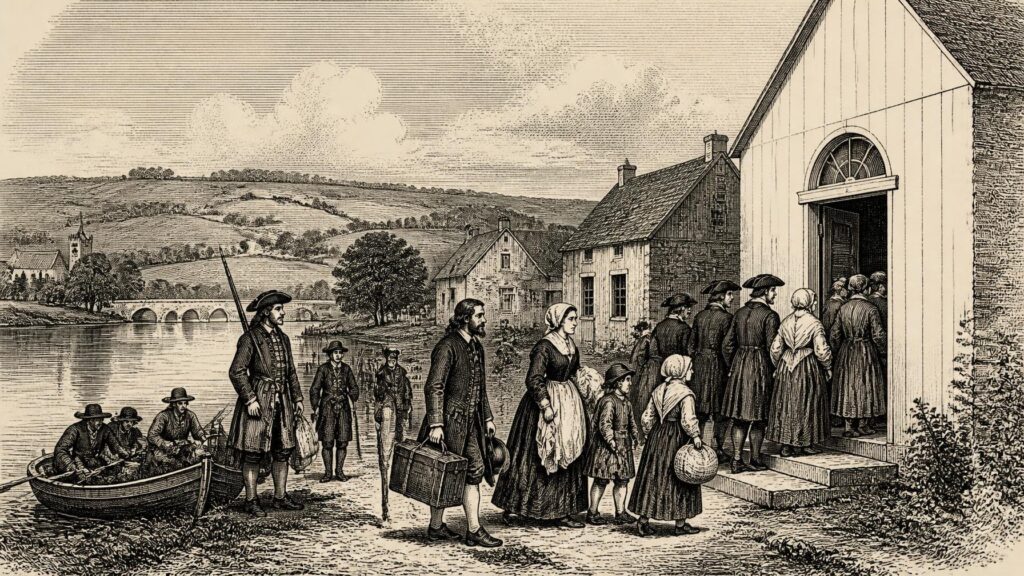
One of 1694’s quieter beginnings had a long cultural afterlife. At Portarlington, in Queen’s County, the register of the French Reformed church began in French. The town was becoming a refuge for Huguenots—French Protestants displaced after Louis XIV’s revocation of the Edict of Nantes—and for veterans and families connected with Williamite service. The register is firmer evidence than later romantic descriptions: it shows that a disciplined French-speaking Protestant congregation had acquired enough permanence to record baptisms, marriages and burials.
Portarlington’s growth joined local reconstruction to international conflict. The settlement offered refugees religious continuity, while the Williamite regime gained inhabitants regarded as loyal Protestants in territory transformed by war and forfeiture. French worship, schooling, craft knowledge and family networks would give the town a distinctive identity for generations. Yet in 1694 this should be understood as an emergent community, not a finished model town. Later churches, schools and much of the built fabric belonged to subsequent years.
Order Beyond Dublin
Government proclamations also provide glimpses of insecurity below the level of high politics. On 19 October a reward was offered for information about a robbery at Youghal, an important Cork port. In December, a proclamation promised pardon and reward for the apprehension of Dermot Leary and other named “notorious rebels”, associated chiefly with the mountainous districts of Cork. The language was the government’s, and it should not be accepted uncritically as a neutral description of every person named. Nonetheless, the order demonstrates that armed fugitives or organised bands remained a concern three years after Limerick.
For communities in the south-west, the end of regular campaigning had not erased the dangers created by disrupted landholding, disbanded soldiers, local enmities and difficult terrain. A reward notice was both an effort to capture suspects and a demand that neighbours supply information. It shows the state attempting to extend post-war authority through sheriffs, magistrates, parish networks and financial incentives, rather than through the great armies of 1690 and 1691.
A Crown Transformed
On 28 December Queen Mary II died at Kensington Palace. Her death occurred outside Ireland, but it immediately altered the crown under which Ireland was governed: William III, hitherto joint monarch with Mary, became sole king. In Dublin, policies, proclamations and claims had all been issued in the names of William and Mary. The change gave particular force to the year’s unfinished questions. Irish government was dependent on decisions made across the Irish Sea; parliamentary plans, treaty interpretation and the distribution of patronage all required royal approval.
Thus 1694 was not a year of a single decisive Irish battle or statute. It was the year in which the settlement after the Williamite war was tested in hearings, taxes, correspondence, church ceremony and the formation of new communities. The political compromises devised in Dublin Castle were still incomplete, and the security promised at Limerick was still being argued over. But the institutions and assumptions that would shape Protestant Ireland in the later 1690s were already being assembled.
Primary Sources
- Statute Law Revision Act 2015
- Chief Secretary's Office: entry book of papers signed by the Lord Lieutenant, Lords Justices or Chief Secretary, 28 Aug 1692–15 Feb 1695/6
- CAPELL, Henry (1638–96)
- Capel (Capell), Sir Henry
- Securing the Protestant interest: the origins and purpose of the penal laws of 1695
- The Treaty of Limerick, 1691
- Hearings Scheduled for Adjudication Under the Articles of Limerick, 1694
- Newly Published: A List of the Claims, 1700
- Versions: Henry Capel, Lord — Parliament
- Copy of Instructions for Henry, Baron Capel, Sir C. Wych, and W. Duncombe, Justices and Commissioners of the Kingdom of Ireland, June 26, 1693
- Private Sources at the National Archives
- The Huguenot Settlement at Portarlington, Ireland
- Portarlington, Ireland, 1694–1816: Parish Records
- The Book of Trinity College, Dublin, 1591–1891
- Thesis Vol 1 — Music at Christ Church Cathedral, Dublin
- Moreton (Morton), William
- Swift, Jonathan
- The Irish Revenue System: Government and Administration, 1689–1702
- The Williamite Confiscation in Ireland, 1690–1703
- English Ministers, Irish Politicians, and the Making of the Eighteenth-Century Irish Constitution
- Life of Lord Chancellor Porter — Continued
- A Jacobite Narrative of the War in Ireland