Public Bank1721 CE
In 1721, Ireland’s proposed public bank collapsed amid post-South Sea Bubble distrust, disputes over credit, land, religious exclusion and dependence on Westminster, recently reinforced by the Declaratory Act. Although supporters sought cheaper loans and retained capital, the Commons rejected the scheme, first narrowly in October and decisively in December, preserving fragmented private finance. Land and influence remained central: Charles Butler regained Ormond estates under British sanction, William Ponsonby became Baron Bessborough, and Luke Gardiner acquired land developed as Henrietta Street. Linen exports linked rural households to imperial markets, while Catholic institutions endured restrictions. Government pursued disorder and imposed plague precautions.
Dateline
In 1721, the most revealing Irish event was not a battle or a rebellion but the collapse of an attempt to create a public bank. The proposal exposed anxieties about money, land, religious hierarchy and constitutional dependence at a moment when the effects of the South Sea Bubble were still fresh. It also showed that Ireland’s political elite could oppose a project promoted under royal authority, though only within a system whose limits had recently been restated by Westminster. Around that dispute, the year brought quieter but consequential signs of change: landed fortunes were rearranged, Dublin’s north side acquired ground for a future Georgian street, linen continued to bind rural households to overseas markets, and government watched both disorder inland and disease arriving by sea.
A Parliament Under Constraint
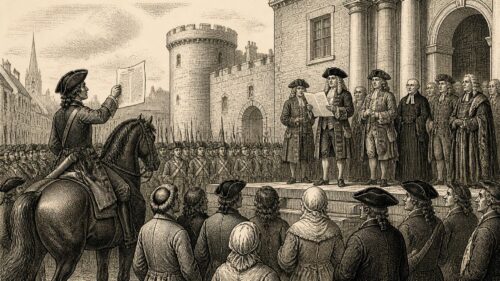
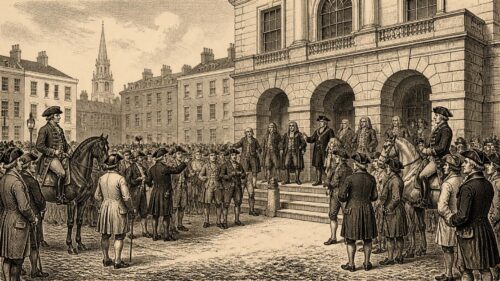
George I was king of Ireland in 1721, but the country’s parliament did not exercise sovereignty in the modern sense. In April 1720, the British Declaratory Act had explicitly asserted Westminster’s authority to make laws binding Ireland and to hear Irish appeals. That constitutional blow formed the background to the Irish parliamentary session which opened on 12 September 1721, its first meeting for almost two years. The session gave Irish members an opportunity to address local finance and trade, but it also made plain the difficulty of doing so in a kingdom politically subordinate to Great Britain.
The proposed bank therefore carried meanings far beyond deposits and loans. Its backers presented it as an answer to a scarcity of coin, expensive credit and the outward movement of Irish money into London-centred investments during the South Sea boom. In 1720, subscriptions for an Irish bank had been sought at Dublin’s Merchant’s Coffee House, with a proposed capital of £500,000. By 1721 competing schemes had been combined. A charter dated 29 July linked the projected institution to the repayment of £50,000 of Irish public debt, but required parliamentary legislation before the enterprise could operate securely.
The Appeal of Credit
For supporters, a public bank promised to put credit on a steadier footing. Ireland already had private bankers, merchants’ bills of exchange and paper obligations, but their reach was limited and confidence in them rested heavily on individual reputations. The crash of the South Sea Company’s share price in 1720 had made the dangers of speculative finance unmistakable, while also demonstrating how quickly money and information could circulate between Dublin and London. A properly constituted bank, proponents argued, could make loans cheaper, give commerce a more dependable medium of exchange and retain capital within Ireland.
Henry Maxwell, an Irish MP, became the best-known parliamentary advocate. His Reasons Offer’d for Erecting a Bank in Ireland, printed in Dublin in 1721, argued publicly with Hercules Rowley, a fellow MP and opponent. Their exchange was not abstract economic theory. It addressed practical questions familiar to landlords, traders and borrowers: whether land or commercial assets should underpin credit; whether notes would be redeemed; whether a corporation could lower interest; and whether the proposed capital was real rather than merely promised.
The controversy also made Dublin’s print culture politically important. Pamphlets enabled arguments first framed among office-holders, MPs and subscribers to reach coffee-house readers and a wider Protestant public. Jonathan Swift’s earlier satire The Swearer’s Bank, written during the bank agitation of 1720 and circulating in 1721 editions, mocked the language of financial promotion. Swift should not be treated as the sole author of the parliamentary defeat, but his satire belonged to an atmosphere in which new paper schemes could readily be described as bubbles, tricks or threats to the public.
Fear of a Public Bank
Opposition was not simply hostility to trade. Many MPs accepted the value of commerce while questioning who would control credit and for whose benefit. The recent South Sea collapse made a joint-stock undertaking seem particularly hazardous. Critics feared that a bank’s notes might prove insecure, that its directors could acquire improper influence, or that its privileges could serve government finance rather than Irish economic needs. The example of the Bank of England was double-edged: it showed the power of a national bank, but also its close connection with state borrowing and war.
Landed interest was central to these fears. Much Irish political power rested on estate ownership, rents and the county electorate, not on a broad commercial public. A bank capable of lending against forms of security other than land might change the balance between landed gentlemen, merchants and professional financiers. It might also, opponents suggested, allow Roman Catholics to accumulate wealth in a corporate investment at a time when the Penal Laws severely constrained Catholic propertyholding and excluded Catholics from Parliament and most political power. This was not a debate among equal participants: Catholic Irish people had no parliamentary voice in the decision that could affect the routes by which wealth was acquired.
Nor were the opponents a unified anti-modern bloc. Dublin’s private bankers had reason to dislike a privileged competitor, especially one expected to lend at lower rates. Some parliamentarians were indebted to them; contemporary rumours alleged pressure and corruption, though such claims should not be accepted uncritically. The important point is that the bank dispute revealed a crowded financial world already present in Ireland: private banking, merchant credit, overseas investment, landed mortgages, paper notes and a politically active reading public.
The Vote That Ended the Project
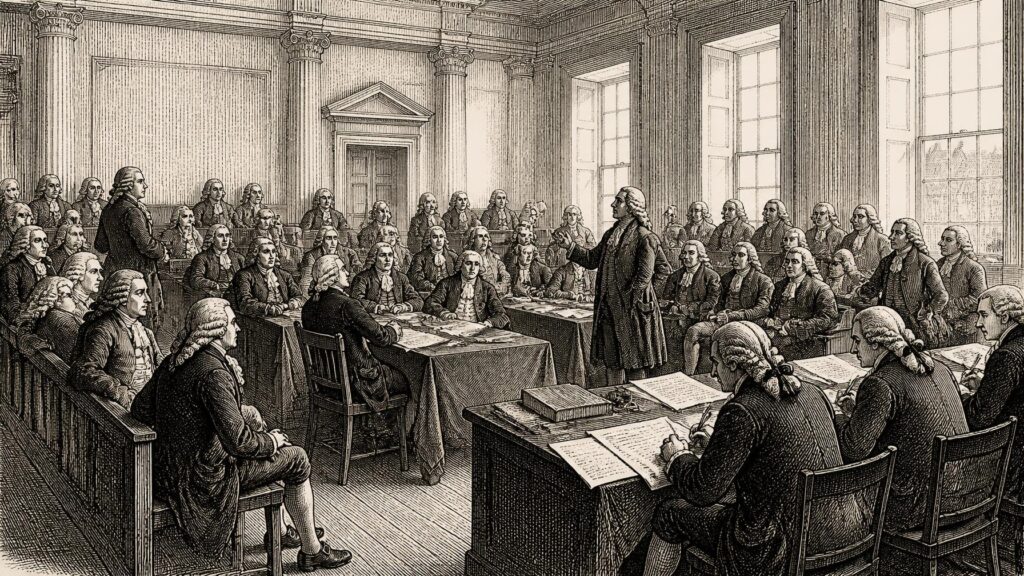
Initial parliamentary business in September was favourable enough to keep the plan alive. The decisive reversal came on 14 October, when the Commons rejected the first clause of the bank bill by 103 votes to 95. A further motion postponed consideration for two months, effectively allowing opponents time to organise and the pamphlet controversy to intensify. The close division matters. The scheme did not fail because Ireland lacked interest in banking; it failed because a substantial parliamentary minority could not overcome an equally substantial and increasingly alarmed opposition.
When the Commons returned to the matter in December, the rejection was emphatic. Members resolved that they could find no safe basis for a public bank that would make it beneficial to Ireland, and rejected both the proposal and its charter by 150 votes to 80. The Lords soon adopted a corresponding hostile resolution. Both Houses treated renewed efforts to establish such a bank as a national danger. The immediate result was not the disappearance of banking, but the preservation of a more fragmented financial system dominated by private arrangements. The institution called the Bank of Ireland would not be founded until 1783; it should not be confused with the abortive venture of 1721.
Estates, Titles and Urban Ground
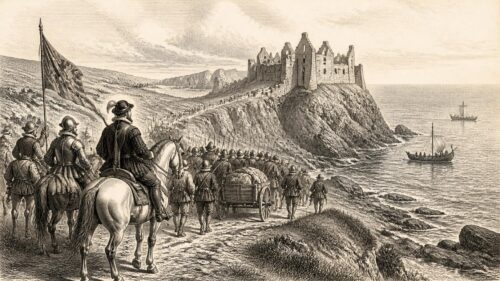
Elsewhere, 1721 demonstrated the continuing importance of land as the chief language of status and political security. On 24 June, a private Act of the Parliament of Great Britain enabled Charles Butler, second earl of Arran, to purchase the Irish estates forfeited by his brother, James Butler, second duke of Ormond. Ormond had been attainted after his Jacobite involvement and lived in exile. The arrangement did not simply restore a dispossessed family: it placed recovery of a great Irish estate under British parliamentary sanction, illustrating how property, loyalty and imperial politics remained entwined.
On 11 September William Ponsonby was created Baron Bessborough, of Bessborough in County Kilkenny, and he took his seat in the Irish Lords on 23 September. The honour marked the advancement of a family whose estate and parliamentary influence would become major features of eighteenth-century Irish politics. Such creations mattered because the Irish House of Lords was not merely ceremonial. Peerages altered access to legislation, patronage and the political management of counties and boroughs.
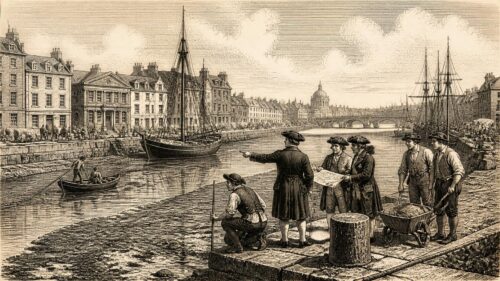
Dublin’s future physical shape was also being prepared. On 12 April, the banker and developer Luke Gardiner bought six acres near Drumcondra Lane for £850. During the following decade, part of this land became Henrietta Street, among the earliest and grandest Georgian residential developments in Dublin. In 1721 it was still ground rather than a finished streetscape, but the purchase captures the city’s expansion and the capacity of banking profits, land speculation and elite demand for housing to remake its northern edge.
Work, Worship and Watchfulness
The wider economy remained overwhelmingly rural, but it was linked to markets across the Irish Sea and Atlantic. Linen was especially important. Official figures for the year ending Lady Day 1721, so covering much of the preceding twelve months rather than the calendar year alone, record 2,398,103 yards of Irish linen cloth exported to Great Britain and 95,488 yards to the plantations. Behind such totals lay household labour: flax growing, scutching, spinning and weaving were commonly divided among members of farming families. The trade did not make every producer prosperous, but it connected Ulster and other linen-producing districts to imperial demand and offered an alternative to dependence on cattle and provisions.
Religious life continued beneath an unequal legal order. The established Church of Ireland possessed public authority, while Catholic worship survived through a mixture of legal restriction, registration and local tolerance. In 1721 the Dominican convent in Dublin was officially recognised by the Order’s general chapter, and its nuns received permission to elect their own superior. This small institutional milestone should not be mistaken for Catholic equality; rather, it shows how religious communities maintained organisation and continuity despite the Penal Laws.
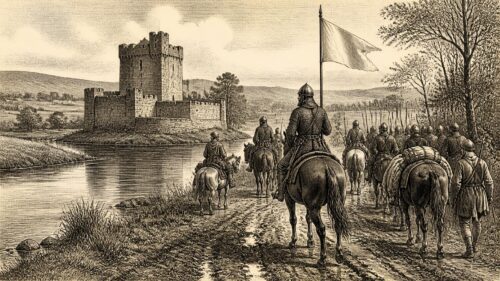
Government proclamations reveal other official concerns. On 10 July, people proclaimed as tories, robbers or rapparees in Tipperary, Donegal, Clare, Antrim and Kildare were ordered to surrender. The wording was deliberately broad and reflects the state’s habit of treating criminality, armed wandering and residual political disorder together. In October, fear of plague also reached Ireland’s ports. Proclamations imposed quarantine on a Dutch frigate carrying disease and regulated the admission of people arriving from France and Italy, where the aftermath of the Marseille plague continued to alarm European governments. These measures do not show that plague took hold in Ireland; they show instead an island administration attempting to control the risks carried by maritime connection.
Thus 1721 was a year in which Irish society confronted connection as both opportunity and danger. Credit tied Dublin to London’s financial shocks; linen joined household work to overseas consumers; sea routes brought both commerce and fears of infection; and land remained the most secure foundation of political power. The defeated bank became the year’s sharpest test of these tensions, exposing a political class willing to regulate finance but unwilling to trust a new public institution with the power to transform it.

Primary Sources
- The Bank of Ireland, 1721: Land, Credit and Dependency
- The South Sea Bubble and Ireland: Money, Banking and Investment, 1690-1721
- Appendix 1: The Division in the Irish House of Commons on the Bank, 14 Oct. 1721
- Oireachtas L&RS Display Case: National Bank of Ireland Pamphlets
- Journals of the House of Commons of the Kingdom of Ireland
- Irish Legislation Database: Sources
- Reasons Offer'd for Erecting a Bank in Ireland
- The Prose Works of Jonathan Swift, Volume VII
- Irish Economics, 1700-1783: A Bibliography with Notes
- The Exchange Business of the Irish Banks in the Eighteenth Century
- Butler, Charles
- Gardiner Papers: Introduction
- Anglo-Irish Architectural Exchange
- Introduction to the Bessborough Papers
- The Active Irish Peers in the Early Eighteenth Century
- The Commercial Restraints of Ireland
- The Provision Trade
- Religion
- The 20th Annual Sir John T. Gilbert Lecture: Transcript
- The Penal Laws: Origins, Purpose, Enforcement and Impact
- Statute Law Revision Act 2015
- State Papers Online: Ireland, 29 July 1721
- Add MS 6116: British Library Archives and Manuscripts Catalogue
- The Bank Notes Act 1721