
Penn’s Cork Arrest1667 CE
In 1667, Restoration Ireland experienced postwar settlement as courts and officials resolved contested land claims under the Acts of Settlement and Explanation. Ormond’s administration stressed legal procedure, military discipline and strained finances, while English restrictions on Irish cattle threatened trade and exposed Ireland’s dependence on Westminster. Dutch naval successes prompted defensive preparations at Kinsale before the Treaty of Breda ended the war. Protestant institutions strengthened, yet religious conformity was enforced: William Penn was arrested with Friends at a Cork meeting. Jeremy Taylor died, Jonathan Swift was born, and Alice Barry’s death marked elite change. The year revealed a fragile order.
Dateline
For Ireland, 1667 was not a year of one decisive battle or parliamentary revolution. It was a year in which the Restoration settlement was made practical, contested and felt: in courtrooms deciding who owned land; in garrisons ordered back to duty; at vulnerable harbours watching the Dutch war; and in a Cork meeting where a young gentleman’s turn towards Quakerism ended in arrest. The island was governed by James Butler, duke of Ormond, Charles II’s lord lieutenant, but the authority exercised from Dublin Castle rested on a fragile combination of armed force, land titles, Protestant institutions and connection to the English court.
The year’s securely dated episodes reveal those pressures particularly well. On 5 January Ormond proclaimed that army officers absent from their garrisons or quarters must return immediately. In May he insisted that a disputed land claim ought to be left to the sworn judges rather than decided through princely favour. During the summer, alarm after the Dutch raid on the Medway brought defensive work at Kinsale. In August Bishop Jeremy Taylor died at Lisburn after contracting fever while visiting the sick. In Cork, later in the year, William Penn’s involvement with Friends brought him into collision with civic authority. And on 30 November, Jonathan Swift was born in Dublin.
Settlement Still in Motion
The most important long-term fact behind daily life in 1667 was the post-war redistribution of property. The Restoration had not returned Ireland to the position that existed before the rebellions, Confederate wars and Cromwellian conquest. The Acts of Settlement and Explanation, enacted in 1662 and 1665, attempted to reconcile incompatible claims: those of adventurers who had financed the parliamentary war, Cromwellian soldiers paid in land, Protestant royalists, restored church institutions and Catholic landowners who petitioned for restitution.
The legal framework was already in place, but its work continued into 1667. The Court of Claims and the commissioners implementing the legislation had to translate broad statutes into possession of particular manors, town houses, tithes, tenancies and profits. Their decisions affected large proprietors most visibly, yet their consequences ran far beyond them. A new landlord, a changed lease, or the confirmation of a former soldier’s grant could alter who collected rents, appointed estate officers, controlled mills or woodland, and exercised influence in a parish. It is difficult to reconstruct the experience of every tenant from official records, and it would be misleading to pretend that all rural people encountered the settlement in the same way. Nevertheless, the settlement supplied the legal foundation for a major transfer of landed wealth and political power towards a Protestant owning class.
Ormond’s letter from Dublin of 6 May captures an important principle of his administration. Asked to support Lord Kingston’s petition over a settlement claim, he advised that the matter be left to the sworn judges. This was not evidence of a modern separation of powers; high politics, patronage and personal influence remained fundamental. But the statement shows why the appearance of lawful procedure mattered. Land titles created by conquest and adjusted by restoration were controversial enough without every disappointed claimant believing that an order from court could overturn a judicial decision.
The process was also incomplete rather than harmonious. The second Court of Claims adjourned in May 1667, but the administration still faced unresolved questions, petitions and the expensive business of grants and registrations. Ormond’s government had to maintain an army, satisfy competing interests and defend its own record in London. Ireland’s finances remained strained: the costs of governing a kingdom still marked by war and confiscation exceeded the resources readily available to the Dublin administration.
Cattle, Markets and Dependence
Economic uncertainty sharpened the political strain. Irish cattle and provisions had long supplied English consumers and English graziers who bought animals for fattening, but English landed interests resented the competition. The contested cattle legislation associated with the parliamentary session of 1667–68 was arranged to operate from 10 October 1667 and restricted the import into England and Wales of Irish cattle, sheep, swine and various salted meats. Its final royal assent came later, in May 1668, so it should not be described simply as a single January or October act. What matters for 1667 is that the impending prohibition became a real commercial threat during that year.
For Ormond and his allies, the measure was an assault on Ireland’s capacity to recover economically. Opposition to it had already entangled Ormond’s son, Thomas Butler, earl of Ossory, in Westminster disputes. The controversy demonstrated the constitutional imbalance of the Restoration kingdoms: Irish producers were subject to decisions taken in an English parliament in which Ireland was not represented. The restriction did not make Irish farming disappear, nor did it affect every district or household equally. But it encouraged a costly search for alternative outlets and helped direct attention towards other forms of export, including beef salted for distant markets. A decision framed as protection for English agriculture thus reached into the calculations of Irish landlords, graziers, merchants, drovers and port towns.
War at Sea, Anxiety Ashore
The Second Anglo-Dutch War made the sea lanes unusually dangerous. In June 1667 the Dutch raid on the Medway shocked the Stuart monarchy by exposing the weakness of naval defence close to London. Ireland was not invaded, but the event transformed a distant naval war into a plausible fear for Irish harbours. Ormond ordered Kinsale’s defences strengthened so that the port might serve as a secure refuge for shipping. The danger officials anticipated was not necessarily a great Dutch landing army; it was the forcing of a harbour, the seizure of vessels, disruption of supplies and the humiliation of an exposed government.
A surviving seaman’s journal gives this anxiety a tangible setting. Edward Barlow’s ship cruised near the west coast of Ireland, anchored in the Shannon, where he found provisions cheap ashore, and then reached Kinsale as preparations against a Dutch attack were under way. No enemy fleet appeared there. The Treaty of Breda, concluded on 31 July 1667, ended the war between England and the Dutch Republic, France and Denmark-Norway, easing the immediate alarm. Yet the episode mattered. It confirmed the strategic importance of Irish ports to the wider Stuart monarchy and reminded coastal communities that international conflict could bring soldiers, naval stores, inspections, privateering and abrupt interruptions to trade.
The proclamation of 5 January, requiring absent officers to return to their posts, belongs in this same atmosphere of administrative vigilance. It does not prove that Ireland was on the edge of rebellion or invasion. Rather, it shows a government unwilling to let its dispersed military establishment become slack at a time when settlement disputes, fiscal weakness and foreign war made discipline valuable.
Churches, Conscience and Cork
Religion remained inseparable from public order. The Church of Ireland was being rebuilt after the upheavals of the 1640s and 1650s, recovering episcopal authority, revenues and institutional confidence. In 1667 James Margetson, archbishop of Armagh, became vice-chancellor of Dublin University. The appointment linked the senior clergy to the kingdom’s principal Protestant institution of higher learning and underlined the close connection between church, education and government.
The death of Jeremy Taylor on 13 August was therefore significant beyond the locality of Lisburn. Taylor, bishop of Down and Connor, had been one of the Restoration church’s best-known writers and defenders of episcopacy. He fell ill after visiting the sick and died after about ten days. His death offers a small but human reminder that fever remained an ordinary danger, even for a well-connected bishop, while pastoral care could expose clergy as well as families to infection. It also removed an energetic figure from the Church of Ireland’s work in Ulster at a time when its structures were still being restored.
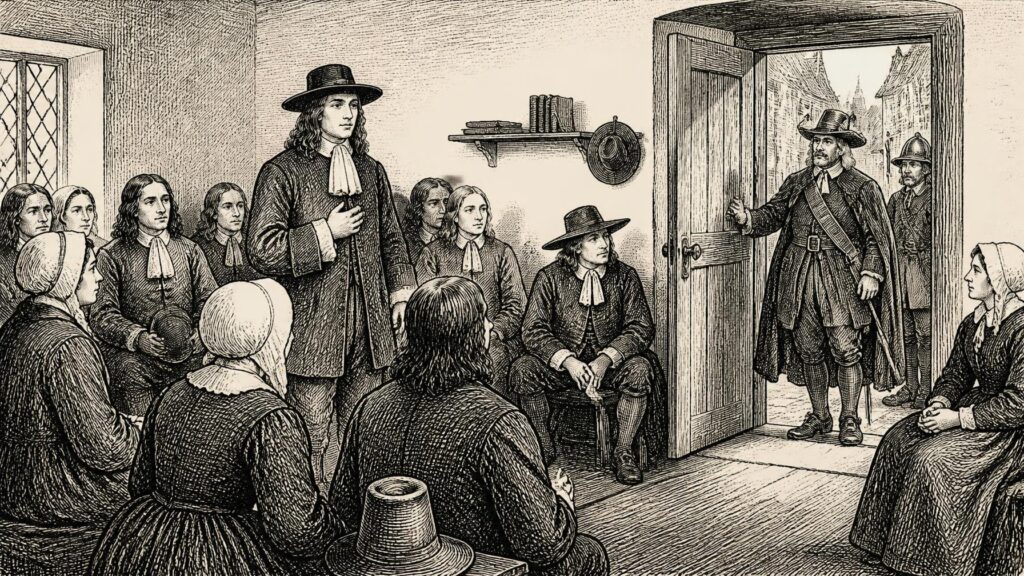
At the same time, Protestant conformity did not encompass all Protestants. Friends had established meetings in Ireland during the 1650s, including in the south. William Penn, then a young heir with family interests in Cork, encountered the Quaker preacher Thomas Loe in Cork during the summer or autumn of 1667. This encounter was a decisive stage in Penn’s movement towards Quakerism. In November he was arrested with other Friends at a Cork meeting on the mayor’s orders. The precise day is reported differently in later accounts, but the arrest itself and its month are well supported.
Penn’s social position did not make the meeting lawful in the eyes of Cork’s authorities. He appealed to Roger Boyle, earl of Orrery and president of Munster, only to be told that the mayor was applying the law. The incident exposes the limits of Restoration toleration. The regime could value Protestant unity against Catholicism and still treat unlicensed or disruptive-looking Protestant worship as a threat to civic order. For Penn, the Cork experience became part of the formation of a religious dissenter who would later advocate liberty of conscience. For Irish Friends, it showed both the vulnerability and the resilience of a small religious community whose worship could continue even when its members were imprisoned.
Lives Beginning, Lives Remembered
On 30 November Jonathan Swift was born in the parish of St Werburgh’s, Dublin, after the death of his father, a steward in the Irish law courts. Nothing in that infant’s circumstances foretold the satirist, cleric and political writer he would become, but the birth belongs to the cultural history of the year. Swift entered a Dublin shaped by English migration, Protestant institutions and the unresolved consequences of conquest. His later writing would make the relationship between Ireland and English power impossible to ignore.
Another death, less precisely dated, also marked the passing of a Restoration generation. Alice Barry, countess of Barrymore, daughter of the first earl of Cork, died in early 1667 and was buried in the Boyle tomb at St Patrick’s Cathedral, Dublin. Her surviving correspondence and household history illuminate an elite world of estates, kinship, devotion, servants, imported goods and cultural performance—worlds sustained by the very property and commercial systems being recalibrated in 1667.
Thus the year’s significance lies in convergence rather than spectacle. Ireland was being settled on paper and on the ground, its economy was threatened by policy made across the Irish Sea, its ports were drawn into a European war, and its religious boundaries were actively policed. Penn’s arrest in Cork makes the year memorable, but it was one episode within a wider Restoration order: legally elaborate, militarily watchful, commercially dependent and never entirely secure.
Primary Sources
- Act of Settlement [1662] and Act of Explanation [1665]
- Proclamation by Ormond, signed by Sir George Lane
- Ormond to Clarendon, Dublin: 6 May 1667
- Butler, James
- BUTLER, James (1610-88)
- The Irish Viceroyalty in the Restoration Period
- Charles II, 1667 & 1668: An Additional Act against the Importation of Forreign Cattel
- Butler, Thomas
- Recto: The MONKE continue to look for enemy ships, without success. They hear news of the Dutch attack on the fleet in the Medway, which Barlow blames on treachery. Verso: The MONKE assists preparations in Kinsale against a Dutch attack, but soon after peace is declared in the Second Dutch War. The MONKE returns to England.
- Penn, William
- Religious Society of Friends (Cork and Munster)
- My Irish Journal, 1669–1670
- William Penn Documents: Chronological List
- Taylor, Jeremy
- Margetson, James
- Swift, Jonathan
- Barry, Alice
- Davies, Christian (alias ‘Mother’ Ross, Kit ‘Kitty’ Cavenaugh)
- Churchill, Sir Winston
- Brodrick, Sir Alan (Allen)
- State Papers Ireland 1509-1782: government papers on Irish affairs
- Statute Law Revision Act 2015
- The Catholic Interest in Irish Politics in the Reign of Charles II
- Ireland Under the Stuarts, Volume III