
Archived: 24 October 2026
Abstract
In 1299, Ireland saw dispersed developments rather than a single national event. Theobald Butler died childless at Turvey, passing his office and lands to Edmund. John Wogan’s government relied on Richard de Burgh as deputy justiciar during his Scottish absence, following settlement of magnate conflict. Edward I protected the Curragh’s pasture by banning swine. In Annaly, Sefraid Ó Fearghail killed Meath knight Seoán de la Mare during a livestock pursuit, illustrating frontier tensions. Irish annals also noted Scottish conflict and Bishop Muiris Ó hÓcáin’s death. Misdated annalistic entries concerning Armagh and Tír Chonaill properly belong to 1303, not 1299 itself.
Read Article

Archived: 25 October 2026
Abstract
In 1267, Connacht and neighbouring districts experienced raids, destruction and political uncertainty rather than a single campaign. Drumcliff, an important ecclesiastical centre and settlement in present-day County Sligo, was completely burned with its churches, although attackers and casualties remain unknown. West Connacht Foreigners raided Carbury and Ballysadare, while Mac William Burke plundered Áed Ó Conchobair’s lands. Murchad Mac Suibne was captured in Umhall, delivered to Walter de Burgh, and died in prison. Áed recovered from grave illness amid several dynastic deaths. Bishop Romanus of Clonfert sought the pope, while annals also noted Munster murder and England’s continuing baronial civil war.
Read Article

Archived: 7 October 2026
Abstract
Around 30,147 BCE, Ireland was entering major glacial expansion during Marine Isotope Stage 3, although dating and ice limits remain uncertain. Growing upland glaciers merged towards the British–Irish Ice Sheet, particularly around the North Channel and northern Ireland, while southern ice remained more localised. Ice and meltwater reshaped bedrock and sediments, contributing to landscapes formed through repeated glaciations. Ice-free areas supported cold, open, variable vegetation and, at different times, fauna including reindeer, mammoth and giant deer. Cave evidence requires reassessment through improved dating. No secure human occupation exists; a modified reindeer bone suggests only an unproven, transient Upper Palaeolithic visit.
Read Article
Archived: 16 September 2026
Abstract
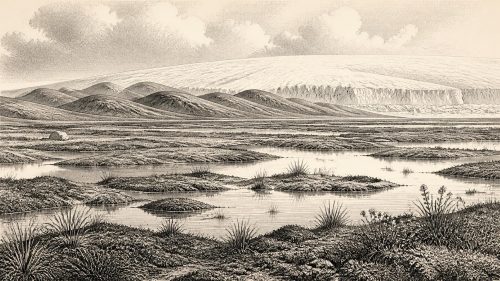
At 31,549 BCE, Ireland had no recorded human history and no secure evidence of occupation. The island formed part of a changing Late Pleistocene glacial environment, preceding the Last Glacial Maximum. Ice within the growing British–Irish Ice Sheet advanced unevenly, with Scottish and Irish centres interacting around the North Channel. At Derryvree, County Fermanagh, freshwater sediments between till layers preserve a temporary ice-free or marginal landscape of wet, treeless tundra, sedges, mosses and cold-adapted plants. Cave remains suggest reindeer, mammoth and hyena occurred during broadly comparable intervals. Glacial processes reshaped drainage, soils, coasts and landforms, establishing conditions inherited by settlers.
Read Article




