Drumcliff Burning1267 CE
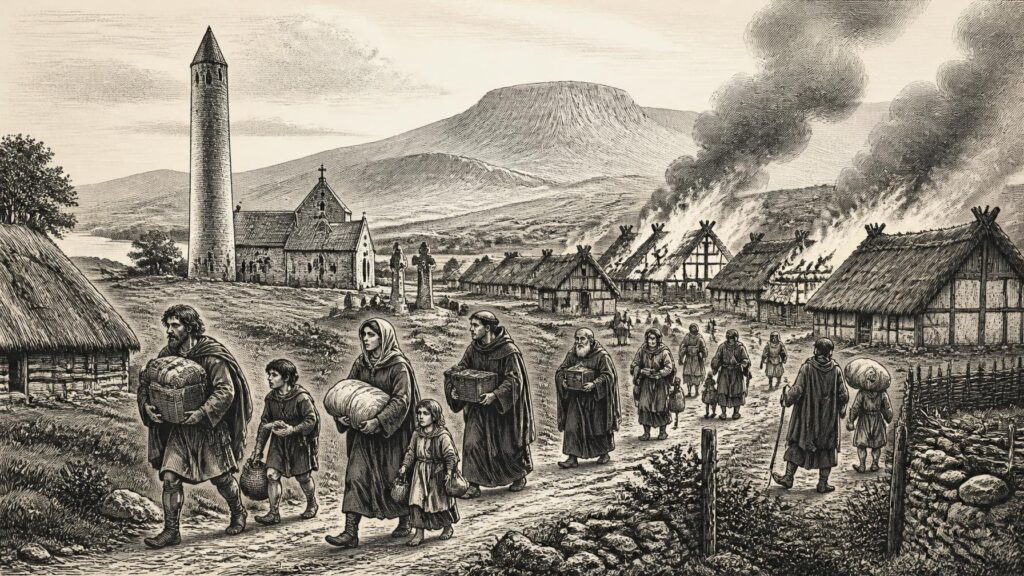
In 1267, Connacht and neighbouring districts experienced raids, destruction and political uncertainty rather than a single campaign. Drumcliff, an important ecclesiastical centre and settlement in present-day County Sligo, was completely burned with its churches, although attackers and casualties remain unknown. West Connacht Foreigners raided Carbury and Ballysadare, while Mac William Burke plundered Áed Ó Conchobair’s lands. Murchad Mac Suibne was captured in Umhall, delivered to Walter de Burgh, and died in prison. Áed recovered from grave illness amid several dynastic deaths. Bishop Romanus of Clonfert sought the pope, while annals also noted Munster murder and England’s continuing baronial civil war.
Dateline
The Irish record for this year is concentrated overwhelmingly in Connacht and its northern approaches. It depicts no single national campaign, but a landscape in which raids, retaliatory destruction, imprisonment and sudden deaths shaped political life. The fullest contemporary-style notice comes from Annála Connacht, whose annalist explicitly heads the sequence as 1267. Its entries are substantially echoed by the later Annals of Loch Cé. Together they allow several developments to be placed firmly in this calendar year, while also requiring restraint: almost none is dated to a particular day, and the motives, participants and human cost of several episodes are left unstated.
A Monastery and Settlement Burned
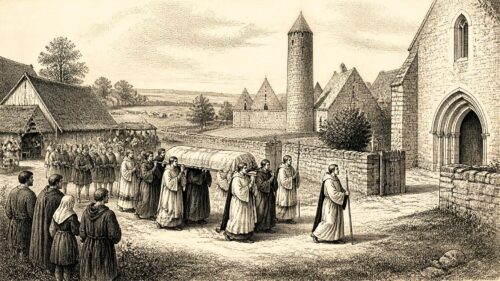
The most arresting entry is also among the briefest: Drumcliff was “completely burned, with its churches”. Drumcliff, in the north-west of present-day County Sligo beneath Benbulben, was not merely an isolated church. It was an old ecclesiastical centre associated in tradition with Columba, with a round tower, high crosses, burial ground and a wider settlement landscape. Archaeology has identified evidence around the monastic enclosure for domestic occupation, craft activity, animal management and grain processing. The annalist’s wording therefore suggests a disaster affecting both sacred buildings and the inhabited community around them.
What cannot responsibly be supplied is equally important. The annals do not name the attackers, describe a battle, report deaths, or say whether the fire began in a raid, a feud or an accident. “Completely” is the annalist’s emphatic judgement, not an archaeological measurement of every structure lost. Yet the inclusion of the churches makes clear that ecclesiastical immunity offered no dependable protection in a violent year. Rebuilding roofs, timber buildings, stores, books, vestments and household goods would have imposed a burden lasting well beyond the fire itself. For clergy, tenants, dependants and travellers using the site, the destruction was likely one of the year’s defining local experiences.
Raiding Across Northern Connacht
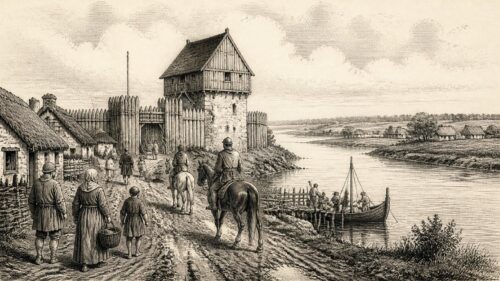
Drumcliff’s destruction occurred amid pressure on the territories around Sligo Bay. The annals record that the Galls, conventionally translated as “Foreigners”, of west Connacht made a great raid into Carbury and plundered Ballysadare. In this context the word was the Gaelic annalists’ usual label for the descendants and political communities of the Anglo-Norman settlement, rather than a precise description of every individual involved. The places named matter. Carbury included the country around Drumcliff, while Ballysadare lay to the south on a sheltered inlet and at an important crossing and route through the district.
Plunder was not a marginal feature of warfare. Livestock, foodstuffs, horses, metal goods and captives could be taken quickly; houses and crops might be damaged to deny an opponent resources and to advertise dominance. A “great raid” need not mean a set-piece battle, and the record offers neither numbers nor a route. It nevertheless shows that the contest reached communities beyond lordly residences and castles. People in open settlements and on farms faced the immediate risks: the loss of animals, food reserves and tools, displacement, and the uncertainty of whether an armed party would return.
A second raid struck further inland and eastward. Mac William Burke plundered Áed Ó Conchobair’s lands of Tír Maine and Clann Uatach. This was a direct challenge to the authority of Áed, king of Connacht, who had succeeded his father Fedlimid only two years earlier. Walter de Burgh, earl of Ulster and lord of Connacht, was the greatest Anglo-Irish magnate in the region; the de Burgh lordship possessed formidable resources but did not command the province without negotiation, alliances and force. The 1267 entries show neither side enjoying settled control. They instead reveal overlapping claims exercised through raids upon rival communities.
A Prisoner from Umhall
One episode links Connacht to the wider Irish Sea world. Murchad Mac Suibne was captured in Umhall, the district around Clew Bay, by Domnall, son of Magnus Ó Conchobair. He was handed over to Walter Burke, earl of Ulster, and subsequently died in the earl’s prison. The sequence is firmly assigned to the year by Annála Connacht and Loch Cé; the Annals of Ulster preserve the same event under their own difficult chronological arrangement.
The notice is revealing even though it withholds the charge against Murchad and the location or conditions of his confinement. A regional ruler could seize a prisoner and deliver him to a powerful magnate, demonstrating both local agency and political connection. Mac Suibne was a name with strong links across the North Channel, later prominent among the military families known as gallóglaigh. It would be unsafe to make this individual’s capture proof of a general migration or to call him a mercenary without contemporary evidence. It does, however, place a member of that kindred in the contested western seaboard at a moment when Connacht’s politics were tied to Ulster, the Isles and Scotland as well as to Dublin and England.
Illness at the Centre of Kingship
The vulnerability of Áed Ó Conchobair is one of the year’s strongest themes. A severe illness overcame him, and word of his expected death, the annalist says, spread throughout Ireland. He recovered, but the report is significant in itself. His survival mattered to allies, rivals and dependants alike because the Connacht kingship was personal as well as territorial: a king’s health could affect alliances, tribute, protection and the prospects of competing branches of his dynasty.
Several deaths sharpened that sense of fragility. Donnchad, son of Ruaidrí and grandson of Áed Ó Conchobair, was killed by the Galls. Brian, son of Toirrdelbach and grandson of the former high king Ruaidrí Ó Conchobair, died at Knockmoy monastery. Elsewhere, Máel Sechnaill Mac Áeda, his father Conchobar, and his brother Áed all died within three months. The sources give no cause for this cluster of deaths and no warrant for calling it an epidemic. Still, in a political order structured through extended kindreds, the disappearance of adult men within a single quarter could alter inheritance, protection and local leadership abruptly.
Áed’s recovery should not be mistaken for peace. His kinsman’s killing and the raids on his territories show that illness had not removed him from the calculations of opponents. Rather, 1267 exposed how quickly uncertainty at the centre could combine with violence at the edges of a kingdom.
Church, Travel and Distant Affairs
Religious institutions were both vulnerable and connected. The burning of Drumcliff showed one reality; the journey of Romanus, bishop of Clonfert, showed another. The annals state that Romanus crossed the sea to seek an audience with the pope. No date of departure, route, business or outcome survives in the entry, but the journey demonstrates that an Irish diocesan bishop could pursue ecclesiastical affairs through the channels of the Latin Church. Clonfert’s bishopric stood within the same Connacht political world as the raids, yet its horizons extended far beyond it.
The year’s record also preserves a murder in Munster: Mathgamain Ó Cuiléin was killed in bed by his own wife, a daughter of Mac Carthaig. The Annals of Inisfallen offer no explanation. It is a sharp reminder that political violence did not occur only when armies moved. Households and marriage alliances could be settings of deadly conflict, though the evidence does not permit a fuller reconstruction of this particular killing.
Finally, the Connacht annalist notes a great war in England between the English king and Simon de Montfort. This should not be treated as evidence that such a war began in 1267: Simon had died at Evesham on 4 August 1265, while the wider baronial conflict continued into 1267. The entry is better understood as Irish notice of a major political crisis across the sea, preserved in a chronologically awkward form. Its presence nonetheless confirms that Irish annalists situated local upheaval within a wider archipelago of kings, magnates, churchmen and war.
For Ireland, the securely dated picture of the year is therefore not one of a single turning point, but of a harsh and connected political environment. Drumcliff’s churches burned; Carbury, Ballysadare, Tír Maine and Clann Uatach were raided; a Mac Suibne prisoner died in de Burgh custody; and the king of Connacht narrowly survived a widely reported illness. These were events with unequal scale, but together they show how warfare, lordship, religion and ordinary settlement were inseparable in thirteenth-century Ireland.
Source References
Hover over a number to see the source. Select it to open the source.

- [1] Annála Connacht, Annal 1267
- [2] Annála Connacht: Irish-language edition and editorial record
- [3] Annals of Loch Cé
- [4] Annals of Ulster
- [5] Annala Uladh: Irish-language edition
- [6] Annals of Inisfallen, Annal AI1267
- [7] Annals of Inisfallen
- [8] Annals of the Four Masters: editorial and bibliographical record
- [9] Burgh, Walter de
- [10] O'Connor (Ó Conchobair), Fedlimid
- [11] Ua Conchobair, Ruaidrí
- [12] O'Kelly (Ó Cellaig), Conchobar
- [13] O'Reilly (Ó Ragallaig), Cathal
- [14] Drumcliff
- [15] 2020:243 - Drumcliffe South, Sligo
- [16] 1999:804 - Sligo: 6-7 Abbey Street, Sligo
- [17] Exploring the Irish Annals
- [18] County Roscommon Urban Archaeology Survey
- [19] Barons' Wars (1215-1217, 1264-1267)
- [20] Retinues, Agents and Garrisons during the Barons' Wars
- [21] Wales and the Welsh in the Middle Ages
- [22] Diocese of Clonfert
Primary Sources
- Annála Connacht, Annal 1267
- Annála Connacht: Irish-language edition and editorial record
- Annals of Loch Cé
- Annals of Ulster
- Annala Uladh: Irish-language edition
- Annals of Inisfallen, Annal AI1267
- Annals of Inisfallen
- Annals of the Four Masters: editorial and bibliographical record
- Burgh, Walter de
- O'Connor (Ó Conchobair), Fedlimid
- Ua Conchobair, Ruaidrí
- O'Kelly (Ó Cellaig), Conchobar
- O'Reilly (Ó Ragallaig), Cathal
- Drumcliff
- 2020:243 – Drumcliffe South, Sligo
- 1999:804 – Sligo: 6-7 Abbey Street, Sligo
- Exploring the Irish Annals
- County Roscommon Urban Archaeology Survey
- Barons' Wars (1215-1217, 1264-1267)
- Retinues, Agents and Garrisons during the Barons' Wars
- Wales and the Welsh in the Middle Ages
- Diocese of Clonfert