Butler Succession1299 CE
In 1299, Ireland saw dispersed developments rather than a single national event. Theobald Butler died childless at Turvey, passing his office and lands to Edmund. John Wogan’s government relied on Richard de Burgh as deputy justiciar during his Scottish absence, following settlement of magnate conflict. Edward I protected the Curragh’s pasture by banning swine. In Annaly, Sefraid Ó Fearghail killed Meath knight Seoán de la Mare during a livestock pursuit, illustrating frontier tensions. Irish annals also noted Scottish conflict and Bishop Muiris Ó hÓcáin’s death. Misdated annalistic entries concerning Armagh and Tír Chonaill properly belong to 1303, not 1299 itself.
Dateline
For Ireland, 1299 is not a year defined by one island-wide battle, parliament or royal expedition. Its evidence is scattered: a magnate died in his Dublin manor; royal government was temporarily delegated; a grassland was protected by law; and a killing during the recovery of livestock exposed the tense frontier between Meath and Annaly. Read together, these items show how authority in late thirteenth-century Ireland operated through estates, courts, pasture, kinship and armed retinues as much as through grand campaigns.
The year must also be handled with particular care. Medieval Irish annals are indispensable, but their numbered year-headings do not always match modern calendar dating. Several dramatic notices placed beneath an Annals of Ulster heading labelled 1299 belong, on the annal’s own chronological system and by independent evidence, to 1303. They should not be transferred into 1299 merely because of the heading. The events treated here are therefore either firmly dated to 1299 or are recorded in sources whose chronology can responsibly be connected to that year.
A Death at Turvey
The clearest dated event came on 14 May, when Theobald le Botiller, or Butler, died without children at his manor of Turvey in north County Dublin. He was only about thirty. A late medieval Irish chronicle gives both the day and place; modern reconstruction from royal and legal records confirms the date. His body was buried thirteen days later at Wotheney, or Abington, abbey in County Limerick.
Theobald’s death mattered because his office was not merely ceremonial. As chief butler of Ireland, he held an inherited position tied to major landed interests in both Ireland and England. The title and lordship passed to his younger brother Edmund Butler. Yet Edmund did not travel to Ireland until July 1300, so the change was not simply a local succession enacted at once on the ground. It was a reminder that many of the greatest landholders in the lordship possessed estates, debts, family ties and royal obligations across the Irish Sea.
Theobald had already served Edward I in Scotland in 1296, accompanying the Irish contribution to the English war effort. His early death therefore joined Irish succession to a wider Plantagenet military and political world. It also removed one of the established members of the colonial aristocracy during a period when the crown repeatedly sought money, food, shipping and military service from Ireland.
Settlement After Disorder
In 1299 the lordship was governed for Edward I by John Wogan, justiciar since 1295. His administration inherited the consequences of the bitter dispute between Richard de Burgh, earl of Ulster and lord of Connacht, and John fitz Thomas FitzGerald, lord of Offaly. Their contest had convulsed Irish politics during the middle of the decade: FitzGerald had captured de Burgh in December 1294, and rival claims in Connacht and Leinster had drawn in royal officials, settlers and Gaelic rulers.
A settlement was made at Athboy in October 1298, only months before the year under review. Its effect shaped 1299. FitzGerald surrendered his claims in Connacht and Ulster to de Burgh, receiving compensatory interests in Leinster and Munster. This did not make Ireland peaceful in any universal sense, but it ended the immediate confrontation between two exceptionally powerful magnates. De Burgh’s authority in the north and west was thereby strengthened.
In October 1299, de Burgh inherited a share in the estates of his maternal uncle, Richard fitz John FitzGeoffrey, adding further wealth and landed complexity to his position. From 29 September 1299 until 13 January 1300 he also acted as Wogan’s deputy justiciar while Wogan was away in Scotland. The arrangement shows both the dependence of Dublin government on leading aristocrats and the continuing pull of the Scottish war upon Ireland’s political resources. Government did not cease when the justiciar crossed the sea; it was entrusted to the man whose territorial influence was already greatest in much of the island.
Protecting the Curragh
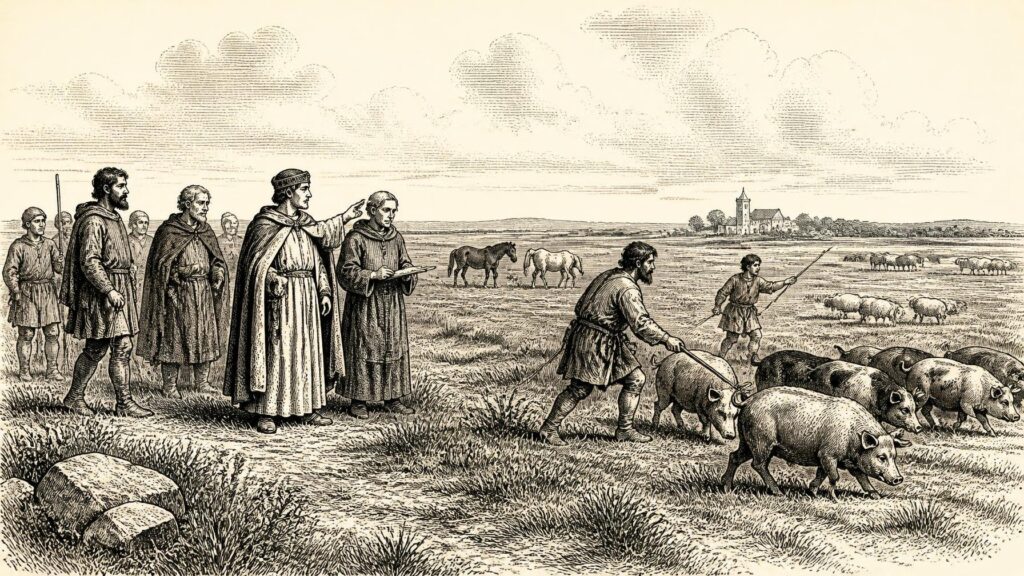
A more modest-looking measure reveals another side of lordship. In 1299 Edward I issued a statute or ordinance forbidding the feeding of swine on the Curragh of Kildare because they damaged its sward. The measure is often identified as the earliest legal reference to the Curragh. No exact day survives for the order, but its association with 1299 is well established.
The importance of the ruling lies in what it says about the landscape. The Curragh was not empty open ground. It was a valuable expanse of grassland, used within a framework of royal ownership, neighbouring interests and customary pasture. Pigs rooting in turf could damage the close, resilient grass cover on which other forms of grazing depended. Restricting them was therefore an act of environmental management, but also a statement of jurisdiction: the crown claimed authority to regulate access to a resource on which local livelihoods relied.
Such a rule offers a rare glimpse of ordinary economic pressures. Cattle, sheep, horses and pigs were central to rural wealth, while access to pasture was a practical question with legal consequences. The Curragh’s later fame for horses should not obscure this older setting. In 1299 the issue on record was not racing or military drill but the protection of common grazing land from a form of animal husbandry judged harmful to the turf.
A Prey in Annaly
Violence nevertheless remained close to everyday economic life. The Annals of Connacht record that Seoán de la Mare, described as the boldest and strongest knight in Meath, was killed by Sefraid Ó Fearghail while pursuing a prey. The annal gives the year but no day, and its language of praise should be read as an annalist’s assessment rather than a neutral official description. Still, the core episode is clear: a colonial lord died amid the armed pursuit or recovery of livestock.
The place was the contested zone around Annaly, broadly corresponding to much of modern County Longford, where the Ó Fearghail lordship confronted the expansion and claims of Meath’s settlers. A “prey” was not a casual theft. Livestock-raiding was a recognised instrument of coercion and retaliation, capable of punishing opponents, feeding followers and asserting rights over land and people. Its pursuit could bring mounted men, household troops and neighbouring communities into sudden conflict.
The killing also shows that legal categories did not neatly describe political realities. Sefraid Ó Fearghail had earlier appeared in English legal processes and could be represented as being “at peace”, even while his family’s territorial interests collided with those of neighbouring settlers. De la Mare’s death was followed by litigation from his son in 1302, but there is no record of an immediate criminal prosecution. In 1299, local power depended not only on royal law but on negotiated coexistence, armed capacity and the ability of communities to defend cattle, land and honour.
The North Channel World
Irish annalists also placed the island within the maritime world shared with western Scotland. The Annals of Connacht record the killing in 1299 of Alexander Mac Domnaill by Alexander Mac Dubgaill, with a very large slaughter of Mac Domnaill’s followers. This was a Scottish conflict, not an event located in Ireland, and should not be presented as an Irish battle. Its inclusion in an Irish chronicle is significant nonetheless. The annalist called Mac Domnaill a man outstanding in both Scotland and Ireland for generosity and prowess, reflecting the real political, familial and military connections that crossed the North Channel.
Those connections mattered especially to Ulster. The earldom of Ulster, the Glens of Antrim, Rathlin and the sea routes to the Isles linked Gaelic, Norse-Gaelic, Scottish and Anglo-Irish interests. People, ships, news and fighting men moved through this zone. The Scottish war of Edward I and the rivalries of the Isles therefore formed part of the strategic horizon of Irish rulers, even when no army landed in Ireland during the calendar year.
Church, Record and Restraint
The Annals of Connacht also record the death of Muiris Ó hÓcáin, bishop of Killaloe, in 1299. It is a brief notice, but it marks a change in one of the major dioceses of the west and south-west. Episcopal vacancies involved more than devotional continuity: bishops held property, exercised jurisdiction, served as patrons and could act within the politics of their regions. The surviving notice does not justify a detailed account of the succession, so none should be invented.
Equally, 1299 demonstrates why chronology matters. The Annals of Ulster and the much later Annals of the Four Masters place the death of Nicholas Mac Máel Ísu, archbishop of Armagh, under a heading styled 1299. Other evidence dates his death to 10 May 1303. The same cluster includes the killing of Toirdelbach Ó Domhnaill, king of Tír Chonaill, now dated to 1303. These are major events, but they belong to a different calendar year and are excluded from this account.
What remains is a year of transitions rather than spectacle: a Butler succession at Turvey, delegated government under Richard de Burgh, the regulation of the Curragh’s grass, a lethal cattle conflict in Annaly, and continued awareness of the North Channel’s unstable politics. In 1299, Ireland’s history was made not only in castles and royal offices, but in manors, pasturelands, livestock raids and the sea-lanes joining the island to Scotland.
Source References
Hover over a number to see the source. Select it to open the source.

- [1] The Annals of Ulster, Year U1299
- [2] Annála Connacht
- [3] Annals of the Four Masters, Part 13
- [4] Annales Hiberniae
- [5] Annales Breves Hiberniae
- [6] Annals of Inisfallen
- [7] Butler (le Botiller), Theobald
- [8] Butler (le Botiller), Edmund
- [9] Burgh, Richard de
- [10] Wogan, John
- [11] FitzGerald, John fitz Thomas
- [12] Curragh Plains Conservation Management Plan
- [13] Curragh – A Land Divided
- [14] Sefraid Ó Fearghail and Anghaile, 1271–1318
- [15] Calendar of Documents Relating to Ireland, Volume 4, Item 580 (1298–1299)
- [16] Calendar of Documents Relating to Ireland, Preserved in Her Majesty’s Public Record Office, London, 1171–1307
- [17] Colonial Society in Co. Louth, 1150–1450
- [18] Scots in ‘English Ireland’ in the Thirteenth and Fourteenth Centuries
- [19] Documents Illustrative of the History of Scotland from the Death of King Alexander the Third to the Accession of Robert Bruce
- [20] Ireland c.1250–1500: Gaelic Revival
Primary Sources
- The Annals of Ulster, Year U1299
- Annála Connacht
- Annals of the Four Masters, Part 13
- Annales Hiberniae
- Annales Breves Hiberniae
- Annals of Inisfallen
- Butler (le Botiller), Theobald
- Butler (le Botiller), Edmund
- Burgh, Richard de
- Wogan, John
- FitzGerald, John fitz Thomas
- Curragh Plains Conservation Management Plan
- Curragh – A Land Divided
- Sefraid Ó Fearghail and Anghaile, 1271–1318
- Calendar of Documents Relating to Ireland, Volume 4, Item 580 (1298–1299)
- Calendar of Documents Relating to Ireland, Preserved in Her Majesty’s Public Record Office, London, 1171–1307
- Colonial Society in Co. Louth, 1150–1450
- Scots in ‘English Ireland’ in the Thirteenth and Fourteenth Centuries
- Documents Illustrative of the History of Scotland from the Death of King Alexander the Third to the Accession of Robert Bruce
- Ireland c.1250–1500: Gaelic Revival