North Channel Ice Advance30147 BCE
Around 30,147 BCE, Ireland was entering major glacial expansion during Marine Isotope Stage 3, although dating and ice limits remain uncertain. Growing upland glaciers merged towards the British–Irish Ice Sheet, particularly around the North Channel and northern Ireland, while southern ice remained more localised. Ice and meltwater reshaped bedrock and sediments, contributing to landscapes formed through repeated glaciations. Ice-free areas supported cold, open, variable vegetation and, at different times, fauna including reindeer, mammoth and giant deer. Cave evidence requires reassessment through improved dating. No secure human occupation exists; a modified reindeer bone suggests only an unproven, transient Upper Palaeolithic visit.
Dateline
30,147 BCE is a modern chronological label, not a year that people in prehistoric Ireland could have named or recorded. It falls roughly 32,100 years before AD 1950, the reference point used for “BP” dating, but calendar-year precision at this depth of time is not available. Radiocarbon determinations must be calibrated and carry ranges rather than exact annual dates; ice-sheet reconstructions are broader still. The responsible subject is therefore Ireland during the later part of Marine Isotope Stage 3, within the Last Glacial Period, rather than an event on a particular day or in a particular year.
At about this point, Ireland stood on the threshold of a major glacial expansion. The best recent reconstruction of the British–Irish Ice Sheet begins at 31,000 years ago, just over a millennium later than the nominal date used here. It depicts a substantial ice cap extending from the Derryveagh Mountains to the Sperrins, alongside separate mountain ice fields and glaciers in places including the Wicklows, Mournes, Dartry Mountains, MacGillycuddy’s Reeks and Knockmealdown Mountains. By 30,000 years ago, that reconstruction has the separate ice masses rapidly merging into a larger British–Irish Ice Sheet. Yet the evidence controlling the exact timing of Irish ice growth remains sparse. It would be misleading to turn a modelled time-slice into a map of Ireland in a single calendar year.
An Island Becoming Glacial
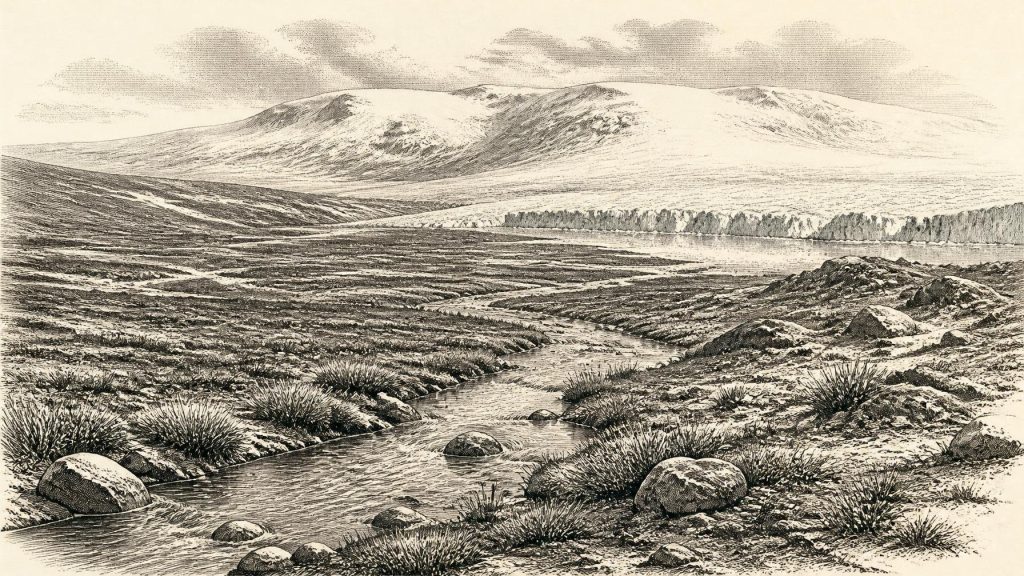
The important development was not a political change but a physical one: the increasing dominance of ice. Snow accumulated in the uplands, glaciers enlarged and ice began to join across low ground and marine channels. The advance was neither uniform nor simple. Ice divides, flow directions and margins shifted as regional ice masses interacted with bedrock topography, sea level and climate. In northern Ireland, the growing ice was connected to the wider system developing in western Scotland; the North Channel was becoming an arena of glacial movement rather than a stable modern-style seaway. Farther south, the available reconstruction suggests separate ice caps and more local glaciers, not an island instantly buried beneath one unchanging sheet.
These changes profoundly altered the ground beneath the ice. Moving ice quarried rock, transported sediment and laid down till, while meltwater cut channels and sorted sands and gravels. Much of the Irish landscape familiar today – its streamlined hills, drumlins, erratic boulders and glacial deposits – was shaped through repeated cold-stage processes, including but not confined to this particular advance. It is safer to say that the terrain was being remodelled than to assign every visible landform to 30,147 BCE. Many landforms preserve the cumulative result of more than one phase of glaciation and later erosion.
What Survived Beyond the Ice
Where land remained ice-free, conditions were markedly colder and more open than modern Ireland. There were no forests comparable to later Holocene woodland. Plant cover would have varied with exposure, soil, drainage and the proximity of ice: sparse herbs, grasses, sedges, mosses and cold-tolerant shrubs are plausible components of such environments, while bare ground, frost-shattered rock and seasonally waterlogged hollows were also important. This was not one continuous “tundra” landscape. It was a shifting mosaic, and the extent of habitable ground could contract sharply as ice advanced.
Irish cave deposits and fossil collections show that Late Pleistocene Ireland supported a striking range of animals at different times. Castlepook Cave near Doneraile in County Cork has yielded remains attributed to reindeer, giant deer, woolly mammoth, brown bear, wolf, Arctic fox, lemmings, mountain hare and carnivores including spotted hyaena. Such a list should not be treated as a census for the nominated year. Cave assemblages can combine material accumulated over long intervals, and many were excavated before modern recording methods. Nevertheless, the fauna demonstrates that parts of Ireland during Marine Isotope Stage 3 could support cold-adapted and open-country animals, including large herbivores whose movement linked Irish environments to wider north-west European ecological systems.
Faunal evidence also changes with improved science. The Irish Quaternary Fauna Project established the importance of direct radiocarbon dating, but subsequent ultrafiltration and redating have shown that some earlier bone ages were too young. Reassessment of Castlepook material, for example, moved some results thousands of radiocarbon years older. This is not a minor technical footnote. It means that apparent associations between species, deposits and climatic phases must be tested again rather than repeated as settled fact. The National Museum of Ireland’s historic collections, university research and renewed cave investigations remain crucial because they allow old finds to be examined with newer methods.
The Human Question
There is no securely documented settlement, hearth, house, burial, tool assemblage or occupation surface in Ireland that can be assigned to 30,147 BCE. There can therefore be no responsible account of an Irish community’s leaders, families, language or daily routines at this date. The nearest controversial clue is a reindeer femur from Castlepook Cave, reported as bearing a modification made while the bone was fresh and interpreted as a possible stone-tool cut mark. The bone has been associated with an age of about 33,000 radiocarbon years BP, which is substantially older when calibrated into calendar years. It is important evidence under active scrutiny, but it is not proof of a permanent population, and its calibrated range does not identify activity in 30,147 BCE.
If people did reach Ireland in this broad period, the most cautious interpretation is a brief Upper Palaeolithic incursion by highly mobile hunter-gatherers, perhaps exploiting a carcass or following animal movements through an exposed and changing north-west European landscape. That is an interpretation, not an established event. No evidence currently permits us to say whether such visitors travelled by an overland or ice-connected route, crossed water, stayed for a season, or returned. Nor may later Mesolithic settlement, which is documented many millennia afterwards, be projected backwards to fill this gap.
No Polities, No Recorded Beliefs
Political affairs, diplomacy and warfare cannot be recovered for Ireland around this date. There is no evidence for states, chieftaincies, territorial institutions, monuments or formal trade networks on the island. Equally, there is no Irish evidence for named deities, ritual places, art traditions or systems of learning from this horizon. The absence is informative: this is a period known chiefly through geological deposits, animal remains, cave stratigraphy and scientific dating, not through the archaeological signatures that later reveal social institutions.
Economy, in the familiar sense of farming, markets or maritime commerce, is likewise inapplicable. If humans were present intermittently, their subsistence would have depended on opportunistic hunting, scavenging and the use of portable materials rather than cultivation or livestock. But even that proposition belongs to a general Upper Palaeolithic comparison, not to demonstrated Irish practice in this year. The stronger story is environmental: ice growth constrained routes, reduced and rearranged habitable zones, and determined where plants, animals and any passing people could survive.
A Record of Ranges
Ireland around 30,147 BCE should thus be understood as a landscape in transition. The ice sheet was growing fast on a regional scale, but its exact Irish limits remain debated and unevenly dated. Ice-free refuges, if present, were exposed to severe cold and ecological instability. Fossil fauna proves that the island was not always biologically empty during the wider Late Pleistocene, while the human evidence remains tantalising but unresolved. The historical value of this date lies not in an invented episode, but in recognising how much of Ireland’s earliest past is preserved: not in annals, but in a reindeer bone, a cave deposit, a buried wetland, a striated rock surface and the calibrated ranges that connect them.
Primary Sources
- Growth and retreat of the last British–Irish Ice Sheet, 31,000 to 15,000 years ago: the BRITICE-CHRONO reconstruction
- The timing and magnitude of the British–Irish Ice Sheet between Marine Isotope Stages 5d and 2: implications for glacio-isostatic adjustment, high relative sea levels and ‘giant erratic’ emplacement
- Pattern and timing of retreat of the last British-Irish Ice Sheet
- Timing and pace of ice-sheet withdrawal across the marine–terrestrial transition west of Ireland during the last glaciation
- Early deglaciation of the British-Irish Ice Sheet on the Atlantic shelf northwest of Ireland driven by glacioisostatic depression and high relative sea level
- Last Glacial Maximum cirque glaciation in Ireland and implications for reconstructions of the Irish Ice Sheet
- Dimensions and chronology of the last ice sheet in Western Ireland
- Radiocarbon constraints on the age of the maximum advance of the British–Irish Ice Sheet in the Celtic Sea
- A reconsideration of the radiocarbon dating of the Marine Isotope Stage 3 fauna from southern Ireland
- The Irish Quaternary Fauna Project
- New insights on the fauna of Ireland's Younger Dryas and Early Holocene from Alice & Gwendoline Cave
- Occurrence of mammalia relicts at site Castlepook Cave
- The IntCal20 Northern Hemisphere radiocarbon age calibration curve (0–55 cal kBP)
- Quaternary
- Guide to the National Museum of Ireland – Natural History
- The Quaternary Period in Ireland: Figure 6—The subdivision of the Quaternary Period in Ireland
- Field Guides
- Archaeological Heritage of County Cork
- The Mesolithic in Ireland: when was it?
- Ireland's Palaeolithic Archaeology – Fleeting Footprints in a Frozen Land
- The Exploration of Castlepook Cave, County Cork