-
Royal Residence
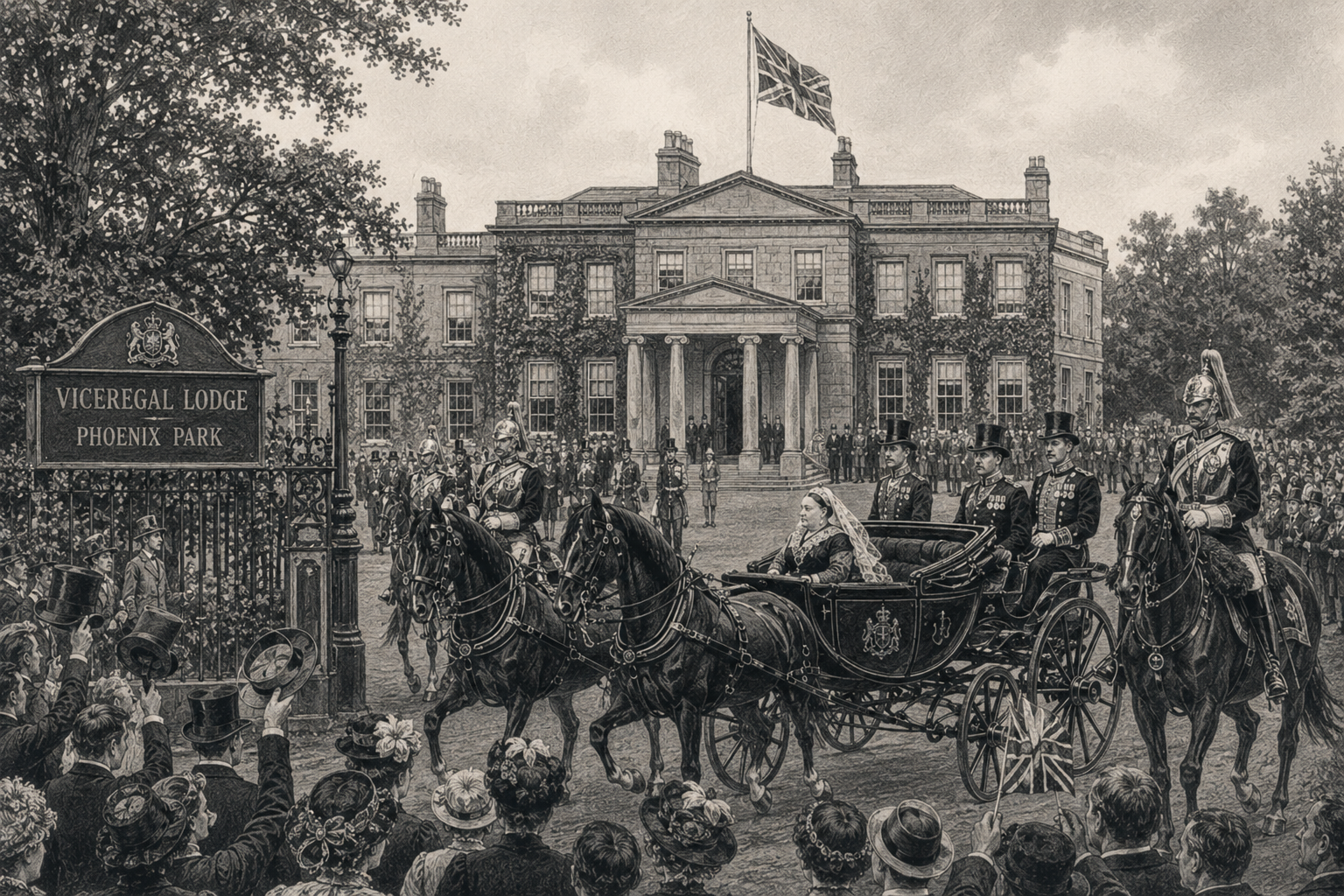
Read Article: Royal ResidenceQueen Victoria has taken up residence at the Viceregal Lodge in Phoenix Park following her arrival at Kingstown and ceremonial journey through Dublin. The house, normally occupied by the Lord Lieutenant of Ireland, will serve as the monarch’s principal residence throughout her final Irish visit. Situated within the extensive parklands west of the capital, the lodge provides both privacy and convenient access to the military, charitable and public engagements arranged for the coming weeks. Reports reaching Limerick describe an elaborate administrative operation involving royal officials, Dublin Castle, police forces, military escorts and household servants responsible for the Queen’s accommodation and security.
The Viceregal Lodge was built during the eighteenth century and later acquired as a residence for the British viceroys who governed Ireland on behalf of the Crown. Its position within Phoenix Park placed it close to Dublin while separating the royal household from the crowded streets surrounding the official ceremonies. The building had already been enlarged before Queen Victoria’s first Irish visit in 1849, when an additional wing was prepared for her use. During the present visit, its reception rooms, private apartments, gardens and surrounding avenues provide the setting from which the ageing monarch will receive officials, dignitaries and selected representatives of Irish public life.
For Dublin Castle, the Queen’s occupation of the lodge gives the residence renewed political importance. The Lord Lieutenant, Earl Cadogan, and his administration have organised a programme intended to demonstrate the efficiency, dignity and stability of British government in Ireland. Royal movements through Phoenix Park will be carefully controlled, while military and police personnel guard the approaches to the residence. Loyalists regard the Queen’s presence as an affirmation of Ireland’s place within the United Kingdom. Nationalists may instead see the guarded lodge as a visible symbol of government by a Crown-appointed administration rather than an Irish legislature responsible to the Irish electorate.
The Queen’s programme will include military reviews, visits to hospitals and institutions, formal receptions and a major gathering of schoolchildren in Phoenix Park. The lodge therefore functions not merely as sleeping accommodation but as the centre of a temporary royal court. Household officials, messengers, soldiers, policemen, servants and invited guests will pass through its grounds throughout April. In Limerick, where the Crown’s authority is encountered through barracks, courts, constabulary stations and public administration, the arrangements will be understood as part of the wider machinery of imperial government. The splendour surrounding the Queen depends upon extensive labour carried out beyond public view.
Victoria is expected to remain at the Viceregal Lodge until her departure from Kingstown later this month. The residence will eventually become Áras an Uachtaráin, the official home of an independent Ireland’s president, but in 1900 it remains closely associated with British rule and the office of the Lord Lieutenant. For the present generation, the building represents power exercised from Dublin Castle under Westminster authority. Its occupation by the Queen transforms Phoenix Park into the ceremonial centre of the United Kingdom’s Irish administration. The peaceful lawns and guarded gateways conceal the political disagreement surrounding the royal visit and Ireland’s constitutional future.
- Queen Victoria, journal entry for 4 April 1900, Royal Archives, Windsor Castle, describing her arrival at Kingstown, journey through Dublin and entry into Phoenix Park. Exact archival volume and folio should be confirmed before formal citation.
- Michael J. F. McCarthy, Narrative of Queen Victoria’s Visit to Ireland, April 1900, contemporary account describing the Queen’s residence at the Viceregal Lodge until 26 April. Exact edition and page should be confirmed before formal citation.
- The Irish Times, Dublin, April 1900, reports on the Queen’s arrival, residence in Phoenix Park and programme of official engagements. Exact issue, page and column should be confirmed before formal citation.
- Freeman’s Journal, Dublin, April 1900, contemporary reports and commentary concerning the royal household, Phoenix Park ceremonies and political response. Exact issue, page and column should be confirmed before formal citation.
- Office of the President of Ireland, institutional history of Áras an Uachtaráin, formerly the Viceregal Lodge, recording its acquisition for the viceroys and enlargement for Queen Victoria’s 1849 visit.
-
Unionist Display
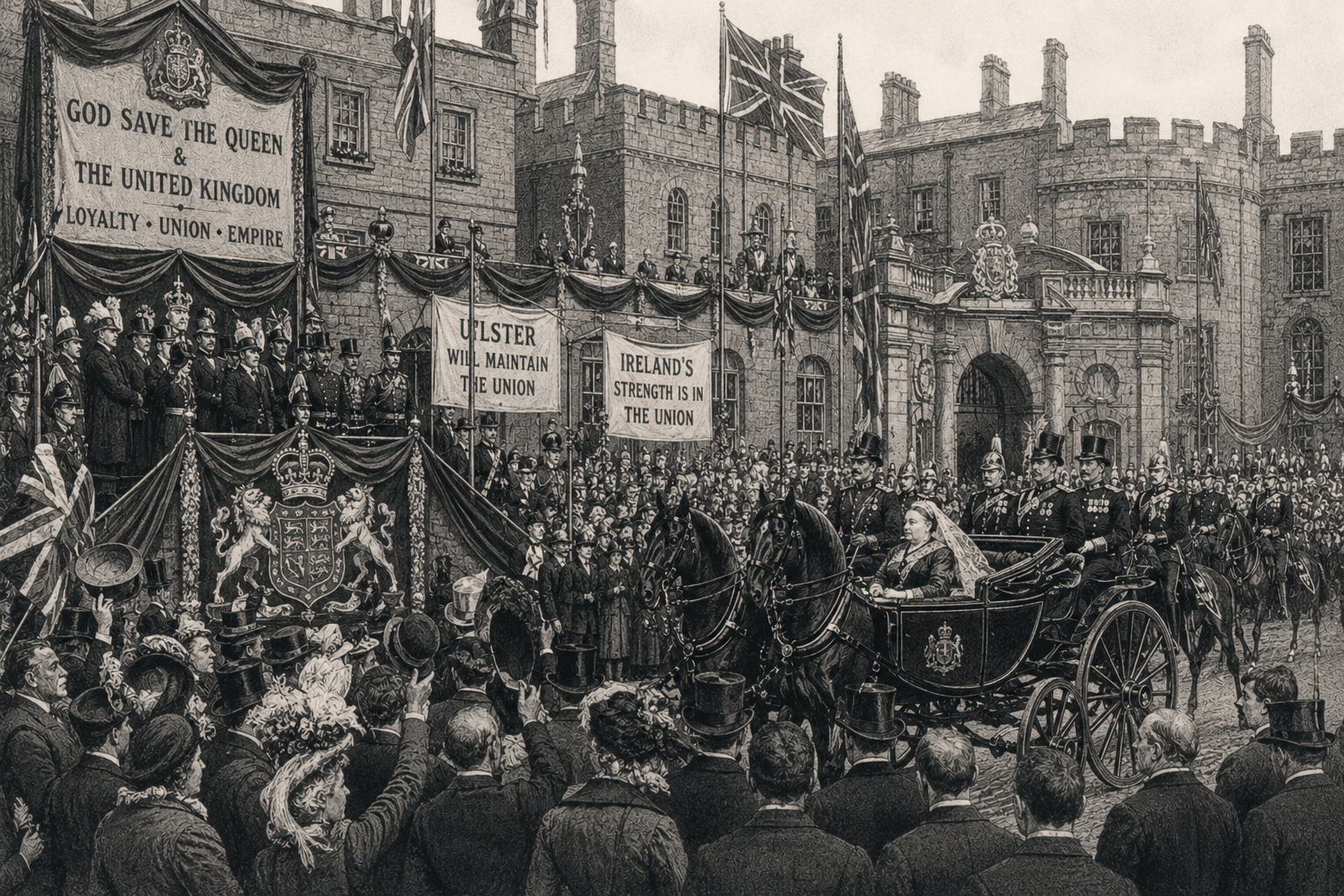
Read Article: Unionist DisplayDublin Castle and unionist organisations have used Queen Victoria’s arrival to affirm Ireland’s constitutional place within the United Kingdom. The administration directed an elaborate programme of ceremonial receptions, military escorts, civic addresses and public decoration intended to display loyalty to the Crown. Reports reaching Limerick describe streets filled with spectators and buildings dressed for the royal occasion. Unionist newspapers and public figures have welcomed the visit as proof that attachment to the monarchy remains substantial despite nationalist demands for Home Rule. The ceremonies present Ireland not as a nation awaiting separation, but as an established and valued part of the Union.
Dublin Castle stands at the centre of British administration in Ireland, housing the officials responsible for government, policing and royal arrangements. The Lord Lieutenant, Earl Cadogan, received the Queen and assisted in organising the programme that will continue throughout April. Castle officials coordinated with the military, Dublin Metropolitan Police, Royal Irish Constabulary, harbour authorities and civic representatives to secure the procession route and manage the crowds. The visit has therefore become an extensive demonstration of administrative power. Every escort, inspection and formal address reinforces the authority of institutions through which British government operates in Ireland.
Irish unionists regard the Queen’s presence as a timely answer to the renewed organisation of constitutional nationalism. The Irish Parliamentary Party has recently restored unity after years of internal division, while the United Irish League is extending nationalist organisation throughout the country. Unionist leaders argue that Home Rule would weaken the connection with Britain, threaten economic stability and place loyal minorities beneath a permanent nationalist majority. Royal ceremony allows them to express an alternative political identity grounded in allegiance to the Crown, Parliament and Empire. The cheering crowds and decorated streets will consequently be cited as evidence that nationalist leaders cannot speak for every Irish citizen.
In Limerick, unionism commands less electoral strength than nationalism but remains visible among sections of the Protestant community, military families, merchants, professional households and those whose employment depends upon imperial institutions. The city’s barracks, courts, police administration and commercial connections ensure that the Union is experienced through ordinary employment as well as political principle. Loyal residents may view the royal visit as reassurance that their identity and interests remain protected. Nationalists, however, will question whether ceremonies arranged by Dublin Castle can demonstrate genuine national consent while Ireland continues to be governed from Westminster without its own legislature.
The visit therefore carries significance extending beyond personal respect for the elderly Queen. Dublin Castle is presenting royal loyalty as a public and constitutional fact, while unionists are using the occasion to defend Ireland’s membership of the United Kingdom. Yet the spectacle also exposes the depth of political disagreement. The same procession that represents stability to loyalists represents foreign rule to separatists and unfinished government reform to Home Rulers. Limerick observers will interpret the ceremonies through local experiences of religion, class, military service, land ownership and political allegiance. Royal pageantry has temporarily united the streets in spectacle without settling the argument over Ireland’s future.
- Queen Victoria, journal entry for 4 April 1900, Royal Archives, Windsor Castle, describing her reception at Kingstown, the military escort and the journey through decorated Dublin. Exact archival volume and folio should be confirmed before formal citation.
- Dublin Castle administrative papers concerning Queen Victoria’s visit to Ireland, April 1900, including ceremonial, policing, harbour and expenditure arrangements. Exact collection, file and folio should be confirmed before formal citation.
- The Irish Times, Dublin, 4–27 April 1900, reports and editorials concerning the royal visit, official receptions and expressions of unionist loyalty. Exact page and column should be confirmed before formal citation.
- Daily Express, Dublin, April 1900, unionist newspaper coverage of Queen Victoria’s arrival, the public decorations and Ireland’s relationship with the Crown. Exact issue, page and column should be confirmed before formal citation.
- Limerick Chronicle, Limerick, April 1900, local reporting and commentary on the royal visit, loyalist opinion and official ceremonies in Dublin. Exact issue, page and column should be confirmed before formal citation.
-
Cheering Crowds
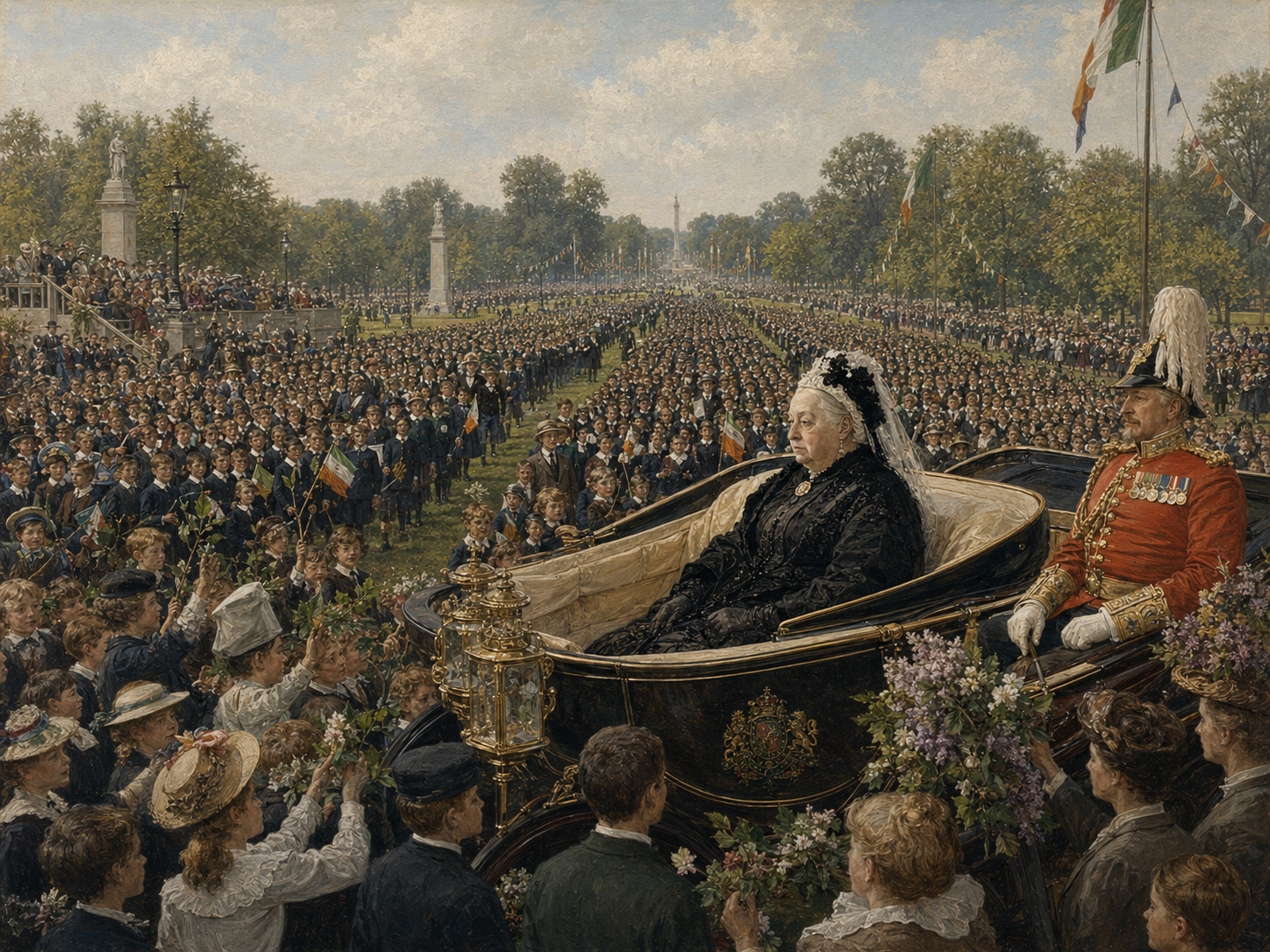
Read Article: Cheering CrowdsLarge crowds have lined the route of Queen Victoria’s procession from Kingstown towards Dublin, creating one of the most striking public spectacles witnessed during her final visit to Ireland. The royal carriage passed through heavily decorated streets while spectators filled pavements, windows and temporary viewing places. Reports reaching Limerick describe sustained cheering as the procession moved towards the capital and the Viceregal Lodge in Phoenix Park. The gathering revealed more than official organisation alone. Public curiosity drew thousands outdoors, while loyalist residents and supporters of the Union treated the Queen’s arrival as an opportunity to demonstrate attachment to the Crown and British Empire.
The Queen recorded that the entire road from Kingstown was crowded and that the people cheered loudly as her carriage passed. She travelled with a military escort in a procession of four carriages, accompanied by members of the royal family and senior officials. Decorative arches, greenery, garlands and imperial emblems marked the route, transforming the approach to Dublin into a carefully arranged ceremonial landscape. Contemporary photographs and moving pictures preserved the density of the gathering and the scale of the preparations. For many spectators, the occasion offered a rare chance to see the elderly monarch whose reign had shaped Irish public life for more than sixty years.
The enthusiasm visible along the procession route should not be mistaken for unanimous Irish approval of British government. Dublin contained substantial loyalist, Protestant, military, commercial and administrative communities, while many constitutional nationalists sought Home Rule without necessarily rejecting the monarchy. Others may have attended from simple curiosity, drawn by the holiday atmosphere, decorations, music, soldiers and unusual movement through the streets. Railway and tram services carried additional visitors into the capital. The crowds therefore represented several impulses at once: sincere royal loyalty, imperial patriotism, fascination with ceremony, commercial opportunity and the ordinary human desire to witness an event that might never be repeated.
Opposition remained active beyond the cheering streets. Advanced nationalists condemned the visit as imperial propaganda during the South African War, while Maud Gonne and her associates invoked memories of famine, eviction and emigration in their protests. The Catholic hierarchy also maintained a cautious distance from some of the official celebrations. Such hostility did not prevent large numbers from attending, but it complicated claims that the procession proved complete Irish devotion to the Crown. In Limerick, where nationalist politics remained powerful but British military connections were deeply established, residents could recognise the same mixture of loyalties, resentments and personal curiosity displayed in Dublin.
The procession consequently revealed an Ireland more politically varied than either loyalist celebration or nationalist protest alone could suggest. The cheering was genuine, as were the decorations and the public excitement, yet attendance did not necessarily amount to approval of British rule. Some spectators honoured the Queen, others admired the display, and still others simply wished to observe history passing before them. For Limerick readers, the scene offers a reminder that imperial attachment and Irish nationalism could exist beside one another within the same city, family or individual. The royal carriage travelled through a crowd united briefly by spectacle, though divided profoundly over what the spectacle represented.
- Queen Victoria, journal entry, 4 April 1900, Royal Archives, Windsor Castle; the Queen described the route from Kingstown to Dublin as heavily crowded, with loud cheering and extensive decoration. Exact archival volume and folio should be confirmed before formal citation.
- The Irish Times, 5 April 1900, contemporary report on Queen Victoria’s arrival, the decorated procession route and the crowds gathered throughout Dublin. Exact page and column should be confirmed before formal citation.
- Freeman’s Journal, 5 April 1900, contemporary nationalist newspaper coverage of the royal arrival, public attendance and political reactions. Exact page and column should be confirmed before formal citation.
- British Mutoscope and Biograph Company, Queen Victoria in Dublin, 4 April 1900, surviving actuality film showing the royal carriage, procession and spectators; preserved by the Irish Film Institute.
- Robert Augustus Henry L’Estrange, photographic series of Queen Victoria’s royal visit to Dublin, 4–26 April 1900, Queensland University of Technology Digital Collections, Robert Augustus Henry L’Estrange Collection.
-
Royal Dublin
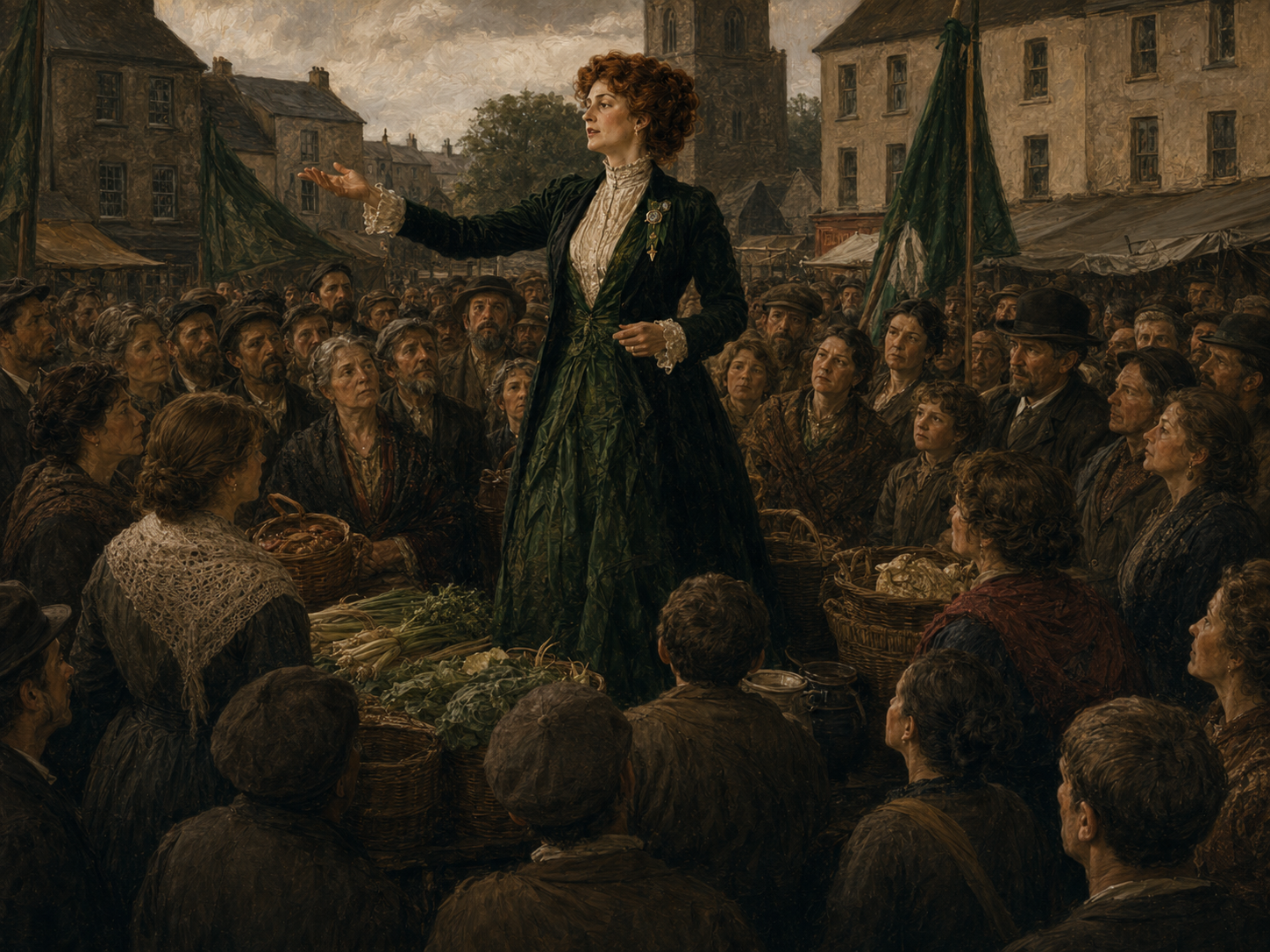
Read Article: Royal DublinQueen Victoria arrived in Ireland today for what will become the final Irish visit of her long reign. The royal programme is centred principally upon Dublin, where streets, public buildings, railway approaches and the route towards the Viceregal Lodge have been extensively decorated. Crowds gathered at Kingstown and throughout the capital to witness the arrival and procession. Although Limerick is not included prominently in the itinerary, reports of the ceremonies are being followed closely throughout the city and county by loyalists, nationalists, soldiers’ families, clergy, merchants and political organisations.
The Queen landed at Kingstown before travelling through Dublin in an open carriage accompanied by members of the royal household, military officers and senior representatives of the administration. Decorative arches, garlands, flags and greenery transformed the principal streets, while balconies and windows were filled with spectators. Authorities have arranged receptions, military displays, institutional visits and a large gathering of schoolchildren during the royal stay. Supporters of the Crown regard the elaborate preparations as evidence of Irish loyalty, while critics believe the decorations present an artificial picture of national contentment.
The visit takes place during the South African War, when Ireland remains sharply divided over British imperial policy. Irish soldiers are serving in British regiments overseas, and many families in Limerick have relatives connected with military life. At the same time, strong sympathy for the Boer republics has developed among nationalists who compare their resistance with Ireland’s own demand for self-government. The royal ceremonies therefore possess an unmistakable political character. Cheers for the Queen may express genuine loyalty, but they also occur amid continuing arguments over Home Rule, land ownership, poverty, emigration and British authority.
Nationalist opponents have criticised the expense and symbolism of the visit. Maud Gonne and other separatist campaigners have drawn attention to memories of the Great Famine and accused the monarchy of representing an imperial system that failed Ireland during its greatest catastrophe. Such arguments are understood in Limerick, where famine memory, eviction, rural hardship and emigration remain part of family experience. Loyalist residents, however, see the Queen as a source of constitutional stability and regard the hostile demonstrations as an insult to the Crown and to Irish people who continue to identify themselves with the United Kingdom.
The royal programme will continue for several weeks before the Queen departs from Kingstown later this month. Its pageantry may briefly place Dublin at the centre of imperial attention, but it cannot conceal the political divisions revealed by the reception itself. Limerick observers will judge the visit according to their own loyalties, memories and expectations. For some, the decorated capital represents honour and royal recognition. For others, the same arches, flags and military escorts symbolise a government that has not answered Ireland’s national demands. The splendour of the occasion has illuminated division as clearly as loyalty.
- Queen Victoria, journal entry for 4 April 1900, Royal Archives, Windsor, recording her landing at Kingstown and journey through Dublin. Exact archival reference should be confirmed before formal citation.
- Freeman’s Journal, Dublin, April 1900, contemporary reports on the Queen’s arrival, the decorations in Dublin and the official programme. Exact page and column should be confirmed before formal citation.
- The Irish Times, Dublin, April 1900, detailed coverage of the royal procession, ceremonial arrangements and public reception. Exact page and column should be confirmed before formal citation.
- Limerick Chronicle, Limerick, April 1900, local reports and commentary concerning Queen Victoria’s visit to Ireland. Exact issue, page and column should be confirmed before formal citation.
- Dublin Castle records concerning policing, ceremonial arrangements and official preparations for Queen Victoria’s visit, April 1900. Exact document and archival reference should be confirmed before formal citation.
-
Royal Farewell
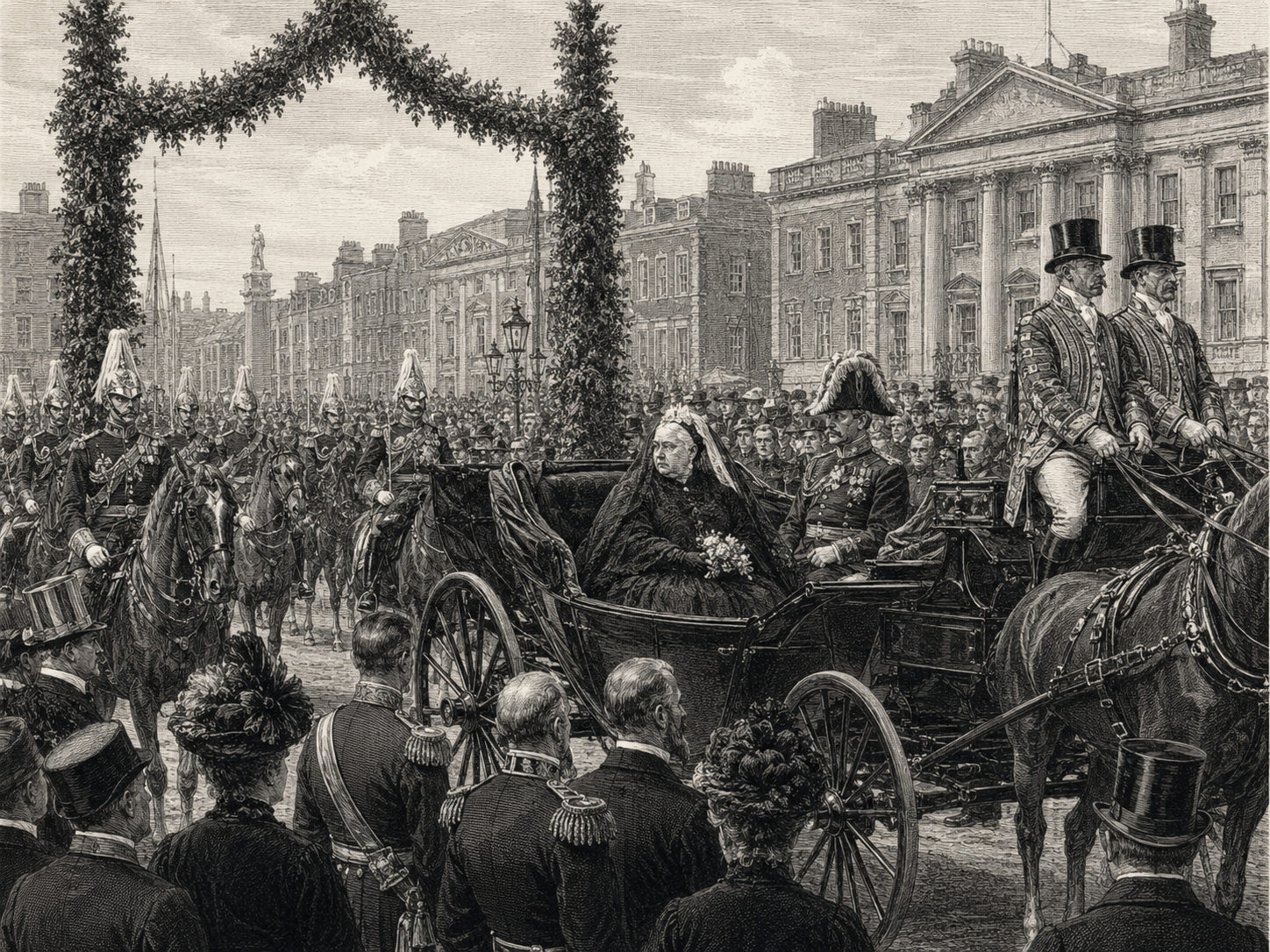
Read Article: Royal FarewellQueen Victoria arrived at Kingstown today for what would prove to be her final visit to Ireland, beginning a three-week residence centred largely upon Dublin and the Vice-Regal Lodge in Phoenix Park. Although the royal party will not travel to Limerick, accounts of the landing, the ceremonial procession and the extensive public decorations are already attracting attention throughout the city and county. Unionist residents may regard the visit as an affirmation of loyalty to the Crown, while nationalists are likely to judge it against continuing demands for Home Rule, land reform and recognition of Ireland’s political grievances.
The Queen travelled aboard the royal yacht Victoria and Albert and landed at Kingstown, where civic representatives presented an address before she proceeded towards Dublin in an open carriage. Crowds lined the decorated route through the southern suburbs, and mounted troops accompanied the procession towards Phoenix Park. Victoria, approaching her eighty-first birthday and increasingly limited in mobility, had not visited Ireland since 1861. Her return came during the South African War, when Irish soldiers were serving in British forces while nationalist sympathy for the Boer republics had generated meetings, protests and sharp political controversy across Ireland.
The official purpose of the journey was presented as an acknowledgement of Irish military service and an expression of royal goodwill. The Queen ordered that Irish soldiers should be permitted to wear shamrock on Saint Patrick’s Day, and she herself displayed shamrock during the visit. Her programme included ceremonial drives, military engagements, civic receptions and a large gathering of schoolchildren in Phoenix Park. The administration hoped that the royal presence would encourage loyalty and soften political hostility, but the splendour of the arrangements could not conceal the deep divisions between Unionists, constitutional nationalists and more advanced opponents of British rule.
Responses to the visit were therefore mixed. Loyal addresses and cheering crowds demonstrated genuine enthusiasm among many spectators, while others attended chiefly for the holiday, pageantry and rare public spectacle. Nationalist organisations differed over whether the occasion should be opposed, ignored or treated with formal courtesy. Critics recalled the suffering of the Great Famine and objected to royal celebration while poverty, emigration and agrarian insecurity continued. Supporters answered that the ageing monarch should be received respectfully and that Irish service in the armed forces deserved recognition. The visit became both a public celebration and a test of competing political loyalties.
In Limerick, the royal tour was experienced through newspaper reports, political discussion, commercial interest and the differing loyalties of local communities rather than through the Queen’s physical presence. The city contained nationalists, Unionists, military families, veterans, clergy, merchants and workers who could interpret the occasion in sharply different ways. For some, Victoria represented constitutional authority and the wider empire; for others, she embodied a government that continued to deny Ireland its own legislature. Her last Irish visit displayed ceremonial confidence, yet it also revealed how difficult it had become for royal pageantry to rise above the unresolved questions of land, poverty and national government.
- Queen Victoria’s Journals, 4–26 April 1900, Royal Archives. The entries record the Queen’s arrival at Kingstown, her journey into Dublin, official engagements, public receptions and personal impressions of the visit. Exact journal volume and folio references should be confirmed before formal citation.
- Queen Victoria in Dublin, 4 April 1900, surviving actuality film held by the Irish Film Institute Irish Film Archive. The film records the Queen travelling in an open carriage after arriving at Kingstown and provides direct visual evidence of the procession, escort and assembled crowds.
- Freeman’s Journal and Daily Commercial Advertiser, 4 and 5 April 1900. Contemporary reports describe preparations, the royal landing, the procession through Dublin and nationalist responses to the visit. Exact page and column should be confirmed before formal citation.
- The Irish Times, 4 and 5 April 1900. Contemporary coverage records the official programme, civic addresses, decorations, security arrangements and loyalist reactions surrounding the Queen’s arrival. Exact page and column should be confirmed before formal citation.
- Dublin Castle records concerning Queen Victoria’s visit to Ireland, April 1900, National Archives of Ireland. The administrative correspondence includes arrangements for Kingstown Harbour, ceremonial dress, policing, transport, decorations and official receptions. Exact file and archival reference should be confirmed before formal citation.
-
Wyndham Appointed
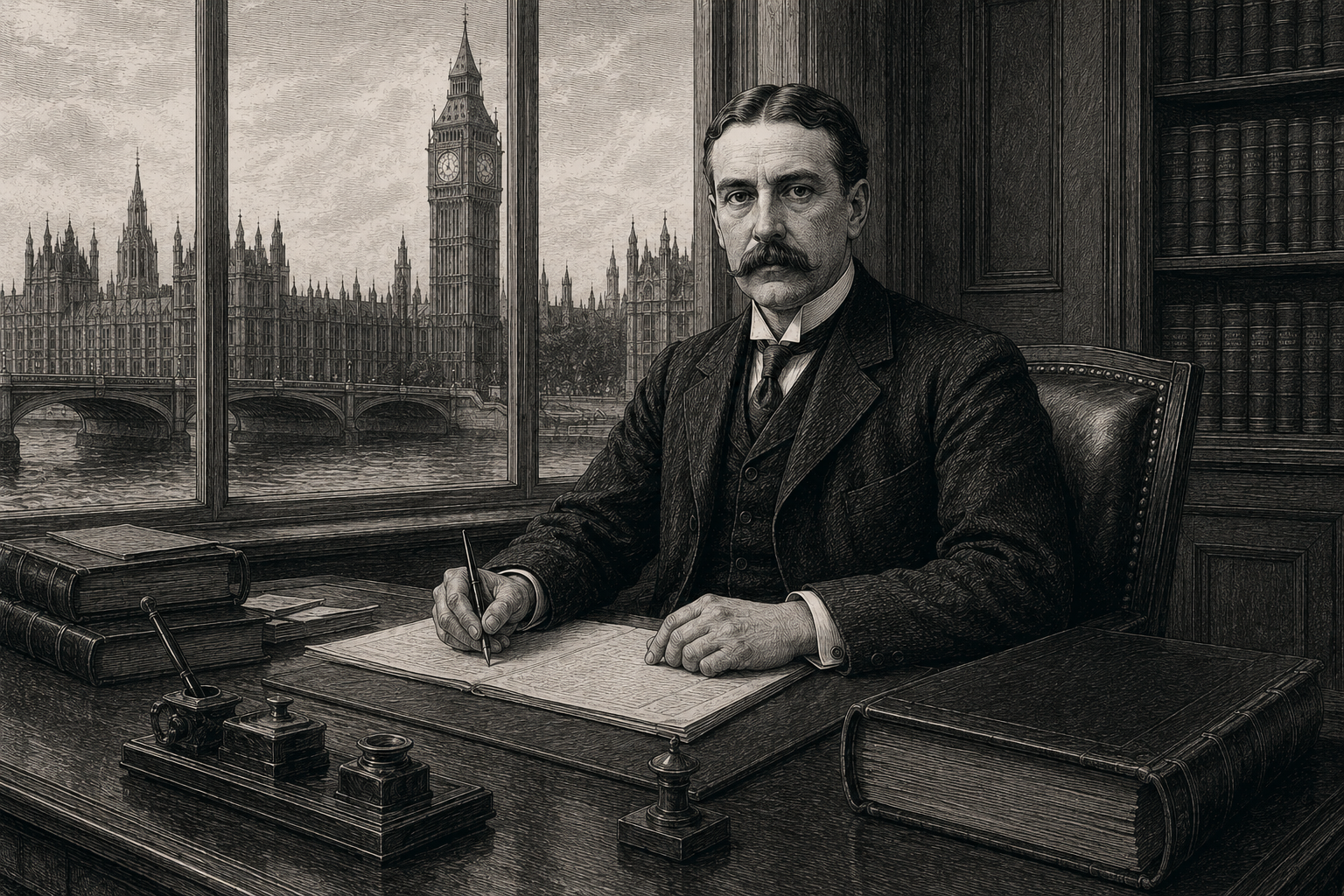
Read Article: Wyndham AppointedGeorge Wyndham has been appointed Chief Secretary for Ireland in succession to Gerald Balfour, placing a younger Conservative minister in charge of Irish administration at a moment of renewed nationalist organisation and growing agitation over the land. His appointment will be watched closely throughout Limerick city and county, where tenant ownership, congested holdings, rural poverty and the position of evicted families remain pressing political concerns. Wyndham enters office after the reunited Irish Parliamentary Party secured seventy-seven seats at the general election, although Lord Salisbury’s government remains firmly opposed to Home Rule and possesses a substantial Westminster majority.
The Chief Secretary serves as the government’s principal minister for Irish affairs and answers in the House of Commons for administration conducted through Dublin Castle. Gerald Balfour held the office from 1895, overseeing the Local Government Act of 1898, which transferred important administrative responsibilities to elected county and district councils. His policy followed the Unionist belief that practical reform could reduce support for Home Rule without conceding an Irish legislature. Wyndham inherits that approach, but he also confronts a revitalised United Irish League, a reunited nationalist parliamentary movement and persistent dissatisfaction with the laws governing relations between landlords and tenant farmers.
Wyndham, Conservative member for Dover, previously served as Parliamentary Under-Secretary for War and is closely associated with Arthur Balfour, the government leader in the Commons. Though lacking long experience in Irish administration, he possesses an unusual family connection with Ireland as a great-grandson of Lord Edward FitzGerald, the United Irish leader who died during the rebellion of 1798. The association may attract public curiosity but offers no guarantee of sympathy with nationalist constitutional demands. Wyndham takes office committed to the Union, and his immediate authority will depend upon cooperation with the Lord Lieutenant, Dublin Castle officials and the government’s parliamentary leadership.
The land question is likely to provide the earliest and most difficult test of the new Chief Secretary. Existing purchase legislation has enabled some tenants to acquire their farms, but transactions remain too limited to settle the wider dispute. Nationalists demand easier purchase terms, assistance for evicted tenants and action against congestion, while landlords seek prices that will protect their financial interests. Wyndham has not yet announced the comprehensive settlement later associated with his name, and no outcome can be assumed in 1900. Nevertheless, the strength of agrarian organisation ensures that land reform will occupy a central place in his administration.
For County Limerick, Wyndham’s appointment carries practical importance beyond the formal politics of Dublin Castle. Farmers considering purchase, tenants burdened by rent, labourers seeking access to land and elected councillors administering the new local government system will judge him by measures rather than ancestry or promises. Nationalist representatives are expected to press both Home Rule and agrarian reform, while Unionists will look to the Chief Secretary to maintain public order and preserve the legislative union. Wyndham begins with no Irish mandate of his own, but decisions taken under his authority may shape landownership, rural security and political argument throughout Limerick.
- The London Gazette, November 1900, official notice concerning George Wyndham’s appointment as Chief Secretary for Ireland. This can verify the appointment and ministerial succession. Exact issue, page and notice should be confirmed before formal citation.
- House of Commons Debates, November and December 1900, contributions and ministerial records concerning George Wyndham’s assumption of responsibility for Irish affairs. These can verify his office, parliamentary role and the Irish questions placed before him. Exact date, volume and columns should be confirmed before formal citation.
- The Times, 10 November 1900. Contemporary reporting can verify the ministerial appointment, Wyndham’s previous service and political reaction to the government reconstruction. Exact page and column should be confirmed before formal citation.
- Freeman’s Journal and Daily Commercial Advertiser, 10 November 1900. Contemporary Irish reporting can verify nationalist reaction to Wyndham’s appointment and expectations concerning land reform and Irish administration. Exact page and column should be confirmed before formal citation.
- Irish Land Act, 1903, 3 Edward VII, chapter 37. The enacted statute provides the definitive primary record of the major land-purchase legislation subsequently introduced under Wyndham, including government advances for tenant purchase and the administration of estate sales.
-
Home Rule Deferred
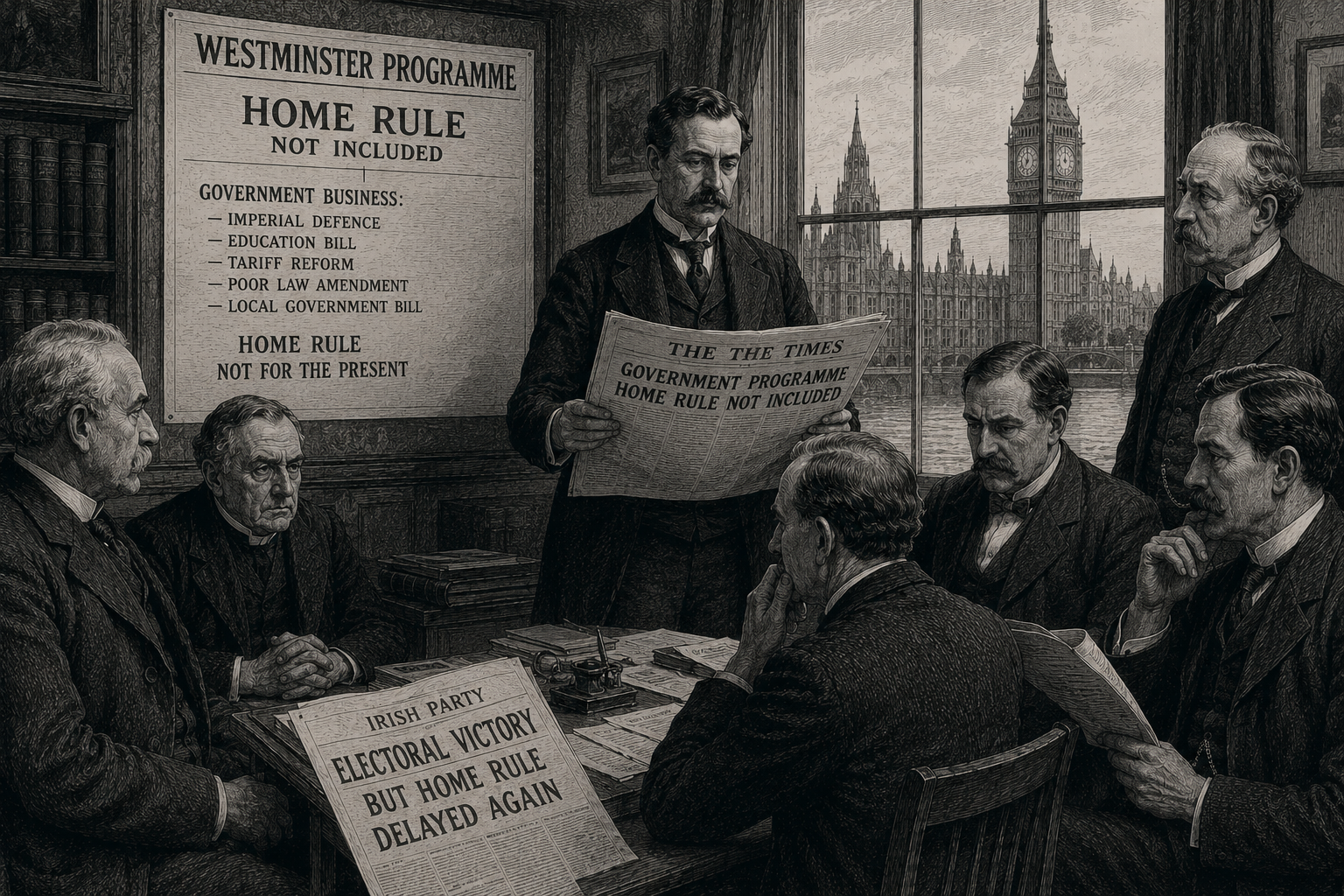
Read Article: Home Rule DeferredThe opening of the new Parliament has confirmed that Home Rule remains outside the immediate programme of the government, despite the strong electoral recovery of John Redmond’s reunited Irish Parliamentary Party. Nationalists returned seventy-seven members from Ireland’s 103 constituencies, giving the demand for an Irish legislature a commanding parliamentary voice. Yet the administration of Lord Salisbury, strengthened by its general-election victory, has offered no proposal for restoring domestic government in Dublin. In Limerick city and county, where nationalist representatives were returned and Home Rule remains central to organised political life, the omission will be received as a deliberate refusal to recognise Ireland’s electoral verdict.
Two Home Rule Bills have already failed at Westminster. William Ewart Gladstone’s first measure was defeated in the House of Commons in 1886, while the second passed that chamber in 1893 only to be rejected overwhelmingly by the House of Lords. The Liberal defeat of 1895 then removed Home Rule from practical government business. During the years that followed, Irish nationalism was weakened by the divisions arising from Charles Stewart Parnell’s downfall. The reunion of the principal factions under Redmond in 1900 restored parliamentary discipline, but it did not alter the Conservative and Unionist majority governing Britain and Ireland.
Redmond’s party now possesses renewed strength but lacks the Westminster balance of power required to force constitutional change. The Conservatives and their Liberal Unionist allies won a substantial majority in the election fought during the South African War. Their coalition remains committed to maintaining the legislative union and is supported by eighteen Irish Unionist MPs, chiefly representing north-eastern Ulster. The government may consider land purchase, local administration, education and other Irish questions separately, but such reforms do not concede the nationalist demand for a legislature controlling Ireland’s domestic affairs. Parliamentary recovery has therefore restored the Irish Party’s voice without restoring its immediate influence over government policy.
The omission presents Redmond with a difficult strategic choice. His members can press Home Rule through debates, amendments and parliamentary obstruction, but the government possesses sufficient numbers to defeat them. Cooperation with the Liberal opposition offers another course, although the Liberals themselves remain weakened and cannot promise early office. Meanwhile, William O’Brien and the United Irish League will continue linking constitutional nationalism with land agitation and local organisation. Success on the land question might bring practical relief to tenants, yet it could also allow ministers to argue that Irish grievances can be addressed without creating a separate parliament. Home Rule remains the declared objective but not an approaching government measure.
For Limerick nationalists, the contrast between electoral success and parliamentary exclusion will reinforce the belief that Irish majorities carry limited weight within the Union. Local branches of the United Irish League, public representatives, tenant organisations and nationalist newspapers may use the omission to strengthen meetings, subscriptions and political discipline. Unionists will answer that the government’s majority, together with determined opposition in Ulster, gives ministers a clear authority to resist constitutional separation. Limerick’s returned members can speak for Home Rule in the Commons, but they cannot place it upon the government programme. The election has revived nationalist organisation while leaving the central constitutional demand unanswered.
- Parliamentary Debates, House of Commons, “Address in Answer to Her Majesty’s Most Gracious Speech,” 6 December 1900. The debate records the programme presented at the opening of Parliament and contemporary responses to its treatment of Irish affairs. Relevant columns should be confirmed before formal citation.
- Her Majesty’s Most Gracious Speech to Both Houses of Parliament, 6 December 1900, reproduced in the official parliamentary debates. The speech can verify which legislative matters the government announced and the absence of an immediate Home Rule proposal. Relevant columns should be confirmed before formal citation.
- Parliamentary Election Returns, General Election of 1900, House of Commons Parliamentary Papers, Irish constituency returns. These official returns verify the election of seventy-seven Irish Parliamentary Party members and the government’s wider parliamentary majority. Exact volume and page references should be confirmed before formal citation.
- Freeman’s Journal and Daily Commercial Advertiser, 7 December 1900. Contemporary reporting can verify nationalist reaction to the Queen’s Speech, Redmond’s parliamentary position and criticism of the government’s Irish programme. Exact page and column should be confirmed before formal citation.
- The Irish Times, 7 December 1900. Contemporary coverage can verify Unionist and government interpretations of the parliamentary programme and the opening debates following the election. Exact page and column should be confirmed before formal citation.
-
British Absence
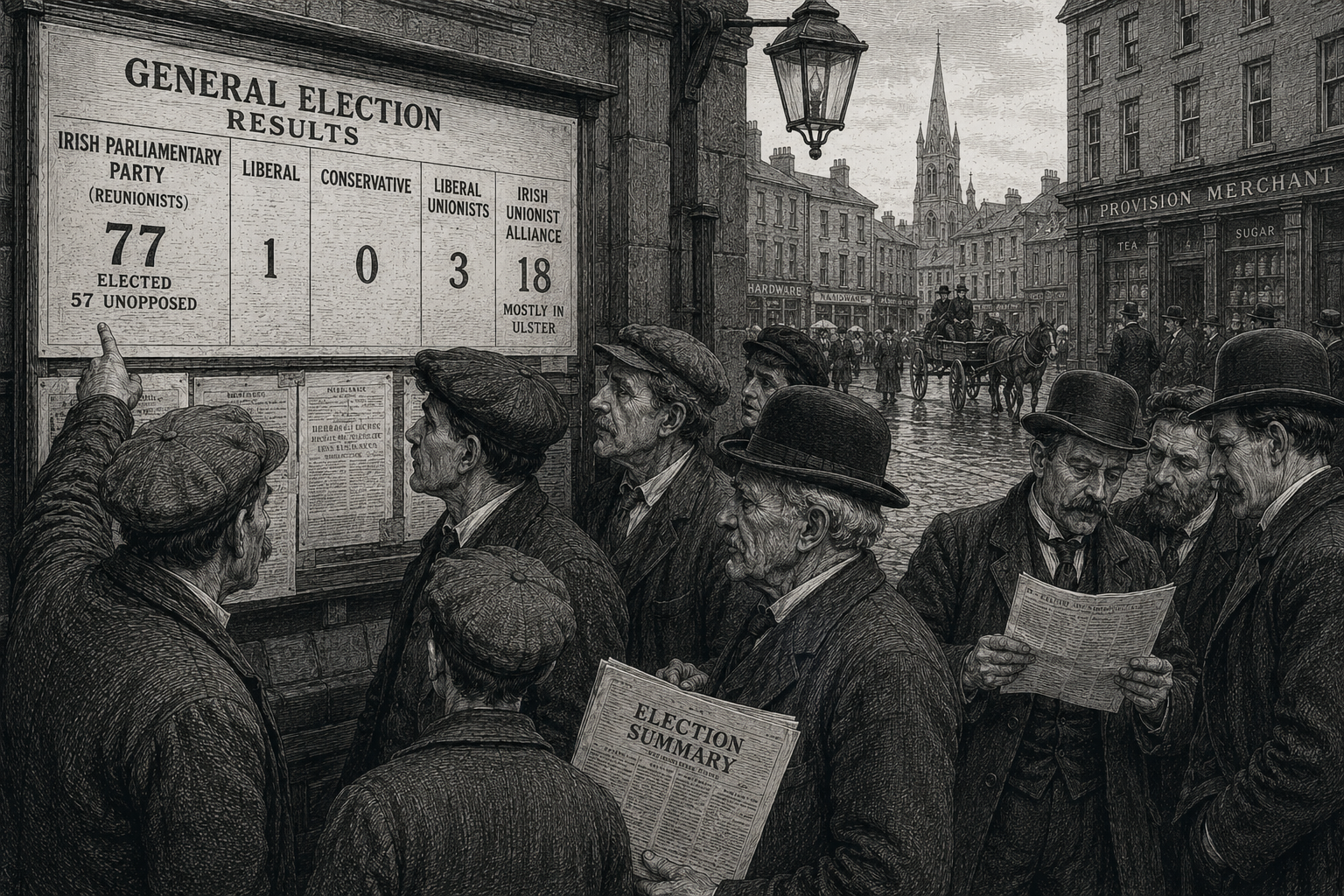
Read Article: British AbsenceThe completed general election has again demonstrated the weakness of the principal British political parties throughout nationalist Ireland. John Redmond’s reunited Irish Parliamentary Party has taken seventy-seven of Ireland’s 103 seats, while candidates standing directly for the British Liberal and Conservative parties made little impression across the south, west and much of the midlands. In Limerick, voters returned nationalist representatives without any prospect of an ordinary contest between the parties governing and opposing at Westminster. Irish political organisation remains shaped principally by the constitutional struggle between nationalism and unionism rather than by the divisions governing electoral life in Great Britain.
The British Liberals once attracted substantial Irish support through promises of reform, religious equality and sympathy for Home Rule. That relationship changed after Charles Stewart Parnell created a disciplined parliamentary movement capable of representing Irish constituencies independently. Gladstone’s conversion to Home Rule encouraged cooperation between Liberals and nationalists at Westminster, but it did not restore a separate Liberal organisation throughout nationalist districts. Conservative hostility to an Irish legislature made that party still less attractive. By 1900, most electors outside Unionist areas regarded British party candidates as unable or unwilling to represent Ireland’s demands for self-government, land reform and more direct control over domestic administration.
Only one Liberal candidate secured an Irish seat, while three Liberal Unionists were returned in constituencies opposed to Home Rule. The principal pro-Union representation came through the Irish Unionist Alliance, which retained eighteen seats, concentrated overwhelmingly in north-eastern Ulster and Dublin University. Across nationalist Ireland, however, the contest was usually between rival nationalists rather than between Liberal and Conservative organisations. Fifty-seven Irish Parliamentary Party members were returned without opposition, revealing the absence of a sustained British-party challenge in many constituencies. Even where elections were contested, local disputes concerning nationalist unity, candidate selection, land agitation and clerical influence frequently overshadowed the conventional British division between government and opposition.
The weakness of British organisation did not mean that Westminster politics had become unimportant. Nationalist MPs depended upon divisions between Liberals and Conservatives when seeking concessions, legislation or influence over governments lacking secure majorities. Many Irish nationalists continued to view the Liberals as potential allies because of their association with Home Rule, while Conservatives and Liberal Unionists governed through a coalition defending the Union. Yet neither British side possessed a broad electoral machine capable of replacing the Irish Parliamentary Party in nationalist constituencies. The election confirmed that cooperation at Westminster could coexist with electoral separation, leaving Irish voters represented by a distinct national party.
For Limerick, the result strengthened the position of local nationalist branches, clergy, public representatives and political organisers associated with Redmond’s movement. Liberal or Conservative candidates could not readily compete where elections were understood as contests over Irish government, tenant ownership and national representation. Unionist residents retained their political convictions, but they lacked the concentrated numbers that sustained Unionist representation in parts of Ulster. Limerick’s parliamentary politics consequently remained Irish rather than conventionally British in organisation and purpose. The governing parties at Westminster might determine legislation, but neither commanded the local allegiance necessary to challenge the nationalist movement for possession of the city and county’s parliamentary seats.
- Parliamentary Election Returns, General Election of 1900, House of Commons Parliamentary Papers, constituency returns for Ireland. These official returns verify the successful candidates, party affiliations, uncontested seats, polling dates and constituency results. Exact volume and page references should be confirmed before formal citation.
- The Times, September and October 1900, general-election reports and completed constituency returns. These contemporary reports can verify the national British result and the comparative strength of Conservative, Liberal, Unionist and Irish nationalist candidates. Exact page and column should be confirmed before formal citation.
- Freeman’s Journal and Daily Commercial Advertiser, September and October 1900. Its election reports can verify nationalist candidatures, uncontested returns, local campaigns and contemporary explanations for the weakness of British party organisation in Irish constituencies. Exact page and column should be confirmed before formal citation.
- The Irish Times, September and October 1900, election reports, constituency summaries and editorials. These issues can verify the performance of Liberal, Conservative, Liberal Unionist, Irish Unionist and nationalist candidates. Exact page and column should be confirmed before formal citation.
- United Irish League, Constitution and Rules Adopted by the Irish National Convention, 19 and 20 June 1900, Dublin, Swan & Co., 1900; National Library of Ireland, Pamphlet Volume A17405; Thomas Bradley Papers, MS 33,561/2(12). This document verifies the nationalist organisation that supported Irish Parliamentary Party candidates and helped displace conventional British party structures.
-
Unity Fractures
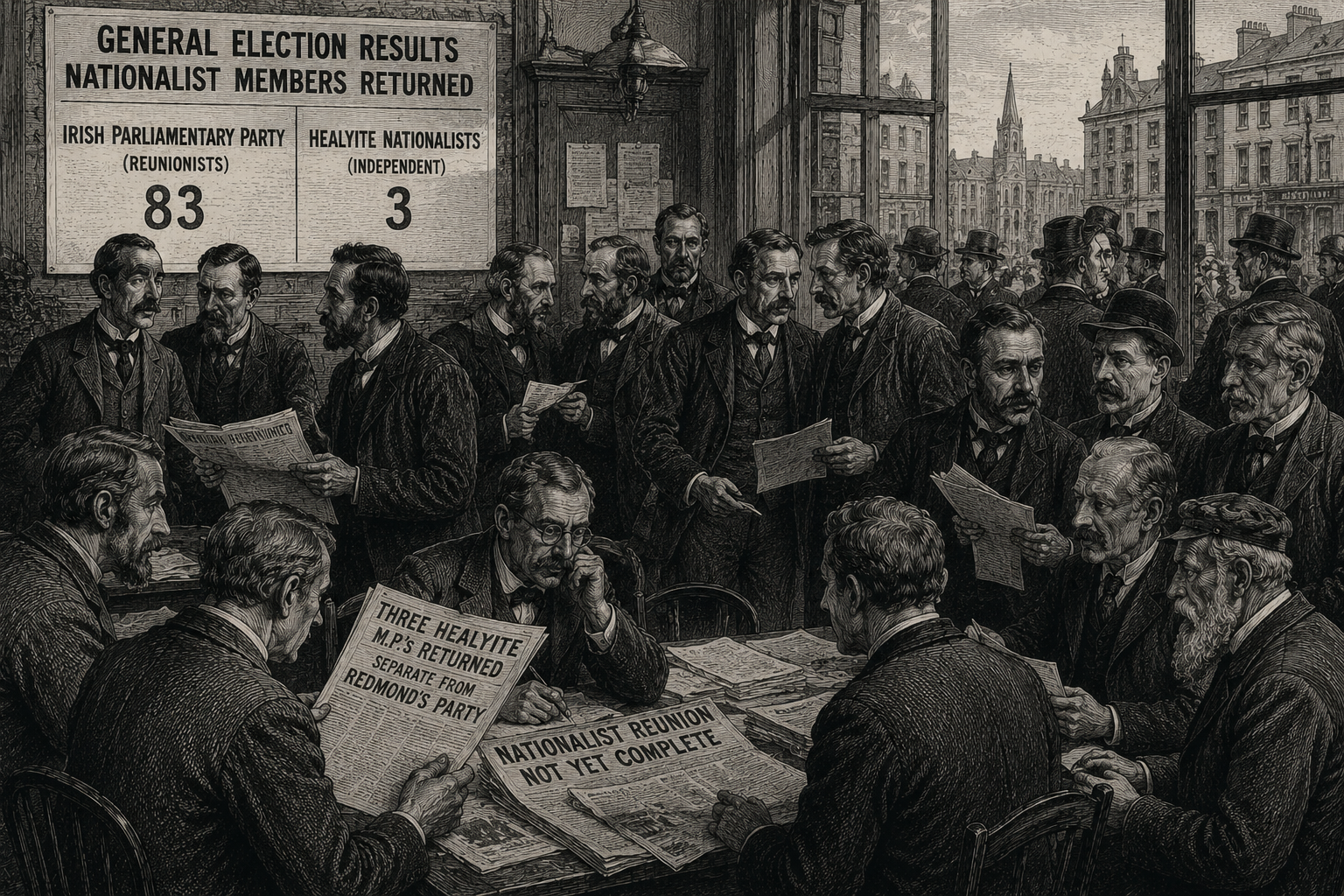
Read Article: Unity FracturesThe completion of the general election has shown that the reunion of Irish parliamentary nationalism remains incomplete. Although John Redmond’s Irish Parliamentary Party has secured the overwhelming majority of nationalist seats, six supporters of Timothy Michael Healy have been returned outside the disciplined party organisation. The result will attract close attention among nationalists in Limerick city and county, where unity has been presented as essential to advancing Home Rule and land reform. Healy’s surviving parliamentary following demonstrates that the personal, clerical and local rivalries created during the bitter divisions of the 1890s have not been entirely overcome.
The nationalist split began after Charles Stewart Parnell’s leadership collapsed in 1890, dividing Irish MPs into competing Parnellite and anti-Parnellite organisations. Healy, initially prominent among the anti-Parnellites, became increasingly estranged from John Dillon and other leaders, cultivating an independent following through the People’s Rights Association. His supporters emphasised local control, clerical influence and hostility towards centralised party management. The formal reunion of the main parliamentary factions in January 1900 placed Redmond at their head, but it did not reconcile every personal grievance or political disagreement. Candidate selection during the election exposed the continuing distrust between party headquarters and Healy’s adherents.
The returned Healyite group included Tim Healy for North Louth, John Campbell for South Armagh, John Hammond for County Carlow, Peter Ffrench for South Wexford, James Laurence Carew for South Meath and Patrick Kennedy for North Westmeath. Their victories were achieved against candidates associated with Redmond’s party or through strong independent local organisation. Healy remained the central figure, combining parliamentary experience, legal ability and combative public speaking with a reputation for fierce personal controversy. His alliance with influential Catholic clergy, particularly Cardinal Michael Logue, gave his movement additional strength in districts where clerical opinion remained important to nationalist electoral organisation.
The result creates an awkward difficulty for Redmond. A reunited nationalist party must demonstrate discipline at Westminster, yet attempts to exclude or silence Healy’s followers may deepen the divisions that reunion was intended to end. Healyites support Home Rule and land reform, but dispute who should control the movement and how parliamentary candidates should be chosen. Their return also reveals the continuing power of local loyalties over national directives. The Irish Parliamentary Party can claim broad electoral supremacy, but the presence of an organised nationalist opposition means that Redmond cannot yet speak without qualification for every constitutional nationalist represented in the House of Commons.
In Limerick, where nationalist associations, clergy, tenant interests and local political organisers all influence public life, the Healyite success may revive debate over obedience to party leadership. Supporters of Redmond will argue that unity is necessary if Ireland is to exert effective pressure at Westminster. Others may sympathise with the claim that constituencies should resist candidates imposed by a central organisation. No Healyite captured a Limerick seat, but the faction’s survival elsewhere carries a clear warning. Nationalist reunion has restored much of the parliamentary strength lost during the previous decade, yet personal allegiance, local independence and disputes over authority remain capable of dividing the movement.
- Parliamentary Election Returns, General Election of 1900, House of Commons Parliamentary Papers, constituency returns for Ireland. These official returns can verify the elected candidates, constituencies, voting figures and polling dates. Exact volume and page references should be confirmed before formal citation.
- Freeman’s Journal and Daily Commercial Advertiser, September–October 1900 election coverage. Contemporary reports can verify Healyite candidatures, speeches, disputes over party endorsement and reactions to the results. Exact page and column should be confirmed before formal citation.
- The Irish Times, September–October 1900 election reports and editorials. These issues can verify constituency contests, candidate classifications and contemporary criticism of continuing nationalist factionalism. Exact page and column should be confirmed before formal citation.
- United Irish League, Constitution and Rules Adopted by the Irish National Convention, 19–20 June 1900, Dublin, Swan & Co., 1900; National Library of Ireland, Pamphlet Volume A17405; Thomas Bradley Papers, MS 33,561/2(12). This document can verify the organisational structure against which independent Healyite candidatures were contested.
- Timothy Michael Healy correspondence and political papers relating to the 1900 general election, National Library of Ireland and associated manuscript collections. These papers may verify Healy’s candidate negotiations, complaints concerning party management and relations with Redmond, Dillon and clerical supporters. Exact manuscript items and archival references should be confirmed before formal citation.
-
Ulster Divide
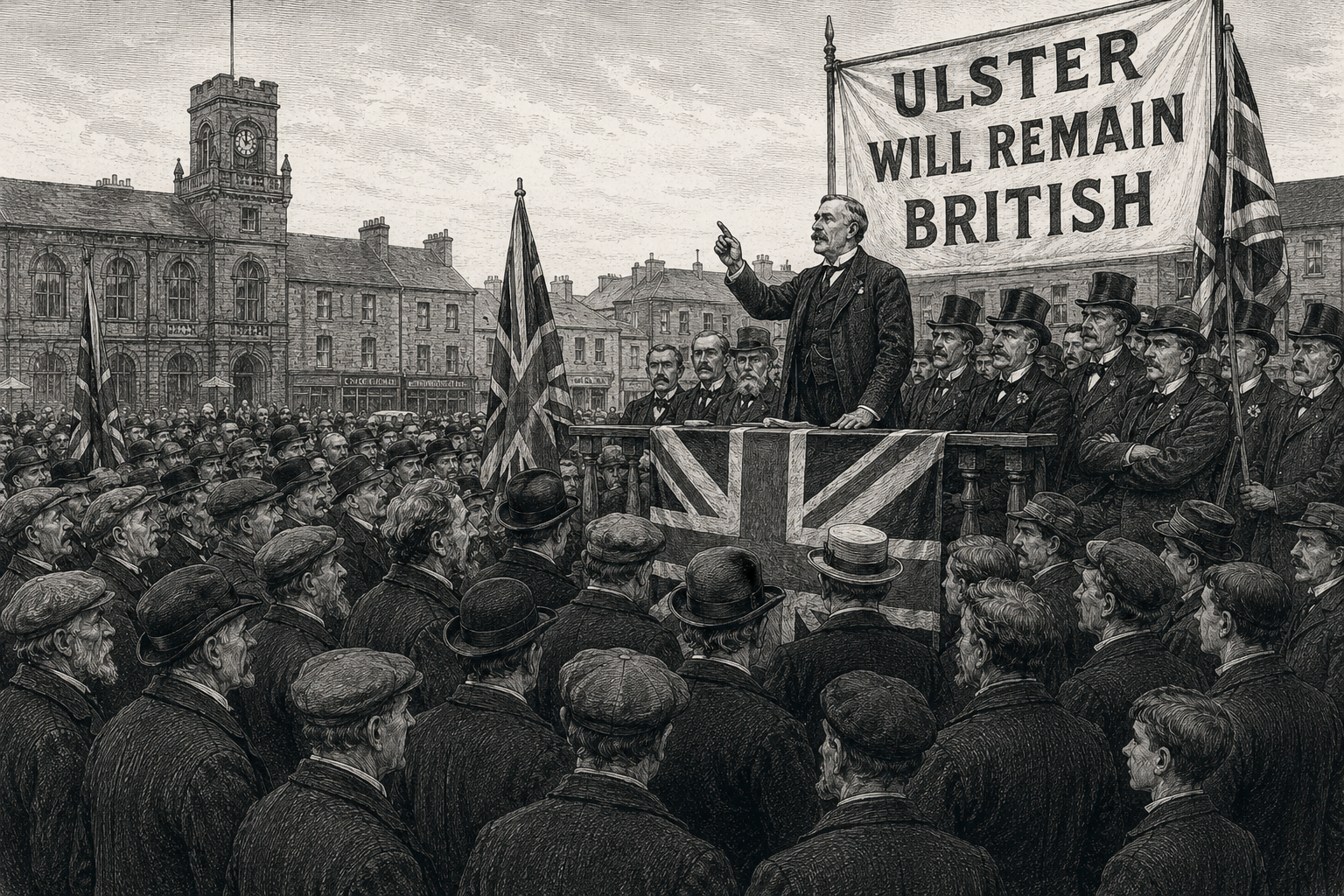
Read Article: Ulster DivideThe general election has confirmed a widening political division between nationalist Ireland and the unionist strongholds of north-eastern Ulster. While the reunited Irish Parliamentary Party has secured overwhelming representation across most of the country, Unionist candidates have retained their commanding position in Belfast, Antrim, Down, northern Armagh and neighbouring districts. The result will be closely studied in Limerick, where Home Rule supporters regard an Irish legislature as the principal national demand. Unionist resistance in Ulster, however, demonstrates that constitutional settlement cannot be considered solely through the wishes of the nationalist majority elsewhere in Ireland.
Unionism had gathered strength after William Ewart Gladstone introduced the first Home Rule Bill in 1886. Conservatives, Liberal Unionists, Protestant organisations, commercial interests and many landowners argued that a Dublin parliament would weaken the United Kingdom and threaten their religious, economic and political position. These fears possessed particular force in the industrial north-east, where Belfast’s shipbuilding, linen manufacture, engineering and commercial links with Britain differed markedly from the agricultural conditions prevailing throughout much of Ireland. The defeat of the second Home Rule Bill in the House of Lords in 1893 postponed the immediate question but did not remove the regional opposition.
The Irish Unionist Alliance remained the principal organisation defending the legislative union, working closely with Conservatives and Liberal Unionists at Westminster. Its northern strength rested heavily upon Protestant voters, Orange lodges, businessmen, professional men and landed interests, although unionism was neither socially uniform nor free from disagreement. Nationalists retained important support in southern and western Ulster, while several constituencies were decided by narrow margins. Nevertheless, the election again showed that many seats in Antrim, Down, Belfast and northern Armagh could be held comfortably by candidates opposed to Home Rule, sometimes without a nationalist challenge.
The results expose two sharply different political mandates within Ireland. Nationalists can point to their large majority of Irish parliamentary seats as evidence that the country demands self-government. Unionists answer that concentrated majorities in north-eastern Ulster cannot fairly be placed beneath a legislature they distrust. The return of Londonderry City to Unionist representation, together with strong Unionist performances across Belfast and surrounding counties, has strengthened that argument. No immediate partition proposal commands political discussion, but the territorial concentration of Unionist support is making the Ulster difficulty increasingly distinct from the position of scattered Unionists elsewhere.
For Limerick nationalists, the result provides both encouragement and warning. John Redmond’s reunited party possesses a powerful Irish mandate, and local supporters may view its success as a renewed opportunity to press Home Rule at Westminster. Yet the strength of north-eastern Unionism shows that Irish opinion is not politically uniform. Protestant and Unionist residents of Limerick may also draw reassurance from the continued representation of their views, even though Unionism has declined as an electoral force outside Ulster. The election has therefore strengthened constitutional nationalism while simultaneously revealing the regional resistance that any future Home Rule settlement must confront.
- Parliamentary Election, 1900: Return of Charges, House of Commons Parliamentary Paper 1901 (33), volume LXIX, including the Irish constituency returns. This official record can verify candidates, contests and election administration. Relevant Irish tables and page references should be checked against the original parliamentary paper before formal citation.
- The Irish Times, 11 October 1900. Contemporary election reporting and editorial discussion can verify reactions to the decline of southern Unionism and the growing importance of Ulster as the movement’s principal electoral base. Exact page and column should be confirmed before formal citation.
- The Irish Times, 12 October 1900. This issue reported and assessed the completed election results and their reception in Ireland and Britain. It can verify contemporary interpretations of the Unionist and nationalist outcomes. Exact page and column should be confirmed before formal citation.
- Belfast News-Letter, 11 October 1900. Contemporary northern reporting can verify Unionist election results, local speeches, constituency reactions and the political arguments advanced by Ulster candidates. Exact page and column should be confirmed before formal citation.
- W. E. H. Lecky to Hugh de Fellenberg Montgomery, 26 November 1900, Public Record Office of Northern Ireland, Hugh de Fellenberg Montgomery Papers, T1089/297. This private contemporary letter records Lecky’s judgement concerning the electoral future and importance of Ulster Unionism.