Now Sharing: Articles (154) | Images (445) | Total Items Archived (599)
Our Mission: 100,000 Items | Total Percentage Achieved (0.60%)

Jaunting Car On O’Connell Street

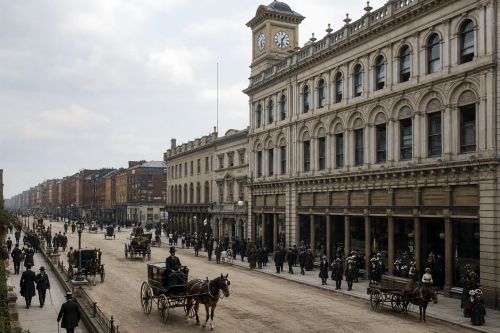
By 1937, O'Connell Street stood as Limerick's principal commercial thoroughfare, its Victorian and Georgian frontages housing chemists, drapers, and grocers that served the city's daily life. Ireland was still finding its footing after the Economic War with Britain, which had strained trade and agriculture through much of the decade, while the country prepared to adopt a new Constitution that same year. Horse-drawn jaunting cars remained a familiar sight on Limerick's streets even as motor vehicles grew more common, reflecting a city balancing older rhythms of trade and transport with the slow arrival of modern urban life in provincial Ireland.

The Heart of Edwardian Limerick

At the beginning of the twentieth century, George Street stood at the centre of commercial life in Limerick. Today known as O’Connell Street, it was bordered by impressive Georgian buildings housing hotels, shops, offices and established local businesses. Horse-drawn carts, private carriages and crowds of pedestrians moved constantly along the busy thoroughfare, while traders brought additional noise and colour to the scene. Landmarks included the Royal Hotel, MacMahon’s Temperance Hotel and firms such as O’Mahony & Company. The street’s elegant architecture and lively commerce made it one of Edwardian Limerick’s most important and recognisable urban spaces for residents and visitors.

Monasteranenagh Abbey, 1148

Founded in 1148 by Toirdelbhach mac Diarmaida Ua Briain, Monasteranenagh Abbey became one of County Limerick’s most important Cistercian foundations. This reconstruction imagines the monastery during its earliest years, with newly completed stone buildings, steep roofs, narrow lancet windows, timber doors, and monks moving quietly through the surrounding grounds. The austere architecture reflects the Cistercian ideals of simplicity, discipline, prayer, and communal labour. Supported by the O’Brien dynasty, the abbey later expanded under Domnall Mór Ua Briain. Though centuries of conflict and collapse reduced it to ruins, its surviving walls remain a powerful monument to medieval Irish faith and craftsmanship.

Adare Manor Colour Print

This variation of a colour print depicts Adare Manor beside the River Maigue in Adare, County Limerick. The imposing Gothic Revival residence is shown within landscaped grounds, reflected in the calm water and framed by mature trees. Often described as a calendar house, the manor is associated with 365 windows and 52 chimneys, representing the days and weeks of the year. Published in Francis Orpen Morris’s A Series of Picturesque Views of Seats of the Noblemen and Gentlemen of Great Britain and Ireland, the image celebrates the architecture, setting, and aristocratic character of one of County Limerick’s most recognisable historic estates and landmarks.

The Treaty Stone

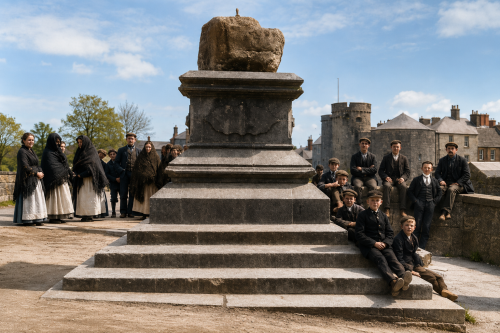
The Treaty Stone on Clancy’s Strand is traditionally believed to have served as the table upon which the Treaty of Limerick was signed on 3 October 1691. Concluded after the Siege of Limerick, the agreement ended the Williamite War in Ireland. Its military articles permitted Patrick Sarsfield’s Jacobite army to depart for France in the Flight of the Wild Geese, while the civil articles promised protections for Catholics. These promises were later undermined by the Penal Laws. Originally a mounting block outside the Black Bull Inn, the stone was placed on its decorated pedestal by Mayor John Rickard Tinslay in 1865.

Glenduff Castle Restored

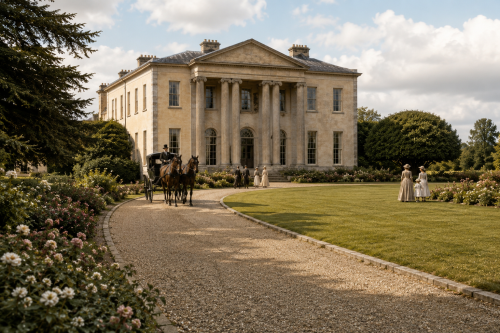
Glenduff Castle is shown restored to its former splendour, standing proudly amid landscaped gardens in rural County Limerick. Built around 1840 for the Ievers family, the castellated country house incorporated an earlier tower house dating from about 1600. Its battlements, flanking towers, arched entrance and long stone façade created a striking Gothic Revival residence. The scene imagines the estate before its destruction, with residents, visitors and a horse-drawn carriage bringing the grounds to life. Glenduff Castle was burned during the Irish Civil War on 29 June 1922, leaving the picturesque ivy-covered ruin that survives on private farmland near Broadford today.

A Busy Day On George Street

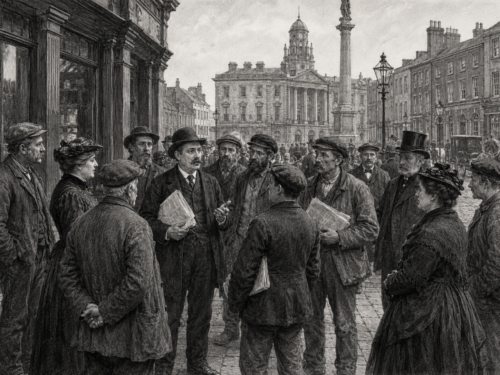
George Street, now O’Connell Street, formed the bustling commercial and social heart of Limerick around 1900. Elegant Georgian and Victorian façades lined the thoroughfare, their ornate shopfronts illuminated by gaslight and filled with goods for local shoppers. Horse-drawn carriages, jaunting cars and merchant carts crowded the roadway, while pedestrians in heavy coats and hats moved between businesses and hotels. The grand Cruises Royal Hotel stood among the street’s most prominent landmarks, welcoming merchants, travellers and visitors. This scene reflects the energy of late-Victorian Limerick before motor traffic transformed the city’s principal shopping street and historic urban centre during a changing era.

Tenancy Dispute

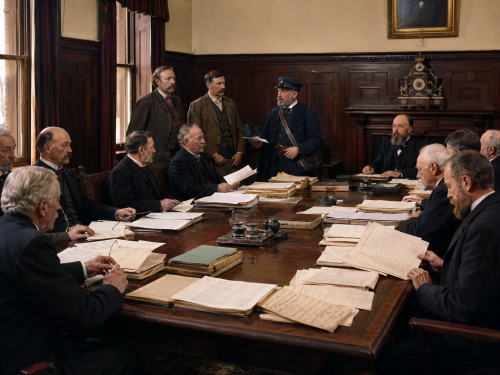
A tenancy dispute involving a Limerick woman came before Cheltenham County Court in March 1900, revealing the uncertainty that could accompany rented accommodation far from home. The proceedings concerned Mrs J. Lestbah and Mrs J. M. Harnett, whose disagreement arose from the letting of two rooms at 2 Queen’s Parade. The tenancy had begun in September 1899, several months before the hearing. For Limerick people living in Britain, such cases formed part of the less visible experience of migration, in which securing rooms, meeting rent and establishing responsibility could become matters for formal legal judgement.

Limerick Boat Club

Limerick Boat Club, established in 1870, is one of the city’s oldest and most distinctive rowing institutions. Situated on the western side of Wellesley Pier beside Sarsfield Bridge, the club occupies a handsome Victorian red-brick clubhouse overlooking the River Shannon. As the second oldest rowing club in Limerick, it has played an important role in the city’s sporting and social life for generations. The club is particularly associated with recreational rowing, welcoming members who enjoy the river for exercise, companionship and leisure. Its historic setting and continuing community presence make it a familiar landmark on Limerick’s waterfront within the city.

The Heart of Edwardian Limerick

At the beginning of the twentieth century, George Street stood at the centre of commercial life in Limerick. Today known as O’Connell Street, it was bordered by impressive Georgian buildings housing hotels, shops, offices and established local businesses. Horse-drawn carts, private carriages and crowds of pedestrians moved constantly along the busy thoroughfare, while traders brought additional noise and colour to the scene. Landmarks included the Royal Hotel, MacMahon’s Temperance Hotel and firms such as O’Mahony & Company. The street’s elegant architecture and lively commerce made it one of Edwardian Limerick’s most important and recognisable urban spaces for residents and visitors.