Now Sharing: Articles (154) | Images (445) | Total Items Archived (599)
Our Mission: 100,000 Items | Total Percentage Achieved (0.60%)

The Heart of Edwardian Limerick

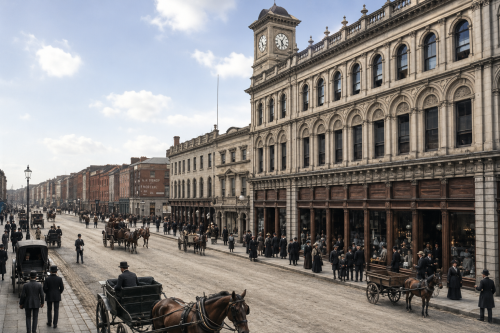
At the beginning of the twentieth century, George Street stood at the centre of commercial life in Limerick. Today known as O’Connell Street, it was bordered by impressive Georgian buildings housing hotels, shops, offices and established local businesses. Horse-drawn carts, private carriages and crowds of pedestrians moved constantly along the busy thoroughfare, while traders brought additional noise and colour to the scene. Landmarks included the Royal Hotel, MacMahon’s Temperance Hotel and firms such as O’Mahony & Company. The street’s elegant architecture and lively commerce made it one of Edwardian Limerick’s most important and recognisable urban spaces for residents and visitors.

A Busy Day On George Street

George Street, now O’Connell Street, formed the bustling commercial and social heart of Limerick around 1900. Elegant Georgian and Victorian façades lined the thoroughfare, their ornate shopfronts illuminated by gaslight and filled with goods for local shoppers. Horse-drawn carriages, jaunting cars and merchant carts crowded the roadway, while pedestrians in heavy coats and hats moved between businesses and hotels. The grand Cruises Royal Hotel stood among the street’s most prominent landmarks, welcoming merchants, travellers and visitors. This scene reflects the energy of late-Victorian Limerick before motor traffic transformed the city’s principal shopping street and historic urban centre during a changing era.

Reunion Advances

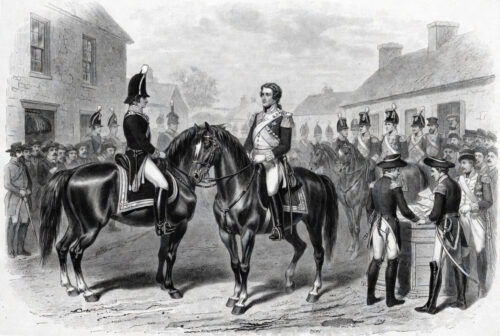
Negotiations to reunite Ireland’s divided nationalist parliamentarians advanced formally during the Mansion House conference held on 17 January. Representatives associated with the rival factions created by the fall of Charles Stewart Parnell met in Dublin to consider practical terms for restoring a single parliamentary organisation. Nearly a decade of internal conflict had weakened nationalist influence at Westminster and exhausted many supporters throughout Ireland. The conference did not instantly remove the personal distrust, political grievances and competing ambitions that had accumulated since 1890, but it transformed informal appeals for reconciliation into a structured negotiation between recognised representatives of the opposing groups.

Castlegarde Castle Through Time

Castlegarde Castle, near Cappamore in County Limerick, is regarded as Ireland’s oldest continuously inhabited castle. Established by the O’Brien family around 1190, its five-storey medieval tower rises from a limestone outcrop, strengthening its defensive position. Original features include an internal well and a murder hole above the entrance passage. In 1820, Waller O’Grady commissioned architects James and George Pain to add a castellated Gothic extension, harmonised with the ancient keep. A carved head of Brian Boru overlooks the entrance, while three unusual stone figures representing Bacchus, Pallas Athene and Aphrodite survive within the gatehouse. Today, it remains a private residence.

Athlunkard Boat Club

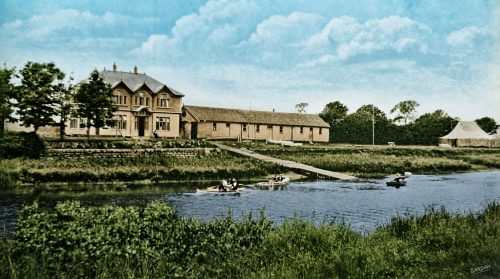
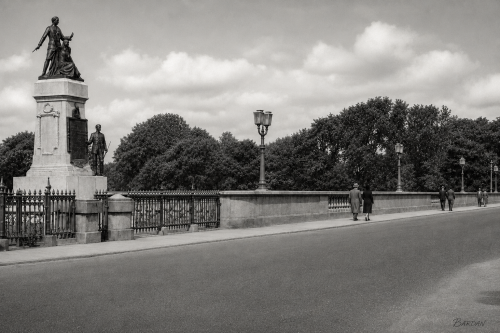
Athlunkard Boat Club was founded in 1898, taking its name from its home beside O’Dwyer Bridge at the end of Athlunkard Street. By the 1930s, the club was already firmly woven into Limerick’s rowing tradition, with a proud record on the water. Its greatest distinction came through the Senior Eight Championship, which Athlunkard won twice, in 1913 and 1923. That achievement made it the only Limerick club to secure the title on two occasions. Its riverside presence and competitive success gave Athlunkard Boat Club a lasting place in the sporting history of the city and the wider Shannon rowing community.

Thatched Cottages of Adare

In July 1981, a row of traditional thatched cottages lends Adare its distinctive old-world character. Whitewashed walls, steep straw roofs and small windows line the roadside, reflecting a style once common throughout rural Ireland. The cottages appear carefully maintained, their simple façades softened by flowers, hedges and mature trees. Passing traffic and summer light place the scene firmly in everyday village life rather than a staged historical setting. The image preserves a familiar view of Adare at a time when its architectural heritage was becoming central to the village’s identity and appeal for visitors to County Limerick and beyond worldwide.

Cannocks, George Street

Before becoming Cannocks, the premises at 134 George Street, now O’Connell Street, housed a successful drapery business dating from around 1814. By the mid-nineteenth century, the shop was operated by Cumine and Mitchell and was regarded as a high-class retail establishment. In 1850, Scottish businessmen George Cannock and John Arnott purchased the property, establishing Cannocks and Company, which developed into one of Limerick’s best-known department stores. The business remained a prominent feature of the city’s commercial life for generations. In 1980, the store was sold to Penneys, which continues to occupy the historic site today on O’Connell Street in Limerick.

Teampall Nua in Ruins

The old church near Holycross, County Limerick, was recorded as a ruin by 1642. In 1679, Rachael Bourchier, Countess of Bath, restored the building, just one year before her death. Thereafter it became known as the New Church, or Teampall Nua in Irish, and served local Church of Ireland parishioners. A belfry was added during the restoration, giving the structure a distinctive profile. Although the church later fell out of use and returned to ruin, its surviving walls, arched openings and graveyard remain important reminders of seventeenth-century religious life and the long history of worship at this historic site today.

Dutch Billy Houses, Mary Street

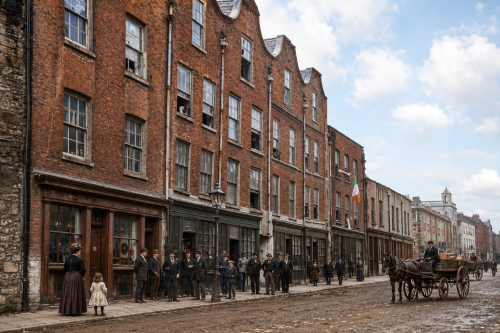
Dutch Billy houses were once a distinctive feature of Limerick’s Englishtown and Irishtown districts. Characterised by narrow brick façades, steeply pitched gables and tall windows, the style developed in Irish towns during the late seventeenth and early eighteenth centuries. Many examples survived along Mary Street into the early twentieth century, preserving the appearance of Limerick’s merchant quarters. Their name is traditionally associated with King William III, although the term was applied broadly to gabled urban houses of the period. By around 1900, these buildings stood as reminders of the city’s commercial growth, architectural character and changing streetscape across previous centuries.

Inside Gurranmore Police Cabin

Around 1880, the interior of a police cabin at Gurranmore, near Pallas in County Limerick, reveals the modest conditions in which rural constables lived and worked. The small room is sparsely furnished, with simple wooden fittings, basic household utensils and few comforts. Uniformed officers occupy the cramped space, suggesting that the cabin served as both workplace and living quarters. Published in The Graphic in 1880, the image offers a rare glimpse of everyday policing in nineteenth-century Ireland. It preserves not only the appearance of the station, but also the disciplined, isolated life experienced by men posted in rural communities nearby.