Membership is completely free, giving members unlimited access to all available resources, services, features, and benefits without any restrictions or fees.
Welcome back. Sign in to continue enjoying unlimited access to all available resources, services, features, and member benefits at no cost.
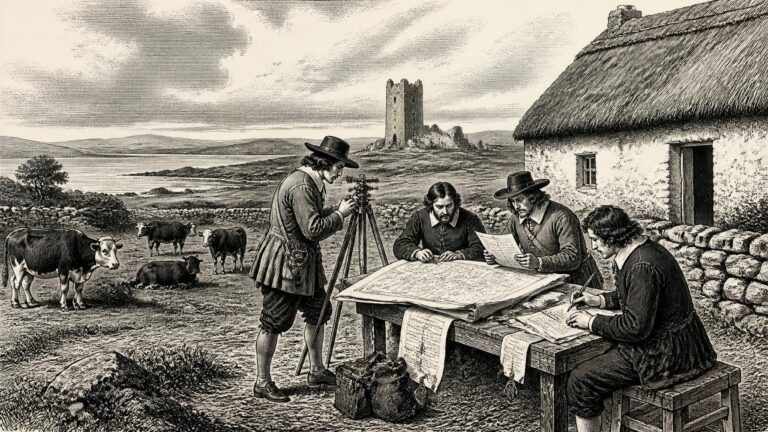
The Down Survey was the year’s most durable Irish development. Directed by Sir William Petty, physician, administrator and practical innovator, it had been undertaken from 1656 and was completed in 1658. It was a vast exercise in measuring land on maps rather than merely describing it in written schedules: the first detailed survey carried out on a national scale. Its immediate purpose was not neutral knowledge. It identified land available after forfeiture so that the Commonwealth could meet commitments to Merchant Adventurers, who had financed the war, and to soldiers owed arrears of pay.
The central firmly dated development came on 8 June, when the Westminster parliament passed An Act for the Assuring, Confirming and Settling of Lands and Estates in Ireland. The long title reveals its purpose. Since the Act for the Settlement of Ireland of 1652, land had been seized, surveyed, assigned, adjudicated and re-assigned through a dense succession of ordinances, instructions and local decisions. The 1657 act confirmed those earlier proceedings. It was intended to give a more dependable legal foundation to the distribution of Irish land among creditors of parliament, army officers and soldiers, Protestant purchasers, and others whom the regime recognised as entitled to grants.
Sir William Petty’s Down Survey lay at the centre of that process. Commissioned to provide a detailed measurement of lands available to satisfy the arrears owed to the Commonwealth army, it was an extraordinary administrative enterprise. Petty’s teams measured land at local level, recording baronies, parishes, townlands, boundaries and the distinction between profitable and unprofitable ground. Maps and accompanying books turned complicated local landscapes into information which Dublin and Westminster could use for allocation.
The most firmly dated business of the year concerns transplantation: the Commonwealth policy of removing many Irish Catholic proprietors and others judged liable to forfeiture from Leinster, Munster and Ulster into Connacht and County Clare. This programme had been framed in earlier legislation and orders; 1655 was not its beginning. Yet the surviving proclamations show that it was being pressed, adjusted and policed in that calendar year. On 27 February the Irish government extended the time allowed for transplantation until 20 May, expressly because heavy rains had impeded movement. The detail is revealing. Removal on paper meant travel on winter and spring roads, across rivers and through a landscape made difficult by weather, livestock, carts and the need to find somewhere to live.