Smith’s Endowment1657 CE
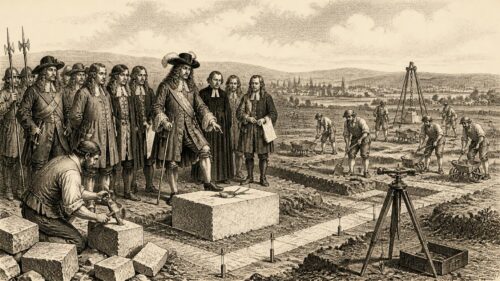
In 1657, Cromwellian Ireland consolidated conquest through law, taxation and institutions. Parliament’s June act confirmed land transfers to soldiers, adventurers and Protestant purchasers, strengthening dispossession while disputes and incomplete occupation persisted. Transplantation to Connacht and Clare continued unevenly, reshaping communities and livelihoods. A costly land assessment funded the army, prompting organised lobbying by Protestant proprietors but offering Catholics little influence. Henry Cromwell’s November appointment as lord deputy regularised government while preserving military control. Erasmus Smith’s foundation deed endowed Protestant education from settlement lands, whereas Luke Wadding’s death highlighted Irish Catholic learning sustained abroad. These measures entrenched division beneath administrative stability.
Dateline
Ireland in 1657 did not witness a single famous battle or a dramatic change of dynasty. Its importance lies instead in the hardening of a conquest into institutions: title deeds, assessments, commissions, leases, schools and offices. The wars of the 1640s and early 1650s were over, but their consequences were being made durable. For Catholic landholders and families displaced by confiscation and transplantation, this was not a peaceful return to normality. For soldiers, adventurers, Protestant settlers and office-holders, it was a year in which the new order sought legal security and a more settled social base.
A Settlement Made Law
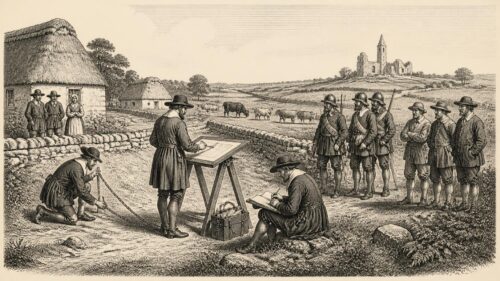
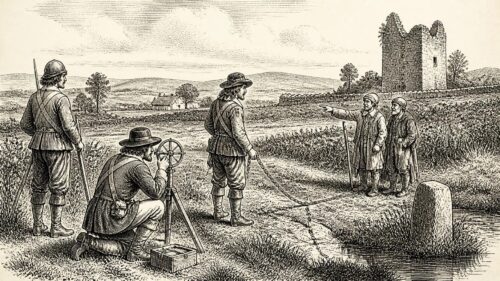
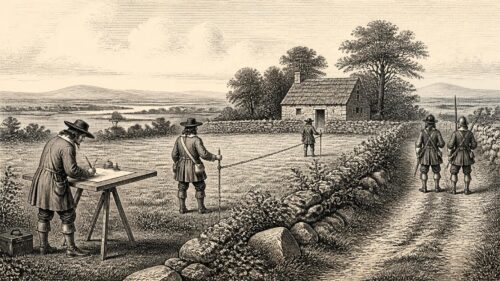
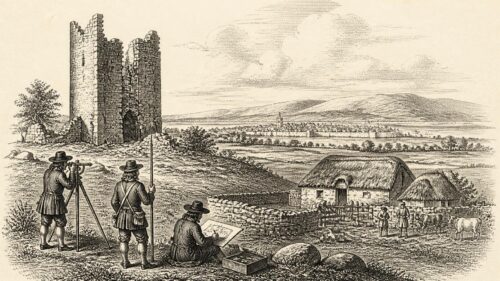
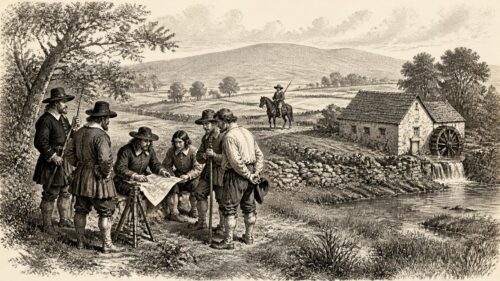
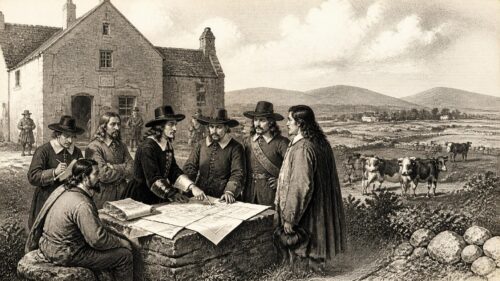
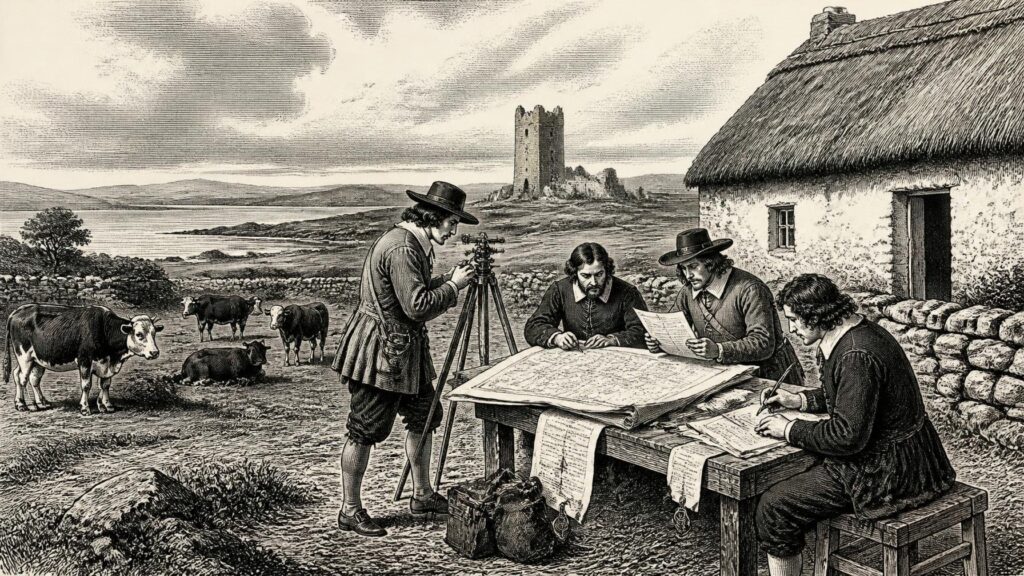
The central firmly dated development came on 8 June, when the Westminster parliament passed An Act for the Assuring, Confirming and Settling of Lands and Estates in Ireland. The long title reveals its purpose. Since the Act for the Settlement of Ireland of 1652, land had been seized, surveyed, assigned, adjudicated and re-assigned through a dense succession of ordinances, instructions and local decisions. The 1657 act confirmed those earlier proceedings. It was intended to give a more dependable legal foundation to the distribution of Irish land among creditors of parliament, army officers and soldiers, Protestant purchasers, and others whom the regime recognised as entitled to grants.
This was not merely technical legislation. Land was the principal source of wealth, standing and political influence. A patent or judgement validated in 1657 could determine who collected rents, controlled a manor, nominated local officers or had the means to improve a demesne. Conversely, confirmation of a new title made the dispossession of previous owners more difficult to undo. The statute therefore registered the immense social revolution following the Cromwellian conquest: the transfer of property on a scale that transformed ownership across much of the island.
It is important not to turn the act into a misleadingly simple conclusion. It did not mean that every claim had been peaceably resolved, that every allotment was physically occupied, or that resistance and uncertainty had vanished. The state’s own need to pass a confirming measure points to the precariousness of a settlement built through war and administrative improvisation. Claims overlapped; surveys, valuations and allocations remained contentious; and policy in London, Dublin and the provinces did not always coincide. Yet the act supplied a legal shield for the people who had acquired land through the Commonwealth’s settlement, and thus made the new Protestant interest more deeply embedded in local life.
Connacht and the Human Geography of Conquest
The statute belongs directly beside the continuing transplantation policy. By 1657, the drive to remove many Catholic proprietors, soldiers and dependants from their former districts to Connacht and County Clare had been under way for several years. It was never as neat or universally completed as later shorthand suggests. Implementation depended upon certificates, deadlines, local officials, available land, military priorities and the capacity of families to travel and establish themselves. Some people obtained exemptions or licences; others were overlooked, concealed, employed by the new owners or remained because the authorities needed their skills. Many suffered the insecurity of being neither fully removed nor securely settled.
Nevertheless, the policy profoundly altered the experience of home. A household compelled to leave an ancestral estate faced more than a change of address: it lost access to customary tenants, grazing, woodland, kin networks, parish associations and local authority. Those arriving in the west had to negotiate accommodation, leases and subsistence in places already occupied by others. Meanwhile, the incoming beneficiaries of forfeiture needed labourers, tenants, estate agents and markets. The planned separation of communities could therefore not erase everyday dependence between old inhabitants and newcomers. Ireland in 1657 was a country where ownership, religion, language and social rank were being rearranged, but where the working countryside still required practical bargains.
That tension helps explain why stability mattered so much to the government. Recovered land did not automatically produce revenue. Farms and towns had endured more than a decade of warfare, displacement, disease and disruption. The economic task was to make confiscated property yield rents and public taxes while maintaining garrisons and preventing renewed disorder. Settlement was therefore both an ideological programme and an urgent fiscal problem.
The Cost of the Army
That problem became particularly visible in the assessment controversy of 1657. The land assessment funded the occupying army, but its burden had risen through the 1650s as the Irish economy struggled to recover. A June assessment provided for £13,000 a month over six months, beginning on 24 June. Such figures belong to the machinery of government, but their effects reached outward: proprietors had to find cash or sell produce; tenants faced pressure from landlords seeking to meet liabilities; and local collectors had to decide how assessments were apportioned and enforced.
The year also demonstrates that power in Cromwellian Ireland did not flow in only one direction. Irish members at Westminster sought a lower rate, while Protestant landowners of varied backgrounds pressed the Dublin administration for changes to how the tax was levied. Their coordinated lobbying crossed provincial lines and brought together people whose origins and interests did not always match. They obtained meaningful concessions in Dublin, although their success in London was more limited. The episode is revealing. The beneficiaries of conquest were not simply obedient recipients of government policy; they could organise collectively when military taxation threatened the profitability and security of their new estates.
For the Catholic majority, who had borne the greatest losses of war and confiscation, there was much less scope to influence such decisions. The contrast exposes an important feature of the Protectorate’s Ireland: it possessed representative connections to Westminster, a powerful Dublin council and elaborate official procedures, but access to those mechanisms was profoundly unequal. Administration was becoming more regular at precisely the moment when political and proprietary exclusion was being entrenched.
Henry Cromwell’s Formal Promotion
On 16 November Henry Cromwell, Oliver Cromwell’s younger son, received his formal appointment as lord deputy of Ireland. The date needs care. Henry had exercised substantial authority in Ireland since 1655, while his brother-in-law Charles Fleetwood remained nominally lord deputy after returning to England. The November 1657 commission gave Henry a clearer constitutional standing; it did not make him lord lieutenant, a higher title he would receive only in November 1658.
His appointment marked an attempt to give the regime a firmer civilian and political face without reducing its reliance on force. Henry Cromwell had worked to discipline the army and cultivate longer-established Protestant elites, especially Roger Boyle, Lord Broghill. Under his influence the government supported the revival of familiar institutions: the courts in Dublin, commissions of the peace, municipal corporations and parish ministry. These measures were intended to make English Protestant rule look less like an emergency occupation and more like a durable system of law, local government and reformed religion.
There were strict limits to his autonomy. Dublin remained answerable to Oliver Cromwell and the council of state in London, while the army’s expense and the possibility of a Spanish attack complicated every calculation. Nor did a change in administrative style cancel the coercive basis of the settlement. Henry’s later reputation for modifying the harshest aspects of transplantation must not obscure the reality that he governed within a regime created by conquest and sustained by confiscation. In 1657, his promotion represented consolidation, not reconciliation.
Learning, Religion and Distant Ireland
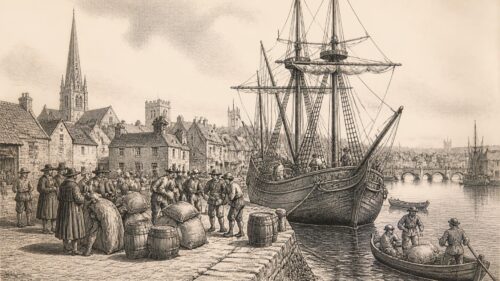
Two developments in the final months of the year illuminate contrasting intellectual worlds shaped by the settlement. On 1 December, Erasmus Smith’s foundation deed established the body later known as the Governors of the Schools Founded by Erasmus Smith. Smith, an adventurer who had acquired Irish lands through the Cromwellian settlement, proposed to direct part of the income from those estates towards schools. The scheme was therefore inseparable from the new order of property: confiscated or reassigned land was to support a Protestant educational project as well as private wealth.
The deed did not mean that a chain of schools suddenly opened across Ireland in 1657. Its immediate significance was institutional and financial. On 9 December, Smith leased lands assigned to the foundation, creating a promised annual income, though the collection of rents would itself prove troublesome. The gesture nevertheless mattered. It imagined education in English, Protestant discipline and grammar learning as tools through which the settlement might reproduce itself in a rising generation. The eventual history of the Erasmus Smith schools was still ahead; in 1657, the durable legal vessel and its endowment were what had been created.
Seventeen days earlier, on 18 November, the Waterford-born Franciscan Luke Wadding died at St Isidore’s College in Rome. His death occurred outside Ireland, but it was directly connected to Irish life under the Protectorate. Wadding had made St Isidore’s a centre for the education and support of Irish Franciscans, and he remained concerned with an Irish Catholic province whose friars had been scattered, exiled or exposed to punishment. The Irish Catholic Church’s intellectual and clerical networks could not safely be contained within the island; Rome, Louvain and other continental centres remained essential places of study, memory and communication.
Wadding’s death thus offers a counterpoint to Smith’s foundation. One institution arose from the proceeds and purposes of the Protestant settlement in Ireland; the other sustained a Catholic learned tradition from exile. Both show that the year was not only about fields, taxes and garrisons. It was also about who would educate the young, preserve religious learning and shape the cultural future of a country whose political order had been violently remade.
A Quietly Decisive Year
By the close of 1657, Ireland was more governable in the narrow sense desired by the Protectorate: titles were being confirmed, taxation administered, authority regularised and endowments organised. But these developments did not make the country socially whole. They formalised divisions created by war, gave new owners stronger claims, and left many Catholics living with displacement, restricted political voice and an insecure religious position. The year’s most consequential events were written not on a battlefield but into statutes, commissions and deeds. Their effects would outlast the Protectorate itself.

Primary Sources
- June 1657: An Act for the assuring, confirming, and settling of Lands and Estates in Ireland
- Flaying the sheep: the 1657 assessment tax and the problems of government in Cromwellian Ireland
- Cromwell, Henry
- Cromwellian Ireland: English Government and Reform in Ireland 1649–1660
- The Cromwellian Regime, 1650–60
- Conquest and Land in Ireland: The Transplantation to Connacht, 1649–1680
- Enforcing transplantation, 1655–1659
- Oliver Cromwell and the ‘Cromwellian’ Settlement of Ireland
- The Correspondence of Henry Cromwell, 1655–1659: From the British Library Lansdowne Manuscripts
- Royal Historical Society Camden Fifth Series: Volume 31
- Add MS 4166
- Parliaments and Politics during the Cromwellian Protectorate
- History
- Faithful to Our Trust
- Erasmus Smith House, College Road, Ennis, Co. Clare
- Wadding, Luke
- History
- Luke Wadding Papers: Correspondence relating to Fr Luke Wadding OFM and the Irish Friars Minor at St. Isidore’s College, Rome
- Lay Catholicism and Religious Policy in Cromwellian Ireland
- Ecclesiastical Reform
- The Down Survey of Ireland
- Ireland under the Commonwealth