Barricades at the Bogside1969 CE
In 1969 civil-rights protests against discrimination in Northern Ireland escalated from the Burntollet attack into communal violence. Reform measures, including universal local-government suffrage, failed to restore confidence, while O’Neill resigned and Chichester-Clark succeeded him. August riots produced the Battle of the Bogside, killings, arson and displacement in Derry and Belfast. British troops deployed, initially welcomed by some Catholics, and Belfast’s peace line embodied deepening segregation. Inquiries urged policing reform and abolition of B-Specials, but loyalist resistance continued. Dublin, strengthened by Fianna Fáil’s election victory, addressed the crisis while pursuing development and EEC membership. The IRA split, confirming a political landscape.
Dateline
In 1969 Ireland entered a year that transformed the meaning of the Border, the authority of Northern Ireland’s government and the everyday geography of Belfast and Derry. The underlying disputes were not new: nationalists and civil-rights campaigners had long protested discrimination in housing, local government and employment, while many unionists believed reform endangered Northern Ireland’s place in the United Kingdom. What was new was the speed with which political argument became sustained disorder, communal violence and a British military deployment. The year did not make later outcomes inevitable, but it created institutions, boundaries and fears that would shape the decades ahead.
A March Ends at Burntollet
The first major episode of 1969 came from the civil-rights movement’s decision to carry its protest across Northern Ireland. People’s Democracy, a student-led group, began a Belfast-to-Derry march on 1 January. Its route passed through predominantly Protestant districts despite warnings that loyalist opposition was likely. At Burntollet Bridge, outside Derry, marchers were attacked by loyalists armed with stones, bottles and sticks. Some marchers alleged that police protection had been inadequate; after the march reached Derry, serious disorder followed and the Bogside was briefly effectively beyond routine police access.
Burntollet mattered because television and press coverage brought the physical vulnerability of civil-rights marchers into homes across Ireland and Britain. It also widened the gap between those who hoped pressure would secure reform and those who concluded that the Northern Ireland state could not impartially police protest. The Cameron Commission, appointed to investigate disturbances since October 1968, later examined the march and its aftermath in detail. Its existence was itself an acknowledgement that the government at Stormont faced a crisis of public confidence.
Politics did not offer a stable release. Terence O’Neill, the Northern Ireland Prime Minister, called a Stormont election for 24 February in an attempt to renew his authority. Unionism remained dominant, but it was visibly divided between supporters and opponents of O’Neill’s limited reform programme. Civil-rights candidates and figures associated with constitutional nationalism also gained prominence. In April Bernadette Devlin won the Westminster by-election in Mid-Ulster as a Unity candidate, becoming the youngest woman then elected to the House of Commons. Her victory signalled the arrival of a combative younger generation whose language and priorities differed sharply from those of the older Nationalist Party leadership.
Reform Without Confidence
Some concessions were made. On 23 April the Unionist Parliamentary Party voted, narrowly, to introduce universal adult suffrage in local-government elections: the demand commonly expressed as ‘one man, one vote’. Yet the decision demonstrated O’Neill’s weakness as much as his capacity to reform. James Chichester-Clark resigned from O’Neill’s government in opposition to it. O’Neill resigned as Prime Minister on 28 April, unable to regain his party’s confidence, and Chichester-Clark succeeded him on 1 May.
The change of premier did not resolve the central problem. Reforms proposed or promised from above could not restore trust where many Catholics and nationalists saw policing, electoral arrangements and housing allocation as structurally unfair, while many unionists viewed the escalating demonstrations as a challenge to constitutional government. In June, the International Commission of Jurists published a review sharply critical of sectarian policies by successive Northern Ireland governments and of aspects of the British government’s human-rights position. The Campaign for Social Justice simultaneously continued to document allegations of discrimination. These interventions gave an international vocabulary to grievances that had often been treated in Stormont as local administrative disputes.
Public order was already deteriorating. Explosions at water installations in April disrupted Belfast’s supply; these attacks were later attributed to loyalist paramilitaries. In July, disturbances around the Twelfth brought further conflict, and Francis McCloskey died after being struck during disorder in Dungiven. Chichester-Clark mobilised the Ulster Special Constabulary, the part-time force generally known as the B-Specials. Its mobilisation was deeply alarming to many Catholics, for whom the force symbolised the unequal character of Northern Ireland’s security arrangements. Thus a year that began with a contested march had, by midsummer, made questions of policing and security inseparable from questions of citizenship.
August: Derry and Belfast
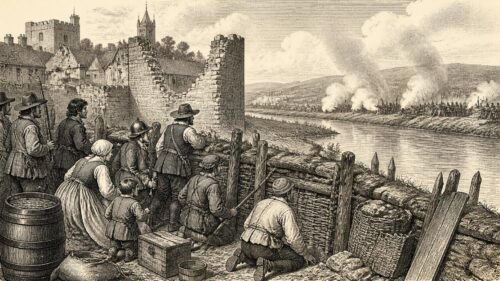
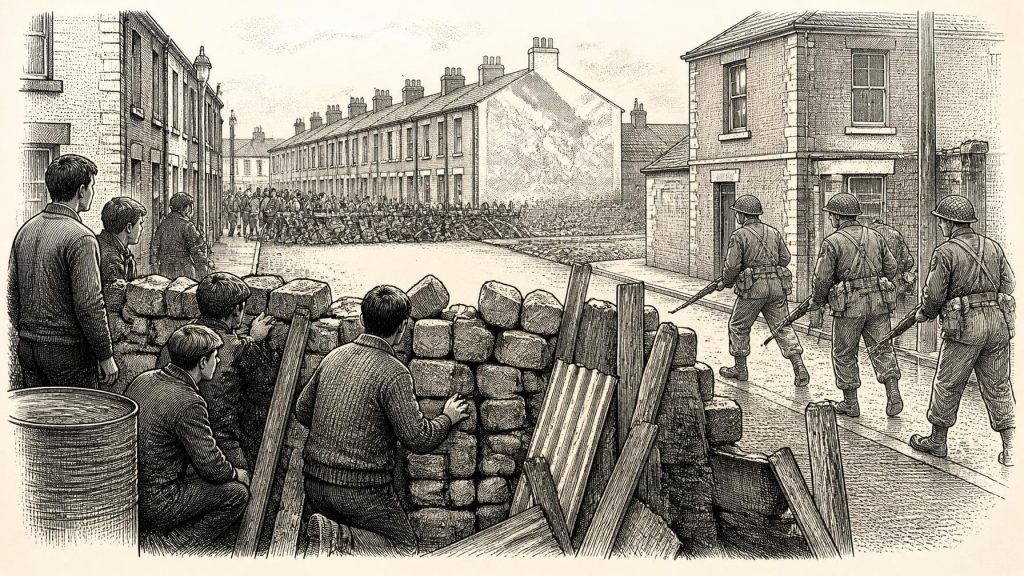
The decisive escalation began on 12 August, when the annual Apprentice Boys’ parade passed near the Bogside in Derry. Serious rioting developed that evening. The Royal Ulster Constabulary used armoured vehicles, water cannon and CS gas in attempts to enter the area; residents erected barricades and resisted them. The ensuing Battle of the Bogside lasted for two days. Behind the barricades, the area became widely known as ‘Free Derry’, a phrase that conveyed both emergency self-organisation and the collapse of normal authority.
The events in Derry immediately reverberated elsewhere. Violence spread into Belfast, where Catholic and Protestant residents, loyalist crowds, republican defenders and the police became caught in a rapidly changing confrontation. Homes were attacked and burned, especially in mixed or exposed districts; families fled with little certainty that they could return. On 14 August, amid violence in Belfast, the RUC fired from an armoured car into the Divis Flats complex, killing nine-year-old Patrick Rooney as he lay in bed. Six people were killed in Belfast on 15 August. These were not abstract political developments: they were losses borne by households, neighbours, hospitals, clergy, voluntary helpers and people seeking shelter.
The Irish government responded with urgency but also with severe constraints. In a televised address on 13 August, Taoiseach Jack Lynch condemned the situation and announced that field hospitals would be established near the Border. He sought international attention, including through the United Nations, but did not order an Irish military intervention. His choice reflected the danger that any cross-Border move could widen the conflict, even as public feeling in the Republic demanded protection for Northern nationalists. In the weeks that followed, the crisis reshaped Dublin’s political priorities and placed the Northern question at the centre of Irish diplomacy.
On 14 August, at Stormont’s request, British troops entered Derry; they moved onto the streets of west Belfast the next day. Many Catholic residents initially received soldiers as a shield against immediate attack, though that response was neither universal nor destined to endure. The deployment nevertheless marked a fundamental constitutional and practical shift. The British Army was no longer a distant guarantor of Northern Ireland’s security: it had become an everyday presence at road junctions, barricades and working-class streets. The Downing Street declaration of 19 August reaffirmed that Northern Ireland’s constitutional status could not change without consent, while arrangements soon gave the British General Officer Commanding overall responsibility for security operations.
Lines Drawn Across Communities
Late summer did not restore normality. A British–Northern Ireland communiqué on 29 August outlined intended changes in local government, housing and employment. On 9 and 10 September the Army constructed a temporary barrier between Catholic and Protestant districts in Belfast: the first ‘peace line’. It was presented as a means of preventing further violence. Yet it also materialised a hardening separation. In Derry and Belfast, barricaded or ‘no-go’ areas demonstrated that the writ of normal policing was not equally accepted or enforceable. The experience of displacement, patrols and restricted movement entered daily life.
There were also efforts to give the crisis a civic and cultural voice. A Liberation Fleadh took place in Free Derry on 30 and 31 August, with musicians including the Dubliners and Tommy Makem performing. Such an event should not be mistaken for a return to peace; rather, it showed how music, local organisation and political identity could coexist within an embattled community. The same year, RTÉ’s reporting made events in the North immediate to audiences throughout the Republic. Television did not cause the crisis, but it altered its public scale: scenes from Derry and Belfast could no longer be treated as remote provincial disturbances.
Official inquiries and reform plans continued. The Cameron Report appeared in September, covering the earlier cycle of civil-rights disturbances. In October, the Hunt Report recommended reshaping policing: the RUC should in normal practice be unarmed, a police authority should improve accountability, and the B-Specials should be replaced by new reserve arrangements under military control. The proposals recognised that security institutions needed to be, and to be seen to be, impartial. But publication also provoked loyalist unrest, demonstrating how difficult reform had become once each concession was interpreted through communal fear.
The Republic: Election, Economy and Wider Horizons
South of the Border, the Republic did not cease to have its own political and economic life. In the general election of 18 June, Jack Lynch’s Fianna Fáil won 75 of 144 Dáil seats on 45.7 per cent of first-preference votes, securing an overall majority. Fine Gael won 50 seats and Labour 18. The result gave Lynch a stronger parliamentary position just before August placed an unforeseen emergency before his government.
The economy still reflected the outward-looking development strategy of the Lemass and Lynch years. Contemporary ESRI assessments described strong domestic demand, rising industrial production and higher exports in much of manufacturing during 1969, although they also warned of a substantial external deficit, wage pressures and a possible slowing of employment growth. Ireland remained closely tied to Britain commercially, which made prospective membership of the European Economic Community especially important. After Charles de Gaulle’s resignation in April, Dublin renewed diplomatic efforts to demonstrate its readiness for EEC membership; Patrick Hillery, appointed Minister for External Affairs after the June election, made this a principal concern alongside the North.
Social and cultural currents also registered a more connected Ireland. In July, protesters stopped play at a Dublin cricket match involving an all-white South African side, demonstrating against apartheid. The incident was small beside the violence in the North, but it showed Irish activists engaging with international struggles. In October, the Dublin-born writer Samuel Beckett received the Nobel Prize in Literature, a conspicuous international recognition of an Irish literary career that had long unfolded beyond Ireland.
By December, the damage done to authority and communal trust was unmistakable. On 28 December the Irish Republican Army split into Official and Provisional organisations, though the division became public in January 1970. That late-year event belongs firmly to 1969 and indicates how August had altered republican politics. The year closed with British troops deployed, new physical divisions in Belfast, families uprooted, major reforms proposed but contested, and governments in Belfast, Dublin and London forced to confront a crisis none had contained. Ireland in 1969 was not merely entering a period of trouble: its political and social landscape had been remade.
Primary Sources
- CAIN: Chronology of the Conflict 1969
- Cameron Report: Disturbances in Northern Ireland
- Cameron Report: Appendices and Chronology of Events
- Report of the Advisory Committee on Police in Northern Ireland (Hunt Report)
- Speech by Jack Lynch Following Violence in Derry, 13 August 1969
- Communiqué and Declaration by the British and Northern Ireland Governments, 19 August 1969
- Joint Communiqué by the British and Northern Ireland Governments, 29 August 1969
- Jack Lynch, The Situation in the Six Counties of the North-East Ireland
- International Commission of Jurists Review, June 1969
- Northern Ireland: The Plain Truth, Campaign for Social Justice
- Violence and Civil Disturbances in Northern Ireland in 1969 (Scarman Report)
- Northern Ireland 1969, RTÉ Archives
- Northern Ireland, House of Commons Debate, 13 October 1969
- Parliament and Northern Ireland, 1921–2021
- Westminster Elections in Northern Ireland Since 1920
- Northern Ireland House of Commons, 1921–1972
- Ireland: Parliamentary Elections, 18 June 1969
- Dáil Elections Since 1918
- The Economy in 1969, Quarterly Economic Commentary
- Ireland Through the Decades: EEC Membership
- Committee on Finance: Vote 45, External Affairs, 28 October 1969
- Anti-Apartheid Protests at Cricket Match, RTÉ Archives
- Annual Report of the Registrar-General of Marriages, Births, and Deaths in Ireland, 1969
- Historical Reports, Central Statistics Office