Lynch’s Landslide, Paisley’s Strike1977 CE
In 1977, Fianna Fáil won a record general-election landslide, giving Jack Lynch a nine-seat Dáil majority after campaigning on tax relief, rates abolition and jobs amid inflation and unemployment. Employment equality and youth-work laws strengthened workplace protections. Northern Ireland, under direct rule, remained marked by violence, prison protest and communal division. Ian Paisley’s loyalist-backed May strike, seeking tougher security and majority-rule devolution, failed despite recalling 1974. British authorities maintained services and opposed intimidation. International attention included Jimmy Carter’s policy statement, Lynch’s talks with James Callaghan, and the Nobel Peace Prize for Betty Williams and Mairead Corrigan. Sport remained culturally significant.
Dateline
A Year of Contrasting Mandates
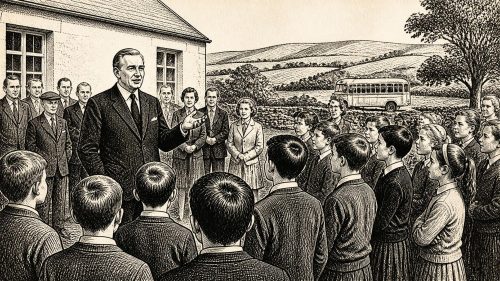
In 1977, political life on the island moved in sharply different directions. In the Republic, the general election of 16 June gave Fianna Fáil and its leader, Jack Lynch, an emphatic democratic mandate. In Northern Ireland, still governed directly from Westminster, an attempted loyalist general strike demonstrated both the continuing capacity for disruption and the limits of a strategy that had succeeded only three years earlier. Violence, prison protest and profound communal division remained facts of daily life in the North; south of the Border, voters rewarded promises of relief from taxation and a more confident response to economic difficulty.
The contrast should not be overstated. The Republic’s election did not remove the pressures created by recession, inflation and unemployment, nor did it make Northern Ireland’s conflict someone else’s problem. Security co-operation, cross-Border economic questions and international interest ensured that the two jurisdictions remained closely connected. Yet the year revealed distinct political moods: electoral optimism in the Republic, and a hard, unsettled struggle over authority in Northern Ireland.
The Lynch Landslide
The outgoing National Coalition of Fine Gael and Labour had governed since 1973 under Liam Cosgrave. It faced the electorate after a difficult period marked by international economic disruption, high prices and rising joblessness. Contemporary assessments placed unemployment at about 12 per cent and annual inflation at about 18 per cent in 1977. These conditions mattered in ordinary households: a wage packet had to stretch further, young people faced uncertain prospects, and emigration remained an option for many who could not find secure work at home.
Fianna Fáil fought a strikingly modern campaign, using television and popular promotional methods as well as the established machinery of local organisation. Its manifesto offered a deliberately immediate message of relief and expansion: abolition of domestic rates, abolition of annual road tax on smaller cars, tax reductions, subsidies and a programme intended to create jobs through public spending. Such pledges spoke directly to household bills and to widespread frustration with austerity. They also made large demands upon the public finances, a tension already apparent in the circumstances of 1977 even if its fuller consequences belonged to subsequent years.
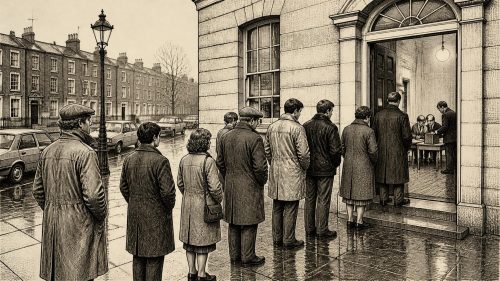
Polling on 16 June produced one of the most decisive results in the State’s history. Fianna Fáil won 84 seats and just over half of the vote, giving it a nine-seat overall majority in the 148-seat Dáil. Fine Gael took 43 seats, Labour 17 and independents four. The distribution of seats magnified the scale of the victory, but the popular vote was itself unmistakable: 811,615 votes, or 50.63 per cent, went to Fianna Fáil. Lynch returned to office with a strength no single Irish party had previously achieved at a general election.
The Twenty-First Dáil first sat on 5 July, and Lynch became Taoiseach at the head of the Fifteenth Government. The result reshaped parliamentary politics. Fine Gael, defeated after four years in office, entered opposition under Garret FitzGerald; Labour also faced a diminished role. For Lynch, whose earlier premiership had been overshadowed by the outbreak of the Troubles and the Arms Crisis, the result brought renewed personal authority. It also elevated a generation of Fianna Fáil ministers, including Charles Haughey in Health and Social Welfare and Michael O’Kennedy in Foreign Affairs.
Economy, Work and Equality
The electoral mood was more buoyant than the economy’s underlying position. An OECD survey subsequently estimated real GDP growth in 1977 at about 5 per cent, reflecting recovery after the mid-1970s downturn. But growth did not instantly resolve unemployment, inflation or the State’s limited fiscal room. Ireland’s economy was increasingly bound to European markets following entry to the European Economic Community in 1973. Farming, food processing, manufacturing and exports were therefore affected both by domestic policy and by wider European demand, prices and rules.
Legislation enacted in 1977 also marked an important, if qualified, advance in working life. The Employment Equality Act, passed on 1 June and brought into operation later that month, made specified discrimination in employment unlawful on grounds of sex or marital status. It created the Employment Equality Agency and extended the legal framework begun by the Anti-Discrimination (Pay) Act 1974. Its effect should not be romanticised: women still encountered entrenched assumptions about marriage, motherhood, pay and suitable occupations. Nevertheless, the Act made equality at work a matter of statutory right, institutional investigation and public policy rather than private discretion alone.
The Protection of Young Persons (Employment) Act, passed in April and commenced on 5 July, regulated minimum ages, hours, rest periods, night work and record-keeping for young workers. Together, the two measures show that 1977 was not solely a year of electoral promises and fiscal debate. It also brought practical changes to the legal rules governing entry into work and treatment within it, matters of direct importance to families, school-leavers and employers.
Northern Ireland: Strike and Security
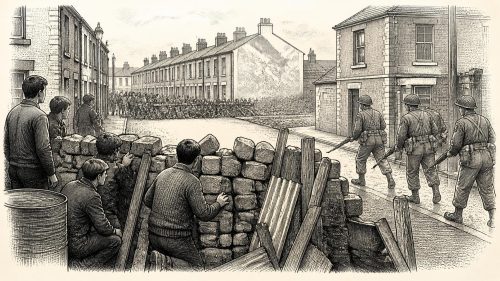
Northern Ireland entered 1977 without a devolved government. Roy Mason, the Secretary of State, exercised authority under direct rule while the British Army, Royal Ulster Constabulary and Ulster Defence Regiment faced continuing republican armed activity. Loyalist paramilitaries also remained active, and civilians bore the consequences of shootings, bombs, intimidation and the fear that accompanied them. The conflict cannot responsibly be reduced to a sequence of spectacular incidents: it shaped journeys to work, school routines, political gatherings, commercial life and the boundaries people observed in Belfast and elsewhere.
The year’s most conspicuous constitutional confrontation came in May. The United Unionist Action Council, associated with Ian Paisley and Ernest Baird and supported by elements linked to the Ulster Workers’ Council and Ulster Defence Association, called a region-wide stoppage. Beginning on 3 May, it demanded tougher security measures against the IRA and a return to devolved government based on simple majority rule. Its organisers hoped to reproduce the force of the 1974 Ulster Workers’ Council strike, which had helped bring down the power-sharing executive.
This time the outcome was different. The British authorities prepared extensively; the RUC tackled roadblocks and intimidation, while crucial services and much of industry continued. Opposition from important unionist figures and the Orange Order weakened the claim that the strike represented all Protestants. The action ended on 13 May without securing its political objectives. Its failure did not mean that unionist anger had vanished, but it showed that direct rule could withstand a loyalist stoppage when the state was prepared to keep power supplies, transport and workplaces functioning.
District council elections followed on 18 May, after the break-up of the earlier United Ulster Unionist Council had left unionist parties competing separately. Formal politics thus continued amid conflict, but the political atmosphere was narrow and distrustful. Republican prisoners, denied the former special category status from 1976, continued the blanket protest in the Maze and other prisons. That dispute over whether politically motivated prisoners should be treated as ordinary criminals was already becoming a defining issue, although the hunger strikes associated with it lay in the future.
Diplomacy, Peace and Public Symbols
Several events gave Northern Ireland an international and symbolic prominence. Queen Elizabeth II visited on 9 and 10 August as part of her Silver Jubilee programme, her first visit to Northern Ireland in eleven years. Security was exceptionally tight; a small bomb exploded after she had left the New University of Ulster at Coleraine, causing no injuries. The SDLP declined to attend a reception in her honour, a reminder that ceremony could not be detached from constitutional disagreement.
On 30 August, President Jimmy Carter issued a statement on United States policy towards Northern Ireland. He rejected violence, supported a peaceful settlement acceptable to both communities and to the British and Irish governments, and linked peace to the prospect of employment-creating investment. The statement did not offer an American solution, but it signalled a more visible US interest in a conflict sustained in part by transatlantic attention and funding. On 28 September, Lynch and British Prime Minister James Callaghan met at Downing Street. Their discussions included the possibility of practical cross-Border economic co-operation, preserving a diplomatic channel despite deep disagreement over Northern Ireland’s constitutional future.
1977 also brought recognition to a civilian peace movement formed the previous year. Betty Williams and Mairead Corrigan received the deferred 1976 Nobel Peace Prize for founding the Peace People, whose marches had expressed a popular revulsion at political violence. The award did not end the conflict, and the movement itself faced intense pressures and internal disagreement. Still, it recognised that Northern Ireland contained organised, courageous constituencies for non-violence as well as armed organisations and hardened political camps.
Faith, Print and Popular Culture
Religious life remained publicly significant across Ireland. In August, the historian and Irish-language scholar Tomás Ó Fiaich was appointed Archbishop of Armagh and Primate of All Ireland; he was ordained bishop at St Patrick’s Cathedral, Armagh, on 2 October. His arrival gave the Catholic Church an intellectual and pastoral leader with roots in south Armagh, a region deeply affected by the conflict. The appointment did not settle the political dilemmas confronting churches, but it mattered in an island where clerical voices still carried considerable authority.
A different generational voice appeared in Dublin in May, when the first issue of Hot Press was published. Built around music but addressing the interests of younger readers more broadly, it offered an alternative to the established press and registered the growing importance of rock, youth culture and self-made media. At Croke Park, meanwhile, mass sporting occasions supplied a more familiar shared ritual. Cork beat Wexford in the All-Ireland hurling final on 4 September, while Dublin defeated Armagh in the football final on 25 September before an attendance of 66,542.
Thus 1977 cannot be told simply as a landslide election or a failed strike. It was a year in which the Republic chose a powerful new government while confronting economic uncertainty; in which Northern Ireland endured violence but also exposed the limits of coercive political mobilisation; and in which law, religion, sport and new cultural media continued to organise everyday Irish life. The island remained divided by jurisdiction and conflict, yet its political, economic and human connections were impossible to ignore.
Primary Sources
- Dáil and Seanad Election Results
- Ireland House of Representatives June 1977 Election
- Twenty-First Dáil
- General Election 1977
- The General Election of 1977 in the Republic of Ireland: A Study of Electoral Change and Continuity
- Fianna Fáil Manifesto 1977
- OECD Economic Surveys: Ireland 1978
- 1977 in the National Archives
- Employment Equality Act, 1977
- Protection of Young Persons (Employment) Act, 1977
- Protection of Young Persons (Employment) Act 1977: Commencement
- A Chronology of the Conflict: 1977
- United Unionist Action Council Strike (1977): Summary of Events
- Northern Ireland, House of Commons Debate, 2 May 1977
- The Protection of Human Rights by Law in Northern Ireland
- Northern Ireland Statement on U.S. Policy, 30 August 1977
- The Nobel Peace Prize 1976
- Cardinal Tomás Ó Fiaich
- Ó Fiaich, Tomás
- Alternative Press And Subculture 1977
- Flashback: 1977 All Ireland SHC Final – Cork v Wexford
- All Ireland Tickets Flood Black Market 1977
- Secret Government Documents Reveal Tensions
- Queen ‘Understood’ Aspirations of Irish People