

Limerick Boycott
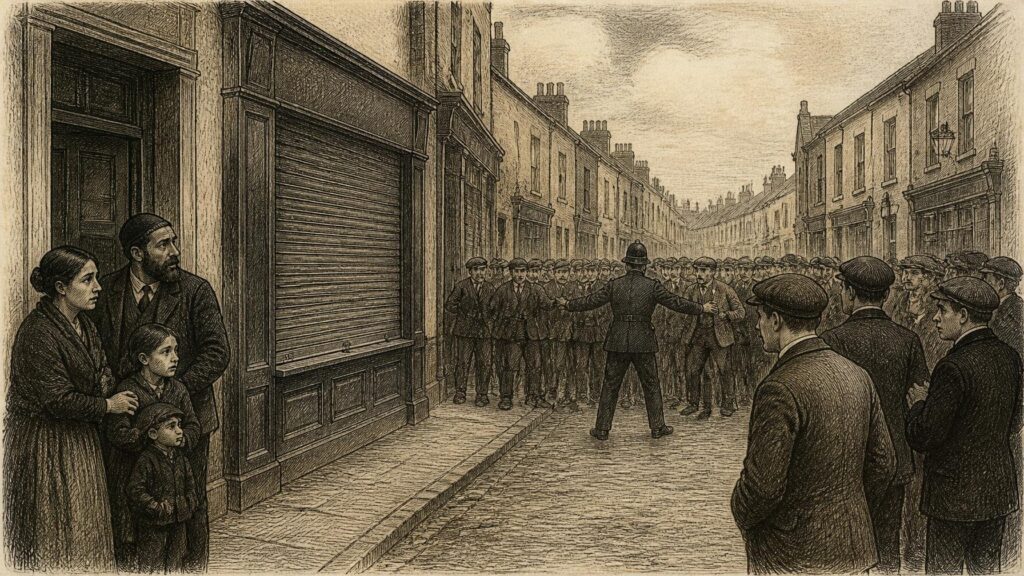
AI generated historical illustration, not a contemporary photograph.
At a Glance
In 1904 Limerick witnessed the most notorious anti-Jewish campaign in modern Irish history: a sustained assault on a small immigrant community through incendiary preaching, street intimidation and commercial exclusion. It is often remembered as the “Limerick pogrom”, but the historical evidence requires a more precise account. There was real antisemitic violence, fear and material loss; there was also an organised boycott which did much of the lasting damage. Neither the later legend of a wholly placid Ireland nor the language of a large-scale Russian-style massacre adequately explains what happened to Limerick’s Jews.
Arrival Patterns
Limerick’s Jewish community was a product of the great east European Jewish migration of the late nineteenth century. Jews from the western provinces of the Russian Empire, including areas then associated with Lithuania, fled legal discrimination, economic insecurity and recurrent anti-Jewish violence. Ireland received only a small proportion of those migrants, and Limerick received a smaller share again. Yet the community that emerged in the city was sufficiently numerous, cohesive and visible to establish institutions, family networks and commercial lives of its own.
Most of the families were not wealthy outsiders arriving to dominate an established market, despite the hostile caricature later promoted against them. They were migrants making precarious livings in a provincial city with limited opportunities. Many worked as pedlars, drapers, shopkeepers, picture sellers or dealers in household goods. Such work commonly relied upon small margins, long hours, extended family labour and the sale of goods by instalment. These occupations made Jewish traders conspicuous, especially in poorer neighbourhoods and among households with little ready cash, but conspicuousness should not be confused with power.
Community Formation
By the opening years of the twentieth century, Jewish residents had created a recognisable communal presence. Families lived particularly around Collooney Street, now Wolfe Tone Street, and in nearby streets. A synagogue and prayer arrangements, charitable associations, burial provision and communal leadership gave structure to a population whose members still faced the everyday insecurity of migration. The acquisition of burial ground at Castletroy in 1902 was especially significant. It showed an intention to remain, to provide for religious obligations locally and to make a settled life rather than merely pass through the city.
The community’s religious and practical needs were served by Rev. Elias Bere Levin, often described as Limerick’s first rabbi, although his formal position and titles need to be understood within the modest scale of the congregation. He was a minister, teacher, representative and organiser. Local historical research records his involvement in welfare bodies, a burial society and communal associations. During the crisis of 1904 he became a principal advocate for those under attack, communicating with police, politicians, Jewish organisations in Dublin and London, and church figures in Limerick. His role demonstrates that the Jewish community was not a silent object of events but an organised body seeking protection.
Urban Conditions
Limerick was not a neutral setting in which an otherwise inexplicable hatred suddenly erupted. It was a city marked by poverty, uneven employment and sharp social distinctions. A commercial and military centre, it had a mixed economy and a population in which many households lived close to financial hardship. The instalment trade operated in precisely such conditions. It enabled customers to obtain clothing, household goods, religious images and other necessities without paying the full price immediately. But it also produced debt, resentment and disputes, whether the seller was Jewish or Christian.
Contemporary critics exploited that resentment by treating a business practice as the alleged racial or religious essence of those who used it. Jewish traders could be represented as predatory “usurers”, while Christian firms using comparable credit arrangements escaped the same collective condemnation. The language was not a sober critique of consumer debt. It drew upon older Christian anti-Jewish themes, presenting Jews as alien, dishonest and inherently exploitative. This distinction matters. Commercial tension was one condition of the boycott, but antisemitism transformed an ordinary field of dispute into a campaign against people because they were Jews.
Sacred Authority
The immediate catalyst was Fr John Creagh, a Redemptorist priest associated with the Arch Confraternity of the Sacred Heart. On 11 January 1904 he delivered a sermon attacking Limerick’s Jews. The following weeks brought further inflammatory speech. Creagh deployed a repertoire recognisable across Christian Europe: the accusation that Jews had rejected Christ, the claim that they bore collective hostility towards Christians, and allegations that Jewish commerce concealed cheating and extortion. Such assertions were false, but their power lay in the authority of the speaker and the setting in which they were delivered.
Creagh spoke to an audience linked to a large religious confraternity. His words therefore did not remain the private prejudices of an individual clergyman. They entered a setting in which religious discipline, local respectability and popular grievance could reinforce one another. It is important, however, not to suppose that every Catholic in Limerick accepted them or that the Catholic Church as a whole can be reduced to Creagh’s conduct. The evidence records opposition from Catholics as well as Protestants, and the diocesan bishop did not share the priest’s militant course. The scandal lies partly in the fact that Creagh’s preaching could mobilise support despite those limits and objections.
Sermon Aftermath
The response to the first sermon made clear that the danger was not merely rhetorical. Jewish residents were abused in public, their houses and premises were targeted, and crowds gathered in threatening ways. Stones and mud were thrown, windows were broken, and some people were assaulted. Contemporary reports differ in detail and tone, as reports produced amid controversy often do. Yet the existence of attacks is not seriously in doubt. The British government later acknowledged in Parliament that police had received special instructions to protect Jews from molestation and violence, and that prosecutions had followed.
The second stage of the campaign was more systematic. Creagh publicly disavowed violence while encouraging people to withdraw their trade from Jewish businesses. That distinction offered a form of moral cover. A boycott could be presented as peaceful self-protection, even as it worked alongside intimidation and as some customers withheld payment for goods already received. For families whose livelihood depended on small, frequent transactions and the collection of instalments, the consequences were severe. Refusal to buy, refusal to pay, public insult and fear of assault combined to make ordinary commerce increasingly impossible.
Street Violence
The language of “pogrom” arises because violence was plainly part of the Limerick episode. Jewish men, women and children could be subjected to abuse or attack in streets that had been part of their daily world. Rev. Levin himself was among those targeted. Reports of violence continued beyond the first outburst, with numerous incidents recorded during the spring and summer of 1904. The number commonly cited in recent scholarship is up to fifty anti-Jewish incidents between February and July. These included intimidation and bodily attacks, although not all produced equal injury or were equally well documented.
There were no recorded killings, no wholesale destruction of a Jewish quarter and no mass expulsion by state authority. Those facts differentiate Limerick from the lethal pogroms of the Russian Empire that were then fresh in Jewish memory. They do not absolve the perpetrators or diminish the terror experienced by a small minority with few local resources. A stone thrown at a family home, a threat made in a street, or a shop abandoned by customers had a force greater than its numerical scale suggests. A small community did not require mass casualties to understand that it had become unsafe.
Economic Pressure
The boycott was the central mechanism of harm. Unlike a short riot, it could continue day after day and reach into every household economy. Jewish traders depended not only upon new sales but upon customers honouring instalment obligations. When customers were urged not to deal with Jews, and when some refused payment, merchants lost both future income and money already due. The campaign thus attacked their capacity to buy stock, meet rent, support dependants and sustain religious and charitable institutions.
Some defenders of the boycott claimed that it concerned trading methods rather than Judaism. The distinction collapses when examined against the sermons, slogans and patterns of action. Jews as a group were publicly denounced; Jewish businesses were singled out; and the economic accusation was inseparable from allegations about Jewish religious identity and supposed collective character. Parliamentary exchanges reveal the same pattern. While ministers spoke of protection and acknowledged hostility, certain Irish representatives repeated the stereotype of Jewish “usurers”. Antisemitic ideas were therefore not confined to a crowd or a pulpit; they could enter respectable political speech.
Police Protection
The response of the Royal Irish Constabulary and the Dublin Castle administration was limited but consequential. The police were instructed to protect Jewish residents and to act against overt illegality. In the House of Commons on 14 April 1904, the Chief Secretary for Ireland stated that eight cases of molestation had been prosecuted and that proceedings were pending in two more. Twelve days later he said that a number of people had been convicted and that police would continue efforts to prevent disorder and illegal acts directed against Jews.
This official action should not be romanticised. Protection did not end the boycott, restore lost income or remove the social authority which had helped to generate the campaign. Nor did prosecution necessarily reassure families who still had to cross hostile streets and trade with unwilling neighbours. Yet it matters that the state did not formally endorse persecution. The surviving official record contradicts later suggestions that all authority in Limerick joined the attackers. Police intervention, court proceedings and government answers represent a real, if insufficient, counter-pressure against violence.
Political Responses
The affair reached beyond Limerick because Jewish organisations, journalists and political figures made it a public question. Michael Davitt was among the most important Irish voices of protest. His intervention carried particular moral weight: he was a prominent Catholic nationalist who had written against antisemitic persecution in the Russian Empire after the Kishinev pogrom of 1903. Davitt condemned the importation of antisemitism into Ireland and argued that Jews, like the Irish, had endured historic persecution. His protest exposed the contradiction between nationalist claims of sympathy for oppressed peoples and the treatment of a vulnerable minority at home.
John Redmond also expressed opposition, though public responses from Irish political leaders were uneven and often cautious. Their caution reveals an uncomfortable feature of the episode. Sympathy for Jewish victims did not automatically overcome anxieties about electoral opinion, clerical influence, commercial grievance or nationalist rhetoric about “foreigners”. The Limerick affair did not produce a united Irish political defence of pluralism. Rather, it generated competing claims: some insisted that the city’s good name was being slandered, while others insisted that a minority’s safety mattered more than civic pride.
Clerical Responses
Church responses were similarly varied. Dr Edward O’Dwyer, the Catholic bishop of Limerick, was approached by Jewish representatives and is reported to have condemned mob action. His authority over Creagh was limited because the Redemptorist priest belonged to a religious order rather than the diocesan clergy. This institutional detail is important. It explains why episcopal disapproval did not necessarily translate into immediate control over the preacher whose words had helped to set events in motion.
Thomas Bunbury, the Church of Ireland bishop of Limerick, issued a stronger public condemnation. That intervention became a source of local resentment among those who believed he had insulted the city. The argument could thus be displaced from the treatment of Jews to the reputation of Limerick and the standing of a Protestant bishop in a predominantly Catholic city. Such displacement was politically useful. It avoided confronting antisemitism directly by presenting criticism as sectarian hostility or external interference. The tendency remains instructive: communities often defend themselves against an accusation of prejudice before they address the prejudice itself.
Jewish Agency
Accounts centred only on Creagh and his followers risk obscuring the resourcefulness of those targeted. Rev. Levin sought police protection, organised appeals and communicated the community’s situation to Jewish bodies elsewhere. Jewish representatives attempted to establish facts against defamatory claims. One leading trader, Max Bland, reportedly offered to open business books to demonstrate that profits were not excessive. Levin drew attention to court summonses to challenge the claim that Jewish merchants were uniquely responsible for debt litigation. These were attempts to refute the economic story on which the boycott had been built.
Jewish organisations in Dublin and London raised relief funds and pressed religious and political leaders to act. Their involvement shows how migration networks could provide a lifeline when a small provincial community was isolated. It also shows that Limerick’s Jews belonged to a wider British and Irish Jewish public sphere. News travelled through the Jewish Chronicle and other newspapers; correspondence crossed the Irish Sea; and local events were assessed in relation to recent Russian persecutions. For those living through the boycott, Limerick was never merely a local quarrel. It became part of an international Jewish understanding of vulnerability and solidarity.
Public Arguments
Newspapers and public meetings supplied the campaign with additional force, but they also provided venues for rebuttal. Some papers supported or repeated allegations about Jewish trading; others condemned the agitation. The debate was rarely calm. Opponents of the Jewish community used the language of debt, national economy and local morality. Defenders described the persecution as shameful and dangerous. Both sides understood that the argument concerned more than a handful of shops. It concerned the kind of society Ireland claimed to be, and whether minority residents could belong on equal terms.
Arthur Griffith’s nationalist newspaper, the United Irishman, published material that supported the distinction between religious belief and supposedly objectionable Jewish business practice. That position itself is revealing. It allowed antisemitic hostility to be repackaged as economic criticism, even though its rhetoric relied upon collective slander. Griffith’s later political importance has encouraged attempts either to excuse or to isolate these writings. Historical honesty requires neither. They should be read as evidence that anti-Jewish language could coexist with Irish nationalist aspirations, not as proof that nationalism alone caused the boycott or that every nationalist shared such views.
Contested Language
The name “Limerick pogrom” has become common, especially in commemorative and popular writing. It has moral force because it links the event to the eastern European violence from which many of Limerick’s Jews or their parents had fled. Some contemporaries themselves compared Limerick with Kishinev, and the comparison captured the shock felt when anti-Jewish hostility appeared in Ireland. It also helped activists communicate urgency to an international audience familiar with the term.
Recent historians have nevertheless urged caution. In its strict historical usage, pogrom commonly evokes collective anti-Jewish violence on a larger scale, frequently involving deaths, widespread looting or the destruction of homes and synagogues, and sometimes state complicity or inaction. Limerick involved sporadic violence, intimidation and a prolonged boycott, but not the scale of killing associated with Kishinev or many Russian pogroms. “Boycott” therefore identifies the campaign’s principal instrument more accurately. The terminology should not become a competition in minimisation. Calling it a boycott must not imply that the coercion was merely peaceful, while calling it a pogrom must not erase the distinctive evidence.
Evidence Limits
Several familiar claims require careful handling. Contemporary reports were partisan, and later recollections were shaped by trauma, communal memory and the desire to secure assistance. Some reports portrayed Limerick as a city under siege; others denied almost all serious wrongdoing and accused Jewish campaigners of exaggeration. Officials and local notables often had reasons to narrow the scale of disorder, while victims and advocates had reasons to stress danger. Neither motive permits historians simply to dismiss evidence. It requires them to compare police records, court proceedings, newspapers, communal correspondence, census returns and later testimony.
For that reason, exact totals should be used sparingly. We can say confidently that there were repeated incidents of hostility and that prosecutions occurred. We can say that many Jewish residents suffered severe commercial pressure and that a substantial number left. We cannot convert every allegation into a verified fact, nor can we assume that every departure was caused by one identical motive. Historical interpretation is strongest when it states both what is clear and what remains uncertain. The surviving record supports condemnation without requiring embellishment.
Measuring Departure
The boycott caused families to leave Limerick, with Cork, Britain and North America among the destinations associated with those departures. The Goldberg family’s move is among the best-known stories. Their later prominence in Cork, including Gerald Goldberg’s election as Lord Mayor in 1977, has given the episode a personal lineage within Irish civic history. Other families adapted in less visible ways: reducing their businesses, relying on relief, seeking work elsewhere or remaining despite the hostile climate.
The scale of demographic loss has been debated. The impression that the entire community vanished is too simple. Census evidence indicates that Jewish residents remained in Limerick after the crisis, and that some new families arrived before 1911. But survival is not evidence of normality. A community can endure while being diminished, economically weakened and psychologically scarred. Nor should a later census be used to deny the effect of forced movement in 1904 and 1905. Demography records presence at particular moments; it cannot fully capture the businesses lost, journeys imposed or sense of belonging damaged by a campaign of exclusion.
National Context
Limerick should be located within, rather than detached from, the wider politics of the United Kingdom and Europe. The early twentieth century saw intense agitation over Jewish migration, especially in Britain, where anti-alien campaigns helped prepare the ground for the Aliens Act of 1905. Economic antisemitism linked fears about credit, sweatshops, peddling and urban change to racialised portrayals of Jewish migrants. Limerick was shaped by its own social and religious circumstances, but it was not isolated from these larger currents.
At the same time, Ireland contained counter-currents. Irish nationalists and Jewish activists sometimes found common ground in opposition to imperial oppression, and Irish people were capable of identifying with the persecuted Jews of Russia. Davitt’s response is the clearest example. Such solidarities were real, yet they did not immunise Ireland against antisemitism. The lesson is not that Irish history was uniquely intolerant, nor that it was uniquely tolerant. It is that a people’s experience of oppression does not automatically prevent some members of that people from participating in the exclusion of others.
Popular Memory
For decades, the Limerick episode occupied an uneasy place in public memory. It could be invoked as an exceptional blemish in a broader narrative of Irish hospitality towards Jews, or as proof that Irish society possessed a deeper antisemitic tradition. Both uses impose too much upon a single episode. Limerick was exceptional in the intensity of its campaign against a Jewish community, but it did not emerge from nowhere. The language employed in 1904 had European precedents and later Irish echoes. Conversely, its exceptional status should not be used as a shield against reflection.
Memory has also been shaped by family testimony, journalism, documentaries and local historical work. These forms preserve emotional truth and details that official files can miss, but they may also sharpen events into a cleaner narrative of total expulsion or total indifference. The most responsible commemoration holds both together: Jewish families endured a frightening and damaging antisemitic campaign; non-Jewish people and institutions included both persecutors and defenders; and the record remains incomplete. Complexity is not an excuse for neutrality between hatred and its victims.
Historical Reckoning
The Limerick Boycott challenges complacent versions of Irish history. It is tempting to describe it solely as an imported prejudice, as though antisemitism arrived from Russia or Britain and never found local soil. Yet imported ideas require local conditions, local voices and local action to become effective. Creagh’s sermons were delivered in Limerick; neighbours implemented the boycott; local public culture supplied arguments about debt, respectability and belonging. The responsibility for the campaign cannot be transferred elsewhere.
It is equally mistaken to treat the city’s entire population as a single persecuting body. Individuals protested, police prosecuted offenders, clergy criticised the violence, and political and communal networks offered support. These responses did not prevent the harm, but they are part of the history. A truthful account must identify the structures that enabled antisemitism while recognising resistance within Irish society. Doing so makes the event more, rather than less, useful as history: it shows that public prejudice is made through choices, and can be opposed through choices.
Lasting Significance
The significance of the Limerick Boycott lies not only in its place within Jewish Irish history but in what it reveals about citizenship. The Jewish residents of Limerick paid rents, raised children, worshipped, traded, buried their dead and sought the protection of law. The boycott told them that these ordinary acts of belonging could be revoked by a hostile majority. It showed how quickly religious authority and economic anxiety could convert neighbours into targets and commercial custom into a weapon.
That is why the episode deserves remembrance in language that is exact as well as humane. “Limerick Boycott” best describes its sustained economic machinery. “Limerick pogrom” conveys the fear, violence and eastern European resonances through which many later people have understood it. The terms should prompt inquiry, not replace it. What is beyond dispute is that an Irish Jewish community was subjected to antisemitic abuse, coercion and violence in 1904, and that many families paid for it with lost livelihoods, disrupted homes and departure from a city they had hoped to make their own.
Internal Fractures
The Limerick Boycott did not descend upon a Jewish community that was either socially uniform or institutionally effortless. Like many small immigrant congregations, the community had to construct religious life, mutual aid and authority while its members were also earning precarious livings in a new city. Its shared origins and common vulnerabilities mattered, but they did not eliminate disagreement. The history of the years before 1904 includes quarrels over leadership, religious observance, communal funds and burial arrangements. These disputes should not be mistaken for evidence that Limerick’s Jews were incapable of solidarity. Rather, they show the ordinary pressures of sustaining a compact congregation whose members brought differing expectations, ambitions and interpretations of tradition from eastern Europe into a provincial Irish setting.
Rev. Elias Bere Levin stood at the centre of this difficult work. Born in Telz, Lithuania, around 1863, he arrived in Limerick with his wife Annie in 1882. He had received extensive religious education and had been ordained while still young, but his position in Limerick was not immediately that of a securely salaried full-time rabbi. As was common in smaller British and Irish congregations, religious office could coexist with commercial work. Levin appears to have supplemented his livelihood as a credit draper before becoming established as a full-time minister after a period in the United States during the mid-1890s. That combination of clerical and commercial experience placed him close to the economic realities that would later become so important during the boycott.
His authority, moreover, developed gradually. Levin was acting as reader and shochet by the late 1880s and was officiating at marriages by 1890, but the formal Limerick Hebrew Congregation only took shape in 1895. Its creation represented an achievement rather than a simple administrative fact. A congregation required a recognised place of worship, arrangements for worship and dietary observance, mechanisms for charitable support, and a leadership structure accepted by members with limited resources. Levin was credited with helping to settle the minor altercations that had marked communal life in the 1880s. Such tensions were familiar in immigrant communities, where status could be contested intensely precisely because the group was small and the available positions of influence were few.
The institutions associated with the congregation reveal that its members were attempting to build a durable social world, not merely a place for weekly prayer. Levin established a Bikur Cholim Society for assistance to the sick in 1889. He was also involved in the Limerick Hebrew Young Men’s Association and the Limerick Hebrew Ladies’ Association, founded in 1893 and 1894. The former provided a setting in which he lectured on Jewish history; the latter indicates the importance of women’s organised work within communal life. In 1901 a Jewish Board of Guardians was established, followed by a Holy Burial Society in 1902. Each body addressed a practical need, but together they expressed a larger claim: that the Jewish residents of Limerick intended to care for their own poor, sick and dead according to communal and religious obligations.
Burial provision carried particular emotional and religious weight. It concerned not simply land or finance but the dignity of death, ritual authority and the question of who could speak for the congregation. In 1899, disagreement surrounding the funding of a dedicated community cemetery at Kilmurry became increasingly bitter. The dispute crystallised wider resentments and rival understandings of communal governance. It culminated in August 1900 in a violent brawl in the synagogue at 63 Collooney Street. The incident is a corrective to overly idealised images of a small Jewish community bound together without conflict. Yet it should also be understood in proportion. A bitter internal argument did not erase the shared position of Jewish residents as migrants and religious minorities in Limerick; it demonstrated how much was at stake in maintaining collective institutions under conditions of limited means.
The immediate result was a formal schism. A breakaway group opened a rival synagogue at 72 Collooney Street in January 1901, with Rev. Moses Velitskin as its minister. Levin remained minister of the original congregation and defended what he regarded as its rights and authority. Thus, by the time anti-Jewish agitation erupted in 1904, Limerick’s Jews did not speak through one uncontested institutional structure. There were competing congregational loyalties and unresolved personal grievances. This history complicates any assumption that the community entered the crisis with perfect unity. It also makes the later response to persecution more striking. External hostility did not magically dissolve old disagreements, but it made division more costly and cooperation more necessary.
The boycott created precisely the kind of emergency in which religious and welfare structures became indispensable. Families facing declining trade, intimidation and uncertainty needed practical relief as well as public defence. Levin’s role during the crisis cannot be reduced to that of a symbolic spokesman. He sought police protection after the first sermon by Fr John Creagh, appealed to political figures including John Redmond and Michael Davitt, and approached the Catholic bishop, Dr Edward O’Dwyer. Most consequentially for immediate welfare, he helped secure support from Jewish authorities in Dublin and London. Those bodies raised the situation with political and ecclesiastical leaders and opened a relief fund for people suffering financial distress. Such aid did not end the boycott, but it connected Limerick’s isolated households to wider networks of Jewish responsibility.
The pressure of the boycott also helped bring the divided congregational groups back together. By 1905, 72 Collooney Street had become the sole synagogue. This reunion should not be romanticised as a complete reconciliation. The earlier fracture had been deep, and good relations between members of the opposing factions were not fully restored. Still, the re-establishment of a single synagogue represented an important act of institutional survival. It enabled the remaining community to retain a centre for worship and collective organisation at a time when departures, economic losses and public hostility threatened its future. In this sense, the boycott did not merely harm individual traders; it altered the internal conditions under which the community could govern itself.
Levin’s wider record helps explain why he was able to assume such a role. The boycott was not the first occasion on which he had defended Limerick Jews against public suspicion. In 1892 he rebutted claims that Jewish pedlar-drapers might introduce cholera into the city from Hamburg through travel or imported clothing. He also protested recurring verbal and physical abuse directed at members of the community and was himself targeted on several occasions. These episodes show that the events of 1904 were not created from nothing. Antisemitic assumptions could attach themselves to disease, migration, street trade and debt well before Creagh’s sermons transformed them into a more sustained campaign. Levin had experience of answering such charges, although no individual leader could neutralise a boycott supported by clerical influence and popular pressure.
His departure for Leeds in 1912 marked the end of a long Limerick ministry. At a presentation before he left, the president of the congregation recognised his service during the anti-Jewish outbreak and throughout more than two decades of communal affairs. Levin had helped shape a congregation, defended it during a period of danger, and remained involved in its charitable, educational and religious institutions despite internal opposition. Later decline should not obscure that achievement. The congregation continued for decades after the boycott, though diminished by departures and broader economic, personal and religious changes. Its synagogue eventually closed in 1947, and the building was sold in 1953. The story of Limerick’s Jews is therefore not only one of persecution and loss. It is also a history of contested institution-building, mutual care and persistence under conditions that repeatedly tested the possibility of belonging.
The article’s distinction between boycott and pogrom is important because terminology shapes how economic coercion, sporadic violence and communal memory are understood. Calling Limerick a boycott highlights the sustained destruction of livelihoods through refusal of trade and withheld instalments, yet the term must not obscure the fear created by assaults and intimidation. Conversely, pogrom conveys the antisemitic terror experienced by residents but may invite comparisons with lethal Russian events that differ in scale and form. How should historians and communities balance precision about the campaign’s mechanisms with language that fully acknowledges its impact on Jewish families in Limerick and beyond?