

Atlantic Departure
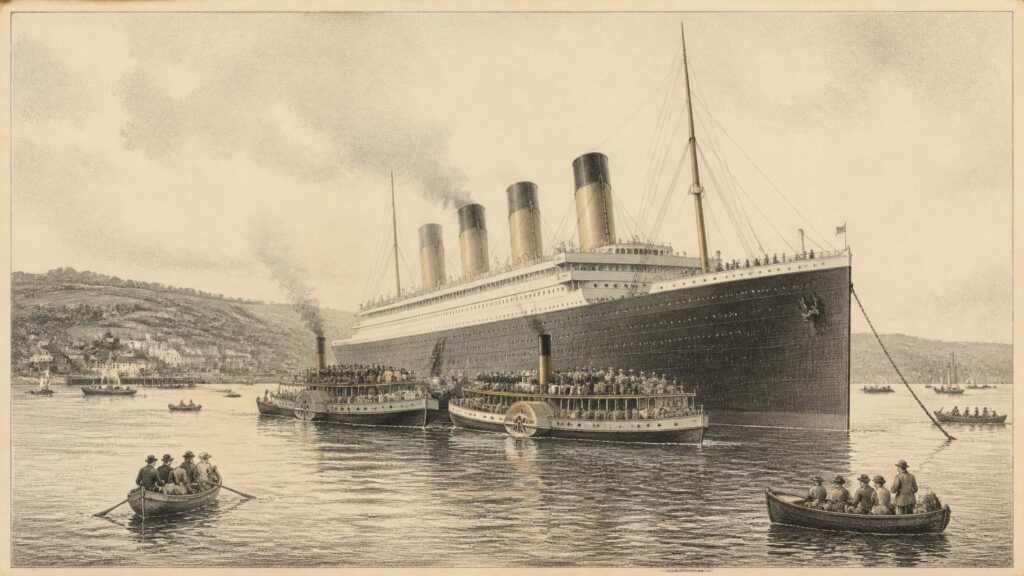
AI generated historical illustration, not a contemporary photograph.
At a Glance
RMS Titanic did not call at Queenstown, now Cobh, on 11 April 1912 merely to make a picturesque Irish detour, nor did she berth in the town itself. She anchored outside Cork Harbour at Roche’s Point because Queenstown was an established Atlantic calling place: a practical point at which the White Star Line could take aboard emigrant passengers and mails, set ashore a small number of travellers, complete formalities, and begin the ocean passage to New York. The stop lasted only a short time, but it joined the ship’s story permanently to Ireland’s much longer history of seafaring, departure and diaspora.
The Question
Asked why the Titanic “visited Cobh”, it is useful first to correct the language without losing the substance of the question. In April 1912 the town was officially Queenstown; the name Cobh was adopted after the establishment of the Irish Free State. Contemporary tickets, newspapers, shipping documents and official inquiries therefore refer to Queenstown. Modern visitors naturally say Cobh, and both names identify the same place, but historical precision matters because the Titanic’s connection was not to a modern tourist landmark. It was to a working imperial and commercial harbour at a moment when Ireland remained within the United Kingdom.
The ship’s call was scheduled commercial business. Titanic had left Southampton on 10 April, called at Cherbourg that evening, and then crossed the approaches to the south coast of Ireland. Queenstown was the final port of call before the open Atlantic and New York. The White Star Line expected passengers to join there, particularly people travelling from Ireland and Britain to North America, and expected mail to be transferred there. The call was therefore part of the planned route, not an emergency, an unscheduled diversion, or a gesture towards the ship’s Belfast builders.
That simple answer needs enlargement because Queenstown represented more than a convenient dot on a map. It was an emigration gateway with railway connections, experienced shipping agents, a deep sheltered harbour, tender steamers, customs and postal arrangements, and generations of local familiarity with transatlantic traffic. Titanic’s brief presence makes sense only in that setting. The famous liner came to Queenstown because the port was already integrated into the system that moved people, letters, money, news and ships between Ireland, Britain and North America.
Names Matter
The town had been known as Cove before it became Queenstown in 1849, when Queen Victoria visited. The later name Cobh reflects an Irish form of the earlier place-name and was formally adopted in 1922. It is entirely reasonable for a modern article to use Cobh when speaking of the place today, but the ship’s passengers were directed to Queenstown and their experience belongs to that named world: a town under British administration, adjacent to a strategically important naval harbour, connected by rail to the wider island and accustomed to outward migration.
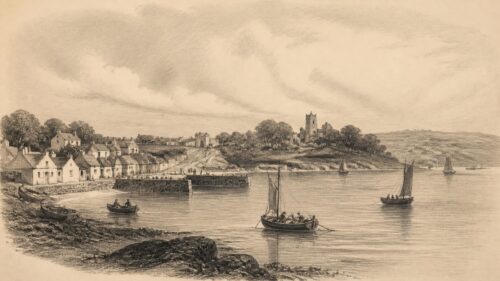
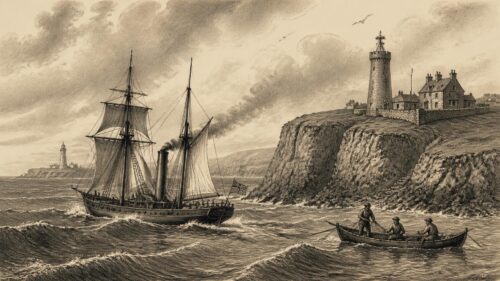
There is another linguistic trap. Titanic did not steam up to a quay in the town and tie up. Her size, draught and the operational demands of a rapid transatlantic call made an offshore anchorage the sensible arrangement. She lay outside the harbour, in the vicinity of Roche’s Point, while smaller vessels carried people, luggage, mail and supplies between shore and liner. Thus “Titanic at Cobh” is historically meaningful shorthand, but it should not create a false mental picture of the giant ship towering beside the railway station or town promenade.
The distinction helps explain the endurance of the connection. Cobh’s Titanic story is a shore story as much as a ship story: passengers gathered at the White Star facilities, travelled from many counties by rail, passed through a port town full of shipping activity, boarded tenders at the quay, and looked back at Ireland from the water. Their final view of home was associated with Queenstown even though the liner itself waited beyond the harbour entrance. In that sense, Cobh was not simply a geographical stop. It was the threshold between an Irish journey and an Atlantic one.
Route Design
White Star’s Southampton to New York service was organised around an itinerary rather than a single point of embarkation. Southampton furnished a principal British terminal, with substantial facilities for passengers, stores and crew. Cherbourg allowed the line to collect continental passengers without taking a large liner into a constrained French harbour. Queenstown performed a related but distinct function at the western edge of Europe: it enabled the company to take aboard passengers from Ireland and elsewhere, load mail, and make a final call before committing the vessel to the North Atlantic passage.
This arrangement was commercially sensible. Large liners carried travellers of very different means and national origins, and shipping companies competed keenly for transatlantic custom. Calling at Queenstown allowed White Star to sell or honour tickets for a considerable Irish market without requiring travellers to make the additional crossing to Southampton. It also served passengers who had come through Britain by rail or coastal steamer. The stop therefore widened the liner’s catchment area. It transformed Titanic from a ship departing an English port into a vessel drawing from a wider Atlantic migration network.
Geography reinforced the logic. A ship leaving Cherbourg for New York had to make westward progress through the Channel approaches and beyond Ireland. Queenstown lay conveniently close to the outward track. After the Irish call, Titanic could make her departure past the Daunt Rock lightship and proceed along the usual southern route across the Atlantic. A stop there did not mean that Ireland was a side excursion. It was compatible with the route chosen for a westbound voyage and was part of a long-established pattern among mail and passenger steamships.
The word “visit” can therefore obscure the businesslike character of the event. Ships visit places for diplomacy, ceremony or leisure; Titanic called at Queenstown to conduct traffic. The distinction does not diminish the human drama. On the contrary, it makes the scene more revealing. What later generations see as an exceptional moment was, at the time, an intensified version of a familiar harbour operation: a mail train arrived, agents processed travellers, tenders left the quay, and people who had said their farewells were carried to an ocean liner bound for America.
Harbour Geography
Cork Harbour was one of the great natural harbours of the Irish coast. Its broad protected waters, approaches and naval significance had long made the district important to merchant shipping as well as the Royal Navy. Yet a good harbour did not automatically mean that every large vessel docked in the town. Deep-water operations, tides, port facilities, time and a ship’s size all mattered. For a swift passenger and mail exchange, anchoring in the outer harbour and employing tenders could be more efficient than manoeuvring a very large liner to a berth and then departing again.
Tendering was not an improvised solution peculiar to Titanic. It was a normal technique at ports where liners anchored offshore or where companies wanted to avoid delay. At Cherbourg, Titanic had likewise received passengers and mail from White Star tenders rather than lying alongside a quay. At Queenstown, the company used the paddle steamers America and Ireland. Their role was indispensable: they were the practical link between the local shore establishment and the ship waiting beyond it.
The outer anchorage also explains why accounts give slightly varying descriptions of time and distance. The precise point at which a vessel was judged to have arrived, the moment an anchor was dropped, and whether the harbour entrance or Roche’s Point was used as reference could differ between recollections and later chronologies. The broad facts are secure. Titanic reached the Queenstown area late in the morning of Thursday 11 April 1912, remained for roughly two hours, received tenders carrying passengers and mail, and departed in the early afternoon for New York.
Modern retellings sometimes call this a stop “in Cork Harbour”, while others say “off Cobh” or “at Queenstown”. Each can be acceptable when used carefully. The most accurate formulation is that Titanic anchored off Roche’s Point, outside or at the outer reaches of Queenstown Harbour, while Queenstown provided the shore-side infrastructure. This is not pedantry. It identifies the actual mechanics of the call and honours the people whose last contact with Ireland was a tender journey rather than a gangway from a town quay.
Mail Business
Mail was one of the chief reasons for the call. Titanic was a Royal Mail Steamer, as the prefix RMS indicates, and transatlantic liners formed part of the communications infrastructure of the period. Letters, newspapers, commercial papers and parcels crossed oceans in enormous quantities. A final westbound collection at Queenstown connected Irish correspondence with the ship’s New York-bound passage. The movement of mail was not a decorative extra to the voyage; it was a core element of the economic and administrative world in which the great liners operated.
Accounts preserved by Cobh Heritage Centre describe mailbags arriving from the train and being carried to the tenders before transfer to Titanic. The image is especially valuable because it restores scale and routine to a story often dominated by the ship’s later loss. For the postal workers, railway staff, agents and tender crews, the operation required organisation rather than spectacle. Bags had to be identified, handled, loaded and transferred quickly. Every delay affected the liner’s timetable and the onward delivery of correspondence on both sides of the Atlantic.
The mail connection also helps explain the choice of Queenstown over a more northerly Irish port. What mattered was not merely proximity to Irish emigrants but the existence of established routes and systems. By the later nineteenth century, Cork and Queenstown had become increasingly important in transatlantic communications and passenger movement. Scholarly work on Cork Harbour’s nineteenth-century administration notes the growing importance of transatlantic steamship calls and American mails. Titanic inherited that infrastructure. Her call was a single, famous instance of an established commercial geography.
It is tempting to imagine the mail as secondary to the passengers because individual passengers have names and family stories. Yet the reverse is also true in institutional records: the mail was a contractual, scheduled responsibility, while travellers were entered in lists and ticket books. The stop served both human and bureaucratic movement. That dual purpose explains why a large new liner would pause at Queenstown even when the time ashore was short. The line could collect revenue passengers and fulfil communications obligations in one efficient harbour call.
Emigrant Traffic
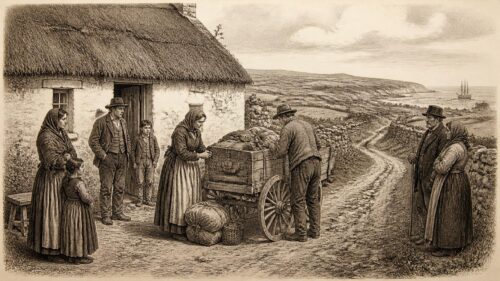
The other principal reason was passenger traffic, above all migration to North America. Ireland’s nineteenth- and early twentieth-century experience of emigration gave ports such as Queenstown an importance far beyond their local population. Departure was shaped by poverty, land pressures, employment patterns, family networks, remittances, education, religion and aspiration. The Great Famine had made emigration tragically visible in the 1840s, but the movement did not end with famine. Across subsequent decades, Irish people continued to leave for Britain, the United States, Canada, Australia and elsewhere.
By 1912, Queenstown was deeply associated with the Atlantic crossing. Some emigrants were travelling alone; others followed parents, siblings, friends or neighbours who had already settled abroad. Tickets could be purchased or sent from America. A passenger leaving a village in Mayo, Cork, Longford, Tipperary or elsewhere might be joining an existing household in New York, Boston, Chicago, St Louis or a smaller industrial town. The ship was not simply transport to an abstract “New World”. It was a bridge into kinship networks already created by earlier departures.
Titanic’s Queenstown passengers included people travelling in first, second and third class, but the largest number were in third class. The common total cited by Cobh Heritage Centre is 123 embarking passengers: three first class, seven second class and 113 third class. Such figures should be used with care because published totals for those boarding, those disembarking, crew changes and the number aboard after the call have varied in different records and later reconstructions. Still, the class distribution conveys an essential truth: Queenstown’s importance lay chiefly in its access to emigrant traffic.
The decision to sail on Titanic was not necessarily an act of faith in a mythical unsinkable ship, despite the later language attached to the disaster. For many passengers, the choice was practical. White Star offered a passage at a price, a scheduled departure, a destination and, in some cases, a ticket bought by family abroad. The ship’s newness may have attracted confidence and publicity, but the deeper explanation lies in ordinary migration economics. Queenstown supplied people to the transatlantic trade because Ireland possessed a large and persistent culture of outward movement.
White Star
The White Star Line had reasons of its own for maintaining the call. Competition on the North Atlantic was intense, and companies sought passengers from every available market. A line that ignored Irish embarkation would surrender business to rivals. Queenstown agents, booking arrangements and rail connections enabled White Star to market passage without building a giant terminal operation in Ireland. The line could concentrate major provisioning and crew functions at Southampton while using Queenstown as an efficient intermediate point.
The company’s use of tenders was part of that calculation. Tenders extended the reach of the liner. Rather than demand that a ship of Titanic’s scale enter every harbour and await dockside service, the company could keep the main vessel in suitable deep water and bring traffic to it. The tender journey itself became a small but memorable stage of travel. It was where passengers crossed from the familiar, visible shore to the vast ship that would carry them away. The logistical device had emotional consequences.
Queenstown’s White Star premises and agents were thus not incidental scenery. They mediated between local passengers and an international corporation headquartered elsewhere. They dealt with tickets, instructions, baggage and embarkation. The town’s economy contained many such intermediary roles: railway workers, hotelkeepers, boatmen, vendors, port officials and families supporting migrants. The arrival of Titanic undoubtedly drew attention because she was the newest and largest liner of her day, but the underlying commercial system had been built over many years and would have been recognisable to those accustomed to sailings from the harbour.
It is also worth resisting a misleading national simplification. Titanic was built in Belfast by Harland and Wolff, operated by the British White Star Line, registered at Liverpool, sailed from Southampton and called at Cherbourg and Queenstown. Her history crosses jurisdictions and identities. The Queenstown call was Irish in place and passenger experience, but it belonged as well to British imperial shipping, French port practice and American migration. Its historical value lies partly in demonstrating how interconnected those worlds were in 1912.
Morning Arrival
Titanic arrived off the Queenstown coast on Thursday 11 April after leaving Cherbourg the preceding night. Contemporary and later accounts generally place her arrival around 11.30 in the morning, though exact timings can vary slightly according to the clock, source and point of observation. She anchored near Roche’s Point. From shore, the sight of the huge four-funnelled liner was impressive, but the business of the call occurred through smaller craft and at the White Star quay rather than through a public reception on board.
The passengers intending to embark had already been assembled and processed. Many had travelled to Queenstown by train. This final domestic journey could itself be long and complex, involving changes of train, relatives accompanying travellers part of the way, luggage, money, food and the anxious social rituals later remembered as an American wake or farewell. It would be misleading to treat every account of those farewells as representative, but the general emotional pattern is well supported by the wider history of Irish emigration. Departure often combined hope, grief, celebration and uncertainty.
From the White Star pier, the tenders carried passengers outward. The America is especially prominent in surviving imagery and recollection because it transported many of the third-class passengers. The Ireland was associated with mail and other traffic. The neat division should not be overstated as a rigid rule for every item and person, but it captures the basic operational arrangement. Small steamers, not the liner’s own boats, brought the last passengers and mail alongside Titanic.
The operation was watched from deck by people already aboard and from shore by people whose relatives were leaving. It also produced photographs, notably those connected with Father Francis Browne, the Jesuit priest and keen photographer who travelled from Southampton and left at Queenstown. His photographs have become central visual evidence for the final port call. They are powerful sources, but they are not complete records. A camera fixes selected moments and people; it does not preserve every transfer, conversation, ticket check or feeling on the quay.
Tender Operations
At the liner’s side, tender operations had to be managed with care. Passengers climbed from a smaller moving vessel to a ship vastly larger than any craft they had previously boarded. Luggage and mail were handled separately. Crew and officers supervised gangways and the safe positioning of the tenders. The task was familiar to maritime workers, yet the scale of Titanic made it remarkable to onlookers. The world’s largest passenger ship depended, in that moment, on modest local vessels and skilled harbour labour.
This dependence is historically significant. Titanic is often remembered as an engineering colossus, apparently self-contained and remote from ordinary life. The Queenstown call shows the opposite. Even a celebrated liner relied on railways, ticket offices, post offices, harbour authorities, local crews, pilots, tenders, coal and provisioning systems, and the knowledge accumulated in a port community. The ship’s greatness did not eliminate these networks; it made their smooth functioning more necessary.
Once their business was completed, the tenders withdrew and Titanic prepared to leave. Cobh Heritage Centre records an exchange of whistles around 1.30 in the afternoon and associates the departure with uilleann piper Eugene Daly, a third-class passenger from Athlone. Accounts say Daly played “Erin’s Lament” and “A Nation Once Again”. The broad fact that Daly played pipes during the Queenstown departure is strongly embedded in contemporary recollection and later research. The exact sequence, audience reaction and every tune should nonetheless be treated with normal caution, since such details often pass through memory and retrospective narration.
The piper’s presence is more than an attractive anecdote. It shows that emigrants did not leave cultural identity on the quay. They carried instruments, songs, languages, habits and political opinions aboard. Daly’s music, if heard as reported, would have given a public Irish sound to a highly personal moment of departure. It has consequently acquired symbolic force: the ship’s final departure from land was marked, in later Irish memory, by music associated with home, national sentiment and loss. Symbolism, however, must not substitute for evidence. It illuminates the story only when distinguished from the operational facts.
Passenger Exchange
Queenstown was a place of embarkation, but it was also a place of disembarkation. A small number of people left Titanic there, including Father Browne. The existence of passengers who got off is important because it reminds us that the ship’s population was not fixed from Southampton. The itinerary allowed travellers to use a portion of the voyage, and it allowed the company to complete passenger exchanges. A person who stepped ashore at Queenstown on 11 April had no reason to think that this ordinary decision would soon be understood as a narrow escape.
Published totals require careful handling. Cobh Heritage Centre gives 123 embarking passengers and a post-departure total of 2,206 persons, based on 1,308 passengers and 898 crew. The British Wreck Commissioner’s Inquiry worked from figures that differed slightly, while other reconstructions incorporate disembarkations and the desertion of crewman John Coffey. Such variations do not mean the event is unknowable. They reflect the difficulty of reconciling ticket lists, company records, inquiry evidence and later identifications in a journey where people joined and left at several ports.
For the central question, exact numerical resolution is not required. Every credible reconstruction agrees that Queenstown supplied a substantial final group of passengers, predominantly third class, and a large consignment of mail. The call changed Titanic from a vessel on a European leg of her route into one fully committed to the Atlantic crossing. It was the last place where passengers could join, leave, post a letter through the established shore system, or where a crewman could step away from the ship before she departed westward.
The story of John Coffey is often presented with dramatic hindsight. A stoker from Queenstown, he left the ship during the call and survived because he was no longer aboard when Titanic sank. His desertion is documented in the wider record, but it should not be romanticised as foresight. There is no sound evidence that he left because he anticipated disaster. The compelling quality of the episode arises precisely from contingency: an administrative and personal choice at a port call became meaningful only after events in the North Atlantic transformed it into a matter of life and death.
Third Class
Most people who boarded at Queenstown travelled third class, then commonly called steerage. The word can conjure images of unrelieved misery, yet the reality deserves more exact treatment. Titanic’s third-class accommodation was more modern and, in several respects, more comfortable than that on many older ships. It still imposed class separation, shared facilities, limited space and a social hierarchy that became terribly consequential during the sinking. Comfort relative to earlier emigrant vessels did not mean equality with first-class passengers, nor did it remove the vulnerabilities attached to age, language, family circumstances and location within the ship.
For Queenstown emigrants, third class represented an attainable route to America rather than luxury. Tickets were expensive in the context of rural or working-class incomes, and travel might be financed by savings, loans, remittances or relatives already abroad. The voyage was an investment in a hoped-for future. Passengers carried clothing, addresses, small possessions and expectations. They may have imagined factory work, domestic service, farm labour, marriage, reunion or simply wages higher than those available at home. The decision to leave was seldom reducible to one motive.
The Irish passengers should not be treated as a single homogeneous group. Some were Irish-born; some had lived in Britain; some were travelling with relatives; some were headed to particular American households or employers; some spoke Irish as well as English; some were Catholic and some Protestant. Their experiences on the ship and in the disaster differed. The historical temptation is to turn them into a collective emblem of Irish suffering. Their individual records instead reveal varied lives that happened to converge at Queenstown on one April day.
This variety makes the local connection more substantial, not less. Cobh’s relationship with Titanic is not merely that a ship was seen offshore. It is that its quays, tenders and rail links brought together people from across Ireland at a decisive point in their lives. The town became a hinge in many personal journeys. When the disaster occurred, news travelled back into numerous communities, and the consequences were felt in parishes far beyond Cork Harbour.
Irish Networks
One of the best-known groups associated with Queenstown was the Addergoole party from County Mayo. Fourteen people from that district boarded Titanic, and only a small number survived. Their story has rightly become important in local remembrance, but it should be read as an example of networked migration rather than an isolated curiosity. People frequently travelled with neighbours and kin, or followed relatives abroad. A ticket could represent a chain of letters, remittances and prior journeys connecting a small Irish community to an American city.
Such networks explain why passengers might travel across Ireland to sail from Queenstown rather than use another port. The timetable, fare, ticket availability, contacts at the destination and the advice of family could all influence the decision. Queenstown’s advantage was not that it was nearest to every emigrant. It plainly was not. Its advantage was that it was a recognised, connected and trusted departure point within an Atlantic system. A person from the west or midlands could make the inland journey because the ship available there offered the right route at the right moment.
Individual stories are most useful when their evidential limits are clear. Passenger lists, civil registration, census returns, letters, newspaper reports and family testimony can establish much, but not every later family memory can be verified. A remembered farewell, a precise conversation or a claimed premonition may be deeply meaningful to descendants without being demonstrable historical fact. Responsible history need not dismiss such memory. It should identify it as memory, compare it with contemporary documentation where possible, and avoid allowing emotionally satisfying details to harden into certainty.
The Titanic disaster has generated a vast afterlife of such stories. Ireland’s connection has sometimes been simplified into a claim that the ship carried “the Irish” or that Cobh was uniquely responsible for the final passenger complement. Neither is accurate. What is accurate is more powerful: Queenstown was a real departure point for a diverse group of people whose journeys embodied the continuing Irish diaspora, and the catastrophe made their place in that larger history painfully visible.
Class Realities
The reason Titanic called at Queenstown should not be confused with the reasons so many people died after she struck an iceberg on the night of 14 April. The call explains how passengers and mail came aboard, not the later failures of evacuation, regulation and emergency organisation. Official inquiries examined the ship’s design, equipment, warnings, speed, lifeboats and conduct. Their records confirm Queenstown as the port from which Titanic left for New York, but the larger disaster must be analysed through its own evidence rather than through retrospective sentiment attached to Ireland.
Still, class matters to the Queenstown story because the passenger composition of the call shaped subsequent losses. Many embarking passengers were third class, and third-class survival rates were lower than those of first-class passengers, especially for women and children compared across the whole ship. That fact has encouraged dramatic accounts alleging that Irish steerage passengers were deliberately imprisoned below. The historical picture is more complicated. Physical layout, unfamiliarity, language, late information, crowd movement, access routes and the overall inadequacy of lifeboat capacity all mattered. Simplistic claims should be avoided, without minimising the unequal outcomes.
The tragedy also altered the meaning of ordinary objects and acts associated with Queenstown. A ticket became a memorial document; a final letter acquired exceptional value; a photograph of a tender became evidence of a last departure; a piper’s tune became an emblem of farewell. Such retrospective transformation is understandable. Yet historians should remember that on 11 April the operation was not staged as a farewell to death. It was a routine commercial embarkation carried out in the expectation of safe arrival in New York.
That contrast is central to the story’s emotional force. The people on the quay, the tender crews and the passengers could not know that the ship would sink four days later. Any reading that treats their every action as ominous imposes later knowledge upon them. Good historical writing allows hindsight to explain consequence while preserving the uncertainty of the moment. Titanic at Queenstown was, first of all, a departure full of ordinary future plans.
Crew Departure
John Coffey’s departure has become one of the most frequently repeated Queenstown episodes. He was a fireman, or stoker, who left the ship during the call and remained ashore. Accounts differ in their incidental detail, including how he avoided notice, but the essential point is secure enough: a crewman deserted at Queenstown. Because Titanic later sank, the event has attracted a mythology of lucky escape, secret knowledge and destiny.
There is no need for those embellishments. Desertion by a seaman was not an impossible or inexplicable event in a labour market where maritime work was hard, discipline strict and personal reasons could intervene. Coffey’s local connection made Queenstown a plausible place to leave. He had reached home territory and could disappear into a familiar environment. That the choice saved his life is historically striking, but striking outcomes do not prove prophetic motives.
His case also reveals why the total numbers aboard Titanic after Queenstown are not always identical in popular accounts. Passenger boardings, passenger disembarkings, crew departures and different methods of counting all influence the final number. Modern writers often repeat one total with excessive confidence. The safer method is to give the specific figure used by a named source, acknowledge that official and later totals vary modestly, and avoid pretending that a small numerical discrepancy changes the larger historical explanation for the stop.
Evidence Limits
Several kinds of evidence support the Queenstown narrative. Official inquiry material establishes the voyage’s broad chronology and treats Queenstown as the point from which Titanic departed for New York. Board of Trade survey and passenger documentation demonstrate the administrative framework around the ship. Local museum interpretation preserves the operational sequence of tenders, mail and embarking passengers. Photographs provide visual evidence of the day, while passenger records, letters and newspapers supply personal detail. No single source tells the whole story.
This mixed archive requires discrimination. An official inquiry may be strong for numbers, regulations and testimony under examination, but it may not capture the emotional texture of the quay. A photograph may prove the appearance of a tender beside the ship but not identify every passenger in view. A survivor’s recollection may vividly preserve music or sensation while being less reliable for exact time. A later family history may preserve names and motives otherwise absent from formal paperwork, but may also contain compressed or altered memories. Historical confidence should match the evidence available.
Folklore has a particular place in Titanic history. Stories of ominous remarks, last-minute warnings, miraculous escapes and symbolic signs are common because catastrophe invites people to seek meaning. Some may contain kernels of truth; many cannot now be tested. They should be presented as folklore or family memory, not as documented fact. The same discipline applies to dramatic claims about passengers supposedly knowing the ship was doomed, or to sentimental statements that every emigrant believed they would never return. Some did return; some intended to; others never had the chance.
The strongest answer to why Titanic called at Cobh therefore rests not on anecdote but on converging evidence: the scheduled route, the established role of Queenstown in passenger and mail traffic, the tender operation, and the large group of embarkations. The human stories enrich that answer once their status is made clear. They cannot replace it.
Disaster Memory
After Titanic struck ice at 11.40 pm ship’s time on 14 April and sank in the early hours of 15 April 1912, Queenstown’s routine call acquired an immense retrospective burden. News was uncertain and often contradictory at first. Families in Ireland and America sought names, telegrams and confirmation. Communities learned that people who had left only days earlier were among the dead or survivors. The physical proximity of the last port gave Cobh a special role in Irish remembrance, even though the disaster happened far away in the North Atlantic.
Father Browne’s photographs were crucial in shaping this memory. Because he disembarked at Queenstown, he survived and his images remained to show Titanic’s interiors, decks, passengers and the final port-call context. They are often reproduced because they make the vessel seem startlingly near. Yet their value is not merely visual. They link the grand ship to Ireland through a witness who left at Queenstown, and they document the normality of life aboard before catastrophe turned every surviving image into a relic.
Local commemoration has also focused on the White Star building, the pier and the tender route. Such places help translate an oceanic disaster into a landscape people can visit. This is legitimate historical interpretation, provided that commemoration does not erase the difference between the actual offshore anchorage and a romanticised dockside scene. The strength of Cobh’s memory lies precisely in its physical specificity: the railway station, harbour, quay and view towards Roche’s Point make the abstract phrase “last port of call” tangible.
Memory can nevertheless distort. The slogan that Cobh was Titanic’s “last sight of land” is evocative, but individual visibility depended on where a person stood, weather, course and attention. The claim that every person boarding was Irish is wrong; Queenstown was in Ireland, but passengers could have varied origins. The claim that the town alone supplied Titanic’s emigrants ignores Southampton and Cherbourg. Responsible commemoration is not weakened by correcting these points. It becomes more durable.
Public Response
Queenstown’s response to the disaster formed part of a wider Irish and international reaction. The loss of life was reported in newspapers, discussed in churches and homes, and addressed through relief efforts. In towns and villages connected to victims, grief was specific: a missing son, daughter, sibling, neighbour or intended bride. The disaster’s public scale could obscure these intimate losses, but local records and family histories repeatedly restore them.
For Ireland, Titanic’s sinking also intersected with a society undergoing political strain and transformation. The Home Rule crisis was intensifying; labour disputes and social questions mattered; migration continued to alter communities. It would be wrong to make Titanic a direct cause of these developments, but the disaster entered an Ireland already familiar with absence and overseas family ties. Its emotional resonance was therefore not produced solely by the ship’s fame. It drew upon older experiences of departure, precarious sea travel and news arriving from across the Atlantic.
The event also reinforced Queenstown’s maritime identity. Within a few years the harbour would be associated with another major wartime maritime tragedy, the sinking of Lusitania in 1915, when survivors and bodies were brought into Queenstown. The two events are distinct and should not be collapsed together, but their association has made Cobh a powerful site of Irish maritime memory. Titanic’s call was short; its place in the town’s historical imagination has been lasting.
Last Port
Calling Queenstown the “last port of call” is correct, but it can conceal what the phrase meant operationally. It was not the last place Titanic touched land, because she did not berth there. It was the last organised port stop on the route before the Atlantic crossing. The ship had departed Southampton, called at Cherbourg, and then completed her final passenger and mail exchange off Queenstown. From there, the voyage entered a new phase: no further scheduled European calls, only the long westbound run towards New York.
That status explains why Queenstown became so important in later narratives. A final port has natural dramatic force. It is the last point at which people may choose not to continue, the last shore from which messages can be sent by ordinary means, and the last place at which a passenger’s identity is newly entered into a ship’s community. For Titanic, that finality became unbearable after the sinking. But it existed before the disaster as a normal feature of route planning.
The final call also had an economic meaning. It allowed White Star to consolidate its transatlantic load before leaving Europe. Passengers were revenue; mail carried contractual and commercial importance; the port’s agents and tenders permitted both to be added without a long interruption. In maritime terms, Queenstown was a node. In personal terms, it was a place of leave-taking. In later historical memory, it became the last Irish threshold crossed by those who sailed on Titanic.
Historical Meaning
The best answer to the original question is therefore layered. Titanic called at Queenstown because the White Star Line had planned it as a commercially efficient final European stop. The harbour’s geography made offshore tendering feasible; its railway, shipping and postal connections made passenger and mail transfer practical; and Ireland’s long-standing emigrant traffic made the call profitable and useful. The ship did not come because Cobh was a ceremonial destination, because it was built in Belfast, or because the company had any presentiment of disaster.
At the same time, reducing the event to logistics would miss its historical meaning. Queenstown represented a great migratory doorway in Irish life. The passengers boarding Titanic were not merely numbers being loaded onto a schedule. They were people moving through social networks that linked Irish townlands and families to North American cities. Their boarding at Queenstown placed a local Irish history within one of the best-known maritime disasters in the world.
The call’s brevity is part of its power. Titanic stayed for only hours, yet those hours contained railway travel, official processing, letters, mailbags, tender whistles, music, photographs, departures and decisions that later acquired immense significance. The ship’s relationship with Cobh was momentary in time but extensive in consequence. It connected a global liner to a local harbour, and an international catastrophe to the lived history of Irish emigration.
Common Errors
Several common errors deserve clear correction. First, Titanic did not dock at Cobh; she anchored off Roche’s Point and was served by tenders. Secondly, she did not call because Belfast was nearby. Belfast, where she was built, lies on a different coast and had no practical role in this westbound itinerary after the ship had been delivered to Southampton. Thirdly, the call was not unscheduled. It was part of the maiden voyage plan, following Cherbourg and preceding the Atlantic crossing.
Fourthly, not every Queenstown passenger was necessarily an Irish emigrant, although most who embarked travelled third class and the port’s emigrant role was central. Fifthly, passenger totals should not be wielded as absolute proof when sources count differently. It is safer to state the source and explain the reason for variation. Finally, popular tales of warnings and omens should be separated from documentary evidence. They may be moving, but they do not explain why the ship called.
These corrections do not make the story colder. They make it clearer. The actual event is sufficiently dramatic without invented embellishment: the largest liner afloat paused outside an Irish harbour; tenders carried more than a hundred new passengers and a major mail consignment to her side; she sailed away in the early afternoon; and within four days many of those people were dead. Historical accuracy gives that sequence its proper weight.
Enduring Connection
Cobh’s enduring bond with Titanic rests on evidence, landscape and memory. The evidence records a scheduled final port call for passengers and mail. The landscape still permits observers to understand the relationship between town, harbour, outer anchorage and sea route. Memory preserves the names and stories of those who embarked, those who disembarked, and those who watched the ship leave. Together they explain why a short operational stop remains one of the defining episodes in the town’s public history.
To ask why Titanic visited Cobh is ultimately to ask how a world-famous ship fitted into the ordinary Atlantic systems of 1912. The answer is that Queenstown was already prepared for her. It was a port of departure, an emigrant gateway, a mail station and a harbour connected to the Atlantic economy. Titanic did not make Cobh historically important; rather, Cobh’s existing importance helped bring Titanic there.
That is the lasting lesson of the call. Behind the legend of an extraordinary ship lies the history of an ordinary but vital port function: people and post leaving Ireland for America. The disaster made the moment unforgettable, but the reason for it was practical, planned and deeply rooted in Ireland’s maritime and migratory past.
The article presents Queenstown as a practical transport hub and an emotional threshold, where tender journeys transformed railway arrivals into Atlantic departures. Its emphasis on mail, agents and offshore anchorage usefully complicates the image of Titanic as a spectacle, placing the call within routine networks of migration, imperial administration and commerce. At the same time, the predominance of third-class embarkations suggests that significance cannot be understood solely through shipping logistics. How might historians connect the operational evidence of White Star’s scheduled call with the diverse family expectations, social pressures and ambitions that shaped why Irish passengers chose to leave home?