
Michael Joyce
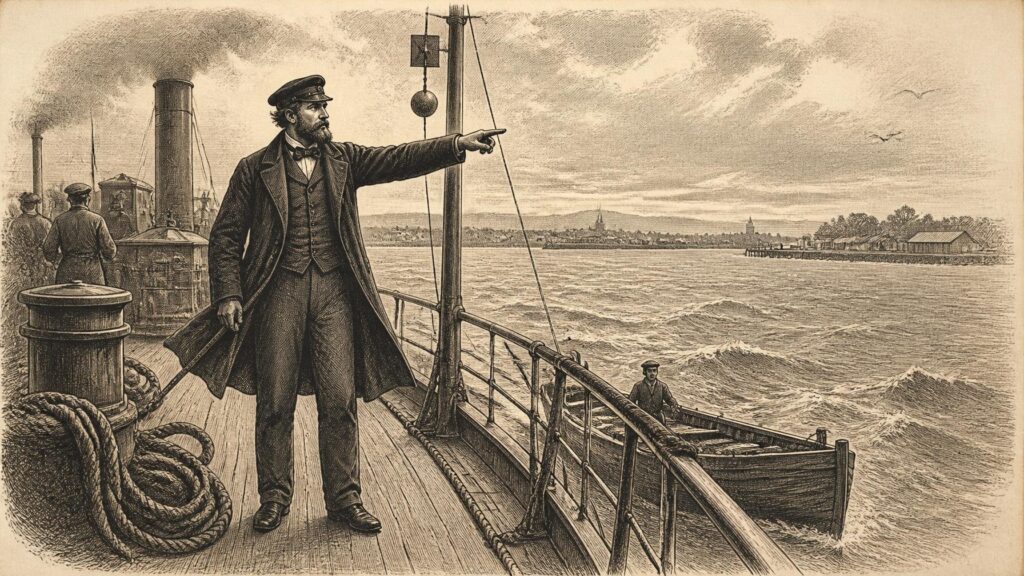
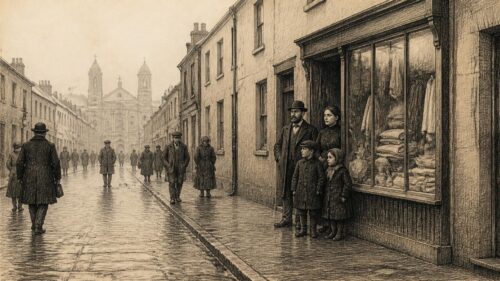
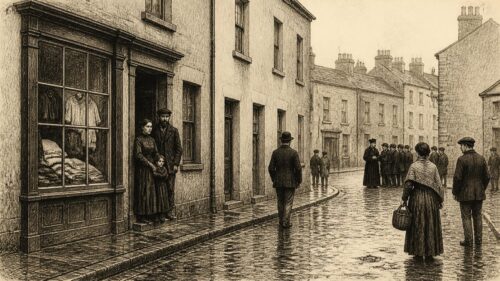
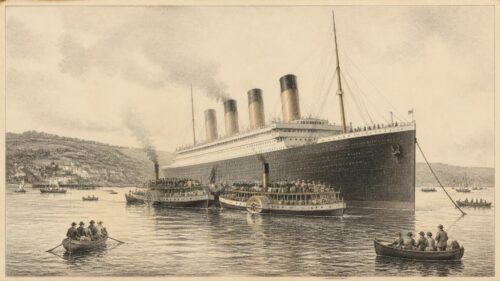
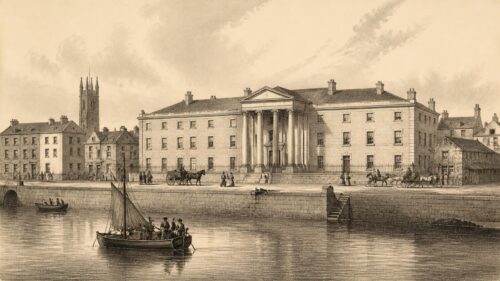
AI generated historical illustration, not a contemporary photograph.
At a Glance
Michael Joyce of Limerick belonged to that practical school of Irish public men whose authority was earned before it was elected. A sailor from boyhood, a licensed Shannon pilot, municipal representative, nationalist MP and twice mayor, he brought the river, the harbour and the everyday grievances of his city into the political life of Westminster. His career also illustrates the fortunes of constitutional Irish nationalism: it flourished in Limerick during the years before the First World War, then was abruptly overtaken by the revolutionary politics of 1918.
River Inheritance
Michael Joyce was born on 4 September 1851 at Merchant’s Quay, Limerick. His connection with the Shannon was hereditary. His father, Richard Joyce, worked as a Shannon pilot, and his grandfather John had done the same. Such a background mattered. The Shannon estuary and the river route to Limerick were not merely picturesque features of the county; they were a difficult working environment, a commercial artery and a source of specialised local knowledge. The river pilot occupied an important place between shipowners, merchants, mariners and the harbour authorities. He had to understand tides, channels, weather and changing shoals, while also commanding enough confidence to take responsibility for valuable vessels and their crews.
Joyce was educated by the Christian Brothers in Limerick, but his formal schooling gave way early to the sea. At fourteen he joined the barque Red Gauntlet. This was not unusual in a port city, yet it placed him in a world much larger and more hazardous than the civic Limerick in which he would later make his name. Merchant sailing offered work and possibility, but it also brought exposure to catastrophe. The documentary record of Joyce’s early career is striking because it preserves not an abstract tale of a man who ‘went to sea’, but a sequence of wrecks and narrow escapes.
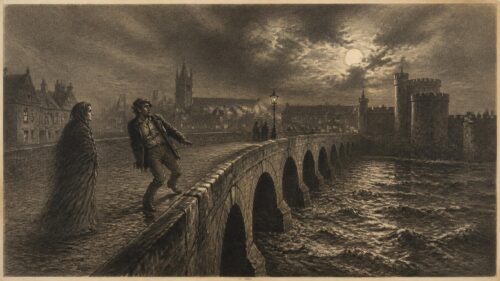
In 1869 he was aboard the Herald when it foundered in the Bay of Biscay. Soon afterwards, another vessel on which he served capsized in the Atlantic. Joyce and the other crewmen reportedly survived for five days on the upturned hull before rescue. Further misadventures followed in the North Sea: one ship was driven ashore in a gale, and another was wrecked during the Franco Prussian War after navigational buoys had been removed from waters affected by the conflict. These episodes should not be embroidered into maritime folklore, but the broad facts are well attested in the principal biographical record. They explain why contemporaries could regard Joyce’s later competence as something learned under exceptional pressure rather than acquired solely in committee rooms.
In 1876 he returned to Limerick and entered the apprenticeship necessary to become a river pilot. In March 1878, Limerick Harbour Commissioners granted him a pilot’s licence. His route of responsibility extended from Cain’s Island downriver towards Scattery Island and Loop Head. The work required local mastery of an estuary whose navigability was central to the economic life of Limerick. His membership of the Royal Naval Reserve further connected his professional identity to wider British and imperial maritime structures. Yet his public career was to be Irish nationalist, revealing a characteristic complexity of the period: participation in British institutions and advocacy of Irish self government were not incompatible for a constitutional nationalist.
Joyce married Annie Mahony in 1878. Her father was also a pilot, joining two families with close occupational links to the river. They made their home in Limerick and had two sons and two daughters. It would be wrong to treat this domestic information as incidental. In the nineteenth century, a man’s local standing was often embedded in family, neighbourhood, occupation, parish and voluntary associations. Joyce’s public credibility was grounded in that local world long before he entered Parliament.
Ocean Apprenticeship
Joyce’s maritime past became the foundation of his later public persona. He was not a gentleman politician adopting nautical language for effect, but a working pilot who had seen the risks of sea travel at first hand. This experience gave him a particular kind of authority when he spoke about shipping, pilotage, loss of life at sea and the administration of harbours. It also gave Limerick an unusual representative: a city MP able to argue national policy from direct technical experience.
The surviving parliamentary indexes show how consistently maritime issues appeared in his work. His contributions included questions and speeches on pilotage certificates, pilotage orders, the safety of seaborne travel, shipping engagement, the Commissioners of Irish Lights and the administration of port services. Such entries may appear dry, but they reveal a pattern. Joyce treated maritime affairs neither as a narrow professional interest nor as a subject detached from Irish life. For a trading city connected to Atlantic routes, the safety, regulation and cost of shipping affected employment, food supplies, export trade and the wider fortunes of the region.
His career invites an interpretation that is more substantial than the simple label of ‘local representative’. Joyce was a local representative in the best sense: he understood that local material concerns could be pursued through national institutions. The Shannon pilot’s knowledge was not a substitute for politics; it became a way of doing politics. He could intervene in questions of navigation and safety as an experienced practitioner, while approaching Irish administrative questions as the elected member for a major provincial city.
Contemporaries recognised this combination of trade knowledge and public presence. At Westminster, Joyce was known as the ‘Pilot of the House’. The nickname was undoubtedly congenial to a man whose life had been spent guiding ships through danger, and it has an obvious metaphorical appeal. Still, it should not be allowed to obscure the practical rather than merely symbolic basis of his reputation. He was closely involved with the Limerick Harbour Board and its pilotage committee, and he later served the United Kingdom Pilots’ Association at its highest level.
There is also an important caution. Public biographies naturally emphasise the dramatic wrecks and the colourful nickname. Those details are memorable, but Joyce’s lasting importance lay in sustained work: harbour governance, local representation, parliamentary questioning and professional organisation. A historical account that dwells only on survival stories risks reducing him to a character. His significance was that of a civic and political operator whose authority rested on a lifetime in an essential Limerick occupation.
Civic Entrance
Joyce’s route into politics ran through associational life. He belonged to a local temperance debating society and became a founding member of the Sarsfield Branch of the National League. Such organisations were vital to late nineteenth century Irish political culture. They brought national questions into local rooms, public meetings and networks of activists, but they also trained men in committee work, speech making, fundraising and electoral organisation. The constitutional nationalist movement relied on precisely these local structures.
The Sarsfield name itself evoked the memory of Patrick Sarsfield and the Jacobite defence of Limerick. Its use did not make a political organisation revolutionary. Rather, it shows how constitutional nationalism could draw upon older patriotic memory while seeking Home Rule through parliamentary action. Joyce’s public life was rooted in that tradition. He was a nationalist, but not a separatist in the later Sinn Féin sense; his strategy centred on representation, municipal power and Westminster legislation.
In January 1899, Joyce stood for Limerick Corporation and was returned on a labour mandate. The description is revealing. It indicates that his appeal rested not solely on abstract nationalism but also on his standing among urban working people and his practical familiarity with the commercial life of the city. Limerick’s politics were shaped by class, religion, occupation and local loyalties as well as by the national constitutional question. Joyce’s ability to secure a labour mandate suggests that he could speak across these concerns.
The widening of local electoral participation in the late nineteenth century created opportunities for figures like Joyce. Men whose authority had been built in occupations and voluntary bodies could acquire a formal civic role. Municipal office was not a minor prelude to ‘real’ politics. It was an arena in which questions of sanitation, roads, housing, schools, markets, rates and public employment were debated, often sharply. It also provided a platform from which nationalist representatives could demonstrate their competence in government.
In 1900 Joyce was elected nationalist MP for Limerick City, decisively defeating a unionist opponent. His election put him in the Irish Parliamentary Party tradition associated with constitutional Home Rule. At the turn of the century, the party represented a powerful strand of nationalist opinion: Irish self government was to be pursued by elected members acting in the House of Commons, allied where necessary with sympathetic British parties and supported by organised public opinion in Ireland.
Joyce’s election also represented an urban Limerick version of this politics. He was not a landed figure, a lawyer of national celebrity or a parliamentary theorist. He was a river pilot whose claim to represent the city emerged from work, locality and association. That background contributed to his popular manner. The Dictionary of Irish Biography describes him as charming and a gifted storyteller. Such qualities mattered in an age when public meetings, dinners, speeches and personal acquaintance remained central to political life.
Westminster Service
Joyce represented Limerick City at Westminster from 1900 until 1918. Parliamentary records confirm his service across those years and identify a broad range of concerns. His interventions were not confined to Home Rule speeches. They included land purchase, old age pensions, trade boards, labour exchanges, public health, agricultural disease, postal services, railway matters, military cases, local government, barrack contracts and the interests of Limerick citizens. This was the everyday labour of an MP, and it provides a corrective to any view that Irish nationalist parliamentarians concerned themselves exclusively with constitutional drama.
His parliamentary record is particularly valuable because it reveals the connection between local grievances and imperial administration. Questions about Irish eggs in transit, imported straw, cattle disease, local appointments, canal work or the provision of services could appear parochial at Westminster. In fact, they exposed how decisions of central government affected ordinary producers, workers and consumers in Ireland. Joyce’s political method was therefore practical and granular. He used Parliament as a place to press the claims of constituents against departments and bureaucracies.
He retained the seat in both general elections of 1910, defeating the independent nationalist John H. Rice by substantial margins on each occasion. This was an important period for the Irish Parliamentary Party. The constitutional crisis produced by the Parliament Act of 1911 and the ensuing Home Rule struggle gave the party influence in the House of Commons. Joyce’s successive victories show that, in Limerick City, his form of constitutional nationalism retained electoral strength during a period of mounting tension.
Joyce’s local and parliamentary careers overlapped. He served two terms as Mayor of Limerick, in 1905 and 1906, and was returned unopposed as MP at the 1906 general election. The dual role is striking to modern eyes, but it was characteristic of an era in which prominent local men commonly combined municipal, professional and national responsibilities. It also meant that Joyce could move between the city’s council chambers, the Harbour Board and the House of Commons without abandoning the identity that had made him electable.
A surviving 1905 civic document demonstrates the kind of work with which he was associated as mayor. In a dispute over the Roxboro Road School property, a statement on behalf of Limerick’s County Borough Council argued that an endowment created from compulsory local rates should serve the public of the city rather than a single religious interest. The document was signed by Michael Joyce as mayor and MP. It should not be taken as proof that he alone formulated the policy; it was a corporate municipal statement. Yet his signature places him directly within a civic assertion of public ownership, ratepayer interest and educational equity.
This episode is also a reminder that Irish municipal politics could involve denominational tensions as well as nationalism. Joyce’s nationalism operated in a city whose institutions had been shaped by unequal power, religious divisions and long running disputes over public resources. His mayoralty cannot therefore be understood merely as an honorary distinction. It was part of a practical effort to claim and administer civic space on behalf of the broader urban public.
Maritime Reform
Joyce’s most distinctive national contribution lay in pilotage reform. He was active in the United Kingdom Pilots’ Association and became its president in 1910, succeeding Commander George Cawley. This was a considerable professional achievement. It positioned an Irish river pilot at the head of an organisation concerned with a trade and safety system extending across the United Kingdom’s waters and ports.
In 1909, Joyce and Cawley met Winston Churchill, then President of the Board of Trade, to press for reform. A select committee on pilotage followed their recommendations. Joyce subsequently served on the Board of Trade’s Marine Advisory Committee and gave evidence about pilotage on the Shannon. The work contributed to the Pilotage Act of 1913. This chain of events should be expressed carefully. Joyce was not the sole author of the Act, and legislation was the outcome of many officials, legislators, shipping interests and professional bodies. Nevertheless, the evidence supports the conclusion that he was a significant practitioner advocate in the process that led to reform.
His speeches and questions during 1912, 1913 and 1914 show sustained attention to the subject. He spoke on the Pilotage Bill, the Board of Trade’s powers to make pilotage orders, certificates, exemptions and by laws, and later on the status of alien pilots during wartime. The technical specificity matters. Joyce did not merely endorse a bill in principle; he engaged with clauses and administrative mechanisms. The parliamentary record confirms that his expertise could be translated into detailed legislative work.
There is a larger historical significance here. Irish representation at Westminster is often remembered chiefly through the great constitutional issue of Home Rule. Joyce’s career shows another dimension: Irish MPs could influence British and Irish public policy through specialist knowledge. The state depended on expertise from outside the permanent bureaucracy, especially in fields such as navigation, labour, agriculture and local government. Joyce’s authority as a pilot gave him access to this process, while his elected status made him answerable to a city whose prosperity depended in part on maritime commerce.
He also brought maritime concerns into the wider social question. The parliamentary index records interventions concerning loss of life at sea in 1912 and the disaster involving the California in 1914. The pattern suggests an MP alert to the human consequences of maritime policy, not only to professional privileges. It would be unwarranted to infer a complete philosophy of safety regulation from indexes alone, but the subjects on which he spoke are consistent with a man whose own life had been shaped by shipwreck and rescue.
Cultural Politics
Joyce’s public identity was not limited to the river and the council chamber. He was a founding member of Garryowen rugby club and played in the first fifteen for both Garryowen and Limerick County. Sport in late nineteenth century Ireland was not politically neutral ground. It could be a site of social connection, local rivalry, cultural affiliation and debate about national identity. Joyce’s sporting life reflects the plural character of urban Limerick culture.
A scholarly study of Irish nationalist MPs notes that Joyce belonged to St Michael’s Hurling Club in the 1880s and attended a Gaelic Athletic Association executive meeting at Thurles in 1886. At that meeting, he was the sole dissenter from a resolution that rugby players could not belong to the association. The evidence permits a clear conclusion about the vote, but not about every private motive behind it. It is plausible that Joyce’s connection with Garryowen and Limerick rugby informed his position. Yet that remains interpretation rather than a documented statement of his reasoning.
The incident is important because it complicates simplified accounts of cultural nationalism. Joyce was a constitutional nationalist, a rugby player and club founder, a hurling club member, and a participant in debates surrounding the early GAA. These affiliations do not fit a neat division between ‘Irish’ and ‘foreign’ sports. Rather, they demonstrate that identities in Limerick could overlap. Civic nationalism, local sport and cultural revival were capable of intersecting, even when their institutions disagreed.
His later cultural activity remained rooted in Limerick. He chaired the committee that erected a cross at the grave of Michael Hogan, the ‘Bard of Thomond’, in 1933. He belonged to the Limerick division of the Ancient Order of Hibernians and served on the Joseph Devlin Memorial Committee, presenting a bust of Devlin to the Limerick Municipal Art Gallery in 1939. These acts belong to the commemorative culture of constitutional nationalism. They preserved poets, politicians and community memory at a time when the political landscape had changed dramatically since Joyce’s parliamentary years.
War Passage
The First World War brought personal loss and a final maritime ordeal. Joyce’s elder son Richard had emigrated to the United States and was wounded while serving in France with the 165th Regiment in 1918. This family connection illustrates the transnational character of Irish lives in the period: Limerick families could be bound to Britain, the United States, France and the Atlantic world at once.
In October 1918 Joyce himself was travelling to England aboard the RMS Leinster when the vessel was torpedoed in the Irish Sea by a German submarine. He narrowly escaped death. The Dictionary of Irish Biography records that he assisted in the evacuation and was later commended for his actions. Accounts preserving his own recollections describe him responding quickly, helping to lower a boat, and later participating in the rescue of people from rafts. The broad outline is documented; the precise drama of individual moments should be treated with restraint.
The sinking of the Leinster was one of the most devastating maritime disasters in Irish waters. For Joyce, it represented a grim recurrence of dangers he had faced since youth. The episode also fused his private vocational history with the wider catastrophe of the war. A man who had helped shape pilotage policy and spoken about safety at sea became a survivor of a wartime sinking only weeks before the Armistice.
There is a temptation to make the Leinster episode the climax of Joyce’s life story. It was certainly dramatic, and it reinforced his maritime reputation. Yet it arrived at the precise moment when the political world in which he had prospered was collapsing. The danger he escaped at sea was followed by an electoral transformation on land from which his constitutional nationalist tradition did not recover.
Political Eclipse
By late 1918 the Irish Parliamentary Party faced a crisis of authority. The Easter Rising, the conscription controversy, the rise of Sinn Féin and the radicalisation of political opinion had transformed Irish nationalism. The parliamentary strategy that had defined Joyce’s career no longer commanded the same popular confidence. In Limerick, his pre election meetings were disrupted by Sinn Féin activists in November 1918.
Joyce decided not to contest the general election, seeking to avoid further disruption in the city. Sinn Féin’s Michael Colivet was then returned for Limerick City. The result marked more than the replacement of one MP by another. It signalled the end of a political era. For nearly two decades Joyce had represented Limerick within the constitutional framework of the United Kingdom. The election of 1918 rejected that framework across much of Ireland and gave democratic force to a new separatist mandate.
His withdrawal should not be mistaken for irrelevance. It demonstrates the historical limits of a once effective political method. Joyce had been repeatedly elected, had served as mayor and had achieved influence in maritime legislation. But politics is not a simple record of individual merit. The conditions that made his career possible—the authority of the Irish Parliamentary Party, confidence in parliamentary negotiation and the older civic nationalist culture—had been overtaken by events.
It is therefore misleading either to celebrate Joyce as an unqualified victor or to judge him solely by the defeat of his party. His career offers a more useful perspective on constitutional nationalism. It shows what that tradition could accomplish in municipal representation, professional reform and parliamentary advocacy, while also revealing how quickly it could lose ground when political legitimacy shifted from Westminster to a new national movement.
Local Afterlife
After leaving Parliament, Joyce retired from the Limerick Harbour Board in 1920 and stepped down as president of the United Kingdom Pilots’ Association in 1923. His formal public roles narrowed, but he remained active in Limerick’s cultural and commemorative life. This continuity is significant. Former Irish Parliamentary Party figures did not simply disappear after 1918; many retained local esteem, professional networks and community commitments even when the national political order had changed.
Joyce died on 9 January 1941 at his home, The Moorings, on O’Connell Avenue, Limerick. He had lived through a period of extraordinary change: the later Victorian age, the Home Rule crisis, the First World War, revolution, partition and the creation of the Irish Free State. His life does not supply a simple allegory for all those events. It does, however, show how one Limerick man navigated the changing relationship between local occupation, civic duty and national politics.
His memory survives in several overlapping traditions: maritime history remembers the Shannon pilot and pilotage reformer; Limerick civic history remembers the mayor and councillor; parliamentary history remembers the nationalist MP; sporting history remembers the Garryowen founder and player; and the story of the RMS Leinster remembers a survivor who helped others during a disaster. Each tradition is true, but none is complete on its own.
Historical Assessment
Michael Joyce deserves attention not because he stood at the centre of every great Irish event, but because his career connects several important histories that are too often separated. He belongs to the history of Limerick as a port city, the occupational history of the Shannon, the municipal history of public resources and local representation, the constitutional nationalist history of the Irish Parliamentary Party, and the social history of sport and voluntary association.
The strongest documentary evidence establishes the principal outline: Limerick birth and pilot lineage; youthful service at sea and repeated shipwreck; a pilot’s licence in 1878; election to Limerick Corporation in 1899; election as nationalist MP in 1900; two mayoral terms; sustained work on pilotage; survival of the Leinster sinking; withdrawal from the 1918 election; and continuing cultural activity before his death in 1941. Interpretation begins when these facts are assembled. Taken together, they suggest a public man who converted occupational expertise into civic authority and treated politics as a practical extension of responsibility to his community.
Folklore and family memory naturally gather around men who survive shipwrecks, meet famous visitors and hold office for decades. Those traditions can preserve valuable colour, but they should not be allowed to outrun the record. Joyce needs no invented legend. The documented life is already remarkable: a sailor who endured four wrecks, a Shannon pilot who helped shape pilotage law, a mayor who signed civic claims on behalf of Limerick, an MP whose work ranged from local labour and services to navigation, and a constitutional nationalist who witnessed the disappearance of the political order he had served.
His story ultimately restores texture to the idea of Irish political representation before independence. It was not made only by celebrated leaders and major declarations. It was also made by men such as Michael Joyce, whose knowledge of a river, a harbour and a city gave substance to public life. In the passage from Merchant’s Quay to Westminster and back again, the Shannon pilot carried Limerick’s concerns into the larger political world.
Michael Joyce’s career complicates any simple divide between local expertise, British institutional participation and Irish nationalism. As a Shannon pilot, Royal Naval Reserve member and Westminster MP, he used practical maritime knowledge to advocate pilotage reform while representing constitutional Home Rule politics. His opposition to excluding rugby players from the GAA similarly suggests that cultural identity in Limerick could be more flexible than narratives imply. The article therefore invites us to consider how occupational experience and civic networks shaped political loyalties. To what extent does Joyce’s life show that early twentieth-century Irish nationalism accommodated overlapping professional, sporting and imperial connections?