
Limerick Volunteers
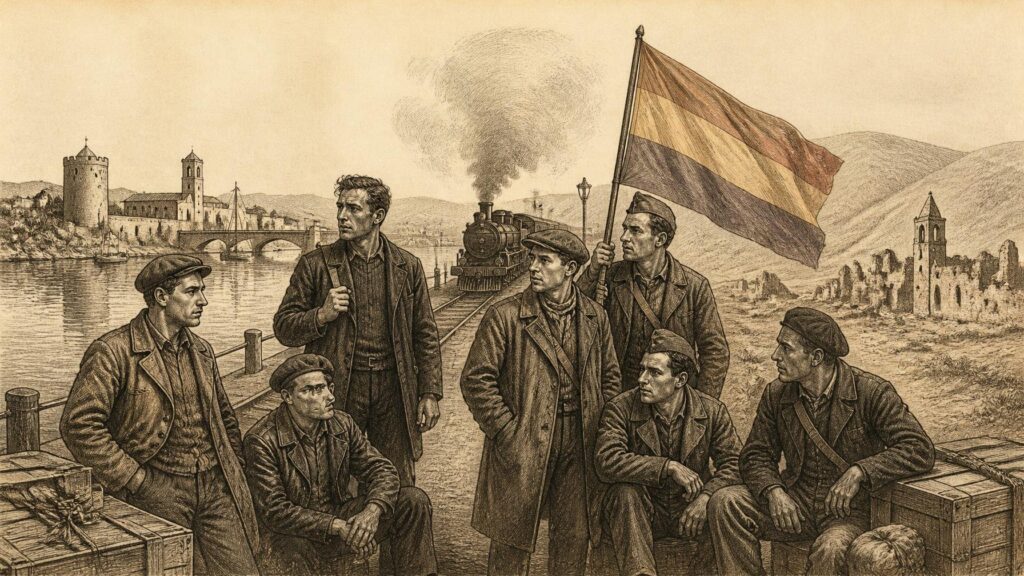
AI generated historical illustration, not a contemporary photograph.
At a Glance
The six Limerick men conventionally remembered as having fought for the Spanish Republic were Frank Ryan, Jim Woulfe, Patrick “Paddy” Brady, Joseph “Joe” Ryan, Gerard Doyle and Maurice Emmett Ryan. Their shared Limerick connection was real, but their lives, politics, routes to Spain and wartime fates were markedly different. To call them a single band is useful as an act of civic remembrance; to treat them as a uniform political unit would conceal as much as it reveals.
The Question
The question, “Who were the six Limerick men who fought in the Spanish Civil War?”, has a simple answer and a complicated history. The names on the memorial in the grounds of Limerick City Hall are Paddy Brady, Gerard Doyle, Frank Ryan, Joe Ryan, Maurice Emmett Ryan and Jim Woulfe. They volunteered on the Republican side, serving within the wider International Brigades movement which brought foreign volunteers to defend Spain’s elected Republic against the military revolt led by General Francisco Franco.
Yet the phrase “the six Limerick men” should be read with care. It is a local commemorative description, not a claim that they formed one intact Limerick company, departed together, held identical views or even had identical relationships with the city at the moment they went to Spain. Several were living outside Limerick or outside Ireland. Their occupations ranged from journalism to shoemaking and labouring; their political affiliations were varied; and one man’s nationality and birthplace have been recorded inconsistently in surviving sources. What unites them securely is their inclusion in Limerick’s public memorial tradition and their service, or attempted service, on the Republican side.
The six have sometimes been described as “ordinary men in extraordinary circumstances”. That is an effective commemorative phrase, but it needs qualification. Frank Ryan was already one of the best-known Irish republicans and radical journalists of his generation. Paddy Brady, Joe Ryan, Gerard Doyle, Jim Woulfe and Emmett Ryan were far less publicly prominent. The contrast is important. Ryan’s fame has often drawn attention away from the less documented men beside him, while the later memorial has restored their names to the local historical landscape.
Spanish Crisis
The Spanish Civil War began after sections of Spain’s armed forces rose against the Second Spanish Republic in July 1936. The conflict rapidly became international in consequence, although the European powers formally promoted non-intervention. Nazi Germany and Fascist Italy assisted Franco’s Nationalist forces, while the Soviet Union provided aid to the Republic. Volunteers from many countries travelled independently or through political networks to join the Republican cause in the International Brigades.
For Irish people the war was never a distant continental quarrel. It was interpreted through the still raw experience of revolution, partition and civil war in Ireland. Many Irish Catholics, influenced by reports of anti-clerical violence and attacks on the Church in Republican Spain, sympathised strongly with Franco. Hundreds joined General Eoin O’Duffy’s Irish Brigade to fight for the Nationalist cause. Others regarded Franco’s rebellion as part of the expanding European fascist threat, and believed that the defence of the Spanish Republic was inseparable from the defence of democratic, socialist, republican or anti-imperial causes elsewhere.
The Irish volunteers for the Republic are often associated with the “Connolly Column”, a later and memorable label drawn from James Connolly. In strict military terms, however, Irish volunteers were distributed through formations of the International Brigades, notably the British Battalion of the XV International Brigade. The names and labels matter because they prevent a sentimental simplification. The Irish volunteers did not comprise a wholly separate national army; they were participants in a multinational, multilingual and often improvised Republican war effort.
The Limerick six therefore belong to two histories at once. One is the history of an international civil war whose outcome shaped Europe for decades. The other is the history of a city and county whose people responded to Spain in sharply divided ways. The decision to commemorate Republican volunteers in Limerick does not erase the presence of Limerick men who went to Spain for Franco. It instead makes visible one strand that had long been much less publicly marked.
Limerick Connections
The strongest public confirmation of the group is the Limerick memorial unveiled in September 2014. It named Brady, Doyle, Frank Ryan, Joe Ryan, Maurice Emmett Ryan and Woulfe, and made a durable local claim on their memory. Contemporary accounts of the event described relatives, historians and International Brigades commemorators gathering in the city. The occasion also demonstrated that the Spanish conflict remained a living family history, not merely an episode preserved in textbooks.
It is tempting to imagine six neighbours leaving Limerick together, but the evidence does not support that neat picture. Frank Ryan travelled in December 1936 with a group of Irish volunteers, after becoming an important organiser of Republican-side recruitment. Paddy Brady was then living in Liverpool. Joe Ryan’s surviving International Brigade record gives an address in Mungret Street, Limerick, but identifies Belfast as his birthplace. Maurice Emmett Ryan’s record gives Limerick as his birthplace and an English address. Such details do not diminish Limerick’s connection; they show the mobility of Irish working lives and political networks in the 1930s.
“Limerick” in this context can mean county of birth, city address, family origin, social formation or later commemorative ownership. Frank Ryan came from Elton near Knocklong in County Limerick; Jim Woulfe was associated with Athea; Brady was born at Thomondgate; Doyle and Joe Ryan were associated with Limerick city; and Emmett Ryan was linked with Catherine Street. The local memorial deliberately joined county and city stories in one civic act.
This distinction between evidence and interpretation is essential. The documentary evidence establishes the individuals’ presence in Republican forces and their local associations. The interpretation—that their experience represents a distinctive Limerick political tradition—is more tentative. They were shaped by Ireland, Britain and Spain alike, by migration, labour, republicanism, anti-fascism and personal circumstance. Their common home place was significant, but it was not the sole explanation for their choices.
Frank Ryan
Frank Ryan, born at Elton, County Limerick, on 11 September 1902, is the best documented and most consequential of the six. He was raised in a family of teachers, became active in the East Limerick Brigade of the IRA around the Truce period, opposed the Anglo-Irish Treaty and was interned during the Irish Civil War. After his release he returned to University College Dublin, completed a degree in Celtic studies and became a forceful figure in republican, Irish-language and radical political circles.
During the 1920s and 1930s Ryan worked as an editor and propagandist as well as an activist. He edited republican publications including An Phoblacht, helped to found Republican Congress, and developed a politics that combined Irish republicanism with concern for workers, tenants and international anti-fascism. His view of Spain was not simply imported from abroad. He understood the Spanish Republic’s plight through an Irish republican outlook which opposed imperialism and clerical political authority alike.
When the Spanish war began, Ryan was among the Irish figures most willing to declare support for the Republic despite overwhelming Catholic and conservative sympathy in Ireland for Franco. By November 1936 he was organising volunteers. He went to Spain in December and became the senior Irish officer associated with the International Brigades. He was wounded at Jarama in February 1937, returned briefly to Ireland, and then went back to Spain in June. There he served in the XV Brigade’s political commissariat and edited the Book of the XVth International Brigade.
Ryan’s Spanish story ended in capture. During the Republican retreat in Aragón in spring 1938, he was taken by Italian troops fighting for Franco near Calaceite. He was imprisoned, sentenced to death and held under harsh conditions. International pressure eventually secured commutation of his sentence. In 1940 German military intelligence secured his release from Spanish custody and brought him to Germany. His subsequent years in Nazi Germany remain controversial and cannot be reduced to either heroic legend or simple condemnation. He died near Dresden on 10 June 1944. His remains were returned to Ireland in 1979 and buried in Glasnevin.
Frank Ryan’s reputation can obscure the fact that he was not a symbolic figure safely distant from the fighting. He was wounded, captured and sentenced to death. But his prominence also creates a danger: using him as a ready-made emblem for all Irish Republican volunteers. The other five Limerick names require their own histories. Their records are thinner, and the uncertainties around them should be acknowledged rather than filled with patriotic invention.
Jim Woulfe
Jim Woulfe, associated with Athea in west County Limerick, was killed in Spain in 1937. He is generally recorded as having died during the fighting around Belchite in Aragón in late August or early September. Contemporary commemorative accounts place him with the Canadian Mackenzie–Papineau Battalion of the XV International Brigade, a reminder that national labels within the Brigades were often porous. Irish, British, Canadian, American and other volunteers could serve within formations whose names reflected recruitment routes more than neat citizenship categories.
Woulfe’s death made him one of the two Limerick commemorative dead of the Spanish war, alongside Maurice Emmett Ryan. Belchite was among the most destructive episodes of the Aragón offensive. The town became a symbol of devastation, and its ruined buildings were later preserved by Franco’s regime as a monument to Nationalist victory. For Woulfe’s family and fellow volunteers, however, the place was first a site of loss.
There is relatively little readily available biographical evidence about Woulfe compared with Frank Ryan. That scarcity has encouraged a commemorative image of a straightforward anti-fascist martyr. The evidence securely permits that he volunteered for the Republican side and died in the campaign. It does not permit a detailed reconstruction of his private motives, personal opinions or every movement in Spain. A responsible account must resist making his silence say more than the surviving records can bear.
His inclusion on the Limerick memorial is nevertheless historically powerful. It connects a small west Limerick community with one of the war’s major battlefields, and it reminds readers that the International Brigades were not composed solely of famous intellectuals or political leaders. Their ranks included men whose names survive chiefly in casualty records, local memory and memorial stone.
Paddy Brady
Patrick Brady, usually remembered as Paddy Brady, was born at Thomondgate, Limerick, in 1904. By the time he went to Spain he was living in Liverpool and worked as a shoemaker. The International Brigade Memorial Trust’s biographical record identifies him as connected with the Communist Party of Great Britain and the National Unemployed Workers’ Movement. Those affiliations place him in the vigorous political world of interwar Liverpool as well as in Limerick’s diaspora.
Brady arrived in Spain in January 1937 and served in a machine-gun company. His service included the Battle of Jarama, fought in February 1937 in an attempt by Franco’s forces to cut the Madrid–Valencia road. The British Battalion suffered appalling casualties there. Brady later fought at Brunete, the Republican offensive of July 1937 west of Madrid. He was shot through the shoulder by a sniper at Villanueva de la Cañada and was eventually repatriated because of the injury.
Brady’s record is valuable because it offers a correction to the notion that the Irish volunteers were simply idealists who stood apart from the harsh practicalities of war. He was a machine-gunner in major engagements, was wounded, hospitalised and returned home with his arm in a cast. In 1939 he was recorded in Liverpool as a disabled shoemaker. During the Second World War he joined the South Lancashire Regiment. The sequence—from Limerick birth, to Liverpool working life, to Spain, disability and further military service—captures the transnational character of many Irish lives in the twentieth century.
Brady’s politics should not be exaggerated beyond the record. Membership or association with left-wing organisations helps explain his route to Spain, but it does not disclose the entirety of his beliefs. The evidence supports describing him as a Limerick-born Liverpool worker who fought for the Republic and was wounded at Brunete. It does not justify turning him into a flawless icon. His importance lies precisely in the solidity of those documented facts.
Joe Ryan
Joseph “Joe” Ryan is among the most revealing cases because his record complicates easy definitions of the Limerick group. The International Brigade Memorial Trust lists him as born in Belfast on 4 January 1916, while giving his address as 9 Mungret Street, Limerick. Limerick commemorative sources include him among the six local volunteers. Rather than choosing one identity against the other, the historical answer is to report both: he belonged to Limerick’s memorial story, but a surviving Brigade record gives Belfast as his birthplace.
Ryan was a labourer and had connections with the Labour Party and the Irish Transport and General Workers’ Union. He reached Spain in late December 1936. His military experience was troubled and brief. The surviving record notes arrests and difficulties with documentation, says that he rejoined the British Battalion in February 1937, and records repatriation on health grounds in July. The language used in internal personnel records could be harsh; its classification of Ryan as “useless” should be treated as an administrative judgement made in wartime circumstances, not as a definitive verdict on a human life.
Ryan’s later death gives his story an especially sombre resonance. At the outbreak of the Second World War he joined the Merchant Navy as a fireman. He died when the Dunvegan Castle was torpedoed by German U-boat 46 off the west coast of Ireland on 28 August 1940; the ship sank the following day. Thus one of the Limerick brigadistas who survived Spain was killed in the wider European war which Spain had so clearly foreshadowed.
His life resists a triumphal narrative. Spain did not make him a celebrated veteran. The available evidence suggests ill health, bureaucratic difficulty and hazardous employment at sea, before a death in wartime. His later commemoration in Limerick is therefore not merely an honour paid to a foreign volunteer. It is also an acknowledgement of a worker whose life was caught repeatedly in the violence of the 1930s and 1940s.
Gerard Doyle
Gerard Doyle, sometimes rendered Gerrard in secondary accounts, was associated with William Street in Limerick city. His story is one of the most substantial among the less famous five. He served with the International Brigades, was promoted to sergeant, was wounded during the Aragón fighting around Belchite in 1937, returned to action at Teruel and was captured with Frank Ryan at Calaceite in March 1938.
That sequence alone indicates prolonged and dangerous service. Belchite and Teruel were not peripheral encounters. The Battle of Teruel, fought in the winter of 1937–38, became notorious for extreme cold, confused operations and heavy casualties. Doyle’s recovery from an earlier wound and return to the front speak to the pressures on the Republican army and to his own persistence. It is not necessary to romanticise the fact: International Brigade volunteers were exposed to fear, exhaustion, political tension and severe material shortages, as well as to combat.
After capture, Doyle was held in the San Pedro de Cardeña camp, near Burgos, until a prisoner exchange in October 1938. His imprisonment gives a direct point of connection with Frank Ryan but should not cause Doyle’s experience to disappear behind the better-known man’s. The two were captured in the same retreat, yet Ryan’s death sentence and later transfer to Germany produced an exceptional and highly publicised story. Doyle’s captivity was no less real for being less famous.
He survived the war and later died in Cornwall in March 1970. His postwar life, like those of many veterans, has left a limited public trail. The absence of an elaborate later legend is itself instructive. Spanish Civil War volunteers could be politically awkward figures in postwar Ireland and Britain, particularly where public cultures remained sympathetic to Franco or suspicious of communist influence. Local commemoration decades later supplied the recognition that had often been absent during their lifetimes.
Emmett Ryan
Maurice Emmett Ryan, often called Emmett Ryan, was born in Limerick in 1915 and was linked in local accounts with Upper Catherine Street. He arrived in Spain in November 1937. His record identifies a previous connection with the Irish Free State Army and describes him as a dealer. Unlike the more clearly politicised Frank Ryan or Paddy Brady, the surviving material does not present an uncomplicated ideological profile. Indeed, internal assessments made by International Brigade personnel were suspicious of his class background and political reliability.
Ryan was wounded at Teruel in January 1938 and later served as a corporal in a British Battalion machine-gun company during the Ebro campaign. He died in late July or early August 1938; the discrepancy in exact dates between sources should be preserved rather than concealed. The broad facts are clear: he died during the Battle of the Ebro, near the fighting around Hill 481 and Gandesa. The circumstances of his death are among the most disturbing and disputed in the story of the Limerick six.
Several later accounts, based on wartime testimony and recollection, say that Ryan opened fire in the direction of his own comrades while drunk and was then shot by fellow Republican volunteers on the orders, or with the involvement, of officers. Rumours that he was a fascist spy also circulated. The available evidence does not allow a simple, final verdict. The International Brigade Memorial Trust explicitly warns that political assessments in the surviving records could be prejudiced, inaccurate or shaped by personal hostility. A scholarly discussion of the episode likewise identifies conflicting recollections and the absence of a formal recorded offence.
The responsible conclusion is not to repeat sensational allegations as settled fact. It is to say that Ryan appears to have been executed by his own side during the Ebro fighting after an incident of grave indiscipline or perceived danger, but that the precise circumstances, justification and evidential basis remain contested. His death reveals the fear and fragmentation that could exist within Republican ranks under battlefield pressure. It should not be used either to discredit all the volunteers or to preserve an uncomplicated heroic tale.
Shared Service
What did the six men have in common beyond Limerick? They each crossed a political and geographical boundary to support the Spanish Republic. That decision was consequential. Foreign volunteers could not assume a swift, orderly or honourable military experience. They encountered poor equipment, unreliable communications, intense internal political argument, military reverses and the possibility of death, wounding, capture or repatriation. The six Limerick stories contain all of those outcomes.
Frank Ryan and Gerard Doyle were captured. Brady was wounded and returned home. Joe Ryan was sent home on health grounds and later died at sea in the Second World War. Woulfe was killed at Belchite. Emmett Ryan died amid the brutal uncertainties of the Ebro campaign. In this respect the group’s history is not one of a shared victory, but of diverse losses. Franco won the war in 1939; the Republic for which they volunteered was defeated; and the survivors carried difficult personal histories into a Europe soon consumed by world war.
There is also a social pattern, although it should not be overstated. The group contains a prominent radical intellectual and organiser, working men connected with migration and British cities, and men whose political motivations are less certain. This variety mirrors the wider International Brigades, which drew communists, socialists, trade unionists, republicans, anti-fascists, idealists, adventurers and people whose motives shifted over time. The Brigades were not politically homogeneous, and neither were the Limerick men.
Conflicting Records
Historical writing about the Spanish Civil War must take special care with names, dates and wartime paperwork. Volunteers used aliases; clerks struggled with accents and spellings; records were made under pressure; and later memoirs could compress, alter or embellish events. Gerard Doyle’s first name appears with variant spellings. Maurice Emmett Ryan is sometimes called Emmet, Maurice or Emmett Morris in commemorative material. Joe Ryan’s birthplace in the Brigade database sits uneasily alongside the local designation of him as a Limerick man. Jim Woulfe’s exact death date is not entirely consistent across accessible accounts.
These are not trivial flaws to be silently corrected by a writer. They are part of the archive. In each case, the firmest claim should be used: the six named men are commemorated in Limerick as Republican International Brigade volunteers. Beyond that point, details should be graded according to the evidence. Official service files and contemporary records are usually stronger for dates, addresses and administrative decisions than later recollection. Oral testimony can preserve experiences otherwise lost, but it needs corroboration where possible, especially when it concerns accusations, executions or motive.
Folklore has a place in this history, but it must be labelled as folklore. The tendency to present every volunteer as a fearless saint, every death as a clear-cut martyrdom, or every internal conflict as enemy propaganda makes poor history. Equally poor is the hostile caricature that treats all International Brigaders as foreign dupes or political conspirators. The Limerick six were individuals acting in a civil war of extraordinary violence; a credible local history must allow them complexity.
Public Memory
The 2014 memorial transformed a scattered set of names into a visible civic history. Its importance lies not only in its artistic or ceremonial form, but in its correction of absence. Public memory in Ireland had long treated the Spanish war unevenly. Volunteers for Franco were once easier to fit into dominant religious and political narratives, while Republican volunteers could be sidelined by anti-communism, Cold War politics and the discomfort caused by their links to radical republicanism or labour militancy.
Commemoration does not settle historical argument. It does, however, establish that these lives deserve inquiry. The Limerick memorial encourages a fuller understanding of the city and county in the 1930s: a place in which support for Franco could be powerful, but from which men also travelled to defend the Spanish Republic. Such coexistence of opposing commitments is not a contradiction to be removed. It is the historical reality of Ireland’s response to Spain.
For descendants, the memorial was also personal. Families had carried fragments: a photograph, a remembered address, an old account of injury or imprisonment, perhaps a silence. Bringing the six names together did not create the history from nothing, but it made room for family memory to meet documentary research. This is one reason local memorials matter. They can prompt new questions, uncover private papers and make a supposedly foreign war part of a community’s own past.
Historical Meaning
The six Limerick brigadistas should neither be detached from their political commitments nor trapped within them. They were volunteers for a Republican cause opposed to Franco’s insurgency. That is a historical fact. Many understood their action as anti-fascist and internationalist; Frank Ryan plainly did. But a modern reader should not assume that every participant expressed that commitment in the same language or possessed the same ideological certainty.
Their history is best understood as a record of choices made under the pressure of the 1930s. Europe was experiencing dictatorship, mass unemployment, ideological polarisation and the after-effects of the First World War. Ireland’s own revolution had produced independent institutions but not universal agreement about the nation’s future. Spain became a screen on which Irish people projected fears about religion, revolution, empire, class and national identity. The Limerick men who went Republican-side chose one answer to those anxieties.
That answer carried costs. Two died in Spain; two were captured; two were returned because of wounds or health; one was subsequently killed in the Second World War; and Frank Ryan died in Germany after an extraordinary and controversial wartime odyssey. Their stories therefore offer no easy moral ending. They instead show how an Irish locality was entangled with a European crisis, and how the consequences of one civil war ran forward into another world war.
Research Boundaries
The evidence supports a confident identification of the six names and a substantial outline of their careers. It does not support a full biography of each man at equal depth. Frank Ryan has attracted extensive scholarship and survives in numerous political, state and personal records. Brady, Joe Ryan, Doyle, Woulfe and Emmett Ryan emerge more intermittently from Brigade files, later research, local commemoration and family-linked accounts.
That unevenness is not a reason to inflate the record. Where sources conflict, uncertainty has been made explicit. Where rumours arose, particularly in relation to Maurice Emmett Ryan’s death, they have not been treated as proven fact. Where the word “Limerick” includes a mixture of birth, address, county association and memorial identity, that complexity has been retained. The six men are historically real; the limits of our present knowledge about them are real too.
The shortest answer, then, remains the right place to begin: Frank Ryan, Jim Woulfe, Paddy Brady, Joe Ryan, Gerard Doyle and Maurice Emmett Ryan. The longer answer is that their names lead from Elton, Athea, Thomondgate, Mungret Street, William Street and Catherine Street to Jarama, Brunete, Belchite, Teruel, Calaceite and the Ebro. Their memorial in Limerick records not a simple legend, but six distinct Irish lives caught in Spain’s unfinished twentieth-century tragedy.
The article usefully shows that Limerick’s six Republican volunteers were linked less by a single shared journey than by migration, varied politics, and later civic commemoration. Joe Ryan’s Belfast birthplace and Limerick address, alongside Brady’s Liverpool life and Woulfe’s service in a Canadian battalion, suggest that local identity can be both genuine and layered. The 2014 memorial therefore appears to preserve connection while avoiding the idea of a uniform Limerick unit. How should historians and communities balance birthplace, residence, family ties, political networks, and memorial traditions when deciding who belongs within a local history of international conflict such as Spain?