
Jim Larkin
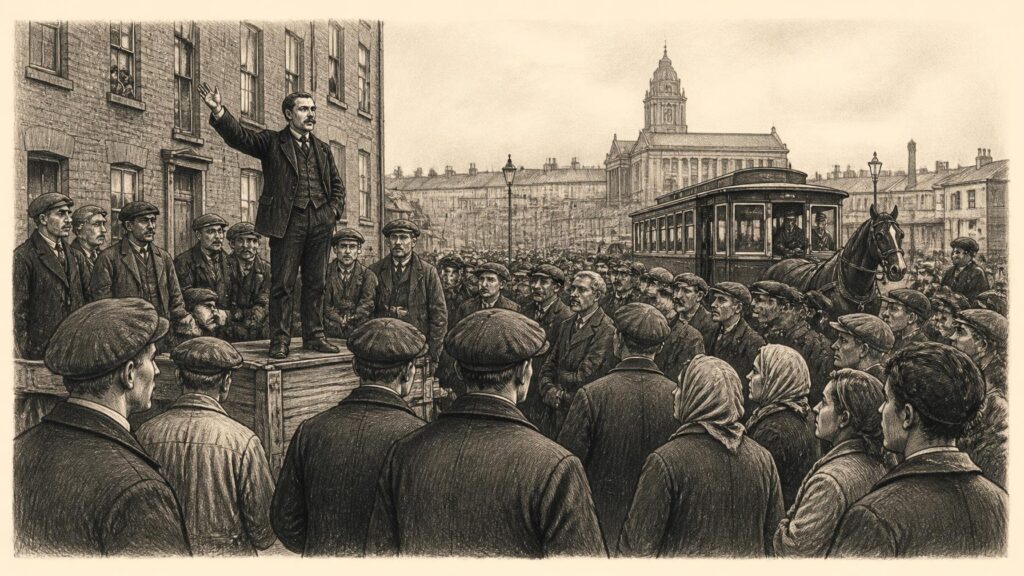
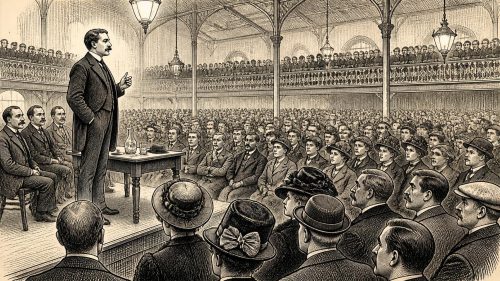
AI generated historical illustration, not a contemporary photograph.
At a Glance
James ‘Jim’ Larkin, often called ‘Big Jim’, was the Irish labour leader whose extraordinary public voice, organising ability and appetite for confrontation made him the most recognisable champion of Dublin’s poorly paid workers before the First World War. Born in Liverpool in 1874 to Irish parents, he made Ireland the principal arena of his life’s work: founding the Irish Transport and General Workers’ Union, editing the Irish Worker, helping to create the Irish Citizen Army, and becoming inseparable from the memory of the 1913 Dublin Lockout. He was neither an uncomplicated hero nor merely a disruptive agitator. He was a formidable organiser with pronounced faults, whose career exposed the social cruelties and political possibilities of modern Ireland.
Liverpool Beginnings
James Larkin was born on 28 January 1874 at Combermere Street in Toxteth, Liverpool. The date deserves emphasis because 1876 has often appeared in older popular accounts, including commemorative material; the Dictionary of Irish Biography records 1874 from his birth certificate. His father, James Larkin, was a foundry labourer from south Armagh, while his mother, Mary Ann McNulty, came from south Down. The family belonged to the large Irish Catholic migrant world of Liverpool: connected to Ireland by kinship, memory and poverty, but formed in an English port city whose docks brought labour, shipping and international politics into close daily contact.
Larkin’s early education was brief. Like many working-class children, he divided time between school and paid work, leaving formal education at about eleven. He subsequently worked in a succession of jobs: as a butcher’s assistant, paper-hanger, French polisher, engineering apprentice, sailor and, most importantly, docker. Such varied employment was not romantic preparation for leadership. It reflected insecurity in a casual labour market, where a worker’s capacity to earn depended on employers, weather, shipping schedules, physical strength and connections at the hiring point.
The docks taught him the realities of casual work and of hierarchy among workers. Dockers might compete for a day’s employment rather than bargain collectively; foremen could exercise considerable power; and the division between permanent and insecure labour encouraged fragmentation. Larkin later made the unorganised worker, rather than the skilled craft worker, the centre of his unionism. That approach was crucial in Ireland, where many labourers and transport workers had little bargaining power and where conventional unions often represented more established trades.
His political development began in Liverpool. He joined the Independent Labour Party and associated with the wider socialist culture represented by the Clarion movement. The evidence suggests a socialism driven less by academic theory than by ethical indignation, practical solidarity and a strong sense of human dignity. He was also influenced by Irish nationalism throughout his adult life. Yet it is misleading to treat his politics as a finished system. Larkin changed language, allies and institutional affiliations many times. His abiding conviction was that workers should be organised, confident and able to resist humiliation.
By the early twentieth century he had become active in the National Union of Dock Labourers. A strike in Liverpool in 1905 cost him his job but revealed his aptitude as an organiser and speaker. The union employed him, and his work in northern England and Scotland helped establish a reputation that preceded his arrival in Ireland. The Larkin who crossed the Irish Sea was already experienced in the mechanics of recruitment, strike organisation and public agitation. He also possessed the theatrical gift that would make him impossible to ignore.
Belfast Upheaval
Larkin was sent to Belfast in January 1907 as an organiser for the National Union of Dock Labourers. Belfast was then a major industrial city whose shipbuilding, engineering and port trades rested upon an unequal and sharply divided workforce. Sectarian loyalties were powerful, but they did not make class organisation impossible. Larkin’s importance lay partly in showing that Protestant and Catholic workers could, under particular circumstances, act together around wages, conditions and employer power.
At first he followed the union’s relatively restrained strategy. Events soon pushed him towards a far more militant course. Employers used replacement labour, the dispute widened and the struggle became increasingly volatile. In June 1907 Larkin called for a general strike in the port. His speeches drew huge crowds, and his willingness to turn sectional grievances into a wider confrontation distinguished him from more cautious officials. The police mutiny of July 1907, when members of the Royal Irish Constabulary sympathised with or refused aspects of duty against strikers, was one of the conflict’s most dramatic episodes. Troops were sent to restore order.
The Belfast strike was not a simple moment of durable cross-community unity. It involved real cooperation across sectarian lines, but the city’s social and political divisions were neither dissolved nor permanently overcome. Later celebration has sometimes made the episode stand for a unity that could have remade Belfast altogether. The documented achievement was considerable enough without that enlargement: Larkin helped mobilise workers in a city where employers and established political interests expected labour to remain divided and deferential.
The settlement disappointed many militants. Larkin’s union superiors, particularly general secretary James Sexton, feared both the costs of escalation and the independence of their organiser. The tension was personal, strategic and constitutional. Larkin believed that national union leaders were ready to restrain the very workers whom they claimed to represent; his critics considered him impulsive and unwilling to accept collective discipline. This dispute was to recur throughout his career. His capacity to inspire followers was matched by difficulty in sharing authority with colleagues who questioned him.
After Belfast, Larkin turned towards Dublin and the south. He organised among unskilled workers in Dublin and Cork, where the social landscape was marked by overcrowding, low wages and insecure employment. His clashes with the National Union of Dock Labourers deepened. Suspended by the union in December 1908, he concluded that workers in Ireland required an organisation not subordinated to officials in Britain. The circumstances produced the institution with which his name would become permanently associated.
Union Creation
On 28 December 1908 Larkin founded the Irish Transport and General Workers’ Union, generally known by its initials, ITGWU. The name expressed an expansive ambition. It was not designed solely for dockers, nor solely for a skilled trade. Its object was to organise transport workers and the broad mass of general labourers who were frequently excluded from the security and bargaining position enjoyed by craft unions.
This was a decisive intervention in Irish labour history. The union offered workers a body capable of defending them across occupations, companies and districts. In practice, organising such a union required subscriptions, meetings, branches, officials, strike funds and continuous recruitment. It also required a public culture. The ITGWU did not merely seek improved wages; it fostered an identity in which workers could view themselves as citizens and collective actors rather than isolated hands available for hire.
Larkin’s own leadership was energetic but highly personal. He acted as general secretary and treated the union as the vehicle of an urgent moral and social cause. Supporters valued his courage, persistence and proximity to ordinary members. Detractors, including people who shared his broad commitment to labour, objected to his domineering methods and combative rhetoric. Both perspectives contain evidence. He built an organisation that transformed Irish labour, but he often made internal disagreements much harder to resolve.
A prosecution in 1910 illustrated both his vulnerability and his talent for converting adversity into public support. He was convicted of misappropriating union funds connected with a Cork dispute and sentenced to twelve months’ hard labour. The severity of the punishment attracted sympathy, and he was released after a public campaign in October. The episode should not be reduced to either persecution or proof of villainy. It was a legal and organisational crisis that opponents used against him, while his followers treated his imprisonment as evidence that the authorities punished working-class leadership more harshly than elite wrongdoing.
From May 1911 Larkin edited the Irish Worker. The paper was an organising instrument as much as a newspaper. It publicised disputes, attacked opponents, encouraged workers to join unions and supplied an idiom of labour solidarity. It also linked industrial struggle to cultural and national questions. Liberty Hall, the union headquarters, became more than an office: it hosted educational, dramatic, musical and social activities. That wider endeavour matters because Larkinism was not simply a strike tactic. It attempted to create confidence, fellowship and an alternative public sphere among people often excluded from respectable political life.
By 1913 the ITGWU had grown dramatically, with the Dictionary of Irish Biography estimating membership at about 20,000. Larkin was elected a Dublin corporation councillor in 1912 and became president of the Irish Trade Union Congress in 1913. These achievements demonstrated that the former Liverpool docker had become a major public figure in Ireland. They also made him a direct challenge to employers who regarded independent unionism as a threat to managerial control and social order.
Dublin Conflict
The Dublin Lockout of 1913 remains the event most closely associated with Larkin. It was not merely a strike, though strikes lay at its beginning. It became a wide employer offensive against the ITGWU and a test of whether workers could retain union membership without losing their livelihoods. Its scale, duration and human cost turned it into one of the defining social conflicts of pre-revolutionary Ireland.
William Martin Murphy, a prominent businessman with interests that included Dublin tramways and the press, was determined to resist Larkin’s union. When ITGWU recruitment reached Murphy’s employees, dismissals followed. Tram workers struck on 26 August 1913. The confrontation broadened in September when hundreds of employers locked out workers who belonged to, or supported, the ITGWU. More than 20,000 workers were affected. The conflict reached far beyond individual workplaces: it entered homes, streets, churches, newspapers and political meetings.
Dublin’s housing conditions made the lockout particularly severe. Many workers lived in overcrowded tenements, and families had little savings to cushion weeks or months without wages. Relief funds and food distribution became essential. Support came from trade unionists and sympathisers in Britain as well as from Ireland; the Dictionary of Irish Biography records approximately £150,000 in outside assistance, much of it from the British Trades Union Congress and labour organisations. Such aid sustained many families, but it could not remove the daily strain of rent, hunger and unemployment.
The dispute was also marked by police violence and arrests. UCD’s digitised Dublin Metropolitan Police prisoners’ books provide unusually important evidence for this period. Their catalogue notes that the records show that most people arrested during the lockout were workers, countering a hostile contemporary depiction of those arrested as merely criminal elements. This does not mean every crowd action was peaceful or that all accounts of confrontation are identical. It does show the value of administrative records in challenging the language through which opponents sought to discredit the labour movement.
Sunday 31 August 1913 became especially notorious. Larkin, who was prohibited from addressing a meeting, appeared from a balcony at the Imperial Hotel on O’Connell Street. Police attempted to suppress the gathering and violence followed. The day entered labour memory as ‘Bloody Sunday’. Its enduring significance rests not only on the clashes themselves but on what they revealed: in a city of profound inequality, the authority of police and the authority of employers appeared to many workers as mutually reinforcing.
Larkin’s opponents described him as an irresponsible demagogue who was leading families into ruin. Supporters regarded him as the first public leader to speak without embarrassment about hunger, low pay and the coercion of casual labour. Neither description should simply be adopted. His language could be fierce and his tactics carried grave risks for members with little material protection. Yet the lockout was not produced by Larkin alone. It was also the product of a concerted employer determination to break or contain the ITGWU. The conflict’s scale makes that clear.
Larkin believed the key to victory lay in sympathetic industrial action in Britain. He travelled extensively, addressing large audiences in his ‘Fiery Cross’ campaign. British trade union leaders, however, hesitated to endorse the direct action he sought. They feared the consequences of a broader industrial confrontation and were wary of syndicalist methods. In December a special Trades Union Congress conference rejected the proposed action by a large majority. The decision was a strategic defeat from which the Dublin workers could not easily recover.
By January 1914 Larkin advised workers to return to employment where they could. The lockout did not end with a formal, triumphant settlement for the ITGWU. Many families had endured appalling hardship; some militants were blacklisted; and the union’s hopes of compelling employer recognition had not been realised. Nevertheless, the word ‘defeat’ needs qualification. The union survived. The lockout entered public consciousness as a great labour struggle, gave workers a language of rights and solidarity, and made the conditions of Dublin’s poor impossible to ignore.
Citizen Defence
The lockout also led to the formation of the Irish Citizen Army. Established on 13 November 1913, it originated as a means of defending workers and pickets from police violence. Larkin was its first commandant. With James Connolly and others, he helped turn what began as a protective force into a uniformed body with a distinctive place in Irish revolutionary history.
It is important not to read later events backwards. In 1913 the Citizen Army emerged from an industrial dispute, not from a settled plan for an armed rising. Its foundation testified to workers’ belief that ordinary political and legal protections did not adequately defend them. Over time, however, the organisation moved into the wider nationalist and republican currents of the period. The National Library of Ireland rightly identifies Larkin’s contribution to the story of 1916 both through his emphasis on social justice and through the organisation’s creation.
Larkin did not participate in the Easter Rising. He had left for the United States in October 1914, initially on what was described as a speaking tour and period of recuperation. Whether he intended a short absence or understood it as a more open-ended departure is uncertain. What is documented is that his relationship with ITGWU officials had deteriorated after the lockout, and that his departure profoundly altered the leadership of the Dublin labour movement.
His absence matters because public memory can make Larkin and Connolly appear as a fixed partnership at the centre of every labour and republican development. They shared causes and worked together at important moments, but they were different personalities with different intellectual habits and organisational styles. Connolly developed a more systematic socialist analysis; Larkin was a mass organiser and orator whose political path was often improvised. Their association was historically consequential, but it should not erase their differences.
American Years
Larkin reached New York in November 1914. America offered Irish nationalist networks, socialist circles and a much wider stage for his talents, but it also brought him into a turbulent political environment shaped by the First World War, state repression and disputes on the American left. His Irish reputation followed him, yet the conditions under which he worked were very different from Dublin’s transport and general labour movement.
He spoke, organised and associated with socialists, Irish-American nationalists and radicals. During the post-war Red Scare he was prosecuted under New York’s criminal-anarchy law. Convicted in 1920, he received a lengthy prison sentence and spent several years incarcerated in Sing Sing. In 1923 Governor Al Smith pardoned him and he returned to Ireland. His American imprisonment reinforced his standing among supporters as a victim of political repression, while critics found in his radical associations further evidence for their mistrust.
During these years Larkin also developed relations with revolutionary Russia and the Communist International. The record is complicated. He attended meetings in Moscow and was elected to the executive committee of the Communist International, but he did not become a straightforward instrument of Soviet policy. His expectations of practical support and political influence were repeatedly disappointed. His eventual break with Moscow in 1929 reflected both ideological reservations and his deep resistance to any organisation that might curtail his personal authority.
In Dublin, his absence contributed to a serious split within the labour movement. In 1915 his brother Peter and his eldest son, James Larkin junior, helped establish the Workers’ Union of Ireland. Thousands of ITGWU members moved to the new body. This division was not a side issue. It shaped trade union organisation for decades and complicated efforts at labour unity long after Larkin’s death. The great organiser of union solidarity had, in one of history’s harsher ironies, become associated with a major institutional rupture.
Return Divisions
Larkin returned to Dublin in 1923 to a dramatic public welcome. The image of ‘Big Jim’ addressing crowds was powerful, and the returning exile seemed to many supporters to embody continuity with 1913. Yet Ireland had changed. The state was emerging from revolution and civil war; the political landscape was more fractured; and the labour movement was divided between organisations with competing traditions, loyalties and leaders.
He led the Irish Worker League and remained associated with communist politics for a time. In the 1927 general election he was elected for Dublin North, becoming the only communist ever elected to Dáil Éireann. He did not take his seat because he was an undischarged bankrupt. The surviving Oireachtas record of a 1928 committee on his incapacity for membership is a reminder that his exclusion was not simply rhetorical but a formal constitutional and legal matter.
By the end of the 1920s Larkin had broken with the Soviet authorities and retreated from revolutionary communism. The Workers’ Union of Ireland adopted a more reformist direction, while Larkin retained his public prominence as a Dublin councillor and labour campaigner. In 1943 he was elected to Dáil Éireann as an Independent Labour TD for Dublin North East, serving until 1944. This later parliamentary role complicates any image of him as permanently outside formal politics. He remained a militant voice, but he also worked within the institutions of the Irish state.
His later career did not restore the unity of the trade union movement. Nor did it reproduce the great expansion of the pre-1914 years. He continued to attract loyalty and to provoke fierce resentment. Historians have therefore debated whether he should be understood primarily as a heroic pioneer or as a destructive figure in Irish labour organisation. That opposition is too blunt if used as a final verdict, but it identifies a real tension. Larkin’s exceptional gifts were inseparable from traits that made durable collaboration difficult.
Public Memory
Jim Larkin died on 30 January 1947. His funeral and burial at Glasnevin Cemetery confirmed his place in the public history of Irish labour. The later O’Connell Street statue by Oisín Kelly, derived from a 1923 image of Larkin addressing a crowd, fixed a particular visual memory: arms raised, speaking to the city, an emblem of defiance. That image is powerful, but public monuments inevitably simplify. They tend to preserve the Larkin of courage and mass speech rather than the Larkin of organisational disputes, family strain and political reversals.
There is also a body of folklore around him. Stories of immense physical presence, irresistible oratory and fearless confrontations circulate because they convey something true about his reputation. But folklore should not be treated as documentary proof of every phrase attributed to him or every dramatic scene later retold. The archival record, contemporary newspapers, union papers, police material and institutional documents are essential correctives. They reveal a human being more complicated than either statue or legend.
The documented record supports several firm conclusions. Larkin changed the scale and character of trade unionism in Ireland. He made the poorly paid and insecure worker central to labour politics. He helped create institutions that connected industrial action to education, culture and political citizenship. His leadership in Belfast and Dublin demonstrated the potential of collective action across entrenched divisions. His role in the 1913 Lockout placed the social question at the heart of modern Irish history.
Interpretation begins when historians weigh his failures. It is reasonable to argue that his commitment to mass mobilisation made him indispensable at moments when cautious leadership would have achieved little. It is equally reasonable to argue that his mistrust of colleagues and tendency towards personal conflict weakened organisations that required stable collective leadership. A historically responsible account must hold both propositions together. Larkin was not important because he was flawless; he was important because his force of character exposed possibilities and dangers within the labour movement itself.
To ask who Jim Larkin was is therefore to ask more than who led a famous lockout. He was a Liverpool-born son of Irish migrants, an organiser of casual workers, a socialist and nationalist, a newspaper editor, a founder of unions and the Citizen Army, a prisoner in Britain and America, a communist ally who broke with Moscow, a councillor and parliamentarian, and a figure whose memory remains contested. Above all, he was the man who made the dignity of working people an unavoidable question in Irish public life.
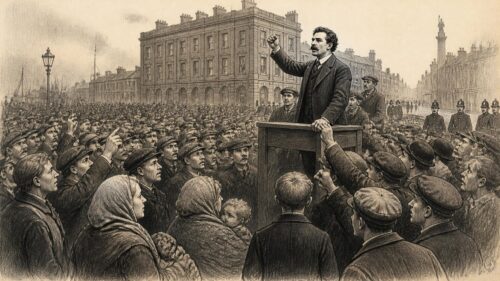
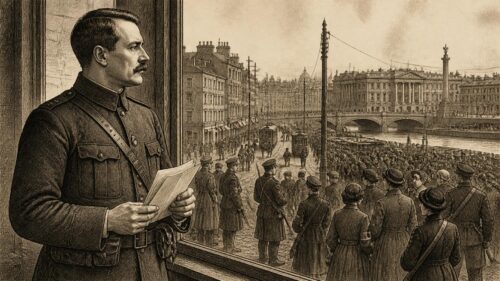
One striking issue is the article’s qualified view of the 1913 Dublin Lockout: materially devastating and strategically unsuccessful in securing recognition, yet still transformative because the ITGWU survived and workers gained a durable language of rights and solidarity. This invites reflection on how labour movements should measure success when immediate concessions are limited but political consciousness changes. Larkin’s personal leadership further complicates the picture, combining extraordinary mobilisation with internal conflict and risky tactics for vulnerable families. To what extent should the Lockout be understood primarily as a defeat, a foundation for later labour politics, or both, based on what evidence?