

Neutral Europe
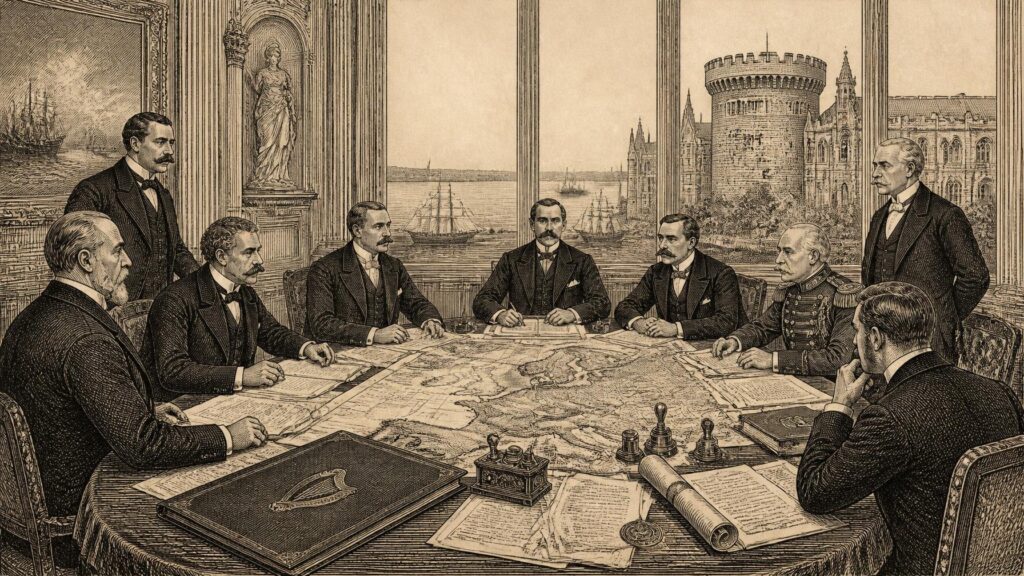
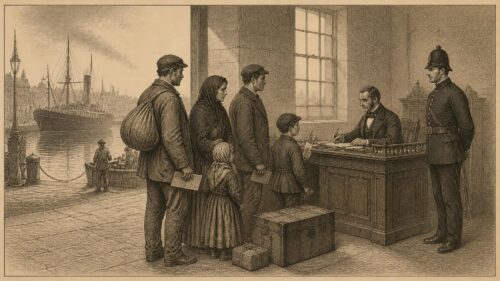
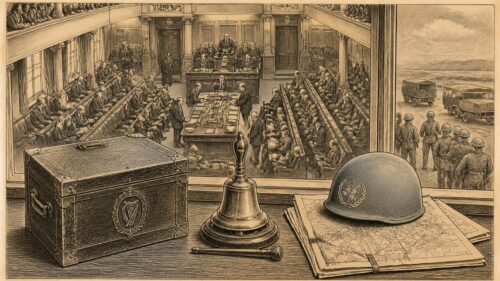
AI generated historical illustration, not a contemporary photograph.
At a Glance
Ireland’s presidencies of the European Communities and European Union offer an unusually revealing way to study the State’s neutrality. They placed a small, militarily non-aligned country at the centre of European bargaining, requiring it to chair, mediate and represent a collective enterprise whose developing foreign and security ambitions repeatedly stirred unease at home. The historical record does not show a simple contest between Irish neutrality and European membership. Rather, it shows a succession of governments attempting to make both commitments credible: demonstrating that Ireland was a capable European partner while preserving freedom from military alliances and common defence obligations.
Historical Foundations
Irish neutrality was neither an ancient constitutional condition nor an unchanging doctrine handed down intact from the revolutionary period. It emerged from particular circumstances. The Irish Free State participated actively in the League of Nations, and its diplomacy in the interwar years commonly stressed small-state rights, international law and collective procedures. Yet the collapse of collective security during the 1930s, together with the recovery of the Treaty Ports from Britain in 1938, made neutrality in a future European war both more practicable and more politically attractive. During the Second World War, officially termed the Emergency in Ireland, the State remained outside the conflict. That decision became a powerful element in public memory of sovereignty, even though historians have shown that wartime policy involved difficult compromises, intelligence exchanges and practical assistance that do not fit popular images of complete detachment.
After 1945, neutrality acquired a different setting. Ireland joined the United Nations in 1955 and became strongly associated with UN peacekeeping, notably through service in the Congo from 1960. It did not join NATO. This was important politically and symbolically, but it did not mean that Ireland occupied an equidistant position between Cold War blocs or pursued a rigid neutrality model comparable in every respect with that of Austria, Sweden or Switzerland. The State belonged culturally, economically and politically to Western Europe, maintained a close relationship with Britain and the United States, and had modest defence resources. Scholars have consequently disagreed over the most precise terminology: neutrality, non-alignment, or a distinctive Irish form of military non-alliance.
The distinction matters because it prevents retrospective simplification. Neutrality in international law describes a state’s rights and duties during an armed conflict. A peacetime policy of neutrality is something else: a political choice, capable of being defined differently by different states and governments. The modern Irish Government has generally characterised its policy through non-membership of military alliances and non-participation in common or mutual defence arrangements. Critics have argued that this official definition is too narrow, while others regard it as an accurate account of a pragmatic policy developed by a small state. The disagreement is itself historical evidence. It reveals that neutrality has been an arena of Irish political argument rather than a settled constitutional formula.
Accession Questions
When Ireland sought entry to the European Economic Community in 1961, neutrality was among the questions raised abroad and at home. The first application was closely tied to Britain’s application: Britain remained Ireland’s dominant trading partner, and the economic logic of joining without it appeared uncertain. President Charles de Gaulle’s veto of British entry in 1963 therefore halted Ireland’s immediate prospects as well. The renewed application of 1967 occurred in a changed economic and political atmosphere, but the question remained whether a country outside NATO could accept the wider implications of European integration.
Successive Irish governments answered that membership and neutrality were compatible. Their case was not that the Community was politically insignificant. On the contrary, officials understood that European cooperation was deepening and that economic membership carried wider consequences. But the Communities were not a military alliance, and the accession negotiations did not oblige Ireland to enter one. The 1970 White Paper on membership considered major economic and institutional implications; public debate before the referendum also ranged more widely, taking in sovereignty, independence and Ireland’s place in Europe. The constitutional amendment required for entry was approved on 10 May 1972, and Ireland entered the Communities on 1 January 1973 alongside Britain and Denmark.
There was an important tension at the heart of this settlement. Irish leaders were attracted by access to markets, agricultural support and a means of reducing dependence on Britain. They also saw membership as a route to greater diplomatic weight. Yet European integration was founded on the idea that states could pool parts of their sovereignty to achieve shared objectives. Irish neutrality, by contrast, had become closely associated with the independent exercise of sovereignty. That tension did not make the two positions irreconcilable, but it ensured that every major advance in European political or defence cooperation could become a domestic test.
Presidency Practice
The rotating presidency was a particularly demanding test because its holder did not simply advocate national preferences. Before the Lisbon Treaty altered institutional arrangements, the presidency chaired most Council formations, organised meetings, pursued legislative files and spoke for the Council in dealings with other institutions and external partners. It was expected to be an honest broker. A national government could supply energy, skill and priorities, but it could not credibly treat the office as a platform for unilateral policy. This is a crucial caution when considering neutrality: an Irish presidency could influence the framing and pace of European business, but it could not place Irish military policy above the collective obligations of the role.
Ireland’s first presidency, from January to June 1975 under Liam Cosgrave, came only two years after accession. It was therefore a practical demonstration of whether a new and comparatively small member could operate at the Community’s centre. The record includes progress on the Equal Pay Directive and agreement to begin work towards a Passport Union and common Community rights. It also coincided with the creation of the European Foundation for the Improvement of Living and Working Conditions, subsequently based in Dublin. None of these developments was principally about neutrality. Their significance lay elsewhere: they helped establish Ireland’s reputation for administrative seriousness and showed that Community membership could bring institutional presence as well as economic adjustment.
The 1979 presidency, held from July to December amid economic difficulty and institutional change, again concentrated on monetary and budgetary questions. It followed the first direct elections to the European Parliament and confronted early work on the European Monetary System. Ireland’s task was to guide negotiations among states with divergent interests, not to articulate a separate neutral bloc. Still, the experience reinforced a broader Irish diplomatic habit: influence could be exercised through preparation, compromise and personal contact rather than military power. This is interpretation rather than a measurable causal claim, but it helps explain why later governments treated the presidency as an asset to a small state’s international standing.
Early Terms
During the 1980s, the European Community’s external role became more consequential. European Political Cooperation, the predecessor of the Common Foreign and Security Policy, encouraged member states to consult and coordinate their positions. The Single European Act of 1986 gave that cooperation a treaty basis. It also contained language permitting closer security cooperation for states that wished to pursue it within the appropriate framework. Such wording offered reassurance because it did not compel Ireland to join NATO or the Western European Union, but it also made clear that political cooperation in Europe was increasingly adjacent to security questions.
Ireland’s third presidency, from July to December 1984, illustrates the broad agenda confronting a presidency. It helped bring outstanding negotiations on Spanish and Portuguese accession towards resolution, including disputes over fisheries, agriculture and social matters. It also secured European responses to famine in Ethiopia and the Sahel. The Ad Hoc Committee on Institutional Affairs produced recommendations that fed into the later Single European Act. The evidence therefore complicates any attempt to make neutrality the sole key to Irish European history. Enlargement, development assistance, economic management and institutional reform were all central concerns. Foreign-policy identity was formed through this wider range of activity.
Nevertheless, European Political Cooperation prompted recurring questions in the Dáil and in public discussion. Would political statements constrain Irish freedom of action? Could cooperation evolve into defence integration? Governments usually answered that consultation was compatible with military neutrality and that Ireland retained control over decisions involving its Defence Forces. Opponents feared that formal legal commitments could create political momentum towards a European military role. Both positions contained an element of prediction. The documents can establish what treaty provisions said and what governments promised; they cannot settle in advance the future meanings politicians or publics would attach to them.
Security Turning
The Irish presidency of January to June 1990 occurred at a moment of exceptional European change. The Berlin Wall had fallen in November 1989, Germany was moving towards reunification, and the political order of Central and Eastern Europe was being remade. Ireland chaired two European Council meetings in April and June that year. Agreement emerged on a common European approach to German reunification and to relations with the states beyond the former Iron Curtain. The presidency also helped prepare the intergovernmental conferences on Economic and Monetary Union and Political Union, which opened the path to the Maastricht Treaty.
This role sharpened the paradox of neutrality. Ireland, a state whose political culture attached value to standing apart from military alliances, was now chairing discussion at a point when Europe’s security order was being reconfigured. The Irish Government could not approach German reunification simply as a detached observer. As presidency-holder it was responsible for facilitating a common position among partners whose histories, security ties and domestic anxieties differed greatly. Its performance demonstrated that military non-alignment did not prevent active participation in European diplomacy. At the same time, it brought home the extent to which European politics could no longer be treated as merely commercial or agricultural.
Academic interpretations differ on what membership had done to Irish foreign policy by this stage. Some accounts describe a deep Europeanisation: officials became accustomed to coordination, consultation and common positions, and Irish policy adjusted accordingly. Other research, including work by M. J. Geary, argues against a simple story of neutrality being steadily eroded. On that reading, Irish governments used European participation to recast neutrality as part of the State’s European identity, rather than abandoning it. The difference is not trivial. It warns against presenting adaptation as surrender, or continuity as immobility. Ireland could change its diplomatic methods while retaining a politically significant claim to military neutrality.
Maastricht Moment
The Treaty on European Union, signed at Maastricht in February 1992, brought the question into sharper legal focus. Its Common Foreign and Security Policy covered all questions related to Union security and envisaged the possible framing, in time, of a common defence policy. It also assigned a role to the Western European Union in implementing decisions with defence implications. Ireland was not a member of the Western European Union, and the treaty did not oblige it to become one. Yet the direction of travel was clear enough to produce vigorous debate during the Irish referendum campaign.
The referendum of 18 June 1992 approved ratification, but the result did not end the argument. Supporters held that the treaty respected national decision-making and did not compromise Irish military neutrality. Critics maintained that its security language made a future defence commitment more likely. The contemporaneous record shows that governments relied heavily on legal distinctions: the difference between participation in a foreign-policy framework and participation in a military alliance, between an eventual possibility and an immediate obligation, and between consultation and automatic commitment. Such distinctions were constitutionally and diplomatically important. Their political persuasiveness, however, depended on public trust.
The decade also saw a more explicit official effort to define policy. The 1996 White Paper, Challenges and Opportunities Abroad, reaffirmed military neutrality and associated it with an independent foreign policy, UN peacekeeping and support for international law. It did not promise isolation from European security discussion. Rather, it envisaged Ireland remaining engaged in European foreign policy while retaining discretion over military participation. This approach reflected a broader practical reality: a state may be neutral in the sense of avoiding alliances and mutual-defence commitments while still having opinions, voting records, economic sanctions policies and humanitarian responsibilities. As one Irish minister later put it, Ireland had not been ideologically neutral.
Dublin Draft
Ireland’s fifth presidency, from July to December 1996, took place amid preparation for monetary union and negotiation of what became the Treaty of Amsterdam. The December European Council in Dublin unveiled the design of the euro. The presidency also produced the so-called Dublin II draft, a significant contribution to the intergovernmental conference. It addressed areas including citizenship, justice and home affairs, social provisions and institutional questions. Here again, the practical business of an Irish presidency was overwhelmingly wider than neutrality, even though security and defence remained a background concern.
The Amsterdam process was important because it expanded the Union’s capacity for crisis-management activity and brought the Petersberg tasks into the EU framework. These tasks included humanitarian and rescue operations, peacekeeping, and tasks of combat forces in crisis management, including peacemaking. Their inclusion alarmed those who saw them as evidence of a European military project. Governments argued that participation in particular missions would remain voluntary and subject to Irish decision. The distinction between a Union capacity and an Irish obligation was central to the official case.
That distinction later became operational. Ireland joined NATO’s Partnership for Peace in 1999, a decision criticised by neutrality advocates but defended by the Government as a means of improving interoperability and participation in UN-mandated peace support. It did not make Ireland a NATO member. The episode is a useful example of why labels alone can obscure historical change. A strict account that notices only continued non-membership of NATO will miss real changes in practical cooperation. An account that treats Partnership for Peace as automatic abandonment of neutrality will overlook the limits Irish governments maintained and the domestic checks they invoked.
Constitutional Debate
The Nice Treaty debate brought these questions to a peak. The first referendum, on 7 June 2001, rejected the proposed constitutional amendment. Many factors shaped the result, including turnout, institutional concerns and dissatisfaction with the campaign, but neutrality was a prominent issue. The Government then sought political assurances at the Seville European Council in June 2002. Ireland’s national declaration stated that it was not party to any mutual-defence commitment, was not party to plans for a European army, and would take sovereign decisions case by case on participation in humanitarian and crisis-management tasks. A European Council declaration acknowledged that the treaty did not affect Ireland’s traditional policy of military neutrality.
These declarations, and subsequent public discussion, were linked to the so-called triple lock for overseas military deployment: a UN mandate, a Government decision and Dáil approval. The triple lock became an important political shorthand, though its detailed legal and administrative application has been debated. Its historical importance lies in how it translated abstract neutrality into procedures of democratic control and international legitimacy. It also represented an attempt to reconcile two popular Irish ideas: that Defence Forces should serve peacekeeping and humanitarian purposes abroad, and that Ireland should avoid being drawn into wars by alliance commitments.
On 19 October 2002, voters approved the Nice Treaty in a second referendum. This did not resolve competing interpretations. For supporters, the outcome confirmed that Ireland could remain fully engaged in the Union while retaining military neutrality. For opponents, the need for declarations showed how insecure that neutrality had become. A careful historical account should not claim that either side was simply mistaken. They were often responding to different standards. Government statements concentrated on formal obligations; critics often concentrated on political trajectory, institutional culture and the likely cumulative effect of cooperation.
Enlargement Moment
The Irish presidency of January to June 2004 is remembered most vividly for enlargement. On 1 May 2004 the European Union admitted Cyprus, the Czech Republic, Estonia, Hungary, Latvia, Lithuania, Malta, Poland, Slovakia and Slovenia, expanding from fifteen to twenty-five members. Ireland hosted a Day of Welcomes at Farmleigh in the Phoenix Park. The symbolism was considerable: Ireland, itself a beneficiary of the 1973 enlargement, welcomed states whose recent histories included communist rule, division or the recovery of national independence.
Enlargement was not a neutralist project in any narrow sense, but it had a clear relationship to Ireland’s broader foreign-policy identity. Irish governments frequently presented the Union as a framework in which smaller states could gain security, prosperity and voice through shared rules rather than through military weight. The 2004 ceremonies embodied that belief. They also linked Ireland’s own European story to that of newer members, particularly those from Central and Eastern Europe. Such symbolism should not be mistaken for proof that enlargement erased strategic differences. Several incoming states had distinct defence policies and strong ties to NATO. Yet enlargement strengthened the Union’s political role and widened the context in which Irish neutrality had to be explained.
The 2004 presidency also brokered agreement on the Treaty establishing a Constitution for Europe after an earlier impasse. The treaty was signed later that year but failed after French and Dutch referendums in 2005. Its successor, the Lisbon Treaty, revived many institutional changes and again made defence provisions central to Irish debate. The 2004 achievement therefore had a double legacy: it displayed Ireland’s reputation as an effective chair during a landmark enlargement, while placing an Irish government at the centre of negotiations whose later constitutional consequences would be fiercely contested at home.
Lisbon Questions
The Lisbon Treaty contained a mutual-assistance clause, now found in Article 42(7) of the Treaty on European Union, alongside language respecting the specific character of certain member states’ security and defence policy. To supporters, that wording preserved the position of neutral or non-aligned members. To critics, a mutual-assistance provision altered the political landscape even if national choices over implementation remained. The first Lisbon referendum, held on 12 June 2008, was defeated. Neutrality and fears of militarisation again formed part of the public debate, although they were not the only issues.
Before the second referendum, Ireland obtained legally binding guarantees, including a protocol confirming that the Lisbon Treaty did not affect or prejudice Ireland’s traditional policy of military neutrality. The electorate approved Lisbon on 2 October 2009. The protocol did not turn neutrality into a constitutional rule, nor did it end disagreement about the meaning of European defence cooperation. It did, however, provide an authoritative statement of the basis on which the Government sought consent. The episode demonstrates the continuing importance of referendums in Irish European policy. Treaty change has repeatedly required not merely parliamentary management but public explanation and constitutional authorisation.
The 2013 presidency, from January to June, occurred after Lisbon had changed the presidency’s environment. The European Council acquired a permanent president and the Union’s foreign representation was altered through the High Representative and European External Action Service. Ireland no longer occupied the same all-encompassing diplomatic role it had in earlier decades. Nonetheless, it chaired Council work across a substantial agenda, including agreement on the Multiannual Financial Framework for 2014–2020, reform of the Common Agricultural Policy, the Youth Guarantee and progress towards the Single Supervisory Mechanism after the financial crisis. Its success reinforced the practical value Ireland placed on the presidency as a test of state capacity.
Neutrality Defined
The historical record supports several conclusions about neutrality. First, it has never meant Irish indifference to international affairs. Ireland has supported sanctions, participated in EU foreign-policy statements, served in UN missions and contributed personnel to international peace-support operations. Second, it has not been set out as an explicit constitutional command. The Constitution contains broad commitments to peace, friendly cooperation, international justice and peaceful settlement of disputes, while the policy of military neutrality has been developed through governmental practice, political mandate and public expectation.
Third, neutrality has been durable precisely because it has been adaptable. Governments have emphasised non-membership of military alliances; activists and some scholars have often argued for a wider conception of active neutrality, involving independent positions, disarmament, neutrality law and stronger restraint in military cooperation. These views should not be collapsed into a single official tradition. Their coexistence helps account for the intensity of Irish debate over European security. A citizen who considers neutrality chiefly a safeguard against automatic war commitments may judge a treaty differently from one who considers it a positive programme of non-alignment and mediation.
Fourth, the presidency has made this adaptability visible. Ireland’s chairing role required it to act as a European mediator, sometimes on questions with major security implications. Yet no Irish presidency has converted the State into a military ally. This is documented in the continuing absence of NATO membership and in repeated governmental commitments to military neutrality. It would be too strong, however, to infer that policy has remained unchanged. Participation in European foreign, security and defence structures has expanded over time, and each expansion has generated debate over whether formal safeguards are enough.
Public Arguments
Folklore and political shorthand have sometimes obscured this complex history. One enduring popular image presents Ireland as naturally neutral, as though geography or national character produced a timeless rule. Another portrays European membership as a hidden, uninterrupted scheme to remove neutrality. Neither is adequate. The first neglects the contingent origins of policy and its changing practice. The second understates the extent to which treaty change has been subject to Irish referendums, public campaigns, governmental declarations and negotiated safeguards. The historical evidence is more interesting: neutrality has endured because it has been repeatedly argued over, defended, redefined and subjected to democratic tests.
There is also a temptation to exaggerate the independent power of the rotating presidency. Irish presidencies have been successful when they have advanced files, built consensus and recognised the limits of the office. They have not enabled Ireland to dictate Europe’s strategic future. The breakthrough on German reunification in 1990 depended on the decisions of Germany, the great powers and Ireland’s European partners. The enlargement of 2004 resulted from many years of negotiation and reform by candidate countries and EU institutions. The Irish contribution was real and important, but it was that of a chair and broker within a larger process.
That limitation was not a weakness. For a small state, the capacity to convene, draft, listen and compromise can be a significant form of influence. Ireland’s presidencies gave officials and ministers an opportunity to exercise those skills on behalf of the Community or Union as a whole. They also gave domestic audiences a recurring reminder that membership involved responsibility as well as benefit. In this respect, the presidency and neutrality were not necessarily opposing ideas. Both rested, in different ways, on the proposition that a small state could protect its interests through law, diplomacy and carefully constructed institutions.
Future Legacy
Ireland assumed its eighth Presidency of the Council of the European Union on 1 July 2026, scheduled to run until 31 December 2026. Its context differs sharply from that of 1975. The Union is larger, the rotating presidency works within eighteen-month trio programmes, and foreign and security policy are shaped by institutions created after Lisbon as well as by Russia’s full-scale invasion of Ukraine, wider instability and intensified European debate about defence capability. These conditions ensure that neutrality remains relevant, though its contemporary policy implications lie beyond a strictly historical verdict.
What history can say with confidence is that Irish presidencies have repeatedly brought the question of neutrality into practical contact with European responsibility. In 1975, Ireland proved it could manage Community business. In 1990, it chaired at a turning point in Europe’s post-Cold War settlement. In 1996, it helped prepare institutional and monetary change. In 2004, it presided over the Union’s largest enlargement and helped revive constitutional negotiations. In 2013, it demonstrated competence during economic recovery and institutional consolidation. Across these episodes, neutrality remained an important domestic boundary and a contested political language, but it did not prevent Ireland from exercising a prominent European role.
The most defensible interpretation is therefore neither celebratory nor fatalistic. Ireland’s European presidencies did not dissolve neutrality, and neutrality did not exempt Ireland from Europe’s political development. Instead, the two histories have developed together. The State has sought influence without military alignment, and European commitments without automatic defence obligations. Whether future governments and voters will continue to define the balance in the same way is an open question. The documentary record shows only that the balance has never been static—and that Ireland’s presidencies have been among the clearest occasions on which it has had to be made visible.
The article highlights how Ireland’s EU presidencies demanded active mediation in an increasingly security-conscious Europe, while domestic debate continued to portray neutrality as both principle and adaptable political practice. Particularly revealing is the gap between legal non-membership of military alliances and growing practical cooperation through peacekeeping, crisis management, and Partnership for Peace. This suggests that neutrality’s significance may depend as much on democratic trust and public interpretation as on formal treaty obligations. To what extent can Ireland deepen European diplomatic engagement while preserving a publicly credible understanding of military neutrality, especially when operational cooperation expands beyond traditional peacekeeping roles abroad?