

Niall Mór
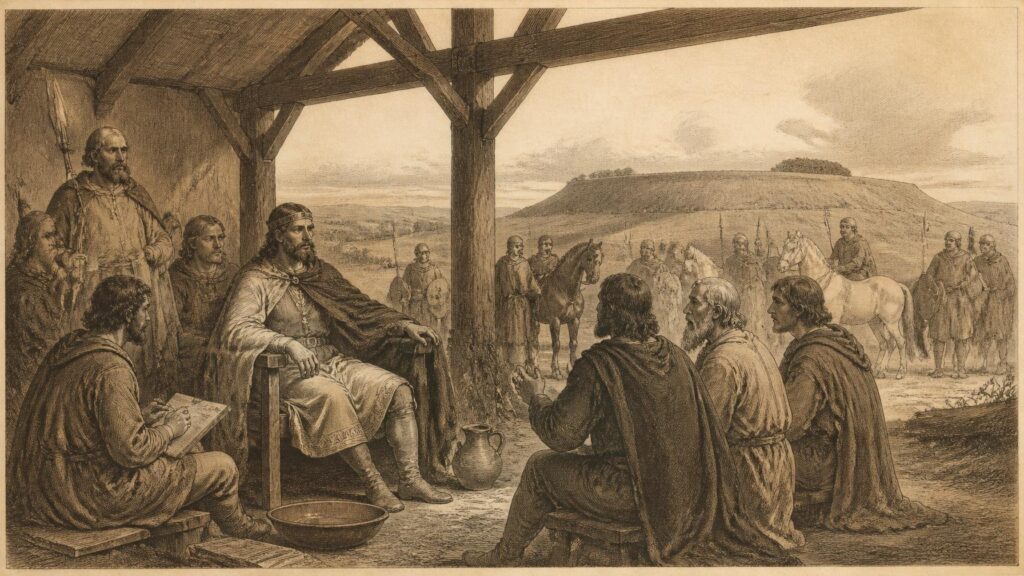
AI generated historical illustration, not a contemporary photograph.
Illustration: AI generated historical reconstruction.
Niall Mór Ó Néill, who died in 1397, was among the most formidable Gaelic rulers of fourteenth-century Ireland. King of Tír Eógain, head of a leading branch of the Uí Néill, military adversary and occasional negotiating partner of the English administration, he presided over an expansion of O’Neill power at a moment when the old Anglo-Norman order in Ulster was under acute strain. His career is best understood not as the story of an isolated ‘Irish chieftain’, but as that of a ruler operating within a crowded political world: Gaelic dynasties, Scottish gallowglass captains, ecclesiastical institutions, colonial towns, the Mortimer earls of Ulster, and the king of England all mattered.
The subject needs one preliminary clarification. There was also a Niall Mór O’Neill who died in 1512 and ruled in Clandeboye, east of the Bann. He was a different man, separated by more than a century from the ruler considered here. The present article concerns Niall Mór Ua Néill, son of Aodh Reamhar, king of Tír Eógain from 1365 until his death in 1397. Contemporary and near-contemporary Irish annals identify him as Niall Mór, while modern reference works conventionally describe him as king of Tír Eógain or Tyrone. The Dictionary of Irish Biography is particularly useful in separating his career from that of the sixteenth-century Clandeboye namesake.
A ruler in a fractured Ulster
Niall inherited power in a region profoundly altered by the preceding generation. The Anglo-Norman earldom of Ulster, created after the conquest of the late twelfth and thirteenth centuries, had once been a vast lordship, centred politically on the de Burgh earls and supported by a chain of castles, boroughs and dependent lordships. Yet the male de Burgh line failed in 1333 with the murder of William de Burgh, third earl of Ulster. The consequences were not immediate or uniform, but they were considerable. Rival aristocratic interests, the long absence of the heirs, and the difficulties of sustaining lordship from England weakened the earldom’s effective hold over much of the north.
This did not mean that English power vanished from Ulster. Carrickfergus remained a major walled town and royal outpost; the ports and colonial settlements retained military and commercial importance; and the Mortimer family, heirs through marriage to the de Burgh inheritance, continued to claim rights and revenues. Nor did political vacuum mean Gaelic unity. Tír Eógain had to contend with the O’Donnells of Tír Chonaill, the MacMahons of Oriel, the Maguires of Fermanagh, the Magennises of Iveagh, the O’Reillys of east Breifne, and competing O’Neill kindreds. Niall’s achievement was therefore contingent rather than inevitable: he exploited the weakness of rivals, but he also had to preserve alliances and accommodate setbacks.
The modern description of this period as one of a ‘Gaelic resurgence’ captures something real, but it can conceal as much as it reveals. Gaelic lords did recover territory and influence in areas formerly dominated by colonial lordship. They also used horses, armour, mercenaries, tribute, marriage arrangements, fosterage, hostage-taking and written instruments in ways that do not fit an uncomplicated contrast between supposedly ‘native’ and ‘English’ political cultures. Niall Mór was not outside the politics of the lordship of Ireland. He was deeply entangled with it, whether raiding its settlements, receiving embassies, making peace, or seeking the protection of Richard II against the ambitions of an English magnate.
Sources, names and the limits of certainty
The principal narrative evidence for Niall’s life comes from annals compiled in Irish learned centres. The Annals of Ulster, available through University College Cork’s CELT project, are especially important for the later fourteenth century; the Annals of the Four Masters preserve a later compilation drawing on earlier traditions and records. These sources are indispensable, but they are not modern biographies. Annals select events, sometimes compress complex campaigns into a sentence, use honorific language, and reflect the interests of their compilers and patrons. They tell us what contemporaries or near-contemporaries considered worth recording, not everything that happened.
It is thus sensible to be cautious about exact details for which the evidence is thin. Niall’s year of birth is unknown. We cannot reconstruct his appearance, daily routines, personal beliefs, the precise size of his household, or the full extent of his territorial control. The sources document actions by an O’Neill-led force, not a bureaucratic state with fixed frontiers. Moreover, medieval titles were flexible. The annals call Niall rí, king, of Ulster or of Cenél nEógain in different contexts; such language asserted status and aspiration as well as describing uncontested sovereignty.
His sobriquet Mór means ‘great’ or ‘big’, but it should not be converted automatically into a modern judgement of character. It may have distinguished him from other men named Niall and, in later usage, naturally acquired the sense of eminence. The Annals of Ulster’s obituary calls him “arch-king of Ulster and contender for the kingship of Ireland”, in the published English translation. That striking formula is evidence for the scale of his claim and reputation. It is not proof that he governed Ireland or was universally recognised as high king. The distinction matters: the wording records a political imagination of overlordship, rather than a constitutional fact comparable to a modern national monarchy. The 1397 annal should be read in precisely that light.
Accession and the politics of Cenél nEógain
Niall succeeded to the kingship of Tír Eógain in 1365, following his father Aodh Reamhar Ó Néill. Tír Eógain was both a territorial lordship and a dynastic world. It took its name from Cenél nEógain, the descendants of Eógan, and its ruling line traced descent from the wider Northern Uí Néill. Such ancestry carried enormous cultural authority, reinforced by genealogists, poets and ecclesiastics, but it did not dictate automatic succession. Gaelic succession could involve competition among eligible adult kinsmen; a lord needed supporters as well as pedigree. The title Ó Néill, often rendered ‘The O’Neill’, represented pre-eminence within a lineage rather than hereditary primogeniture in the later English sense.
Evidence from the year of his accession presents Niall as a ruler already capable of assembling a substantial coalition. The Annals of Ulster record a great hosting by Niall against Brian MacMahon in Oriel, joined by nobles from across Ulster. The campaign ended in negotiations and, significantly, in manoeuvring by subordinate allies. The record shows both the reach and the limits of his command. Niall could lead a regional army and receive offers of payment or concession; yet allied captains could pursue their own agendas without leave. The annal for 1365 is a useful corrective to the image of a king issuing uncontested orders.
Oriel, broadly corresponding to parts of modern counties Armagh, Monaghan and Louth, was strategically vital. It lay between Tír Eógain and the English Pale, contained powerful MacMahon lordships, and offered routes southward towards Dundalk and the frontier settlements. Control there was never absolute. It depended upon tribute, military pressure, treaties and personal loyalty. Niall’s early campaigns indicate that he was trying to turn northern influence into a more durable regional supremacy, while avoiding the fatal cost of trying to govern every neighbouring lordship directly.
War, raiding and political communication
Medieval Irish warfare was frequently mobile and seasonal. Raids could seize cattle, burn crops or settlements, capture prisoners, enforce claims and punish defiance. Such actions were destructive, but they were also messages. A raid announced that a lord could penetrate disputed territory and compel an answer. A successful defence protected both resources and honour. Annalistic phrases such as ‘a great hosting’, ‘a prey’, ‘burning’, or ‘devastation’ should not be treated as empty formulae; they point to a political economy in which livestock, labour, food and captives were integral to the exercise of lordship.
In 1374 Niall routed forces associated with Carrickfergus, according to the biographical synthesis in the Dictionary of Irish Biography. The encounter mattered because Carrickfergus was the foremost surviving colonial stronghold in the north-east. Its castle and harbour linked Ulster to Scotland, England and the wider Irish Sea. To defeat men from its orbit was not necessarily to seize the town or end its importance. Rather, it demonstrated that the settlers could no longer assume security beyond defended enclaves.
Niall’s conflicts with Irish neighbours were just as significant. In 1379 he defeated Pilib Maguire in Fermanagh, an episode which reveals how little a simple Irish-versus-English narrative explains. Fermanagh lay west of Tír Eógain and commanded approaches towards Donegal and Connacht. The Maguires were neither colonial interlopers nor helpless clients; they were a rising Gaelic power with their own interests. Niall’s authority had to be made credible in this competitive landscape through victory, alliance and the capacity to mobilise men beyond his immediate household.
The Mortimer challenge
Niall’s expansion encountered a formidable counterweight in the Mortimer claim to Ulster. Edmund Mortimer, third earl of March, had married Philippa of Clarence, whose descent made their family heirs to the de Burgh earldom. When Edmund arrived in Ireland in May 1380 as royal lieutenant, he did so with a strong interest in recovering control and revenue from lands nominally attached to the earldom. His position joined royal office, aristocratic inheritance and personal ambition in a way that made confrontation with the O’Neills highly likely.
Modern scholarship emphasises that this was not simply a campaign against disorder. A recent study in Irish Historical Studies notes Mortimer’s efforts to catalogue and revive inherited rights in Ulster and Connacht before and after his arrival. Such policy brought the Mortimer programme into direct collision with lords who had prospered precisely because those rights had become difficult to enforce. In other words, Niall did not confront an abstract ‘English crown’; he confronted a claimant attempting to restore a particular feudal inheritance.
In 1380 Niall and other Ulster lords submitted to Edmund Mortimer at Coleraine after months of pressure and skirmishing. Submission should not be read as simple surrender. It was a recognised political act that could acknowledge superior force, buy time, define terms, and preserve a lord’s position under changed circumstances. Yet the peace did not last. Relations worsened after Mortimer captured Art Magennis, an O’Neill vassal, in circumstances later characterised as treacherous. The precise motives are difficult to reconstruct, but the result is clear enough: mutual suspicion made a lasting settlement improbable.
Edmund’s Irish career was brief. He died at Cork in December 1381, before a sustained recovery of the Ulster inheritance could be achieved. His death relieved immediate pressure on Niall, but it did not remove the Mortimer problem. The claim passed to Edmund’s son Roger, and the prospect that a future earl might return with royal support remained a central fact of Ulster politics.
Conflict on the frontier, 1381–1385
Niall resumed offensive activity rapidly. In 1381 he raided much of Oriel but suffered losses when pursued by the MacMahons. This was an important warning against retrospective triumphalism. Niall was powerful, but he was neither invincible nor free to act without consequence. The MacMahons could defend their country and inflict casualties on an O’Neill host. A successful lordship required resilience after reverses as much as dramatic victories.
During 1383 and 1384 Niall directed campaigns towards Antrim and Down. The most conspicuous recorded act was the burning of Carrickfergus on the vigil of Easter, 10 April 1384. The entry in the Annals of Ulster is terse: “The burning of Carraic-Ferghusa was done by Niall Ua Neill.” Its brevity itself is striking. The annalist assumed the significance of the event needed little explanation. This contemporary-style entry confirms the action, though it does not tell us the scale of destruction, whether castle and town were affected equally, or how long the attackers held the place.
It would be misleading to imagine the burning as a decisive conquest. Carrickfergus survived, and its castle remained a symbol of royal and colonial authority. But the raid exposed its vulnerability and advertised O’Neill reach into the north-east. It also had an Irish Sea dimension. Control of coastal routes, access to Scottish military labour, and the ability to threaten an entrepôt mattered in an era when Ulster could not be understood in isolation from western Scotland and the Isles.
By the summer of 1385 Niall and the MacMahons, temporarily reconciled, threatened Louth. The alliance is revealing. Former enemies could cooperate where interests converged; feud and friendship were not permanent categories. Louth was close to the core territories of the lordship of Ireland and to the route between Dublin and Ulster. Threatening it projected power towards the Pale and helped make Niall a figure with whom central government had to reckon.
Eamhain Macha: place, memory and patronage
In 1387 a house was built at Eamhain Macha for the learned companies of Ireland. The Annals of the Four Masters state that Niall Ó Néill, described there as king of Ulster, made the house “to entertain the learned companies of Ireland”; the same annal observes that no house had stood there for a long time. The annalistic record for 1387 is unusually explicit about the association between a ruler, a building and learned patronage. It is one of the most revealing episodes in Niall’s career.
Eamhain Macha, known today as Navan Fort near Armagh, had immense symbolic depth. Archaeologically it is a prehistoric ceremonial complex, not a late medieval palace preserved intact beneath the grass. Official heritage material describes it as one of the ancient provincial capitals of Ulster and notes its enduring place in Irish historical tradition and mythology. The Northern Ireland Department for Communities rightly distinguishes the surviving earthwork from later stories attached to it. In medieval literary tradition, however, Eamhain was the celebrated royal centre of the Ulster Cycle, associated with Conchobar mac Nessa, Cú Chulainn and the Red Branch.
Niall’s building therefore deserves interpretation rather than romantic inflation. It does not establish an unbroken institutional continuity between Iron Age rulers and the O’Neills. Nor can the annal prove what the building looked like, how many people it accommodated, or how often gatherings occurred. What it does show is that a fourteenth-century ruler deliberately used a legendary royal landscape to stage hospitality for poets, historians, lawyers and learned visitors. In a society where learned praise, genealogy and historical knowledge could validate rank, that was a serious political act.
Patronage was not ornamental. Poets and seanchaithe preserved genealogies, praised patrons, satirised enemies and articulated ideals of kingship. Legal and ecclesiastical learning likewise formed part of elite authority. By associating himself with Eamhain, Niall could present the O’Neill lordship as heir to a prestigious Ulster past. This was a claim made through cultural performance, not merely military coercion. The later celebratory language of his obituary, which calls him a patron of the churches and learning of Ireland, should be treated as praise rather than neutral description; nevertheless, the 1387 event provides firm evidence that patronage was central to his public kingship.
Dynasty, delegation and Niall Óg
Niall Mór’s power was increasingly exercised alongside that of his son, Niall Óg. The younger Niall was his eldest son and eventual successor, and the two appear together in military and political activity from the 1380s. The Dictionary of Irish Biography entry on Niall Óg records that the elder king divided Tír Eógain with his brother Domhnall around 1370 and arranged Niall Óg’s marriage to Domhnall’s daughter, Úna. Such arrangements sought to contain dynastic rivalry by binding potentially competing branches together.
Shared leadership was practical as well as dynastic. A successful Gaelic ruler needed trusted relatives capable of leading raids, representing the family in negotiations, holding dependants to loyalty and succeeding without a destructive interregnum. Niall Óg’s early prominence did not mean that his father had disappeared from affairs; rather, it shows the deliberate construction of an O’Neill political house with more than one active leader. The distinction became increasingly important as Niall Mór’s health declined in the early 1390s.
Hostages were another instrument of this political order. They were not merely prisoners in the modern criminal sense. The delivery of close kin was a guarantee for agreements, though it could be harsh and dangerous. When Niall Óg was captured by colonial forces in late 1389, it checked O’Neill momentum. The settlement arranged by Sir John Stanley in February 1390 secured the younger Niall’s release, but only on terms that included obligations to respect settlers and the earl of Ulster’s rents, as well as the surrender of seven close O’Neill relatives as hostages. Such terms demonstrate both O’Neill vulnerability and the continuing leverage of the administration.
The episode also exposes the human cost of high politics. The hostages were held at Trim, far from their Ulster home, and their detention constrained O’Neill choices. Later correspondence with Richard II complained about their treatment. We should not assume every allegation in a partisan letter was literally exact, but it is clear that hostages were valuable bargaining assets whose welfare was inseparable from diplomatic calculations.
From settlement to renewed warfare
The 1390 agreement did not settle the frontier. Niall Mór and Niall Óg still burned the suburbs of Dundalk and devastated the Carlingford peninsula in 1392. These attacks were not random outbreaks. Dundalk and Carlingford were strategic gateways on the north-eastern frontier of the lordship, places whose damage would register with colonial authorities and commercial interests. Yet the campaigns also underline an essential constraint: raiding could produce booty, leverage and prestige without permanently converting settled colonial districts into O’Neill territory.
At approximately this point Niall Mór’s physical health appears to have deteriorated. The evidence does not allow a diagnosis, and no responsible account should supply one. Modern scholarship instead notes the political consequence: more responsibility passed to Niall Óg. The elder Niall nonetheless retained enough prestige and authority to act as negotiator and dynastic spokesman when Richard II came to Ireland. His later role is a reminder that reduced military activity does not necessarily equal political irrelevance.
The later 1390s also brought sharpening competition with the O’Donnells of Tír Chonaill. The O’Donnell lordship was a natural rival for regional predominance in the north-west, and its leaders were fully capable of projecting force into Fermanagh, Sligo and Tyrone. The rivalry was not invented by the English intervention; it had its own Gaelic dynamics. Nevertheless, English royal and Mortimer policy altered its stakes by offering some lords opportunities to use outside power against rivals.
Richard II in Ireland
Richard II’s expedition of 1394–95 was one of the most dramatic royal interventions in medieval Ireland. The king arrived with a large army, sought submissions from Gaelic rulers and hoped to stabilise the lordship after decades of disorder and contraction. For the O’Neills, the expedition presented danger and opportunity. Resistance to a king at the head of a major army could be ruinous. Submission, however, might obtain royal protection against the Mortimer earls whose revival of the Ulster inheritance was perceived as a more immediate territorial threat.
Niall Mór’s diplomacy should be seen in that context. On 20 January 1395 he submitted to Richard at the Dominican house in Drogheda and produced letters patent in Latin from Niall Óg. These represented a complaint against Roger Mortimer, earl of March and Ulster, and an acknowledgement of Richard’s supremacy. The exact terms and ceremonial choreography matter because they reveal political sophistication: the O’Neills did not merely capitulate; they petitioned the king against a powerful subject and sought to recast their relationship with royal authority. The account is summarised in the Dictionary of Irish Biography and analysed in scholarly work on Richard’s Irish policy.
Niall Óg subsequently did homage to Richard at Dundalk on 16 March 1395. The younger ruler’s participation was essential, because he was increasingly the active leader in Tír Eógain. A recent reassessment of Richard II’s dealings with Gaelic lords argues that the wider settlement was undermined by competing local interests, especially Mortimer ambitions and regional rivalries. The Journal of British Studies article places the O’Neill negotiations within a wider world of Gaelic politics rather than treating them as a simple English victory.
There is a temptation to regard homage as either cynical theatre or decisive submission. Neither extreme is satisfactory. Medieval homage was theatre in the serious sense: public ritual created obligations, hierarchy and expectations. But its effectiveness depended upon enforcement and mutual confidence. The O’Neills expected a royal shield against Mortimer; Richard expected peace and obedience. Once the king left Ireland, the underlying conflict over Ulster rents, military service and territorial claims remained unresolved.
The collapse of the settlement
Before Richard departed, the O’Neills warned that Roger Mortimer intended to attack them when the royal army was gone. Events soon appeared to validate their fears. In March 1396 Mortimer, supported by the earls of Ormond and Kildare, launched a campaign in Ulster that struck the O’Neills and their allies. Modern discussion of the campaign notes the burning of Armagh and its cathedral, as well as attacks on other Gaelic lordships. The result was not a restoration of lasting Mortimer control, but a renewed cycle of violence that made Richard’s arrangement unworkable.
The episode is historically important because it demonstrates the limits of royal authority in late medieval Ireland. Richard could accept submissions and issue protections; he could not easily reconcile the interests of an absentee magnate who claimed revenue from Ulster with the rulers who actually commanded men and land there. A settlement that promised incompatible things to both sides was fragile from the outset. Niall Mór’s late diplomacy was therefore rational but constrained: he had chosen the best available royal counterweight to Mortimer, only to find that the counterweight could not be sustained after the king’s departure.
Thereafter the sources tell us little directly about Niall Mór’s actions. Silence should not be filled with invented final campaigns or dramatic scenes. We know that he died in 1397, after receiving unction and doing penance, according to the Annals of Ulster. The religious phrasing belongs to the conventional Christian language of a good death, but it also shows the esteem in which the annalist wished to place him. His son Niall Óg was installed in his stead. The obituary gives the succession in the same brief entry that elevates Niall Mór as an Ulster arch-king and claimant to wider Irish kingship.
Death, obituary and reputation
The more expansive obituary in the Annals of the Four Masters calls Niall Mór “king of Cenél nEógain” and a contender for Ireland, describing him as a defender against oppression, an enemy of the English, a supporter of the Irish, and a patron of the churches and learning of Ireland. It is eloquent, but it is not detached. Such obituaries were part of how learned culture made rulers memorable. They condensed a political career into moral categories: valour, generosity, defence of the people, piety and patronage.
For historians, the value of this language lies partly in what it tells us about the ideals attached to late medieval Gaelic kingship. Niall’s remembered greatness did not rest solely on battlefield success. It also involved hospitality, learned patronage, relations with the church and resistance to external exactions. The terms “enemy of the English” and “supporter of the Irish” should be interpreted carefully. They express an annalist’s political and cultural alignment, not a modern programme of national independence. Niall could oppose colonial settlements vigorously while negotiating with English officials and recognising Richard II’s superior lordship when advantageous.
The obituary does, however, correspond in broad outline to independently attested features of his reign. He fought at the colonial frontier; he extended influence over Gaelic neighbours; he used Eamhain Macha to sponsor learned culture; and he dealt directly with the English king. The praise is therefore not baseless invention, but it is stylised evidence. A balanced account must hold both facts together.
Folklore, legend and historical memory
Niall Mór’s association with Eamhain Macha naturally draws his memory into the much older legendary landscape of Ulster. Eamhain is inseparable in medieval Irish literature from the Ulster Cycle and tales of heroic kings and warriors. Those tales cannot be used as biographical evidence for a ruler who lived in the fourteenth century, still less as proof that he inherited an ancient throne in a direct institutional sense. They are folklore and literary tradition, not a record of Niall’s ancestry or actions.
Yet folklore and history meet in a meaningful way here. Niall and his learned associates knew that Eamhain was a site of royal memory. Building there for poets was a conscious act within a culture that treated places, genealogies and stories as political resources. The historical fact is the 1387 building recorded in the annals. The interpretation is that it constituted a claim to Ulster-wide legitimacy. The folklore lies in the heroic narratives and sacred associations that gave the place its resonance. Keeping these categories distinct does not diminish the episode; it explains why it mattered.
Modern heritage interpretation makes a similar distinction. Navan Fort is an archaeological monument with prehistoric phases, while its identification as Eamhain Macha has made it a powerful focus for later literary and historical tradition. It is not necessary to invent precise prehistoric dates or imagine a continuous royal residence in order to recognise the site’s exceptional long-term significance. Niall Mór’s use of it in 1387 is evidence that places can retain political force long after their original ceremonial functions have changed.
What Niall Mór achieved
Niall Mór did not create a unified Irish kingdom, extinguish English power in Ulster, or secure an uncontested O’Neill monopoly over the north. Those claims would go beyond the evidence. His career instead demonstrates the scale of regional authority that a capable Gaelic ruler could achieve in the later fourteenth century. Under his leadership, Tír Eógain became a force able to threaten colonial towns, exact concessions from neighbours, survive confrontation with a royal lieutenant, and negotiate with Richard II himself.
His achievement rested on several connected practices. He mobilised military followings and allied lords; used raids to communicate power; managed kinship and succession through Niall Óg; treated hostages and submissions as tools of diplomacy; cultivated clerical and learned support; and deployed the symbolic geography of Eamhain Macha. None of these elements alone made him exceptional. Together they explain why the annals could portray him as more than a local lord.
There were also structural limits. The Mortimer claim remained unresolved, the O’Donnells remained rivals, and agreements with the English administration could be reversed or ignored. Niall’s late life coincided with a transition of power towards his son, rather than the final consolidation of an orderly state. Nonetheless, the succession of Niall Óg in 1397 suggests that the elder king had created a durable political inheritance, even if it was contested immediately afterwards.
Conclusion
Niall Mór Ó Néill belongs at the centre of any account of late medieval Ulster. His reign reveals a world in which political authority was negotiated through violence, marriage, patronage, ritual and correspondence; where Gaelic and colonial polities were rivals but also interlocutors; and where ancient places could be actively repurposed to support current claims. He was not simply a rebel in an English narrative, nor a timeless Gaelic hero in a nationalist one. He was a late medieval ruler of considerable capability, making hard choices in a volatile political landscape.
The evidence is strongest for the public acts: campaigns, burnings, submissions, hostages, the house at Eamhain Macha, and his death in 1397. It is weaker for private motives and personal character. That limitation should shape the portrait. What can responsibly be said is that Niall Mór transformed the balance of power in Ulster, gave O’Neill kingship an unusually broad public profile, and left successors to contend with the opportunities and dangers created by his success.
Sources and Further Reading
- O'Neill (Ó Néill), Niall Mór — Dictionary of Irish Biography
- The Annals of Ulster — University College Cork CELT
- The Annals of Ulster, 1397 entry — University College Cork CELT
- The Annals of Ulster, 1365 entry — University College Cork CELT
- The Annals of Ulster, 1384 entry — University College Cork CELT
- Annals of the Four Masters — University College Cork CELT
- O'Neill (Ó Néill), Niall Óg — Dictionary of Irish Biography
- Richard II and the Wider Gaelic World: A Reassessment — Journal of British Studies
- The Rise and Fall of the Clann Éinrí Aimhréidh Uí Néill — Irish Historical Studies
- Navan Fort — Department for Communities, Northern Ireland